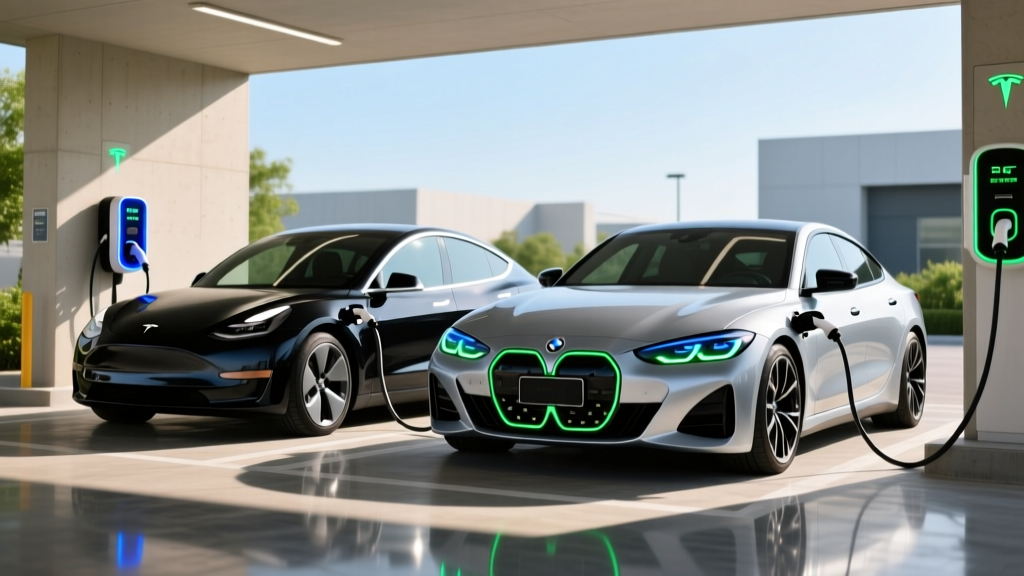
If you've been searching for a "Model 3 BMW" comparison, you're likely cross-shopping the two dominant electric sedans in the premium compact segment: the Tesla Model 3 and the BMW i4. Both offer compelling range, fast charging, and modern tech, but they approach the EV experience from fundamentally different philosophies. The Model 3 leans into software-defined minimalism and Supercharger network access, while the i4 wraps proven BMW driving dynamics around a more traditional luxury interior.
This guide breaks down every number that matters — EPA range, real-world efficiency, battery chemistry, DC fast-charge curves, Level 2 home charging rates, pricing after federal tax credits, and cargo practicality — so you can make a data-driven decision between these two electric sedans for the 2026 model year.
Quick Verdict: Model 3 vs BMW i4 at a Glance
The Tesla Model 3 Long Range AWD delivers class-leading efficiency and the lowest cost per mile of any premium electric sedan, paired with access to the most reliable DC fast-charging network in North America. The BMW i4 eDrive40 trades some range and efficiency for a more refined cabin, superior ride quality, and a driving experience that rewards engagement. Both are excellent — but they serve different priorities.
Choose the BMW i4 if: You value interior material quality, traditional luxury sedan ergonomics, adaptive suspension tuning, and a more engaging steering feel on back roads.
Side-by-Side Spec Table: 2026 Tesla Model 3 vs BMW i4
| Specification | 2026 Tesla Model 3 LR AWD | 2026 BMW i4 eDrive40 | 2026 BMW i4 M50 |
|---|---|---|---|
| EPA Range | 341 miles | 307 miles | 270 miles |
| Battery (usable) | 75 kWh (NMC) | 80.7 kWh (NMC) | 80.7 kWh (NMC) |
| Drivetrain | Dual-Motor AWD | Rear-Wheel Drive | Dual-Motor AWD |
| Horsepower | 346 hp | 335 hp | 536 hp |
| 0–60 mph | 4.2 sec | 5.5 sec | 3.7 sec |
| Max DC Fast Charge | 250 kW | 205 kW | 205 kW |
| 10–80% DC Time | ~25 min | ~31 min | ~31 min |
| Level 2 Home Charge | 11.5 kW (~44 mi/hr) | 11 kW (~38 mi/hr) | 11 kW (~38 mi/hr) |
| MPGe (combined) | 134 MPGe | 109 MPGe | 97 MPGe |
| kWh/100 mi | 25 kWh | 31 kWh | 35 kWh |
| Cargo Volume | 23 cu ft (trunk + frunk) | 13 cu ft (liftback, no frunk) | 13 cu ft (liftback, no frunk) |
| Rear Legroom | 35.3 in | 34.5 in | 34.5 in |
| Base MSRP | $47,740 | $57,975 | $69,975 |
| Battery/Powertrain Warranty | 8 yr / 120,000 mi | 8 yr / 100,000 mi | 8 yr / 100,000 mi |
Sources: EPA fueleconomy.gov, Tesla Model 3 specs, BMW i4 specs. MSRP excludes destination fees. Specs reflect 2026 model year.
Real-World Range: What the EPA Sticker Doesn't Tell You
Tesla Model 3 LR AWD: EPA 341 mi → Expect ~290–310 mi on mixed highway driving at 70 mph; ~230–260 mi in freezing temperatures (below 32°F) without preconditioning.
BMW i4 eDrive40: EPA 307 mi → Expect ~260–280 mi highway; ~210–240 mi in cold weather.
BMW i4 M50: EPA 270 mi → Expect ~220–245 mi highway; ~180–210 mi in cold weather.
Both vehicles use NMC (nickel manganese cobalt) battery chemistry, which offers high energy density but is more sensitive to cold-weather range loss than LFP chemistry. The Model 3's advantage here is its standard heat pump, which recovers waste heat from the powertrain to warm the cabin and battery — reducing cold-weather range penalty by roughly 10–15% compared to resistive heating. The i4 also uses a heat pump system, but the Tesla's thermal management is more aggressively optimized, which is partly why the Model 3 achieves 134 MPGe combined versus the i4 eDrive40's 109 MPGe despite similar battery sizes.
On a real-world 300-mile highway trip at sustained 75 mph in 65°F weather, the Model 3 LR AWD will typically arrive with roughly 10–15% state of charge remaining, while the i4 eDrive40 will need a brief charging stop or arrive at single-digit SoC. This efficiency gap — 25 kWh/100 mi for the Tesla versus 31 kWh/100 mi for the BMW — compounds over years of ownership into meaningful electricity cost savings.
Charging Speed and Network Access
| Charging Level | Tesla Model 3 LR AWD | BMW i4 eDrive40/M50 |
|---|---|---|
| Level 1 (120V, 12A) | ~1.4 kW / ~5 mi/hr | ~1.4 kW / ~4 mi/hr |
| Level 2 (240V, 48A) | 11.5 kW / ~44 mi/hr | 11 kW / ~38 mi/hr |
| DC Fast Charge (peak) | 250 kW (NACS) | 205 kW (CCS1) |
| DC 10–80% Time | ~25 min | ~31 min |
| DC 10–80% Sustained Avg | ~150–170 kW | ~130–145 kW |
| Native Connector | NACS (Tesla Supercharger) | CCS1 (EA, EVgo, etc.) |
The Model 3's 250 kW peak DC fast-charge rate and native NACS connector give it direct access to Tesla's Supercharger network — still the most reliable and widely deployed DC fast-charging infrastructure in North America, with plug-and-charge simplicity and real-time stall availability in the Tesla app. The charging curve on the Model 3 LR peaks at 250 kW from roughly 10–25% SoC, then tapers progressively: expect ~170 kW at 50% SoC and ~80 kW above 80%. This means the practical 10–80% session averages around 150–170 kW, which is why the session takes approximately 25 minutes rather than the theoretical minimum.
The BMW i4 charges at a maximum of 205 kW via CCS1, which connects to Electrify America, EVgo, and other third-party networks. BMW now provides access to Tesla Superchargers via a BMW-supplied NACS adapter (included with new 2026 i4 models), though peak speeds through the adapter may be limited to roughly 150–175 kW depending on the Supercharger generation. The i4's charge curve is slightly less aggressive — it holds peak rate for a shorter SoC window and tapers more steeply above 60%, which explains the 31-minute 10–80% time.
For home Level 2 charging, both vehicles fully replenish overnight on a 48-amp circuit. The Model 3's slightly higher 11.5 kW onboard charger adds about 6 extra miles of range per hour of charging compared to the i4's 11 kW unit — a marginal but measurable advantage for drivers who frequently return home with a near-empty battery.
Pricing, Trims, and Federal Tax Credit Eligibility
| Trim | Base MSRP | Destination | Est. §30D Credit | Effective Price |
|---|---|---|---|---|
| Tesla Model 3 RWD | $38,990 | $1,390 | Up to $7,500* | ~$32,880 |
| Tesla Model 3 LR AWD | $47,740 | $1,390 | Up to $7,500* | ~$41,630 |
| Tesla Model 3 Performance | $54,990 | $1,390 | Up to $7,500* | ~$48,880 |
| BMW i4 eDrive40 | $57,975 | $995 | Up to $7,500* | ~$51,470 |
| BMW i4 M50 | $69,975 | $995 | Up to $7,500* | ~$63,470 |
*Federal tax credit eligibility under IRS §30D is subject to multiple requirements. The credit is now available as a point-of-sale transfer, reducing your purchase price at the dealer.
- MSRP cap: Sedans must be ≤ $55,000 (SUVs/pickups ≤ $80,000). The Model 3 RWD and LR AWD qualify; the Performance trim at $54,990 qualifies. The i4 eDrive40 qualifies at $57,975 because BMW classifies it as a "sport activity coupe" (SUV cap applies). The i4 M50 at $69,975 also qualifies under the SUV cap.
- Buyer income cap: Modified AGI ≤ $150,000 (single), $225,000 (head of household), $300,000 (joint).
- Battery sourcing: Critical minerals and battery components must meet phased-in domestic/free-trade sourcing thresholds. Full $7,500 requires meeting both halves ($3,750 each). Verify current-year compliance on the IRS clean vehicle credit page before purchase.
- Point-of-sale transfer: You can transfer the credit to the dealer at purchase, reducing your out-of-pocket cost immediately — you do not need to wait until tax filing.
The Model 3's price advantage is substantial. A well-equipped Model 3 LR AWD with the $7,500 credit lands near $42,000 — roughly $10,000 less than a comparably equipped i4 eDrive40 after the same credit. However, the i4's interior quality, optional adaptive M suspension, and Harman Kardon audio system justify the premium for buyers who weigh luxury feel over cost efficiency.
Interior, Technology, and Daily Practicality
The Model 3's cabin is defined by its 15.4-inch center touchscreen, which handles all vehicle functions — including climate, mirrors, and glovebox — with no physical buttons. This minimalist approach maximizes perceived space and simplifies the dashboard, but it demands screen interaction for basic adjustments that traditional luxury buyers may find frustrating. The 2026 Model 3 "Highland" refresh added ventilated front seats, ambient lighting, rear-seat ventilation controls via an 8-inch rear screen, and improved sound insulation — closing several of the comfort gaps that earlier Model 3s had against German competitors.
The BMW i4's interior follows a more conventional luxury layout: a curved display combining a 12.3-inch instrument cluster and 14.9-inch infotainment screen running BMW iDrive 8.5, physical climate controls, a head-up display, and available Vernasca leather with heated and ventilated seats. The i4's cabin materials — soft-touch surfaces, real aluminum trim, precise switchgear — are a clear step above the Model 3's vegan leather and plastic. If interior ambiance matters to your daily experience, the i4 wins this category decisively.
On cargo practicality, the Model 3's 23 cubic feet (trunk + front trunk) significantly outpaces the i4's 13 cubic feet of liftback space. The i4 has no frunk — BMW uses that space for power electronics. For weekly grocery runs, airport luggage, or carrying a stroller, the Model 3's cargo advantage is immediately noticeable.
Driver Assistance: Both vehicles offer Level 2 driver-assist systems — meaning the driver must remain actively engaged at all times. Tesla's Autopilot (standard) and optional FSD (Supervised) provide adaptive cruise, lane centering, and automatic lane changes. BMW's Driving Assistant Professional offers similar functionality with more conservative lane-keeping behavior and a capacitive steering wheel that doesn't require constant torque input. Neither system is "self-driving" — both are SAE Level 2 and require your full attention.
Both Tesla Autopilot/FSD (Supervised) and BMW Driving Assistant Professional are SAE Level 2 systems. The driver must continuously monitor the road, keep hands available, and be prepared to take over instantly. These are driver-assist features, not autonomous driving systems.
Ownership Costs and 5-Year Total Cost of Ownership
| Cost Category (5 yr / 75,000 mi) | Tesla Model 3 LR AWD | BMW i4 eDrive40 |
|---|---|---|
| Purchase Price (after $7,500 credit) | ~$41,630 | ~$51,470 |
| Estimated Electricity Cost | ~$3,750 | ~$4,650 |
| Insurance (avg) | ~$9,500 | ~$8,800 |
| Maintenance | ~$1,200 | ~$1,800 |
| Est. Depreciation (5 yr) | ~$18,000 | ~$22,000 |
| Est. 5-Year Total | ~$74,080 | ~$88,720 |
| Cost Per Mile | ~$0.99 | ~$1.18 |
The Model 3's efficiency advantage translates directly to lower electricity costs: at a national average of $0.17/kWh, the Model 3 costs roughly $4.25 per 100 miles to charge at home, while the i4 costs about $5.27. Over 15,000 miles per year, that's approximately $153 in annual savings for the Tesla. Insurance tends to run slightly higher on the Model 3 due to Tesla's repair-cost profile, which partially offsets the energy savings. BMW's complimentary scheduled maintenance program (3 years/36,000 miles) also narrows the maintenance gap.
Pros and Cons
- Best-in-class efficiency: 134 MPGe / 25 kWh/100 mi
- Fastest DC charging: 250 kW peak, ~25 min 10–80%
- Native Supercharger network access (most reliable DC network)
- Largest cargo capacity: 23 cu ft with frunk
- Lowest purchase price after tax credit
- Over-the-air updates continuously add features
- Standard heat pump for cold-weather efficiency
- Minimalist interior lacks physical controls
- Higher insurance premiums than segment average
- Build quality improved but still inconsistent vs. BMW
- No Apple CarPlay or Android Auto
- FSD (Supervised) requires $8,000 add-on and remains Level 2
- Superior interior materials and build quality
- Adaptive suspension available for excellent ride comfort
- Physical controls and head-up display
- Apple CarPlay and Android Auto standard
- Engaging driving dynamics with precise steering
- BMW's complimentary maintenance program
- ~$10,000 more expensive after tax credit
- Lower efficiency: 109 MPGe / 31 kWh/100 mi
- Slower DC charging: 205 kW peak, ~31 min 10–80%
- No frunk; only 13 cu ft cargo space
- CCS1 relies on third-party networks (adapter needed for Superchargers)
Who Should Buy Which?
The Tesla Model 3 LR AWD is ideal for: Daily commuters covering 40+ miles who want to minimize per-mile cost, road-trippers who rely on DC fast charging and value Supercharger network reliability, and tech-forward buyers who prefer software-driven features and OTA updates. Its efficiency and charging speed make it the most practical electric sedan for high-mileage drivers.
The BMW i4 eDrive40 is ideal for: Luxury sedan buyers transitioning from a 3 Series or 4 Series Gran Coupe who want EV powertrain benefits without sacrificing cabin refinement, drivers who prioritize ride quality and steering feel, and those who prefer physical controls and smartphone integration (CarPlay/Android Auto). The i4 is also well-suited to buyers who primarily charge at home and take fewer long road trips.
The BMW i4 M50 is ideal for: Performance-oriented buyers who want 536 hp and a 3.7-second 0–60 time in a practical electric sedan, and who accept the range and efficiency trade-off for that acceleration.
Frequently Asked Questions
What is the real-world range of the Tesla Model 3 vs BMW i4?
In mixed highway driving at 70 mph and moderate temperatures, expect ~290–310 miles from the Model 3 LR AWD (EPA 341 mi) and ~260–280 miles from the i4 eDrive40 (EPA 307 mi). In freezing weather, subtract roughly 15–25% from both figures unless you precondition the battery while plugged in.
How fast does each car charge at home and on the road?
At home on a 48-amp Level 2 charger, the Model 3 adds ~44 miles of range per hour (11.5 kW) and the i4 adds ~38 miles per hour (11 kW). On DC fast chargers, the Model 3 peaks at 250 kW (10–80% in ~25 min) while the i4 peaks at 205 kW (10–80% in ~31 min).
Does the Tesla Model 3 or BMW i4 qualify for the $7,500 federal EV tax credit?
Both can qualify, but eligibility depends on your income (≤ $150K single / $300K joint), the specific vehicle's battery sourcing compliance, and MSRP caps. The Model 3 qualifies under the $55,000 sedan cap; the i4 qualifies under the $80,000 SUV cap due to BMW's classification. Always verify current sourcing compliance on IRS.gov before purchasing, as rules and eligible configurations change.
Is the Tesla Model 3 worth buying over the BMW i4?
Yes, if your priorities are range, efficiency, charging speed, and lowest total cost. The Model 3 LR AWD is objectively more efficient, charges faster, costs ~$10,000 less after credits, and offers more cargo space. The i4 is worth the premium if interior luxury, driving feel, and traditional controls matter more to you than spec-sheet efficiency.
Can I use Tesla Superchargers with the BMW i4?
Yes. BMW provides a NACS adapter for the i4, enabling access to Tesla Superchargers. However, peak charge speeds through the adapter may be lower than the i4's native 205 kW CCS1 rate, typically limited to ~150–175 kW depending on the Supercharger generation.
What is the battery warranty on each vehicle?
Tesla covers the Model 3 battery and drive unit for 8 years or 120,000 miles (whichever comes first) with a minimum 70% capacity retention guarantee. BMW covers the i4 battery for 8 years or 100,000 miles with a 70% retention threshold. Both warranties are competitive, though Tesla's 20,000 extra miles of coverage is a meaningful advantage for high-mileage drivers.