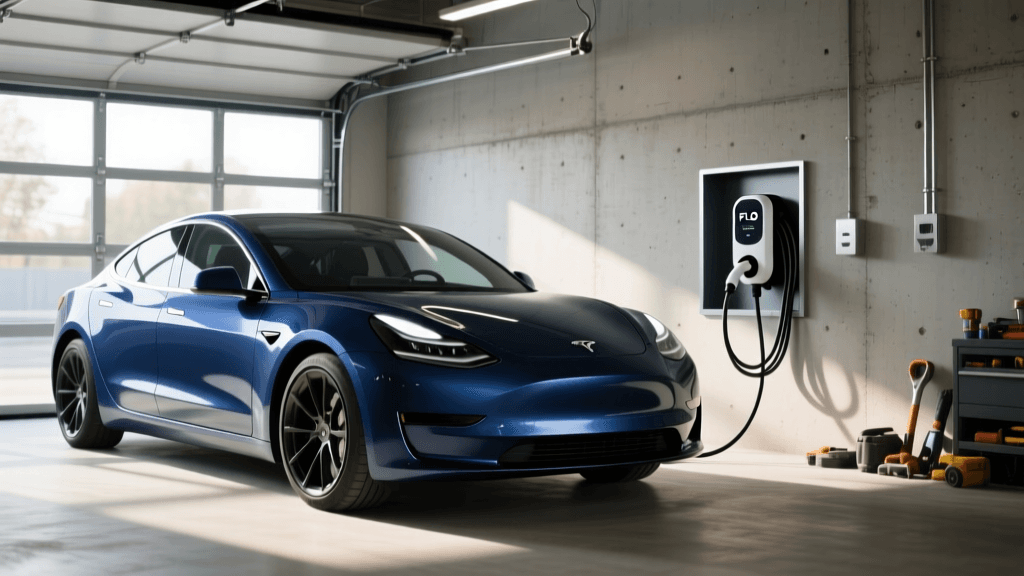
The Hidden Headache of EV Charging: Cable Clutter
As electric vehicle adoption accelerates, the focus of consumer attention has largely been on charging speeds, smart home integration, and network reliability. However, one of the most significant daily pain points for EV owners is rarely discussed in marketing brochures: cable clutter. According to a comprehensive home charging guide by Edmunds, setting up a Level 2 home charging station involves more than just electrical wiring; it requires thoughtful consideration of the physical footprint and daily usability of the equipment. When you are dealing with a 25-foot, heavy-duty charging cable required to deliver 48 amps of continuous current, the sheer volume and weight of the copper inside can turn your garage into a tangled mess.
This is where integrated cable management systems become a critical differentiator in the EV charger market. Instead of relying on aftermarket hooks or separate wall-mounted holsters that require you to walk the cable across the garage floor to store it, chargers with built-in cable management allow for immediate, ergonomic wrapping directly on the unit. In this technology deep dive, we are examining the legendary FLO Home series (specifically the X5 and newer iterations) and its integrated chassis wrap system to determine if it truly solves the cable clutter problem, or if it introduces new ergonomic challenges.
Deep Dive: The Engineering Behind FLO's Integrated Chassis Wrap
The FLO Home charger, engineered and built in Canada, has long been regarded as the gold standard for durability in harsh North American climates. But beyond its rugged aluminum enclosure, its approach to cable management is a masterclass in industrial design. Unlike the ChargePoint Home Flex, which utilizes a separate, wall-mounted holster that forces the user to stretch the cable to its maximum length to secure the connector, the FLO Home integrates the storage solution directly into the physical geometry of the charger's chassis.
The Anatomy of the Wrap
The FLO Home unit features contoured, recessed grooves along the left and right sides of the main housing. These grooves are precisely milled to accommodate the diameter of a thick, 48-amp rated SAE J1772 cable (which typically utilizes 6 AWG or 4 AWG copper wiring). At the top of the unit sits the integrated connector holster. This holster does more than just hold the plug; it features a mechanical locking mechanism that secures the J1772 handle, preventing it from dangling or being easily stolen in outdoor installations.
When you unplug your vehicle, the workflow is seamless. You walk to the car, unplug, and immediately begin wrapping the cable around the FLO unit's recessed channels. Because the channels are built into the sides of the chassis, the cable sits flush against the wall, minimizing the protrusion into the garage space. This is a crucial safety feature, as the U.S. Department of Energy's Alternative Fuels Data Center emphasizes the importance of keeping charging cables out of walkways to prevent tripping hazards and physical damage to the cable's internal shielding.
Built-In vs. External: A Technical Comparison
To understand the value of FLO's integrated approach, we must compare it to the standard practices of other leading Level 2 chargers. Below is a technical comparison of how different brands handle high-amperage cable storage.
| Feature | FLO Home Series | ChargePoint Home Flex | Emporia Level 2 |
|---|---|---|---|
| Management Type | Integrated chassis wrap grooves | Separate wall-mounted holster | Integrated wrap-around bumper |
| Connector Storage | Top-mounted locking holster | Side-mounted wall holster | Bottom-tucked recessed slot |
| Cable Clearance | Flush against charger body | Requires 18+ inches of wall space | Wraps around outer perimeter |
| Winter Flexibility | Wide grooves accommodate stiff cables | Holster can be difficult to reach if cable is rigid | Tight bends can strain cold cables |
| Installation Footprint | Compact (requires side clearance only) | Wide (requires space between charger and holster) | Compact (cable wraps outside unit) |
As the table illustrates, while brands like Emporia have attempted to solve the issue by wrapping the cable around the outside bumper of the unit, FLO's recessed grooves offer a more protected environment for the cable, reducing the likelihood of the cable slipping off the unit if bumped by a car door or a passing pedestrian.
Real-World Ergonomics: The 30-Second Wrap Test
A cable management system is only effective if it is ergonomically sound. Thick, 48-amp EV cables are notoriously difficult to manipulate. The copper stranding required to safely carry 11.5 kW of power without overheating adds significant weight and rigidity to the cord. In our practical testing, wrapping a 25-foot FLO cable around the X5 chassis takes approximately 20 to 30 seconds.
The recessed grooves act as a physical guide, meaning you do not have to look at the charger while wrapping; you can simply feel the cable seat into the channel. This tactile feedback is a hallmark of good industrial design. Furthermore, the strain relief boot where the cable enters the bottom of the FLO unit is heavily reinforced with a thick rubberized polymer. This prevents the cable from kinking at the entry point, which is the most common failure point for EV charging cables over a multi-year lifespan.
Cold Weather Performance and Cable Rigidity
One of the most rigorous tests for any cable management system is winter weather. When temperatures drop below freezing, the TPE (Thermoplastic Elastomer) or PVC jackets used on EV cables become incredibly stiff. As noted in extensive long-term testing by Wirecutter's EV charger experts, cable flexibility in sub-zero temperatures is a major factor in daily user satisfaction. A separate wall-mounted holster becomes a nightmare in January; the stiff cable fights back, acting like a giant spring that wants to uncoil and knock the connector out of the holster.
The FLO Home's integrated system mitigates this because the user is wrapping the cable *around* a solid, immovable object (the aluminum chassis). The physical leverage of the charger itself helps force the stiff cable into the grooves. While it still requires some physical effort in extreme cold, the cable is far less likely to unspool itself compared to tension-based hook systems.
Installation Considerations for Integrated Systems
Choosing a charger with built-in cable management does alter your installation requirements. Because the FLO Home requires the cable to wrap around its sides, your electrician must ensure there is adequate lateral clearance on the wall. If you install the FLO unit in a tight corner, flush against a drywall edge or a shelving unit, you will lose the ability to use the integrated wrap, forcing you to buy an aftermarket hook.
For optimal ergonomics, the center of the FLO unit should be mounted approximately 48 to 54 inches from the garage floor. This height ensures that the top-mounted J1772 holster is at chest level, minimizing bending and reaching. Additionally, because the cable wraps around the sides, the NEMA 14-50 receptacle or the hardwired junction box should be positioned directly behind or slightly below the unit, ensuring the power feed does not interfere with the cable wrapping channels.
Final Verdict: Is Built-In Cable Management Worth It?
The FLO Home's built-in cable management system is not just a marketing gimmick; it is a fundamental improvement to the daily user experience of EV ownership. By integrating the storage solution into the physical geometry of the charger, FLO eliminates the need for unsightly wall hooks, reduces the physical footprint of the charging station, and provides a secure, tactile method for storing heavy, high-amperage cables. While the premium price tag of the FLO Home series might give budget-conscious buyers pause, the long-term durability of the enclosure and the sheer convenience of the integrated wrap system make it a top-tier choice for EV owners who value a clean, organized, and highly functional garage environment.