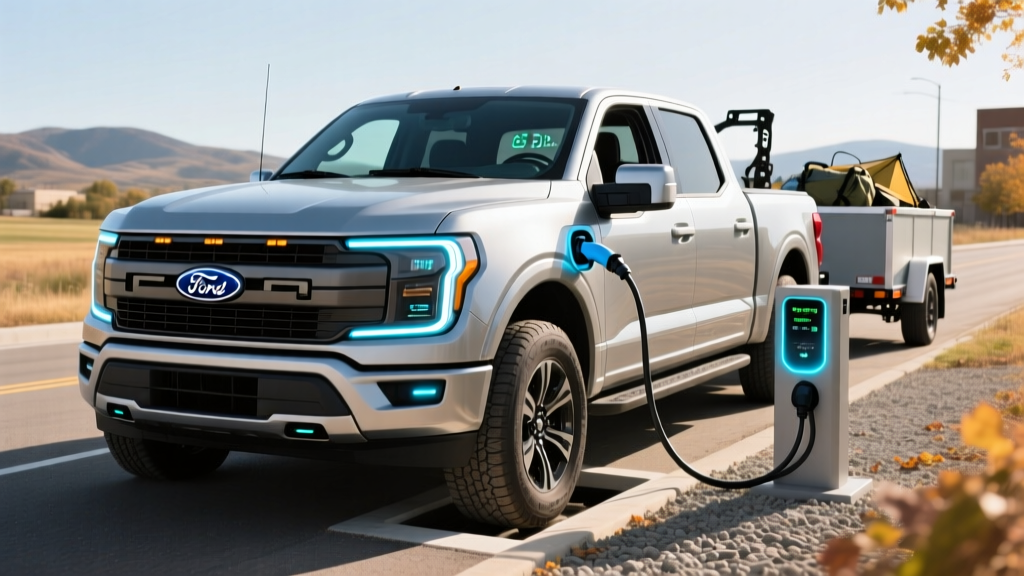
The Ford F-150 Lightning Pro is the work-truck face of Ford's electric pickup lineup. Stripped of the luxury touches found on Lariat and Platinum trims, the Pro targets fleet managers, contractors, and budget-conscious commercial buyers who need a zero-tailpipe-emission truck without paying for leather seats and panoramic glass roofs. For the 2026 model year, Ford continues to offer the Pro exclusively with the Standard Range battery, keeping the entry price below $60,000 before incentives — a critical threshold for both fleet procurement and §30D tax-credit eligibility.
But a work truck lives and dies by its utility: Can it tow a trailer to a job site and make it back? How fast does it charge on a lunch break? Does the real-world range match the EPA sticker? This review answers those questions with hard data, not marketing copy.
2026 F-150 Lightning Pro: Quick Specs at a Glance
| Specification | 2026 F-150 Lightning Pro (Standard Range) |
|---|---|
| Base MSRP | $59,995 (includes destination) |
| EPA Range | 230 miles |
| Battery Capacity | 98 kWh usable (LFP — lithium iron phosphate) |
| Drivetrain | Dual-motor AWD |
| Horsepower / Torque | 452 hp / 775 lb-ft |
| 0–60 mph | ~4.0 seconds (Ford est.) |
| Max DC Fast Charge | 150 kW peak |
| 10–80% DC Charge Time | ~36 minutes |
| Level 2 Home Charging | 11.5 kW (~23 mi/hr) |
| MPGe (Combined) | 68 MPGe (2.0 kWh/mi) |
| Max Towing (w/ Max Tow Pkg) | 7,700 lbs |
| Max Payload | 2,235 lbs |
| Battery/Powertrain Warranty | 8 years / 100,000 miles |
| Federal Tax Credit (§30D) | Up to $7,500 (subject to eligibility) |
Range and Efficiency: The Real-World Truth
Real-World Expectation: 185–210 miles highway (70–75 mph); 150–175 miles in cold weather (below 32°F); up to 240+ miles in mild city driving with regen braking.
The 230-mile EPA figure for the Standard Range Lightning Pro is a combined cycle — a blend of city and highway driving at moderate temperatures. In practice, your mileage will vary considerably based on how you use this truck.
Highway driving is where full-size electric pickups lose efficiency fastest. Aerodynamic drag on a slab-sided truck at 75 mph is brutal. In EPA testing, the combined cycle yields 68 MPGe, which translates to roughly 2.0 kWh per mile. At sustained highway speeds, expect consumption closer to 2.3–2.5 kWh/mile, cutting effective range to approximately 190–205 miles on a full charge.
Towing is the range killer. If you hook up a 5,000-lb enclosed trailer, expect range to drop by 40–50%. That means a realistic 115–135 miles before you need a charger. This isn't unique to the Lightning — every electric truck suffers similarly — but it's a hard operational constraint that fleet managers must plan around. A round-trip job-site run of 120 miles with a trailer in tow will require mid-route DC fast charging or a very conservative drive.
Cold weather (below freezing) typically reduces lithium-ion range by 20–30% due to battery heating demands and reduced regenerative braking efficiency. The Lightning Pro's LFP chemistry is slightly more resilient to cold-induced degradation over the long term, but immediate range loss in winter is comparable to NMC packs. Plan for 155–180 miles in January in the upper Midwest.
City and suburban use is where the Lightning Pro shines. Regenerative braking recaptures energy at every stoplight, and lower speeds mean less aero drag. Drivers with stop-and-go commutes of 30–50 miles round trip will find the 230-mile EPA figure conservative — 240+ miles is achievable in mild weather.
Charging Speed: DC Fast, Level 2, and the Home Setup
Charging a 98 kWh battery isn't instantaneous, but the Lightning Pro's charging hardware is adequate for most work-truck duty cycles — provided you understand the charge curve.
| Charging Level | Power | Speed / Notes |
|---|---|---|
| Level 1 (120V outlet) | ~1.4 kW | ~3 mi/hr — emergency/trickle only; full charge in ~70 hours |
| Level 2 (240V, 48A) | 11.5 kW | ~23 mi/hr — full charge in ~8.5 hours; ideal overnight |
| DC Fast Charge (peak) | 150 kW | 10–80% in ~36 minutes; tapers significantly above 80% |
DC fast charging reality check: The Lightning Pro peaks at 150 kW, but that peak only holds between roughly 15–40% state of charge. Above 60%, the charge rate tapers to ~80 kW, and above 80% it drops below 40 kW. This is standard lithium-ion charge-curve behavior, not a flaw — but it means the advertised 10–80% time of ~36 minutes is accurate, while a 10–100% session will take closer to 60–65 minutes. For a work truck, charging to 80% during a 30-minute lunch break is practical; topping to 100% at a public charger wastes time and money.
Home Level 2 charging at 11.5 kW is the bread and butter of Lightning ownership. Ford includes a mobile charger (32A, ~7.7 kW on 240V) with the truck, but for the full 11.5 kW rate, you'll need a hardwired 48-amp Level 2 station. Expect home installation to run $800–$2,500 depending on your electrical panel. A 200-amp panel is usually sufficient; older homes with 100-amp service may need a panel upgrade ($1,500–$3,000 additional).
One important detail: the Lightning Pro uses the NACS (North American Charging Standard) connector as of the 2025 model year, giving it native access to Tesla Supercharger stations (now open to non-Tesla EVs via NACS). This dramatically expands the public DC fast-charging network available to Lightning owners compared to the older CCS1 connector.
Performance, Payload, and Towing Capacity
The F-150 Lightning Pro is quick for a 6,500-lb truck. Dual electric motors produce 452 horsepower and 775 lb-ft of torque, delivering a 0–60 mph time of approximately 4.0 seconds. Instant torque means passing maneuvers on two-lane roads are effortless — no turbo spool-up, no downshift delay.
Payload: The Pro's maximum payload rating is 2,235 lbs in the bed. That's competitive with gas-powered F-150 XL trims and sufficient for tools, materials, and equipment that most trades require.
Towing: With the optional Max Trailer Tow Package, the Lightning Pro is rated for up to 7,700 lbs. Without it, the standard tow rating is 5,000 lbs. These are real limits — not marketing figures — and exceeding them will not only void your warranty but will hammer your range. Ford's onboard Pro Power Onboard system (standard 2.4 kW, optional 9.6 kW on higher trims) lets you run job-site tools directly from the truck's battery, which is a genuine work-truck differentiator. The Pro trim includes the 2.4 kW system as standard.
What the Pro doesn't have: The extended-range battery (131 kWh, 320-mile EPA) is not available on the Pro trim. If you need 300+ miles, you'll have to step up to the XLT or Lariat. The Pro is exclusively Standard Range.
Interior, Tech, and Cargo Dimensions
The Lightning Pro's cabin is utilitarian by design. Vinyl-trimmed front seats (cloth optional), rubberized floor mats, and a 12-inch touchscreen running SYNC 4 are standard. The instrument cluster is a 12-inch digital display. Apple CarPlay and Android Auto are wireless.
Cargo dimensions:
- Bed length: 67.1 inches (5.5-foot Styleside)
- Bed volume: 52.8 cu ft
- Front trunk (frunk): 14.1 cu ft — lockable, weather-sealed, with a drain plug. This replaces the engine bay and is ideal for tools, cords, or groceries.
- Rear-seat legroom: 43.6 inches (SuperCrew cab)
- Front headroom: 40.8 inches
Driver-assistance technology: The Pro includes Ford Co-Pilot360 2.0 as standard, which bundles automatic emergency braking, blind-spot monitoring, lane-keeping assist, rear cross-traffic alert, and a rear-view camera. Adaptive cruise control with stop-and-go is available as an option. Note: Ford's BlueCruise hands-free highway driving system is not standard on the Pro — it requires the available BlueCruise package or a higher trim. BlueCruise is a SAE Level 2 system, meaning the driver must remain attentive and is legally responsible for the vehicle at all times.
Pricing, Tax Credits, and Total Cost of Ownership
The 2026 F-150 Lightning Pro starts at $59,995 (including $2,095 destination charge). That price lands just under the IRS §30D MSRP cap of $80,000 for trucks, making it eligible for the federal clean vehicle tax credit — provided you meet all other requirements.
| Cost Factor | Amount |
|---|---|
| Base MSRP (Pro Standard Range) | $59,995 |
| Federal Tax Credit (§30D, max) | Up to $7,500 |
| Effective Price After Max Credit | ~$52,495 |
| Estimated Annual Fuel Savings vs. Gas F-150 | $1,200–$1,800/yr (varies by electricity rate & miles driven) |
| Estimated 5-Year Maintenance Savings | $2,000–$3,500 (no oil changes, fewer brake replacements due to regen) |
Tax credit eligibility is not automatic. To claim the full $7,500 under §30D for 2026, all of the following must be true:
- Buyer income caps: Modified AGI ≤ $150,000 (single), $225,000 (head of household), or $300,000 (married filing jointly)
- MSRP cap: Vehicle MSRP must not exceed $80,000 for trucks/vans — the Pro at $59,995 clears this easily
- Battery sourcing: A percentage of critical minerals and battery components must be sourced from the U.S. or free-trade-agreement countries (thresholds increase annually; check current-year IRS guidance)
- Point-of-sale transfer: As of 2024, buyers can transfer the credit to the dealer at purchase, receiving the discount upfront rather than waiting for tax filing — this effectively reduces the out-of-pocket price at the dealership
Ford's LFP battery sourcing has been a point of scrutiny under §30D critical-mineral rules. As of the 2026 model year, Ford sources LFP cells from its BlueOval SK joint venture partners, and the Lightning Pro currently qualifies for at least a partial credit. Confirm exact eligibility with your dealer and a tax professional before purchase, as sourcing rules tighten annually.
Warranty Coverage and Battery Longevity
Ford backs the F-150 Lightning's battery and electric powertrain with an 8-year / 100,000-mile warranty, whichever comes first. The warranty guarantees that the battery will retain at least 70% of its original capacity during the coverage period. If it drops below that threshold, Ford will repair or replace it.
The vehicle's limited bumper-to-bumper warranty is 3 years / 36,000 miles, which is standard for the segment.
LFP chemistry advantage: The Lightning Pro's lithium iron phosphate (LFP) battery offers a meaningful longevity benefit over NMC (nickel manganese cobalt) chemistries. LFP cells tolerate more charge cycles before significant degradation — typically 2,000–3,000 full cycles to 80% capacity retention versus ~1,000–1,500 for NMC. LFP also allows (and benefits from) regular charging to 100%, unlike NMC packs which are best kept between 20–80% for daily use. For fleet managers who want to charge to full overnight without worrying about long-term degradation, LFP is the pragmatic choice.
The trade-off: LFP has lower energy density than NMC, which is why the Pro's 98 kWh pack yields only 230 miles while the Extended Range pack (131 kWh, NMC-based) achieves 320 miles. Weight and space constraints limit LFP to the Standard Range configuration.
Lightning Pro vs. the Competition
The Lightning Pro occupies a specific niche: the most affordable full-size electric pickup from a legacy automaker. Here's how it stacks up against key alternatives:
- Chevrolet Silverado EV (Work Truck trim): GM's electric Silverado WT starts around $60,000 with a similar range target. It offers a slightly larger bed and competitive towing, but real-world charging infrastructure via CCS/NACS adapters varies by region.
- Rivian R1T (Dual-Motor Standard): Starts at ~$69,900 — significantly more expensive. Superior off-road capability and a more refined interior, but not a work-truck proposition at this price point. Better suited for lifestyle/adventure buyers.
- Tesla Cybertruck (Base AWD): Announced at a lower price point but availability remains constrained and real-world pricing with options often exceeds $70,000. Stainless-steel body and 48V architecture are unique, but the Cybertruck's bed is smaller and its service network less established for fleet use.
- Gas F-150 XL: Starts ~$15,000–$20,000 cheaper, refuels in 5 minutes anywhere, and tows 10,000+ lbs. The Lightning Pro makes financial sense only when you factor in fuel savings, lower maintenance, tax credits, and zero tailpipe emissions — typically a 3–5 year payback for high-mileage fleet use.
Pros and Cons: Honest Assessment
✓ Pros
- Lowest entry price for a full-size electric pickup from a legacy OEM
- LFP battery tolerates daily 100% charges and offers long cycle life
- 775 lb-ft of instant torque — excellent for merging and job-site use
- 14.1 cu ft lockable frunk is a genuine work-truck advantage
- Pro Power Onboard (2.4 kW) runs tools directly from the battery
- NACS connector opens the full Tesla Supercharger network
- Eligible for up to $7,500 federal tax credit (subject to rules)
✗ Cons
- 230-mile EPA range is limiting for long-haul or rural work routes
- Towing cuts range by 40–50% — plan routes carefully
- Extended-range battery (320 mi) not available on Pro trim
- 150 kW peak DC charge rate is slower than rivals (Silverado EV peaks higher)
- BlueCruise not standard — add-on cost for hands-free highway driving
- Vinyl interior and basic infotainment reflect the price point
- Insurance premiums run 15–25% higher than equivalent gas F-150
Who Should Buy the F-150 Lightning Pro?
Choose the Lightning Pro if: You're a fleet manager or contractor with predictable daily routes under 150 miles round-trip, you have access to overnight Level 2 charging at a depot or home, you want to eliminate fuel costs and reduce maintenance, and you qualify for the §30D tax credit.
Look elsewhere if: You regularly tow trailers over long distances, your routes exceed 200 miles without reliable DC charging, you need the Extended Range battery (step up to the XLT), or you want a premium interior (consider the Lariat or Platinum).
Frequently Asked Questions
What is the real-world range of the F-150 Lightning Pro?
The EPA rates the 2026 Lightning Pro at 230 miles combined. In real-world highway driving at 70–75 mph, expect 190–210 miles. In cold weather (below 32°F), plan for 155–180 miles. City driving with regenerative braking can exceed the EPA figure, reaching 240+ miles in mild conditions.
How fast does the F-150 Lightning Pro charge?
On a DC fast charger, the Pro peaks at 150 kW and charges from 10–80% in approximately 36 minutes. At home on a 240V Level 2 charger (48A / 11.5 kW), a full charge takes about 8.5 hours — practical for overnight charging. On a standard 120V outlet, expect roughly 3 miles of range per hour, useful only for emergencies.
Does the F-150 Lightning Pro qualify for the federal EV tax credit?
The Pro's $59,995 MSRP is below the $80,000 truck cap, making it potentially eligible for up to $7,500 under IRS §30D. However, eligibility depends on your income (≤$150K single / ≤$300K joint), battery critical-mineral and component sourcing requirements (which tighten annually), and purchasing through a qualified dealer. The credit can be transferred at point of sale for an immediate price reduction. Verify current-year rules at irs.gov and consult a tax professional.
Is the F-150 Lightning Pro worth buying vs. the gas F-150 XL?
It depends on your use case. The Lightning Pro costs ~$15,000–$20,000 more upfront (before tax credits) but saves $1,200–$1,800 annually on fuel and $400–$700 annually on maintenance. For a fleet vehicle driven 20,000+ miles per year with depot charging, the payback period is roughly 4–6 years. For a personal truck used for occasional towing and long road trips, the gas F-150 XL remains more practical and affordable.
Can I tow a trailer with the Lightning Pro?
Yes — up to 7,700 lbs with the Max Trailer Tow Package (5,000 lbs standard). However, towing reduces range by approximately 40–50%. A 5,000-lb trailer will limit practical range to roughly 115–135 miles. Plan charging stops accordingly for any trip exceeding that distance.
What is the battery warranty on the F-150 Lightning Pro?
Ford covers the battery and electric powertrain for 8 years or 100,000 miles, guaranteeing at least 70% capacity retention. The LFP chemistry in the Pro is well-suited to long-term durability, with lab data suggesting 2,000+ full charge cycles before reaching 80% capacity — equivalent to over 450,000 miles of theoretical use.