The Apartment EV Charging Dilemma
Owning an electric vehicle (EV) while living in an apartment, condo, or multi-family dwelling presents a unique set of challenges. Unlike homeowners with private garages, renters and apartment dwellers often lack dedicated, easily accessible electrical outlets near their parking spaces. According to the U.S. Department of Energy's Alternative Fuels Data Center, the vast majority of EV charging happens at home, making residential charging infrastructure a critical component of EV ownership. But what happens when your home is a rented apartment or a condo with strict HOA rules?
For beginners, the transition to an EV in a multi-family building can feel overwhelming. You might be dealing with shared parking garages, outdoor carports, or landlords who are hesitant to approve permanent electrical upgrades. Fortunately, the EV charging market has evolved to include highly portable, rugged, and smart Level 1 and Level 2 chargers designed specifically for the constraints of apartment living. This complete guide will walk you through the best EV chargers for apartment dwellers, how to navigate landlord negotiations, and what features you absolutely need to look for.
Understanding Your Rights: The 'Right to Charge' Movement
Before purchasing a charger, it is vital to understand the legal landscape of multi-family EV charging. Many renters and condo owners assume their landlord or HOA can outright ban EV chargers. However, the 'Right to Charge' movement has gained significant legislative traction across the United States. Organizations like Plug In America actively track and promote state laws that prevent HOAs and landlords from unreasonably denying EV charging installations.
States like California, New York, Florida, Colorado, and Hawaii have enacted legislation that protects your right to install an EV charger in your designated parking spot, provided you cover the costs of installation, electricity, and insurance. Knowing your local laws is the first step in transitioning to an EV as an apartment dweller.
What to Look for in an Apartment-Friendly EV Charger
When shopping for an EV charger for an apartment, your criteria will differ significantly from a homeowner's. Here are the critical features to prioritize:
- Portability vs. Hardwired: If you are renting, you likely want a plug-in charger (NEMA 14-50 or standard 120V) rather than a hardwired unit. This allows you to take the charger with you when your lease ends without having to patch walls or rewire the building.
- Cable Length and Management: Apartment parking spots can be oddly shaped or far from the nearest outlet. A cable length of at least 20 to 25 feet is highly recommended. Additionally, look for units with built-in cable management systems to keep cords off the ground and away from pedestrians.
- Weather Resistance (IP Rating):strong> If your apartment parking is outdoors or in a partially covered carport, your charger must be able to withstand rain, snow, and dust. Look for an IP65 or IP67 rating.
- Smart Features and Security: In shared parking garages, charger theft or unauthorized use is a real concern. Chargers with RFID card locking, app-based scheduling, and auto-locking features are essential to ensure only you (or your authorized household members) can activate the charging session.
- Weight and Ergonomics: If you have to carry your charger from your apartment unit down to the parking garage every time you need to charge, a heavy, bulky unit will quickly become a nuisance. Lightweight, portable designs with carrying cases are ideal.
Top EV Chargers for Apartment Dwellers Reviewed
1. Lectron Portable Level 2 EV Charger (Best Overall for Renters)
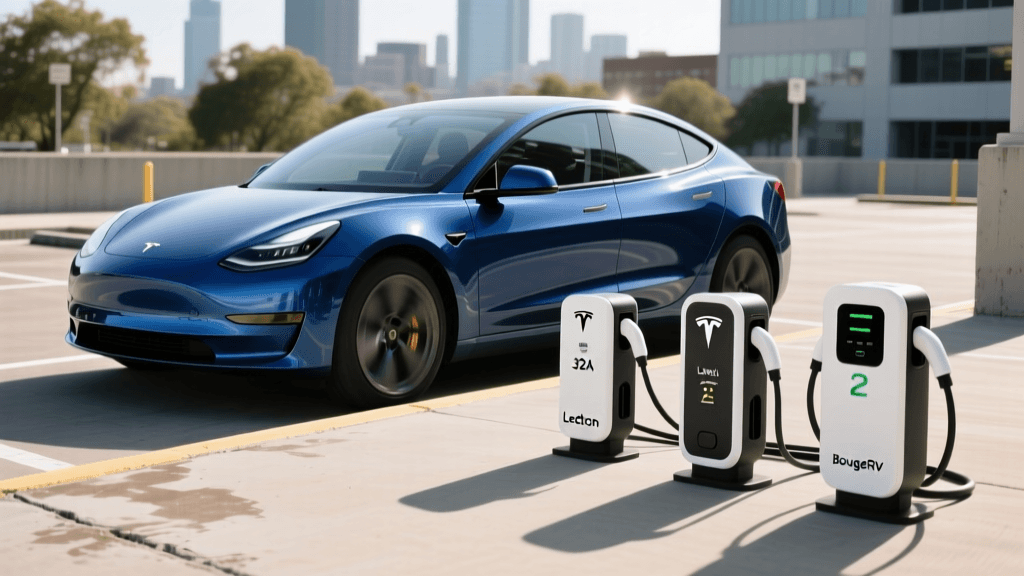
The Lectron Portable Level 2 EV Charger is a standout choice for apartment dwellers who have access to a 240V NEMA 14-50 outlet in their parking garage or who are willing to work with their landlord to install one. Delivering up to 40 Amps of power, it can add roughly 30 to 36 miles of range per hour of charging, which is more than enough for daily commuting needs.
Why it works for apartments: The control box is compact, and the unit comes with a convenient carrying case. You can easily store it in your trunk or carry it up to your apartment to prevent theft. The 21-foot cable provides ample reach across most standard and oversized parking spaces. Furthermore, the Lectron features a robust IP66 weatherproof rating, meaning you can safely use it in open-air carports during heavy rain.
2. Grizzl-E Smart (Best for Outdoor & Shared Carport Parking)
Manufactured in Canada, the Grizzl-E Smart is legendary for its rugged durability. It is built like a tank, featuring an IP67-rated enclosure that can withstand extreme temperatures, heavy snow, and even direct water jets. For apartment dwellers whose assigned parking spot is completely exposed to the elements, the Grizzl-E is arguably the most reliable hardware on the market.
Why it works for apartments: The 'Smart' version of the Grizzl-E includes RFID security cards. In a shared apartment parking lot, you can set the charger to require an RFID tap before it dispenses power, ensuring your neighbors cannot plug into your equipment. It also features adjustable amperage (16A, 24A, 32A, 40A), which is incredibly useful if your apartment's electrical panel has limited capacity and your landlord requires you to cap the charging speed to prevent tripping breakers.
3. Tesla Mobile Connector (Best for Tesla Owners on a Budget)
If you drive a Tesla and live in an apartment with only standard 120V household outlets available in the shared basement or garage, the Tesla Mobile Connector is your best entry point. While it only provides Level 1 charging (roughly 3 to 5 miles of range per hour), it is a lifesaver for low-mileage commuters who can plug in overnight.
Why it works for apartments: It is exceptionally lightweight and easily fits in a backpack or glovebox. The standard NEMA 5-15 adapter allows you to plug into any standard wall outlet. If your apartment management later upgrades the garage with 240V dryer-style outlets, you can simply purchase the NEMA 14-50 adapter head separately, transforming the unit into a capable Level 2 charger without buying a whole new system.
4. Emporia Level 2 EV Charger (Best if Landlord Allows Hardwiring)
If you own your condo or have a landlord who is willing to approve a permanent electrical upgrade, the Emporia Level 2 EV Charger is a phenomenal, budget-friendly option. While it is often hardwired for maximum safety and code compliance in multi-family buildings, it can also be configured with a plug.
Why it works for apartments: The standout feature for multi-family dwellings is Emporia's advanced energy monitoring. The companion app tracks exactly how much electricity the EV is consuming down to the kilowatt-hour. If your apartment complex requires you to reimburse the HOA or landlord for EV electricity usage, the Emporia app provides the exact data needed to settle the bill fairly. Additionally, its compact footprint takes up minimal wall space in tight garage stairwells or parking pillars.
Comparison Chart: Apartment-Friendly EV Chargers
| Charger Model | Max Amperage | Cable Length | Weather Rating | Security / Smart Features | Best For |
|---|---|---|---|---|---|
| Lectron Portable Level 2 | 40A | 21 ft | IP66 | App scheduling, delay timer | Renters with 14-50 outlets |
| Grizzl-E Smart | 40A | 24 ft | IP67 | RFID locking, OCPP network | Outdoor / exposed carports |
| Tesla Mobile Connector | 12A (120V) / 32A (240V) | 20 ft | IP44 | Tesla App integration | 120V trickle charging in garages |
| Emporia Level 2 | 48A (Hardwired) / 40A (Plug) | 24 ft | IP65 | Energy monitoring, solar integration | Condo owners / permanent installs |
How to Talk to Your Landlord or HOA About EV Charging
Approaching your property manager or HOA board with a request to install an EV charger requires preparation. According to guidelines published by ChargePoint for multifamily housing, property managers are primarily concerned with three things: electrical capacity, liability, and aesthetics. Here is a step-by-step strategy to get your charger approved:
- Do Your Homework: Research your local 'Right to Charge' laws. If you live in a state with protective legislation, politely inform the HOA of your legal rights while emphasizing your desire to work collaboratively.
- Propose a Load Management Solution: Landlords fear that multiple tenants plugging in EVs will blow the building's main transformer. Suggest using a smart charger with 'dynamic load balancing' or offer to set a hard amperage cap (e.g., limiting a 40A charger to 24A) to ease their electrical concerns.
- Offer to Cover All Costs: Put it in writing that you will pay for the licensed electrician, the permit, the charger, and any necessary wall repairs when you eventually move out. Offer to add the landlord to your renter's insurance policy to cover liability.
- Suggest a Sub-Metering Plan: If the outlet is on the building's master meter, propose installing a smart charger (like the Emporia or Grizzl-E) that tracks exact kWh usage, allowing you to pay the building back monthly via Venmo or a property management portal.
Final Thoughts for Beginner Apartment EV Owners
Living in an apartment does not mean you have to sacrifice the convenience and cost-savings of owning an electric vehicle. By selecting a portable, weather-resistant, and secure EV charger like the Lectron or Grizzl-E, you can create a reliable charging routine that fits within the constraints of multi-family living. Always prioritize safety, communicate transparently with your property management, and leverage local Right to Charge laws to advocate for your needs. With the right equipment and a bit of negotiation, apartment EV charging can be just as seamless as charging in a private suburban garage.