Quick Verdict: The Benchmark Sedan Gets Smarter
The 2026 Tesla Model 3 remains the default answer for buyers entering the EV space. With an EPA-estimated range up to 363 miles, a mature Supercharger network, and a starting price that undercuts most luxury electric sedans, it sets the bar that competitors measure themselves against. But ownership nuances — from how Tesla door handles work in freezing weather to the realities of its minimalist cabin — separate informed buyers from frustrated ones. This review covers every spec, cost, and quirk you need before signing.
| Spec | Long Range AWD | Performance | Rear-Wheel Drive |
|---|---|---|---|
| EPA Range | 363 mi | 315 mi | 272 mi |
| Battery (usable) | ~79 kWh (NMC) | ~79 kWh (NMC) | ~57.5 kWh (LFP) |
| Max DC Fast Charge | 250 kW | 250 kW | 170 kW |
| 10–80% DC Charge | ~25 min | ~25 min | ~30 min |
| Level 2 Charge Rate | 11.5 kW (~44 mi/hr) | 11.5 kW (~44 mi/hr) | 11.5 kW (~44 mi/hr) |
| 0–60 mph | 4.2 sec | 2.9 sec | 5.8 sec |
| Horsepower | ~346 hp | ~510 hp | ~271 hp |
| Drivetrain | Dual-Motor AWD | Dual-Motor AWD | Single-Motor RWD |
| MPGe (combined) | 132 MPGe | 121 MPGe | 132 MPGe |
| Efficiency | 25 kWh/100 mi | 28 kWh/100 mi | 25 kWh/100 mi |
| Base MSRP | $47,740 | $53,740 | $38,990 |
| Battery Warranty | 8 yr / 120,000 mi | 8 yr / 120,000 mi | 8 yr / 100,000 mi |
How Tesla Door Handles Work (and When They Don't)
If you're researching the Model 3, you've likely searched "how does Tesla door handles work" — and for good reason. Unlike conventional pull-handles, the Model 3 uses electronically actuated flush-mounted handles that sit flush with the door panel for aerodynamic efficiency (contributing to its 0.219 Cd drag coefficient).
From the outside: Press the wider, outer portion of the handle with your thumb. The handle pivots outward on a micro-switch, and you pull the door open by the exposed edge. There's no mechanical latch linkage — it's a drive-by-wire release.
From the inside: Press the electronic button on the top of the armrest-mounted handle. A secondary mechanical release cable exists near the window switch panel as a backup in case of 12V system failure.
Key-card and phone-key behavior: The doors auto-present their handles (slightly extending) when the car detects your authenticated phone key approaching via Bluetooth Low Energy. With the RFID key card, you tap it on the B-pillar, and the handles activate.
Cold-weather caveat: In sub-freezing conditions, ice can seal the handle flush against the body, preventing the micro-switch from actuating. Tesla recommends firmly pressing the handle area with your palm to break ice adhesion before attempting to open. The 2026 Model 3 Highland refresh improved handle seal design, but owners in northern climates still report occasional freezing after ice storms. Keeping the car in a garage or using a car cover mitigates this. There is no heated handle element as of the 2026 model year.
Child safety: Rear doors feature electronic child locks controlled from the touchscreen, disabling interior electronic release while preserving the mechanical backup.
Real-World Range vs. the EPA Sticker
EPA Estimate: 363 miles (Long Range AWD) / 272 miles (RWD)
Real-World Expectation: In mixed driving at 70°F, expect 310–340 miles from the Long Range. Sustained highway driving at 75 mph drops this to approximately 270–290 miles. In cold weather (below 30°F), plan for a 20–30% reduction — roughly 250–290 miles for the Long Range, depending on cabin heat usage and whether you precondition.
The Model 3 Long Range uses an NMC (nickel manganese cobalt) battery pack with approximately 79 kWh of usable capacity. NMC chemistry offers higher energy density than LFP, which is why the Long Range achieves more miles per kilogram of battery. The RWD trim uses an LFP (lithium iron phosphate) pack at roughly 57.5 kWh usable — lower energy density, but better cycle longevity and the ability to charge routinely to 100% without accelerated degradation.
Efficiency is where Tesla still leads the industry. At 25 kWh per 100 miles (Long Range), the Model 3 converts more battery energy into forward motion than nearly any competitor. The Hyundai Ioniq 6 SE achieves similar numbers, but most rivals sit in the 28–32 kWh/100 mi range. This efficiency advantage comes from the heat pump (standard on all 2026 trims), the SiC inverter, the octovalve thermal management system, and that slippery body.
According to fueleconomy.gov, the 2026 Model 3 Long Range achieves 132 MPGe combined (139 city / 124 highway).
Charging Speed: DC Fast, Level 2, and the Curve
| Level | Power / Rate | Miles Added per Hour | Notes |
|---|---|---|---|
| Level 1 (120V) | 1.4 kW | ~5 mi/hr | Emergency/trickle only |
| Level 2 (240V, 48A) | 11.5 kW | ~44 mi/hr | Home Wall Connector; full charge in ~7–8 hr |
| DC Fast (V3 Supercharger) | Peak 250 kW | ~1,000 mi/hr at peak | 10–80% in ~25 min; tapers sharply above 80% |
| DC Fast (V4 Supercharger) | Peak 250 kW (cable-limited) | Similar to V3 | Newer stalls with CCS-adapter integration |
The Model 3 Long Range and Performance peak at 250 kW on V3 and V4 Superchargers. However, peak rate is not sustained rate. The charge curve holds above 200 kW from roughly 10% to 35% SoC, then progressively tapers. From 60% to 80%, expect roughly 80–110 kW. Above 80%, charging slows dramatically to protect the NMC cells — plan to unplug at 80% on road trips unless you need the final miles.
The RWD trim with its LFP battery peaks at 170 kW. LFP cells accept charge differently: Tesla recommends charging to 100% at least once weekly to maintain cell-balancing accuracy. On road trips, you can charge the RWD to 100% without the same degradation concerns as NMC.
With the NACS connector now adopted industry-wide, the Model 3 accesses the full Supercharger network natively — over 6,500 stalls in North America as of early 2026, with increasing open-access to non-Tesla EVs. Reliability remains a key advantage: Tesla reports >99.9% uptime across the network.
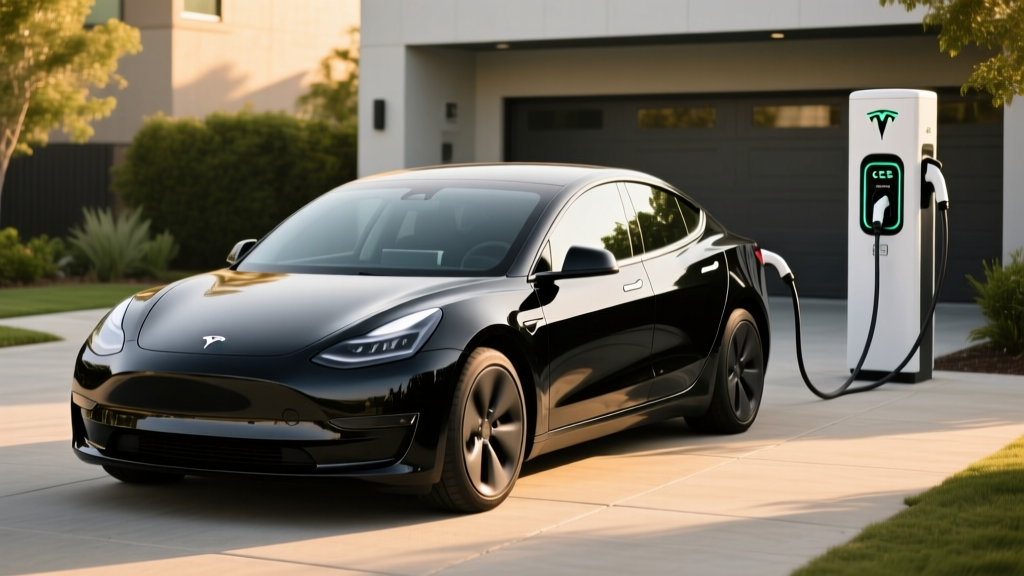
Home charging reality: A Tesla Wall Connector on a 60A circuit (48A continuous) delivers 11.5 kW, adding about 44 miles of range per hour. A full overnight charge from 20% to 80% takes roughly 5 hours — more than enough for daily use. Installation typically runs $800–$2,000 depending on panel proximity and local permitting. Always consult a licensed electrician for a site-specific quote.
Performance, Ride, and the Highland Refresh
The 2026 Model 3 carries forward the Highland refresh introduced for the 2024 model year. Key improvements over the pre-refresh car include:
- Acoustic glass on all windows — noticeably quieter at highway speed
- Revised suspension tuning with frequency-selective dampers — firms up on rough pavement but absorbs sharp impacts better
- Ventilated front seats (finally) and ambient lighting
- 8-inch rear touchscreen for climate and entertainment
- Rear seat cushion redesigned for better thigh support
The Performance trim's 2.9-second 0–60 time remains blistering for a sedan at this price. Track Mode allows adjustable front/rear torque bias and regen tuning. The dual-motor AWD system provides confident all-weather traction, though dedicated winter tires still outperform the stock Michelin Pilot Sport 4S in snow.
Ride quality divides opinion. It's firmer than a Hyundai Ioniq 6 or BMW i4, and road imperfections transmit more into the cabin. For spirited drivers, this communicates feedback. For comfort-prioritized commuters, it can feel busy on rough concrete freeways.
Interior, Cargo, and Daily Practicality
The Model 3 cabin remains the most minimalist in the segment — no instrument cluster, no physical stalks (turn signals are steering-wheel-mounted buttons), and nearly all vehicle functions live on the 15.4-inch center touchscreen.
Passenger space:
- Front legroom: 42.7 inches
- Rear legroom: 35.2 inches
- Front headroom: 40.3 inches
- Rear headroom: 37.8 inches
Rear seat space is adequate for adults under 6 feet, but the sloping roofline cuts headroom for taller passengers. The center rear seat is best suited for children due to the raised floor hump.
Cargo: 23 cu ft of trunk space, plus a 3.1 cu ft frunk (front trunk) suitable for a charging cable bag or small backpack. The trunk opening is a conventional sedan lid — not a hatchback — which limits loading bulky items. The 60/40 split rear seat folds flat, extending usable length for longer cargo.
Tech highlights:
- 15.4-inch center display with responsive UI, Netflix/YouTube/Theater while parked
- Bluetooth, Wi-Fi, two front USB-C (65W), two rear USB-C
- 17-speaker premium audio (Long Range/Performance) — one of the best in any car at this price
- Autopilot standard (SAE Level 2 driver-assist): adaptive cruise, lane centering, automatic emergency braking
- Full Self-Driving (Supervised) available as a $8,000 option or $99/month subscription — still SAE Level 2, requiring active driver supervision at all times
SAE Automation Level Reminder: Autopilot and FSD (Supervised) are Level 2 systems. The driver must remain fully engaged, hands on the wheel (or applying torque), and eyes on the road. Tesla's camera-based monitoring will issue escalating warnings and eventually disengage the system if inattention is detected. This is not autonomous driving — Level 4 robotaxi services (Waymo, Zoox) operate without a human driver in geofenced areas.
Pricing, Tax Credits, and Ownership Cost
| Trim | Base MSRP | As-Tested (typical) | §30D Credit Eligibility |
|---|---|---|---|
| RWD | $38,990 | $39,990 (w/ paint) | Up to $7,500 — subject to sourcing, income, and MSRP caps |
| Long Range AWD | $47,740 | $49,740 (w/ paint + wheels) | Up to $7,500 — subject to sourcing, income, and MSRP caps |
| Performance | $53,740 | $55,740 (w/ paint + wheels) | Up to $7,500 — subject to sourcing, income, and MSRP caps |
All Model 3 trims fall under the $55,000 MSRP cap for sedans under IRS §30D. However, the full $7,500 credit depends on three factors that change frequently:
- Battery sourcing and critical minerals: A percentage of battery components must be manufactured or assembled in North America, and critical minerals must be sourced from the US or FTA partners. Tesla's Fremont-built packs have generally met these thresholds, but supply-chain shifts can alter eligibility mid-year.
- Buyer income caps: Modified AGI must not exceed $150,000 (single), $225,000 (head of household), or $300,000 (married filing jointly).
- Point-of-sale transfer: As of 2024, eligible buyers can transfer the credit to the dealer at purchase, reducing the out-of-pocket price immediately rather than waiting for a tax refund.
Always verify current eligibility on irs.gov before purchasing — battery sourcing rules have shifted multiple times since 2023, and a car that qualified in January may not qualify in June.
5-year estimated cost of ownership (Long Range AWD, 15,000 mi/yr):
- Purchase price (after estimated $7,500 credit): ~$40,240
- Electricity (home charging at $0.14/kWh): ~$3,150
- Insurance (national EV average): ~$9,500
- Maintenance (tires, cabin filter, wiper fluid): ~$1,200
- Estimated depreciation: ~$14,000
- 5-year total: ~$68,090
Compared to a similarly equipped BMW 330i xDrive, the Model 3 saves roughly $6,000–$9,000 over five years, primarily through fuel savings and lower maintenance, though insurance premiums tend to run 10–15% higher for Teslas.
Warranty and Long-Term Battery Outlook
Tesla's warranty structure:
- Basic vehicle: 4 years / 50,000 miles
- Battery and drive unit (Long Range/Performance): 8 years / 120,000 miles, with a minimum 70% capacity retention guarantee
- Battery and drive unit (RWD): 8 years / 100,000 miles, same 70% retention threshold
Real-world degradation data from Tesla's fleet suggests the NMC packs in the Long Range lose approximately 10–12% capacity over the first 100,000 miles, then flatten into a slow linear decline. LFP packs in the RWD tend to show slightly more initial drop (12–15%) but maintain a very flat curve thereafter. Both chemistries are projected to retain well above 70% at 150,000 miles under normal use.
Out-of-warranty battery replacement currently runs $12,000–$16,000 depending on the pack, though prices have been declining. Most owners will never need a replacement — Tesla data indicates fewer than 1% of packs require service-related replacement before 200,000 miles.
Pros, Cons, and Who Should Buy
Pros
- Industry-leading efficiency (25 kWh/100 mi)
- Access to the Supercharger network — the most reliable DC fast-charging infrastructure in North America
- Class-leading range on Long Range (363 mi EPA)
- Over-the-air updates add features continuously
- Strong resale value relative to most EVs
- 250 kW peak charging with usable charge curve
- Excellent safety ratings (NHTSA 5-star, IIHS Top Safety Pick+)
Cons
- Firm ride quality on rough roads
- Turn-signal buttons on steering wheel take adaptation; no stalk
- Rear seat headroom limited for tall passengers
- Door handles can freeze shut in ice storms
- Minimalist interior polarizing — no physical climate knobs
- FSD (Supervised) at $8,000 remains Level 2 — expensive for what it delivers
- No hatchback — trunk opening limits bulky cargo
Who the Model 3 Suits Best
Choose the Model 3 Long Range if: You commute 40+ miles daily, take regular road trips, want the broadest Supercharger access, and prioritize efficiency and tech over plush ride quality.
Choose the Model 3 RWD if: You charge primarily at home, drive under 200 miles daily, want the lowest entry price, and prefer LFP's 100% daily-charge tolerance.
Choose the Performance if: You want sports-sedan acceleration (2.9 sec 0–60) with EV running costs, and accept the range trade-off.
Look elsewhere if: You need a hatchback (Ioniq 5), a softer ride (Ioniq 6), or a larger back seat (Model Y, Hyundai Ioniq 5). Families needing three-across rear seating should consider the Model Y or Kia EV9.
Competitor Comparison: Model 3 vs. the Field
| Spec | Tesla Model 3 LR | Hyundai Ioniq 6 SEL | BMW i4 eDrive40 |
|---|---|---|---|
| EPA Range | 363 mi | 342 mi | 301 mi |
| Battery | ~79 kWh NMC | 77.4 kWh NMC | 83.9 kWh NMC |
| Max DC Charge | 250 kW | 240 kW | 205 kW |
| 0–60 mph | 4.2 sec | 5.1 sec | 5.5 sec |
| Base MSRP | $47,740 | $46,700 | $57,900 |
| NACS Native | Yes | Yes (2025+) | Yes (2025+) |
| Ride Comfort | Firm | Compliant | Refined |
The Ioniq 6 is the closest efficiency rival and offers a more comfortable ride, but its charging network access (even with NACS adoption) doesn't yet match Tesla's Supercharger maturity. The BMW i4 delivers superior interior materials and ride refinement but costs $10,000+ more for less range.
Frequently Asked Questions
What is the real-world range of the 2026 Tesla Model 3?
The Long Range AWD achieves an EPA-estimated 363 miles. In real-world mixed driving at moderate temperatures, expect 310–340 miles. Sustained highway driving at 75 mph reduces this to roughly 270–290 miles. Cold weather (below 30°F) can drop range by 20–30%, yielding approximately 250–290 miles depending on conditions and preconditioning.
How fast does the Model 3 charge at home and on the road?
On a Level 2 home charger (Tesla Wall Connector, 48A/11.5 kW), the Model 3 adds approximately 44 miles of range per hour — a full overnight session covers most daily needs. On a V3 or V4 Supercharger, the Long Range and Performance peak at 250 kW, charging from 10–80% in roughly 25 minutes. The RWD peaks at 170 kW with a 10–80% time of about 30 minutes. Charging tapers significantly above 80% SoC.
How much does the Model 3 cost after the federal tax credit?
The RWD starts at $38,990 and could drop to approximately $31,490 if you qualify for the full $7,500 §30D credit. The Long Range starts at $47,740 (~$40,240 after credit). Eligibility depends on your income (AGI caps of $150K/$225K/$300K by filing status), battery component sourcing requirements, and the $55,000 sedan MSRP cap. Verify current eligibility at irs.gov before purchasing.
Does the 2026 Model 3 qualify for the federal EV tax credit?
All three trims fall under the $55,000 sedan MSRP cap. Tesla's Fremont-manufactured battery packs have generally met North American component and critical-mineral sourcing thresholds, but these rules shift with supply-chain changes. Your personal eligibility also depends on income limits. Check fueleconomy.gov and irs.gov for the latest status before ordering.
How do Tesla door handles work, and are they reliable?
The Model 3 uses electronically actuated flush handles. From outside, press the wide end of the handle with your thumb to pivot it outward, then pull. From inside, press the electronic button on the armrest. A mechanical backup cable exists for 12V failure. The handles are generally reliable but can freeze flush to the body in ice storms — pressing firmly with your palm to break ice adhesion usually resolves it. Tesla improved the seal design in the Highland refresh, but cold-climate owners should still garage the car when possible during freezing rain events.
Is the Model 3 worth buying over the competition in 2026?
For most buyers, yes — the combination of Supercharger access, efficiency, range, and pricing is difficult to beat. The Ioniq 6 is a strong alternative if you prioritize ride comfort and a more conventional interior layout. The BMW i4 wins on build quality and refinement but at a significant price premium. If you value charging convenience and software above all, the Model 3 remains the default recommendation. If you need cargo versatility, the Model Y hatchback is the more practical Tesla.