The New Era of Automaker-Backed Charging Networks
The electric vehicle landscape has fundamentally shifted from a fragmented, third-party charging ecosystem to one dominated by massive automaker coalitions. Here at the AutoEdgeView EV Charging Industry News desk, our Automaker Partnerships Announcement Tracker has been working overtime. Over the past eighteen months, we have logged dozens of press releases, joint ventures, and standard-adoption agreements. Out of this flurry of industry consolidation, two distinct charging titans have emerged, effectively splitting the North American market into two massive camps.
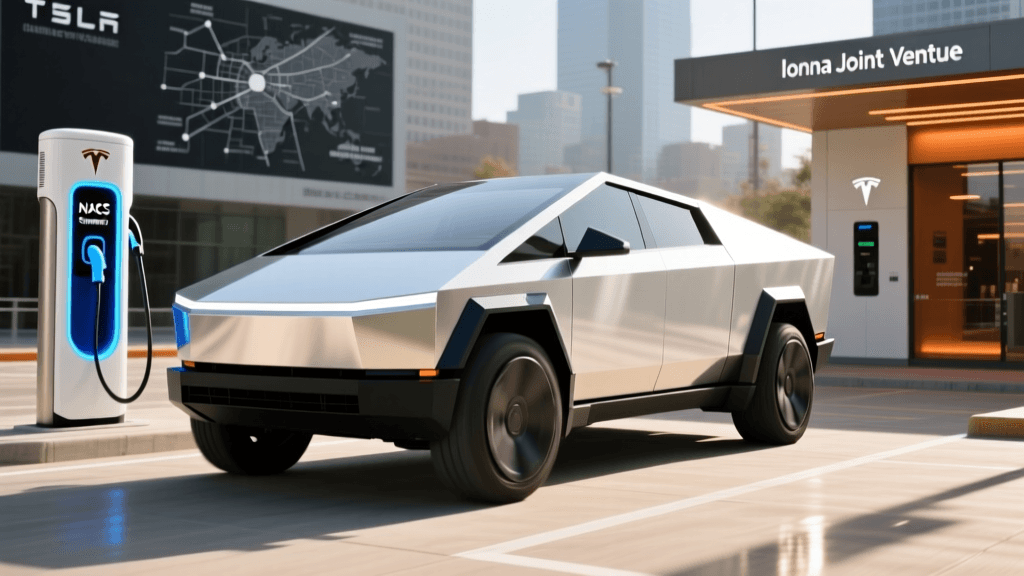
On one side, we have the reigning champion: the Tesla Supercharger network, now rapidly expanding its North American Charging Standard (NACS) to legacy automakers like Ford, General Motors, Rivian, and Volvo. On the other side, we have the formidable challenger: Ionna, a massive joint venture backed by seven global automotive giants—BMW, GM, Honda, Hyundai, Kia, Mercedes-Benz, and Stellantis—aiming to build a ground-up, high-power charging empire. But which partnership yields the better 'product' for the end consumer? Today, we are putting these two automaker-backed networks in a head-to-head product showdown to evaluate density, hardware, software, and real-world usability.
The Contenders: Tesla Supercharger (NACS) vs. Ionna Joint Venture
Tesla Supercharger (The NACS Expansion): Tesla has effectively won the standards war by convincing nearly every major automaker to adopt NACS. Starting in 2024, non-Tesla EVs equipped with CCS1 ports can access the Supercharger network via authorized adapters, while future EVs from these brands will feature native NACS ports. The product here is not just the charger, but the unprecedented reliability and ubiquity of Tesla's existing 20,000+ North American stall footprint.
Ionna (The Seven-Automaker Coalition): Announced in mid-2023 and officially branded in early 2024, Ionna represents a unified counter-strike. As noted by Reuters during the coalition's formation, the joint venture aims to install at least 30,000 high-powered chargers across North America by 2030. Unlike Tesla's utilitarian approach, Ionna is marketing its stations as premium, amenity-rich destinations featuring canopies, retail spaces, and universal plug support.
Head-to-Head Comparison Chart
| Feature | Tesla Supercharger (NACS Access) | Ionna Joint Venture Network |
|---|---|---|
| Backing Automakers | Tesla, Ford, GM, Rivian, Volvo, Polestar, Mercedes, Nissan, etc. | BMW, GM, Honda, Hyundai, Kia, Mercedes-Benz, Stellantis |
| Current NA Stall Count | ~25,000+ (and growing) | 0 (First stations breaking ground in 2024) |
| Target 2030 Footprint | Continue organic growth (estimated 50,000+) | 30,000+ High-Power Chargers |
| Primary Plug Standard | NACS (CCS1 via Magic Dock or Adapter) | CCS & NACS (Dual-cable stalls planned) |
| Max Charging Speed | 250kW (V3) / 350kW+ (V4) | 350kW+ (Targeting 800V architectures) |
| Station Amenities | Minimal (Relies on co-located businesses) | Premium (Canopies, lounges, retail, Wi-Fi) |
Round 1: Network Density, Footprint, and Reliability
When evaluating a charging network as a consumer product, availability is the most critical metric. Tesla holds an insurmountable lead in pure footprint. According to data tracked by the Alternative Fuels Data Center (AFDC), Tesla's Supercharger network accounts for the vast majority of reliable, high-speed DC fast charging corridors in North America. For a Ford F-150 Lightning or Rivian R1T owner buying an adapter today, the 'product' they are purchasing is immediate access to thousands of proven, highly reliable routing corridors.
Ionna, conversely, is starting from zero. While their 30,000-charger goal is ambitious, it will take years to permit, build, and energize these sites. Early Ionna deployments will focus heavily on major metropolitan hubs and key highway corridors, but rural routing will remain a challenge for the coalition through at least 2026. Furthermore, while Tesla's uptime is legendary (often exceeding 99%), new networks frequently suffer from teething issues regarding grid interconnection and software bugs during their first year of operation.
Winner of Round 1: Tesla Supercharger. You cannot beat a decade-long head start in infrastructure deployment and grid integration.
Round 2: Hardware, Plug Standards, and Charging Speeds
This is where the Ionna coalition aims to deliver a knockout blow. Tesla's ubiquitous V3 Superchargers are capped at 250kW. While Tesla is rolling out its V4 architecture (which supports higher voltages and CCS/NACS agnosticism via the 'Magic Dock' or native cables), the vast majority of the current network cannot fully saturate the charging curves of modern 800V EVs like the Hyundai Ioniq 5, Kia EV6, or Porsche Taycan.
Ionna is building for the future. By committing to 350kW+ liquid-cooled chargers from day one, Ionna stations will allow 800V vehicles to charge from 10% to 80% in under 18 minutes. Additionally, Ionna has promised a vastly superior physical hardware experience. Tesla's open-air parking lots leave drivers exposed to rain, snow, and blistering sun. Ionna's blueprint mandates solar canopies, integrated lighting, and dedicated retail spaces, turning a mundane 20-minute wait into a comfortable layover. Furthermore, Ionna will natively support both CCS and NACS connectors on the same pedestal, eliminating the need for adapters or specialized 'Magic Dock' stalls.
Winner of Round 2: Ionna. Future-proof 350kW+ hardware and premium, weather-protected physical infrastructure make it a superior physical product.
Round 3: Software Integration, Payment, and User Experience
Tesla’s software ecosystem is the gold standard for EV charging. The seamless integration between the vehicle's navigation, battery preconditioning, and the charger itself is unmatched. When a native NACS vehicle pulls up to a Supercharger, Plug & Charge (ISO 15118) initiates billing automatically. There are no screens to swipe, no apps to open, and no RFID cards to fumble with. Even for legacy CCS vehicles using adapters, the Tesla app provides robust routing and payment tracking.
Ionna is promising a similar 'Plug & Charge' experience, leveraging the ISO 15118 standard backed by its parent automakers. Because GM, Hyundai, and BMW are deeply involved in Ionna's software stack, we expect deep vehicle-to-infrastructure (V2I) integration, allowing the car to handle battery preconditioning and automatic payment authentication. However, third-party networks like Electrify America have struggled with app latency, payment gateway failures, and handshake errors between the car and the charger. Ionna will need to prove that its software stack is as bulletproof as Tesla's proprietary, vertically integrated code.
Winner of Round 3: Tesla Supercharger. Until Ionna launches and proves its software reliability, Tesla's vertically integrated Plug & Charge ecosystem remains the undisputed king of user experience.
Actionable Advice: Navigating the Transition Years
As our announcement tracker continues to monitor these partnerships, EV buyers are left wondering how to navigate this transitional era. Here is our practical, actionable advice for consumers based on the current state of these partnerships:
- Factor in Adapter Costs and Logistics: If you are buying a legacy CCS EV today (like a Ford Mustang Mach-E or GM Ultium vehicle), you will need an adapter to use Tesla's network. Ford's official adapter costs roughly $230, while Tesla's official CCS adapter is $250. Ensure you order these directly from the automaker or Tesla to guarantee safety and warranty compliance. Avoid cheap, unverified third-party adapters on Amazon, as they can cause thermal runaway or void your vehicle's warranty.
- Route Planning for 800V Vehicles: If you own an 800V vehicle (Hyundai, Kia, Porsche, Audi), the Tesla V3 network will bottleneck your charging speed to roughly 150kW-180kW due to voltage step-up limitations. For road trips, continue to prioritize Electrify America or wait for Ionna's 350kW hubs to open along your specific routes to maximize your vehicle's hardware capabilities.
- Leverage Government Subsidies: The Joint Office of Energy and Transportation (DriveElectric.gov) is actively funding rural and disadvantaged community charging corridors. When planning road trips through rural areas, look for NEVI-funded stations, as these are required to meet strict uptime and payment reliability standards, offering a safer bet than aging, unverified third-party chargers.
- Time Your Native NACS Purchase: If you are cross-shopping a new EV, prioritize models launching in late 2024 or 2025 that feature native NACS ports. Relying on an adapter adds weight, requires you to store a dirty cable in your trunk, and introduces an additional point of mechanical failure at the charge port.
Final Verdict: Which Partnership Wins?
The head-to-head showdown between the Tesla Supercharger NACS expansion and the Ionna joint venture reveals a fascinating dichotomy between current reality and future potential.
If you are buying an EV today, the Tesla Supercharger network is the undisputed winner. The sheer density, unmatched reliability, and seamless software integration make it the only network you can truly depend on for cross-country travel. The automaker partnerships that unlocked NACS access for Ford, GM, and Rivian owners have instantly doubled the usable fast-charging footprint for millions of drivers.
However, if we are looking at the 2026 and beyond horizon, Ionna represents the superior product vision. By combining the financial might of seven global automakers, Ionna is building a network that addresses every major complaint EV drivers have about Tesla: lack of weather protection, insufficient 350kW charging for 800V architectures, and a lack of premium amenities.
Ultimately, the consumer wins. The era of fragmented, unreliable, venture-capital-backed charging startups is ending, replaced by well-funded, automaker-backed coalitions that treat charging not as an afterthought, but as a core pillar of the vehicle ownership experience.