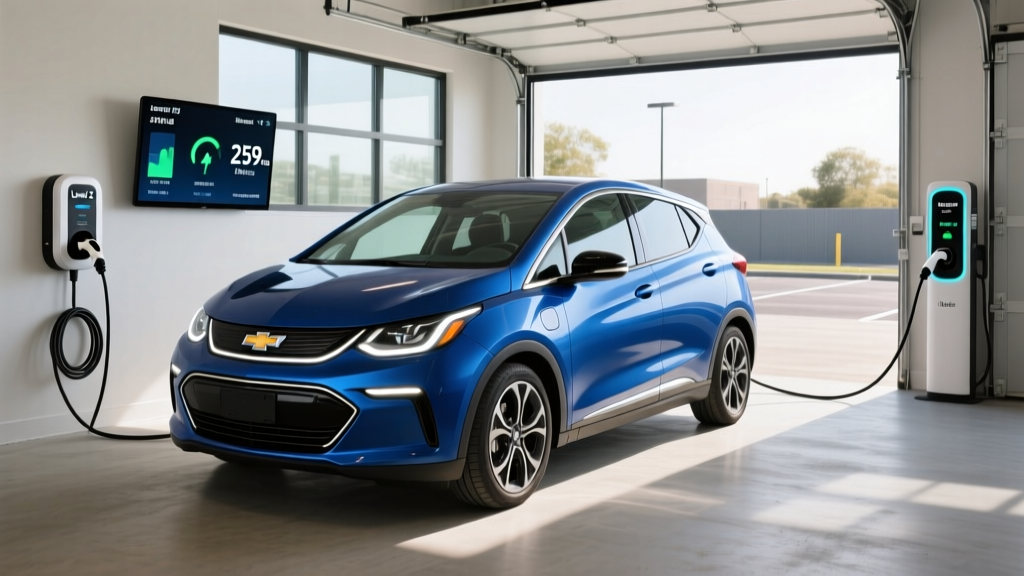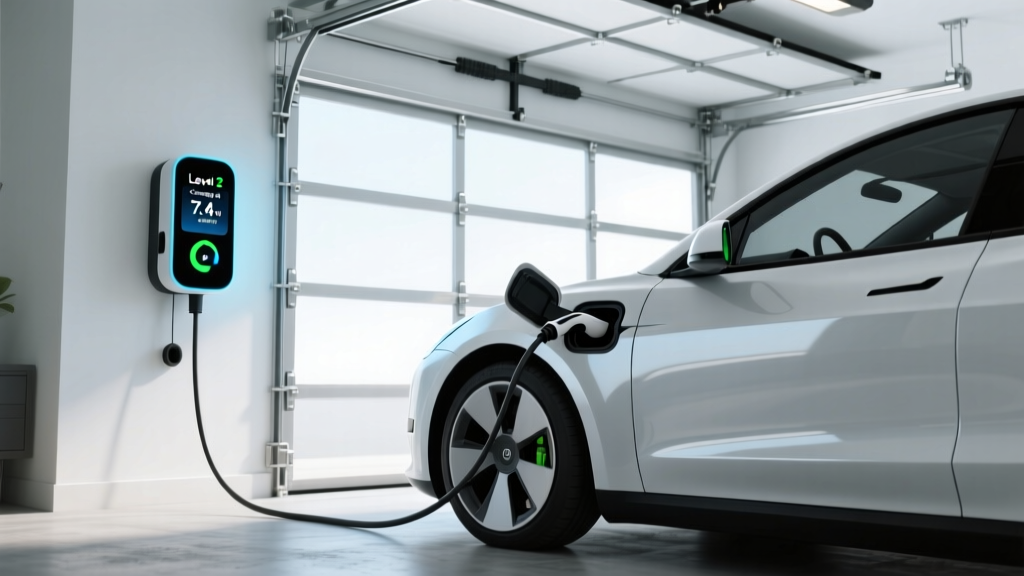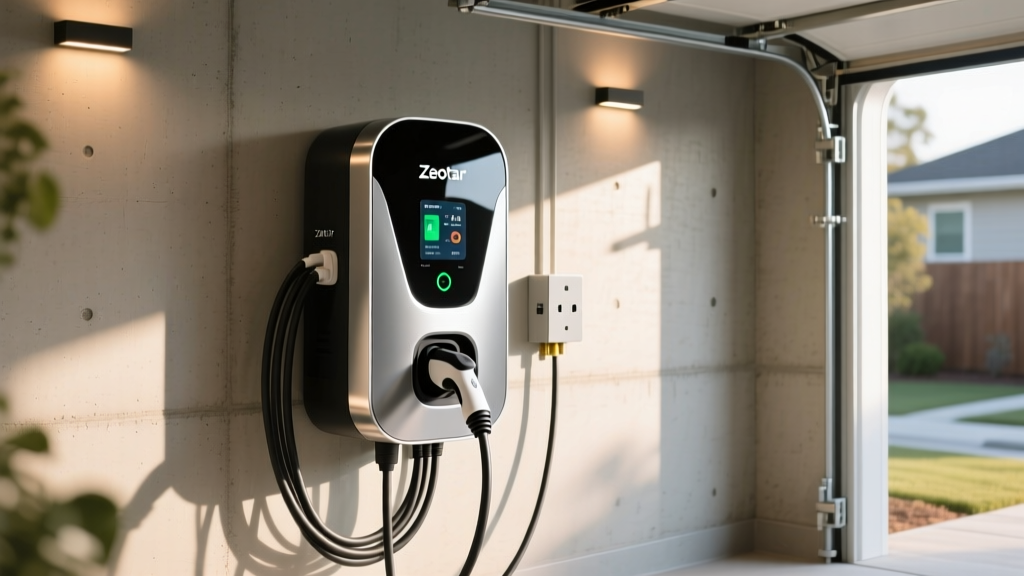
If you've been browsing Amazon or EV forums for an affordable home Level 2 charger, you've likely encountered the Zeotar charging station — a wall-mounted or plug-in unit priced well below name-brand alternatives like ChargePoint or Tesla. At roughly $250–$350 for a 40-amp, 9.6 kW unit, it undercuts most competitors by 40% or more. But does it actually deliver reliable daily charging, and what will installation really cost?
We broke down the Zeotar's specs, real-world charge speeds, connector compatibility, electrical requirements, and total installed cost so you can decide whether it's a smart budget pick or a false economy.
Zeotar Charging Station: Core Specs at a Glance
| Specification | Value |
|---|---|
| Max Power Output | 9.6 kW (240V / 40A) |
| Available Amperage Settings | 16A / 24A / 32A / 40A (DIP switch) |
| Connector | J1772 (NACS adapter sold separately) |
| Cable Length | 25 ft (standard) |
| Wi-Fi / Smart Features | Basic app scheduling; no load sharing |
| Indoor/Outdoor Rating | NEMA 4 (indoor/outdoor rated) |
| UL/ETL Certification | Verify current listing — early batches lacked UL mark |
| Approximate Unit Price | $270–$330 (varies by retailer) |
| Warranty | 1 year manufacturer |
Charging Levels Explained: How Fast Will Each Add Range?
Before evaluating the Zeotar specifically, here's how the three EV charging levels compare in practical terms:
| Level | Voltage | Power (kW) | Miles of Range Added Per Hour | Typical Use Case |
|---|---|---|---|---|
| Level 1 | 120V AC | 1.2–1.4 kW | 3–5 mi/hr | Overnight top-up; PHEVs; emergency |
| Level 2 | 240V AC | 3.3–19.2 kW | 12–75 mi/hr | Daily home/workplace charging |
| DC Fast Charge | 400–900V DC | 50–350+ kW | 150–1,200+ mi/hr (peak) | Road trips; 10–80% in 15–30 min |
The Zeotar operates at Level 2, delivering up to 9.6 kW. In real-world terms, that translates to approximately 28–35 miles of range per hour of charging for a typical mid-size EV like the Tesla Model Y or Hyundai IONIQ 5 (assuming ~3.0–3.5 mi/kWh efficiency).
Real-World Charging Time Examples at 9.6 kW
| Vehicle (2025–2026 MY) | Usable Battery (kWh) | 10–80% Energy Needed | Estimated Time at 9.6 kW |
|---|---|---|---|
| Tesla Model Y LR (NMC) | 75 kWh | ~52.5 kWh | ~5.5 hours |
| Hyundai IONIQ 5 (77.4 kWh NMC) | 74 kWh usable | ~51.8 kWh | ~5.4 hours |
| Ford F-150 Lightning Ext. Range | 131 kWh | ~91.7 kWh | ~9.5 hours |
| Chevrolet Equinox EV (85 kWh) | ~81 kWh usable | ~56.7 kWh | ~5.9 hours |
| Toyota RAV4 Prime PHEV (18.1 kWh) | ~14.5 kWh usable | ~10.2 kWh | ~1.1 hours |
For most EV owners driving 30–50 miles per day, a 9.6 kW charger like the Zeotar fully replenishes daily use in under two hours. Overnight charging on a standard 8–10 hour window handles even large batteries like the F-150 Lightning.
Home Installation: Electrical Requirements & Real Costs
The Zeotar requires a dedicated 240V circuit — the same type of outlet your electric dryer or oven uses. Here's what that means for your electrical panel:
- Circuit breaker: 50A breaker required for the 40A continuous load (NEC code mandates 125% overhead: 40A × 1.25 = 50A)
- Wire gauge: 6 AWG copper (THHN in conduit or 6/2 NM-B Romex for short indoor runs)
- Panel capacity: Your main panel must have at least 50A of available headroom — typically fine on a 200A service, but older 100A panels may need an upgrade
- Hardwired vs plug-in: The Zeotar is available in both configurations; hardwired avoids the cost of a NEMA 14-50 receptacle but is less portable
Installation Cost Breakdown
| Item | Low Estimate | High Estimate | Notes |
|---|---|---|---|
| Zeotar charger unit | $270 | $330 | 40A model, J1772 connector |
| Electrician labor (2–4 hrs) | $300 | $800 | Varies by region; $100–$200/hr |
| Materials (wire, breaker, conduit) | $100 | $350 | Longer runs = more wire cost |
| Permit fee | $50 | $200 | Required in most jurisdictions |
| Panel upgrade (if needed) | $1,500 | $3,500 | 100A → 200A service upgrade |
| Total (no panel upgrade) | $720 | $1,680 | Most homes with 200A service |
| Total (with panel upgrade) | $2,220 | $5,180 | Older homes with 100A panels |
The federal §30D tax credit for home charging equipment (officially the Alternative Fuel Vehicle Refueling Property Credit) covers up to 30% of equipment and installation costs, capped at $1,000, but only for taxpayers in eligible census tracts (typically lower-income or rural areas). Check your eligibility at IRS.gov and consult a tax professional — eligibility depends on your specific address and income.
Connector Compatibility: Will the Zeotar Fit Your EV?
The Zeotar ships with a J1772 connector, which is the legacy North American standard. Here's what that means for your vehicle:
| Vehicle Connector Standard | Brands Using It (2025–2026) | Works with Zeotar? | Adapter Needed? |
|---|---|---|---|
| J1772 (legacy) | Chevrolet Bolt, older Nissan Leaf, VW ID.4 (pre-2025), Rivian | ✅ Direct plug | No |
| NACS (Tesla standard, now industry-wide) | Tesla (all), Ford (2025+), GM (2025+), Hyundai/Kia (2025+), Rivian (2025+) | ⚠️ With adapter | Yes — J1772-to-NACS adapter (~$50–$150) |
| CCS1 (Combined Charging System) | Most non-Tesla EVs through 2024 MY | ✅ For Level 2 (J1772 portion) | No — CCS1 includes J1772 pins for AC charging |
| CHAdeMO | Nissan Leaf (older), Mitsubishi Outlander PHEV | ✅ For Level 2 AC | No — CHAdeMO vehicles use J1772 for AC |
Key takeaway: As of 2025–2026, the industry is rapidly shifting to NACS (Tesla's connector). If you're buying a new EV from Ford, GM, Hyundai, Kia, or BMW, it will have a NACS port. The Zeotar's J1772 plug will still charge these vehicles, but you'll need a J1772-to-NACS adapter — an added cost of $50–$150 depending on brand and amperage rating. If you plan to keep the charger for 5+ years, consider whether buying a native NACS charger (like the Tesla Wall Connector at ~$420) is a better long-term investment.
Cost to Charge: Zeotar at Home vs Public vs Gas
One of the strongest arguments for home Level 2 charging is cost. Here's how it breaks down:
| Scenario | Cost per kWh | Cost per Mile (at 3.0 mi/kWh) | Annual Cost (12,000 mi/yr) |
|---|---|---|---|
| Home — off-peak utility rate | $0.08–$0.12 | $0.027–$0.040 | $320–$480 |
| Home — standard residential rate | $0.14–$0.18 | $0.047–$0.060 | $560–$720 |
| Public Level 2 (ChargePoint, EVgo L2) | $0.25–$0.49 | $0.083–$0.163 | $1,000–$1,960 |
| DC Fast Charge (Electrify America, EA Pass) | $0.35–$0.56 | $0.117–$0.187 | $1,400–$2,240 |
| Gasoline (25 MPG avg, $3.40/gal) | — | $0.136 | $1,632 |
At off-peak home rates, the Zeotar can fuel an EV for roughly $0.03–$0.04 per mile — about one-quarter the cost of a 25 MPG gas car at $3.40/gallon. Even at standard residential rates, you're saving $900–$1,300 per year versus gasoline. Data from fueleconomy.gov confirms that most 2025–2026 EVs achieve 3.0–4.0 mi/kWh in combined driving.
However, if you rely exclusively on public DC fast charging, your per-mile cost can exceed that of a fuel-efficient gas car. Home charging is where the economics work — and the Zeotar is purpose-built for exactly that.
Equipment Recommendations: Zeotar vs Competitors
Here's how the Zeotar stacks up against established Level 2 home chargers in 2025–2026:
Zeotar 40A — Budget Pick
- Power: 9.6 kW (40A)
- Connector: J1772 (NACS adapter extra)
- Cable: 25 ft
- Smart features: Basic app scheduling
- Price: ~$270–$330
- UL listed: ⚠️ Verify before purchase
- Warranty: 1 year
Best for: Budget-conscious buyers with a simple charging setup who want fast overnight replenishment.
ChargePoint Home Flex — Reliable All-Rounder
- Power: Up to 12 kW (50A), adjustable
- Connector: J1772 or NACS (2025+ model)
- Cable: 23 ft
- Smart features: Full app, Alexa, load sharing
- Price: ~$550–$650
- UL listed: ✅ Yes
- Warranty: 3 years
Best for: Buyers who want proven reliability, robust app features, and multi-year warranty.
Tesla Wall Connector — Best for NACS Vehicles
- Power: Up to 11.5 kW (48A)
- Connector: NACS native
- Cable: 24 ft
- Smart features: Wi-Fi updates, power sharing, access control
- Price: ~$420
- UL listed: ✅ Yes
- Warranty: 4 years
Best for: Tesla owners or any 2025+ NACS-equipped EV; excellent value at 11.5 kW.
Emporia Vue — Smart Grid Integration
- Power: Up to 11.5 kW (48A)
- Connector: J1772 (NACS adapter available)
- Cable: 24 ft
- Smart features: Full energy monitoring, solar integration, V2H-ready
- Price: ~$400–$450
- UL listed: ✅ Yes
- Warranty: 3 years
Best for: Solar-panel owners or those wanting whole-home energy visibility.
The Zeotar wins on price — it's roughly half the cost of the ChargePoint and significantly cheaper than the Emporia. However, the shorter warranty (1 year vs 3–4 years), uncertain UL certification status, and basic app features are real trade-offs. If you're installing in a detached garage or hard-to-reach location where a failure would be highly inconvenient, the extra $200–$350 for a ChargePoint or Tesla Wall Connector buys meaningful peace of mind.
Safety, Code & Installation Best Practices
Whether you choose the Zeotar or a premium unit, these code and safety requirements apply to every Level 2 home installation:
- Dedicated circuit: The charger must be on its own dedicated breaker — no sharing with other appliances (NEC 210.23)
- GFCI protection: NEC 2020 and later requires GFCI protection for all EV receptacles (NEMA 14-50 outlets). Hardwired installations may be exempt depending on local AHJ interpretation — ask your electrician
- Outdoor rating: If mounting outside, ensure the unit is rated at least NEMA 4 (weather-resistant). The Zeotar claims NEMA 4, but verify the gasket quality on the connector holster
- Permit required: Virtually all jurisdictions require an electrical permit for a new 240V circuit. Skipping the permit risks insurance denial if an electrical fire occurs
- Wire sizing: Never undersize wire. 40A continuous load = 50A breaker = 6 AWG copper minimum. Some electricians upsizing to 4 AWG for long runs (>50 ft) to minimize voltage drop
- Surge protection: Consider a whole-panel surge protective device (SPD), especially in lightning-prone regions. Cost: $150–$300 installed
For authoritative installation guidance, reference the NHTSA EV charging resources and your local building department's EV-specific bulletins.
Verdict: Is the Zeotar Charging Station Worth It?
- You want the lowest-cost 9.6 kW Level 2 charger available
- Your EV uses J1772 or you don't mind using a NACS adapter
- You're installing in an easily accessible location (simple swap if it fails)
- You've verified the specific unit carries UL or ETL certification
- You want a 3–4 year warranty and proven long-term reliability
- You're installing in a hard-to-access location (detached garage, underground)
- Your EV has a native NACS port and you want a direct plug without adapters
- You need advanced smart features (load sharing, solar integration, utility demand-response)
- UL/ETL certification is non-negotiable for your insurance or HOA requirements
The Zeotar charging station delivers legitimate 9.6 kW Level 2 performance at an aggressively low price. For the cost-conscious EV owner with a straightforward installation, it can save $200–$400 on equipment without sacrificing charge speed. The critical caveat is certification and longevity — a 1-year warranty and unclear UL status mean you're accepting more risk than with established brands. For a primary daily charger expected to last 5–10 years, spending $150–$300 more on a proven unit is often the wiser investment.
Frequently Asked Questions
How much does it cost to install a home EV charger like the Zeotar?
Total installed cost ranges from $720 to $1,680 for homes with adequate 200A electrical service (no panel upgrade needed). This includes the charger ($270–$330), electrician labor ($300–$800), materials ($100–$350), and permit fees ($50–$200). If your home needs a panel upgrade from 100A to 200A service, add $1,500–$3,500 to the total.
How fast will each charging level add range to my EV?
Level 1 (120V) adds 3–5 miles per hour. Level 2 (240V) at the Zeotar's 9.6 kW adds roughly 28–35 miles per hour depending on your EV's efficiency. DC fast charging at 150+ kW can add 150–1,200+ miles per hour at peak, though charge curves taper significantly above 80% SoC.
Which connector is compatible with my EV?
The Zeotar uses a J1772 connector. This plugs directly into any vehicle with a J1772 or CCS1 port. For 2025+ vehicles with NACS ports (Tesla, Ford, GM, Hyundai, Kia), you'll need a J1772-to-NACS adapter ($50–$150). CHAdeMO vehicles (older Nissan Leaf) also accept J1772 for Level 2 AC charging.
How much does charging cost per mile vs gas?
Home charging at off-peak rates costs roughly $0.03–$0.04 per mile — about one-quarter the $0.136/mile cost of gasoline at 25 MPG and $3.40/gallon. Even at standard residential rates ($0.14–$0.18/kWh), home charging costs $0.047–$0.060/mile. Public DC fast charging ($0.35–$0.56/kWh) can cost as much or more than gasoline per mile.
What electrical upgrades might I need for a Level 2 charger?
You'll need a dedicated 50A breaker on a 240V circuit with 6 AWG wire. The most common and expensive upgrade is a panel upgrade from 100A to 200A service ($1,500–$3,500), required when your existing panel lacks the capacity headroom for a 50A continuous load alongside existing appliances. A licensed electrician will perform a NEC Article 220 load calculation to determine if an upgrade is necessary.
Does the Zeotar support NACS (Tesla) vehicles?
Not natively. The Zeotar outputs through a J1772 connector. Tesla and other NACS-equipped EVs will charge through a J1772-to-NACS adapter. For a native NACS experience without adapters, consider the Tesla Wall Connector ($420, 11.5 kW) instead.
Is the Zeotar safe for outdoor installation?
The Zeotar carries a NEMA 4 rating, which covers rain and splashing water. However, verify the specific unit you receive has intact gaskets and a weather-sealed connector holster. For harsh climates (driving rain, snow, salt air), a NEMA 4X-rated unit from a major brand may offer better long-term weather resistance.