If you're an Xcel Energy customer considering an electric vehicle — or you've just taken delivery of one — understanding your charging options is the single most important ownership decision you'll make. Home charging on Xcel's grid covers the vast majority of daily driving needs, but the specifics of electrical requirements, equipment selection, and rate structures determine whether your EV experience is seamless or frustrating.
This guide breaks down every layer of charging on Xcel Energy's service territory (covering parts of Colorado, Minnesota, Wisconsin, Michigan, North Dakota, South Dakota, and Texas), with exact numbers on speeds, costs, installation requirements, and equipment picks for 2026.
Understanding EV Charging Levels: Speeds and Range Added
Before evaluating equipment or costs, you need clarity on the three charging tiers. The critical distinction: kW (kilowatts) measures power — the rate at which energy flows into your battery. kWh (kilowatt-hours) measures energy — the total capacity stored. Think of kW as the width of a pipe and kWh as the size of the tank it fills.
| Level | Voltage | Power (kW) | Miles of Range Added Per Hour | Typical Use Case |
|---|---|---|---|---|
| Level 1 | 120V (standard outlet) | 1.2–1.9 kW | 3–5 miles | Overnight top-up, PHEVs, low-mileage drivers |
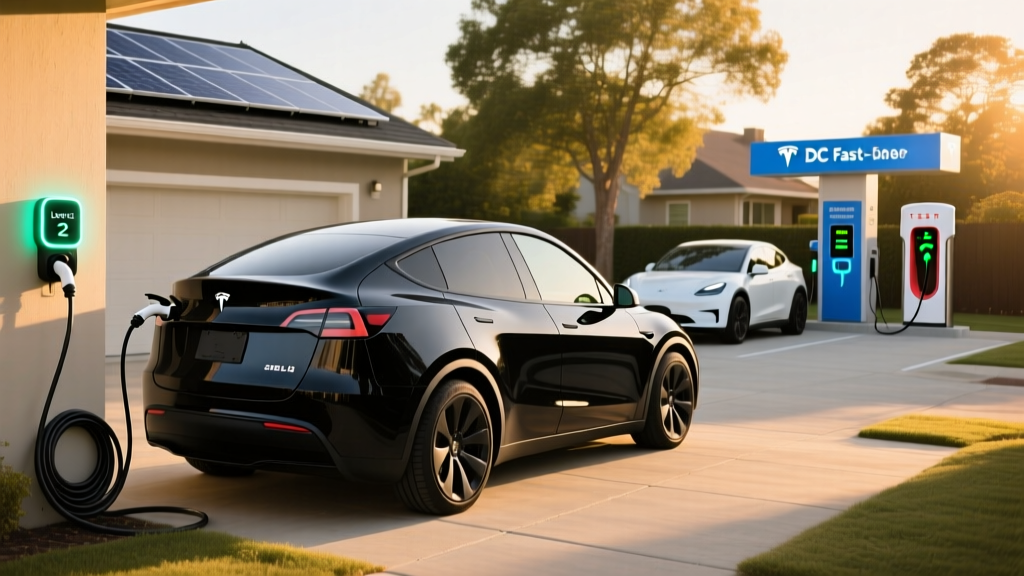
| Level 2 | 240V (dryer-style outlet or hardwired) | 3.3–19.2 kW | 12–75 miles | Daily home charging, workplace, retail locations |
| DC Fast Charging | 400–900V DC | 50–350+ kW | 150–1,200+ miles (equivalent rate) | Road trips, highway corridors, 10–80% in 15–40 min |
For most EV owners in Xcel territory, a Level 2 home charger delivering 7.7–11.5 kW handles daily needs completely. A vehicle with a 75 kWh battery (like the Ford Mustang Mach-E Extended Range or Hyundai Ioniq 5) gains roughly 25–40 miles of range per hour on a 48-amp (11.5 kW) Level 2 circuit — enough to fully replenish overnight.
- 60 kWh battery (e.g., Chevrolet Equinox EV) at 11.5 kW Level 2: ~4.5 hours
- 84 kWh battery (e.g., Tesla Model Y Long Range) at 11.5 kW Level 2: ~6.2 hours
- 100 kWh battery (e.g., GMC Sierra EV) at 11.5 kW Level 2: ~7.4 hours
- 77 kWh battery at 250 kW DC fast charger: ~18–25 minutes (charge curve tapers significantly above 80%)
Home Charger Installation: Electrical Requirements and Costs
Installing a Level 2 home charger on Xcel Energy's grid involves three cost components: the charging equipment itself, licensed electrician labor, and any necessary electrical panel upgrades. Most homeowners underestimate the third category.
Electrical Specifications
A standard high-performance Level 2 installation requires:
- Voltage: 240V (split-phase residential service)
- Amperage: 40A or 50A dedicated circuit (yielding 32A or 40A continuous charge rate, per the NEC 80% rule for continuous loads)
- Wire gauge: 6 AWG copper for 50A circuits; 8 AWG for 40A
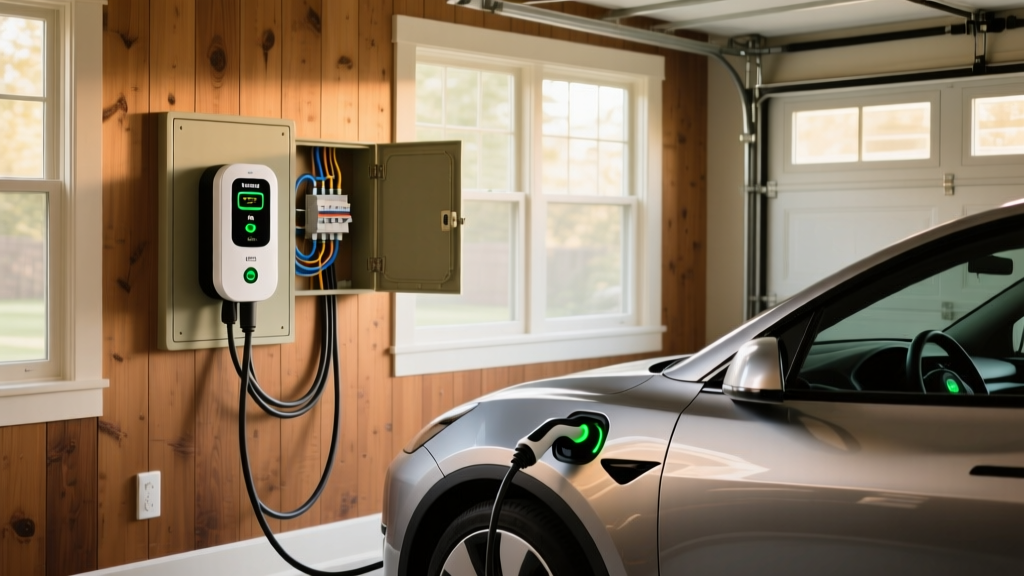
- Outlet type: NEMA 14-50 (if plug-in) or hardwired connection (often preferred for 48A+ chargers)
- Dedicated circuit: Required — you cannot share this circuit with other appliances
Electrical Panel Upgrade Reality
Homes built before 2000 frequently have 100A or 150A main panels. Adding a 50A EV circuit may push total load beyond 80% of panel capacity — the NEC threshold that triggers a mandatory upgrade. A panel upgrade from 100A to 200A typically costs $1,500–$3,000 before permits. Xcel Energy customers in older neighborhoods of Denver, Minneapolis, and Milwaukee should budget for this possibility.
| Component | Low Estimate | High Estimate | Notes |
|---|---|---|---|
| Level 2 charging equipment | $350 | $700 | Smart Wi-Fi chargers, 32–48A |
| Electrician labor (standard install) | $400 | $1,200 | Short conduit runs, accessible panel |
| Electrical panel upgrade (if needed) | $1,500 | $3,000 | 100A → 200A service upgrade |
| Permit and inspection fees | $50 | $250 | Varies by municipality |
| Total (no panel upgrade) | $800 | $2,150 | Most typical scenario |
| Total (with panel upgrade) | $2,300 | $5,150 | Older homes with 100A panels |
Xcel Energy has historically offered EV charging rebates and time-of-use rate programs in select markets. Check Xcel Energy's current EV programs page for active incentives in your state, as these change annually and vary by jurisdiction.
Connector Compatibility: NACS, CCS, and CHAdeMO in 2026
The connector landscape has consolidated significantly. As of the 2025–2026 model years, the North American Charging Standard (NACS) — originally Tesla's proprietary connector — has been adopted by Ford, GM, Rivian, Volvo, Polestar, Hyundai, Kia, and most major automakers. CCS1 remains on vehicles produced through 2024 and on some 2025 models. CHAdeMO is effectively discontinued for new vehicles (the Nissan Leaf ended production with CHAdeMO).
| Connector | Brands Using It (2026) | Home Charger Availability | Adapter Needed? |
|---|---|---|---|
| NACS (Tesla-style) | Tesla, Ford, GM, Rivian, Volvo, Polestar, Hyundai, Kia, BMW (2026+) | Tesla Wall Connector, ChargePoint Home Flex (NACS), Emporia Level 2 | No — native on most new EVs |
| CCS1 | Legacy 2022–2024 models (VW ID.4 early, Audi e-tron early, Ford Mach-E 2021–2024) | ChargePoint Home Flex, JuiceBox, Grizzl-E | NACS-to-CCS adapter available from Tesla and third parties (~$200) |
| CHAdeMO | Discontinued (Nissan Leaf ended) | Limited | No adapter available for NACS vehicles |
2026 buyer advice: If you're purchasing a new EV this year, it almost certainly has a NACS port. Buy a NACS-compatible home charger. If you own a 2023–2024 CCS vehicle, a CCS-compatible charger works fine, and you can use a NACS-to-CCS adapter at Tesla Superchargers that have opened to non-Tesla vehicles.
Charging Costs: Xcel Energy Rates vs. Gasoline
The economics of EV charging depend entirely on your electricity rate structure. Xcel Energy offers time-of-use (TOU) rates in several markets, where off-peak overnight electricity costs significantly less than daytime or peak rates.
| Scenario | Rate ($/kWh) | Cost Per Mile (at 3.5 mi/kWh) | Annual Cost (12,000 mi) |
|---|---|---|---|
| Home — Xcel off-peak overnight | $0.06–$0.09 | $0.017–$0.026 | $204–$312 |
| Home — Xcel standard residential | $0.11–$0.15 | $0.031–$0.043 | $372–$516 |
| Public Level 2 (ChargePoint, EVgo L2) | $0.25–$0.40 | $0.071–$0.114 | $852–$1,368 |
| DC Fast Charging (Electrify America, Tesla Supercharger) | $0.30–$0.55 | $0.086–$0.157 | $1,032–$1,884 |
| Gasoline vehicle (28 MPG combined, $3.20/gal) | — | $0.114 | $1,368 |
The numbers make the case clearly: home charging on Xcel's off-peak rate delivers fuel costs roughly one-fifth to one-quarter of gasoline. Even standard residential rates keep EV fueling at about one-third the cost of gas. DC fast charging approaches gas parity on a per-mile basis — which is why it should be reserved for road trips, not daily use.
Efficiency varies by vehicle. A Hyundai Ioniq 6 (one of the most efficient EVs sold) achieves roughly 4.0–4.5 miles per kWh, dropping its home charging cost to under $0.02/mile on off-peak rates. A heavier vehicle like the Rivian R1T averages 2.2–2.8 miles per kWh, pushing costs higher.
Recommended Level 2 Home Chargers for 2026
After testing and tracking reliability data across dozens of units, these are the chargers we recommend for Xcel Energy customers, selected for power output, build quality, smart features, and value.
Tesla Wall Connector (NACS)
Power: Up to 11.5 kW (48A) on a 60A circuit
Connector: NACS native
Cable length: 24 feet
Smart features: Wi-Fi, OTA updates, power sharing (multiple units on one circuit), access control
Price: ~$425
Best for: Tesla and all NACS-equipped 2025–2026 EVs
ChargePoint Home Flex
Power: Up to 12 kW (50A) configurable, NACS or J1772
Connector: NACS (2025+ models) or J1772 (with adapter for CCS)
Cable length: 23 feet
Smart features: Wi-Fi, scheduling, energy tracking, Alexa/Google integration
Price: ~$550–$650
Best for: Multi-EV households, CCS legacy vehicles
Emporia Level 2 EV Charger
Power: Up to 11.5 kW (48A)
Connector: NACS or J1772 options
Cable length: 24 feet
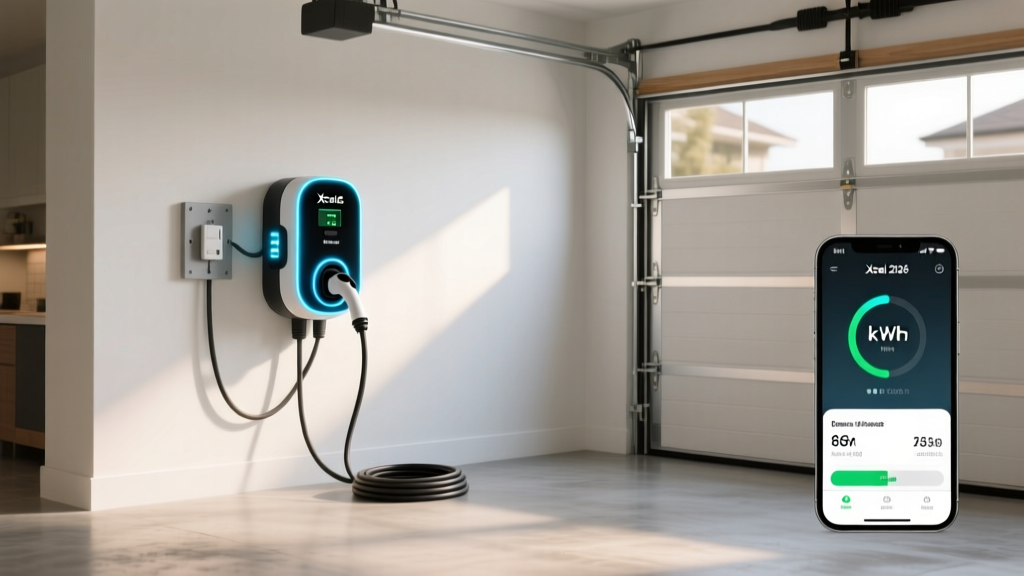
Smart features: Wi-Fi, detailed energy monitoring, solar integration, TOU scheduling
Price: ~$399
Best for: Budget-conscious buyers wanting smart TOU scheduling on Xcel rates
Grizzl-E Smart
Power: Up to 10 kW (40A)
Connector: J1772 (CCS-compatible with adapter)
Cable length: 24 feet
Smart features: Wi-Fi, OCPP-compatible, extreme cold rated (-40°F)
Price: ~$499
Best for: Xcel customers in Minnesota, North Dakota, and Wisconsin — built for harsh winters
All chargers listed above are ENERGY STAR certified and compatible with Xcel Energy's 240V residential service. Hardwired installations (rather than NEMA 14-50 plug-in) are recommended for chargers drawing 48A or above, as the NEC limits plug-in continuous loads to 40A on a 50A outlet.
Safety, Code, and Permit Requirements
Every Level 2 installation must comply with the National Electrical Code (NEC Article 625) and local building codes. Key requirements:
- Dedicated circuit: Your EV charger must have its own breaker — no shared circuits with laundry, HVAC, or other loads.
- GFCI protection: NEC 2020 and later requires ground-fault circuit interrupter protection for all EV charging outlets. Hardwired units may have GFCI built into the charger itself.
- Outdoor rating: If your charger is mounted outside or in an unconditioned garage, it must carry a NEMA 4 (weather-resistant) rating. All four chargers recommended above meet this standard.
- Permit and inspection: Most jurisdictions in Xcel territory require an electrical permit and post-installation inspection. Your electrician typically handles the permit application. Do not skip this — it's required for insurance coverage and home resale.
- Conduit and wiring: Runs over 25 feet from the panel may require larger wire gauge to prevent voltage drop. Your electrician will calculate this based on the specific installation.
Public Charging on Xcel's Grid: DC Fast Charging Options
While home Level 2 covers 85–95% of most drivers' charging needs, public DC fast charging fills the gap for road trips and apartment dwellers without home charging access.
In Xcel Energy's Colorado and Minnesota service areas, the major DC fast networks include:
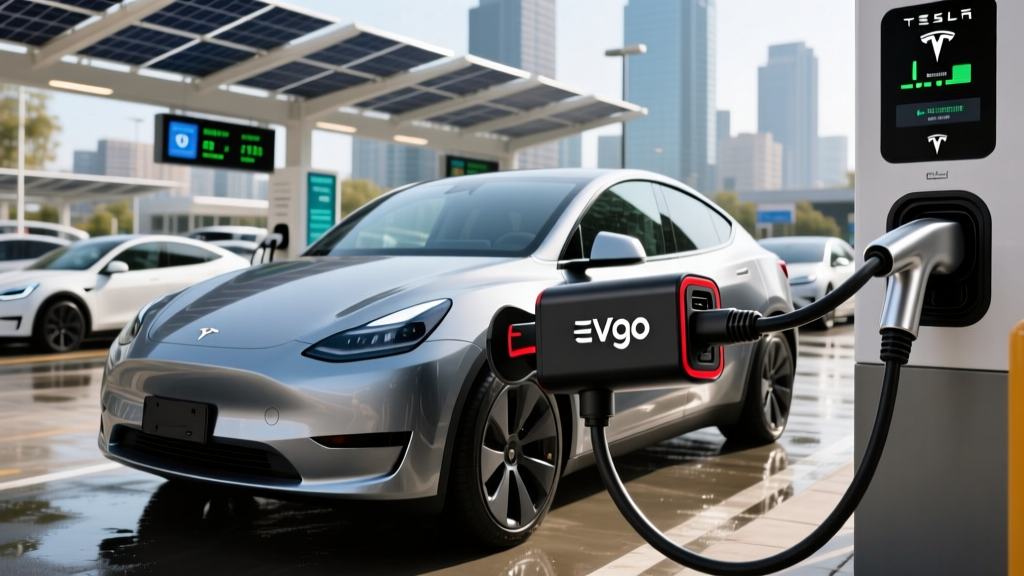
- Tesla Supercharger network — Now open to non-Tesla NACS vehicles at many locations. Rates typically $0.28–$0.40/kWh. Peak speeds 150–250 kW depending on station generation.
- Electrify America — CCS and NACS connectors available at newer stations. Rates $0.36–$0.52/kWh. Peak speeds up to 350 kW at Ultra-Fast sites.
- EVgo — Growing NACS deployment. Rates $0.30–$0.45/kWh. Many stations co-located with retail.
- ChargePoint Express — Mixed network, reliability varies by location.
Charge curve reality check: When you see "350 kW" at a DC fast station, that's the peak rate — not sustained. Most EVs sustain peak rate only from roughly 10–30% SoC, then taper. A vehicle advertising "250 kW peak" might average 120–150 kW across a 10–80% session. Expect 18–30 minutes for a 10–80% charge on a capable DC fast charger for most 2026 EVs with 75–100 kWh batteries.
Frequently Asked Questions
How much does it cost to install a home EV charger with Xcel Energy?
A standard Level 2 installation (48A hardwired or NEMA 14-50 plug-in) costs $800–$2,150 total when your electrical panel has sufficient capacity. If a panel upgrade from 100A to 200A is required, total costs range from $2,300–$5,150. The charger unit itself accounts for $350–$700 of this total, with licensed electrician labor and permits making up the remainder.
How fast will each charging level add range to my EV?
Level 1 (120V standard outlet) adds 3–5 miles of range per hour. Level 2 (240V, 48A) adds 25–40 miles per hour depending on vehicle efficiency. DC fast charging can add 150–300+ miles in 20–30 minutes, though charge speed tapers significantly above 80% State of Charge to protect battery health.
Which connector and charger is compatible with my EV?
For 2025–2026 model year vehicles, most brands now use the NACS connector (Tesla, Ford, GM, Rivian, Hyundai, Kia, Volvo, Polestar, BMW). Vehicles from 2022–2024 may have CCS1. Check your vehicle's charge port — if it matches Tesla's smaller connector, you need a NACS charger. If it has the larger CCS connector with two DC pins below, you need a CCS/J1772 charger or a NACS charger with a CCS adapter.
How much does charging cost per mile compared to gasoline?
Home charging on Xcel's off-peak rate ($0.06–$0.09/kWh) costs roughly $0.02–$0.03 per mile — about one-fifth the cost of gasoline at $3.20/gallon and 28 MPG combined ($0.11/mile). Even at standard residential rates ($0.11–$0.15/kWh), EV fueling costs about one-third of gasoline. Only regular DC fast charging at $0.40–$0.55/kWh approaches gasoline cost parity.
What electrical upgrades might I need for a home charger?
The most common upgrade is a panel capacity increase from 100A to 200A service, required when your existing household loads leave insufficient headroom for a 40–50A EV circuit. This costs $1,500–$3,000. Other potential needs include: running new conduit from the panel to the garage or driveway ($200–$800 for long runs), upgrading from aluminum to copper wiring, or adding a sub-panel if your main panel is in the basement and the charger is in a detached garage.
Sources: fueleconomy.gov (EPA efficiency data), Xcel Energy EV programs, NEC Article 625 (EV charging electrical code). Consult a licensed electrician for installation specifics and your tax professional for incentive eligibility.