If you've searched for wireless charging for Tesla, you've probably encountered a confusing mix of Kickstarter campaigns, YouTube demos, and forum speculation. As of 2026, Tesla does not offer a factory-supported wireless charging pad for any of its consumer vehicles — not the Model 3, Model Y, Model S, or Model X. What does exist is a small ecosystem of third-party inductive charging systems, a growing SAE standard (J2954), and a lot of unanswered questions about efficiency, cost, and practicality.
This guide cuts through the hype. We'll explain where wireless EV charging actually stands today, what it would take to set it up for a Tesla, and — critically — how it compares to the proven, affordable Level 2 wired charging that most Tesla owners rely on. You'll walk away with exact numbers: kW speeds, installation costs, per-mile charging costs, and specific equipment recommendations.
The Reality of Wireless Charging for Tesla in 2026
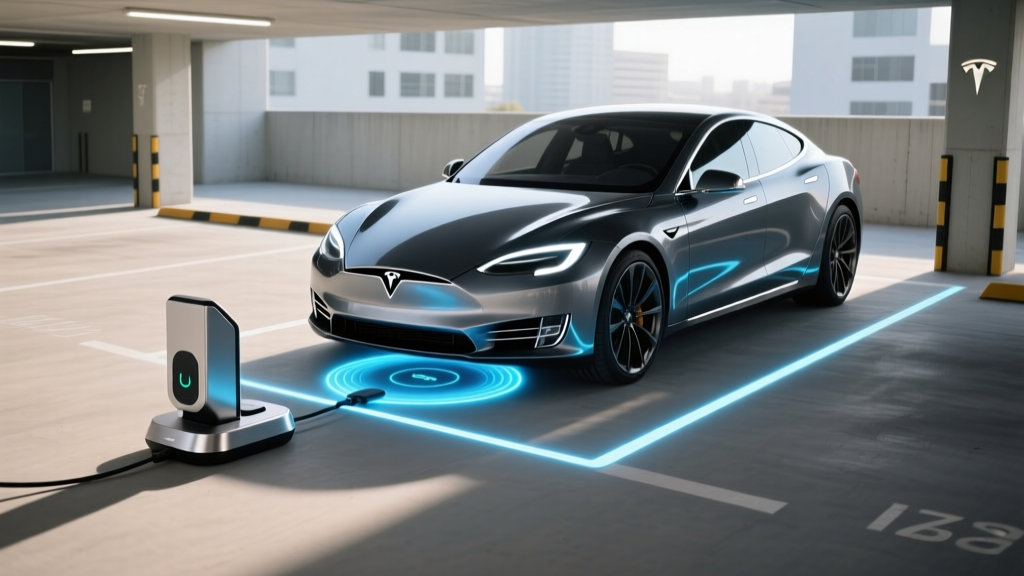
Inductive (wireless) EV charging works on the same principle as a Qi phone charger, scaled up dramatically. A ground-mounted transmitter pad creates an alternating magnetic field; a receiver coil on the vehicle's underside converts that field back into electrical current to charge the battery. The SAE International J2954 standard defines wireless power transfer up to 11 kW for light-duty vehicles, with alignment tolerances and electromagnetic field safety limits.
Here's the catch for Tesla owners: Tesla has never integrated a receiver coil into any production vehicle. That means any wireless charging setup requires an aftermarket receiver installed on the car's underbody — a modification that voids portions of Tesla's battery and drive unit warranty, requires professional installation, and adds weight (typically 30–50 lbs for the receiver assembly).
The companies that have demonstrated wireless EV charging systems — WiTricity, Plugless Power (Evatran), and a handful of Chinese firms — have largely pivoted to fleet and commercial applications. Plugless Power, which briefly offered a Tesla Model S adapter around 2017, discontinued its consumer product line. WiTricity licenses its technology to automakers and Tier 1 suppliers but does not sell direct-to-consumer pads. A few startups continue to demonstrate prototypes, but no turnkey, warrantied wireless charging system is commercially available for Tesla vehicles as of early 2026.
How Wireless EV Charging Compares: Speed and Efficiency
To evaluate wireless charging honestly, we need to compare it against the wired charging levels Tesla owners actually use. Here's where the physics matters — and where wireless falls short for now.
First, a critical distinction: kW (kilowatts) measures power — the rate at which energy flows. kWh (kilowatt-hours) measures energy — the total amount stored in your battery. A 75 kWh battery charged at 11 kW takes roughly 7 hours from empty; the same battery charged at 150 kW DC fast charging can reach 80% in about 30 minutes. Wireless charging sits firmly in the slow-to-moderate category.
| Level | Voltage / Power | kW Output | Miles of Range Added per Hour | Typical Use Case |
|---|---|---|---|---|
| Level 1 (120V) | 120V / 12A | 1.4 kW | 3–5 mi/hr | Overnight trickle, emergency |
| Level 2 (240V) | 240V / 32–48A | 7.7–11.5 kW | 25–44 mi/hr | Home daily charging |
| Wireless (J2954) | 240V / Inductive | 3.6–11 kW | 12–40 mi/hr | Prototype / fleet only |
| DC Fast (Supercharger) | 400–800V DC | 150–250+ kW | 500–1,000+ mi/hr | Road trips, quick top-ups |
Wireless charging at its theoretical best (11 kW, J2954 WPT3 class) matches a mid-range Level 2 wired charger. But real-world wireless efficiency losses tell a different story. Wired Level 2 charging operates at 93–97% efficiency from wall to battery. Wireless inductive systems typically achieve 85–93% efficiency, with losses from coil misalignment, air gap distance, and thermal management. That 5–10% gap means higher electricity costs and longer charge times for the same amount of energy delivered to the battery.
For context, charging a Tesla Model Y Long Range (75 kWh usable battery, EPA-estimated 310 miles range) from 10–80% on an 11 kW wireless pad would take approximately 5.5–6 hours accounting for efficiency losses — versus roughly 4.5–5 hours on an 11.5 kW wired Level 2 charger like the Tesla Wall Connector.
What It Would Take: Home Installation Requirements and Costs
Let's say a viable wireless system becomes available for your Tesla. What would installation actually involve, and what would it cost? The electrical requirements for a wireless pad are essentially identical to a Level 2 wired charger — and that's where most of the cost lies.
Electrical Requirements
Any wireless EV charging pad rated at 7–11 kW requires a dedicated 240V circuit. Common configurations:
- 7.7 kW pad: 240V / 40A circuit (requires 50A breaker per NEC continuous-load derating)
- 11 kW pad: 240V / 50–60A circuit (requires 60–70A breaker)
- Ground-mounted pad: Requires trenching or surface conduit from your electrical panel to the parking spot, plus a weatherproof junction box
- Vehicle receiver: Professional underbody installation, routing high-voltage cabling to the charge port or directly to the battery management system
Most homes built after 2000 have a 200A electrical panel with sufficient spare capacity for a 40–60A EV circuit. Older homes with 100A or 150A service may need a panel upgrade — a $1,500–$4,000 project on its own.
| Component | Wired Level 2 (Tesla Wall Connector) | Hypothetical Wireless Pad (11 kW) |
|---|---|---|
| Equipment (charger/pad) | $400–$500 | $2,500–$5,000 (estimated) |
| Vehicle-side receiver | N/A | $1,500–$3,000 (estimated) |
| Electrician labor (circuit + install) | $600–$1,500 | $1,000–$2,500 |
| Permit and inspection | $100–$300 | $150–$400 |
| Panel upgrade (if needed) | $1,500–$4,000 | $1,500–$4,000 |
| Total (no panel upgrade) | $1,100–$2,300 | $5,150–$10,900 |
| Total (with panel upgrade) | $2,600–$6,300 | $6,650–$14,900 |
The cost disparity is stark. A wired Tesla Wall Connector installation typically runs $1,100–$2,300 all-in (without a panel upgrade). A hypothetical wireless system would cost 3–5× more, with no improvement in charging speed and a measurable efficiency penalty. That's before considering the warranty implications of modifying your Tesla's underbody.
Connector Compatibility and the NACS Ecosystem
One reason wireless charging remains niche for Tesla owners is that Tesla's wired charging ecosystem is already best-in-class. The North American Charging Standard (NACS) connector — which Tesla developed and opened to the industry in late 2022 — is now the dominant EV connector in North America.
| Connector | Brands Using It (2026) | Max DC Fast Rate | Tesla Adapter Needed? |
|---|---|---|---|
| NACS (Tesla) | Tesla, Ford, GM, Rivian, Volvo, Polestar, Hyundai (2025+), most new models | 250+ kW (V4 Supercharger) | No — native on Tesla |
| CCS1 | Legacy VW ID.4, older BMW iX, some Stellantis models | 350 kW (EA, Ionity) | Yes — CCS-to-NACS adapter (~$200–$250) |
| CHAdeMO | Nissan Leaf (discontinued), Mitsubishi Outlander PHEV | 100 kW | Limited — CHAdeMO-to-NACS adapters rare |
Wireless charging sidesteps the connector question entirely — there's no plug to insert. But that "convenience" comes at the cost of being locked into a single parking spot with an installed pad. With a NACS connector and Tesla's 17,000+ Supercharger network (plus access to Electrify America and other networks via adapter), wired charging gives you portability that wireless fundamentally cannot match.
Cost Per Mile: Wireless vs. Wired Charging vs. Gas
Charging cost is where wireless efficiency losses translate directly into dollars. Let's run the numbers for a Tesla Model Y Long Range (averaging 3.5 miles per kWh, or roughly 28.5 kWh per 100 miles based on EPA data).
| Scenario | $/kWh | Efficiency Factor | Cost per 100 Miles | Cost per Mile |
|---|---|---|---|---|
| Home Level 2 (off-peak, wired) | $0.13 | 95% efficient | $3.87 | $0.039 |
| Home wireless (off-peak, 88% efficient) | $0.13 | 88% efficient | $4.18 | $0.042 |
| Public Level 2 (ChargePoint, Blink) | $0.25–$0.49 | 95% efficient | $7.44–$14.58 | $0.074–$0.146 |
| Tesla Supercharger V3/V4 | $0.25–$0.40 | 95% efficient | $7.44–$11.90 | $0.074–$0.119 |
| Gas vehicle (28 MPG, $3.40/gal) | — | — | $12.14 | $0.121 |
Even with wireless charging's efficiency penalty, home charging remains dramatically cheaper than gasoline — $0.042/mile wireless versus $0.121/mile gas. Over 12,000 miles per year, that's $498/year for wireless home charging versus $1,452 for gas. The difference between wired and wireless home charging is roughly $37/year — modest in isolation, but it comes with zero performance benefit and thousands in additional equipment cost.
What You Should Actually Buy: Best Level 2 Chargers for Tesla (2026)
Rather than chase a wireless charging system that doesn't meaningfully exist for consumers, here are the best proven Level 2 home chargers for Tesla owners in 2026. Each recommendation includes power output, connector type, cable length, smart features, and price.
Tesla Wall Connector (Gen 3) — Best Overall
- Power: 11.5 kW (48A) on a 60A circuit
- Connector: NACS (native Tesla)
- Cable: 24 ft
- Smart features: Wi-Fi, OTA updates, power sharing (pair two units on one circuit), Tesla app integration
- Price: ~$450
- Best for: Tesla-only households wanting maximum charge speed
ChargePoint Home Flex — Best Multi-Vehicle
- Power: Up to 12 kW (50A) on a 60A circuit; configurable 16–50A via DIP switches
- Connector: NACS or J1772 (select at purchase); NACS version fits Tesla natively
- Cable: 23 ft
- Smart features: Wi-Fi, ChargePoint app, Alexa, scheduled charging, energy tracking
- Price: ~$550–$650
- Best for: Households with a Tesla plus a non-Tesla EV
Emporia Level 2 EV Charger — Best Budget Smart Charger
- Power: 11.5 kW (48A) on a 60A circuit
- Connector: J1772 (requires Tesla's J1772 adapter, included with every Tesla) or NACS version available
- Cable: 24 ft
- Smart features: Wi-Fi, Emporia app, solar integration, time-of-use scheduling, energy monitoring
- Price: ~$300–$350
- Best for: Budget-conscious buyers with solar panels
Grizzl-E Smart — Most Durable / Cold Climate
- Power: 10 kW (40A) on a 50A circuit
- Connector: NACS or J1772
- Cable: 24 ft (cold-rated flexible cable)
- Smart features: Wi-Fi, OCPP protocol, adjustable amperage, extreme-temp rated (-40°F to +122°F)
- Price: ~$450–$550
- Best for: Unheated garages, outdoor installs in cold climates
All of these chargers require a dedicated 240V circuit installed by a licensed electrician. Per the National Electrical Code, a continuous-load EV circuit must be derated to 80% of the breaker rating — so a 48A charger needs a 60A breaker, and a 40A charger needs a 50A breaker. Your electrician will verify panel capacity, wire gauge (typically 6 AWG copper for 50A, 4 AWG for 60A), and whether a GFCI breaker is required in your jurisdiction.
Safety, Code, and Installation Considerations
Whether you're installing a wired charger today or preparing for a future wireless pad, these code and safety requirements apply:
- Dedicated circuit: EV chargers must be on their own dedicated circuit — no sharing with appliances, outlets, or HVAC
- GFCI protection: Many jurisdictions now require GFCI (Ground Fault Circuit Interrupter) breakers for EV circuits, especially outdoor installations. Confirm with your local AHJ (Authority Having Jurisdiction)
- Outdoor rating: Any charger or pad installed outside must carry a NEMA 4 or IP65 weatherproof rating. Tesla's Wall Connector is rated for indoor and outdoor use
- Permit and inspection: Most municipalities require an electrical permit ($50–$300) and a post-installation inspection. Skipping this can void home insurance coverage for electrical fires
- Wireless-specific concerns: Inductive pads generate electromagnetic fields. J2954 sets EMF exposure limits, but local building departments may have additional requirements. Foreign object detection (FOD) — which shuts the pad down if metal debris or a pet wanders onto it — is mandatory under the standard
For older homes, the panel upgrade question is often the deciding factor. If your panel is at or near capacity (common in homes with electric ranges, dryers, and HVAC on a 100–150A service), adding a 50–60A EV circuit may require upgrading to 200A service. This is a significant project ($1,500–$4,000) but adds lasting home value. Some utilities offer rebates for panel upgrades paired with EV charger installations — check with your local provider.
When Will Wireless EV Charging Be Ready for Consumers?
Several automakers — BMW (with its 530e iPerformance wireless pilot), Mercedes-Benz (testing in Germany), and various Chinese OEMs — have run limited wireless charging programs. The SAE J2954 standard is mature. The technology works. But consumer availability for Tesla vehicles requires one of two things:
- Tesla integrates a receiver coil in a future vehicle platform. Tesla has not announced any such plan. Elon Musk has historically dismissed wireless charging as unnecessary given the Supercharger network's convenience.
- A third-party receiver becomes reliable, warrantied, and affordable. No company has achieved this at consumer scale for any EV, let alone Tesla's tightly integrated electrical architecture.
The more likely near-term application for wireless charging is in fleet and autonomous vehicle contexts — robotaxis that autonomously position over a pad between rides, or delivery vans that top up at depot pads overnight without driver intervention. For individual Tesla owners, wired Level 2 charging remains faster, cheaper, more efficient, and universally supported.
Frequently Asked Questions
Does Tesla sell a wireless charging pad?
No. As of 2026, Tesla does not offer any wireless charging product for its vehicles. Tesla's home charging solution is the Wall Connector (Level 2, wired, NACS, 11.5 kW). Tesla's public charging solution is the Supercharger network (DC fast, up to 250+ kW at V3/V4 stations).
Can I add a wireless charging receiver to my Tesla Model 3 or Model Y?
No commercially available, warrantied aftermarket receiver exists as of 2026. Some companies have demonstrated prototypes, but none are sold as consumer kits. Any underbody modification risks voiding Tesla's battery and drive unit warranty (8 years / 100,000–120,000 miles depending on model).
How much does it cost to install a home EV charger?
A wired Level 2 home charger installation typically costs $1,100–$2,300 total (equipment + electrician + permit) if your electrical panel has sufficient capacity. If a panel upgrade from 100A/150A to 200A is needed, add $1,500–$4,000. A hypothetical wireless system would cost $5,000–$15,000+ all-in.
Is wireless charging less efficient than plugging in?
Yes. Wired Level 2 charging is 93–97% efficient from wall to battery. Wireless inductive charging achieves 85–93% efficiency, meaning 7–15% of the electricity drawn from your panel is lost as heat rather than stored in the battery. Over a year of daily charging, this translates to roughly $30–$50 in additional electricity cost.
What electrical upgrades might I need for an EV charger?
The most common upgrade is a panel capacity increase. If your home has a 100A or 150A main service panel that's already near capacity, adding a 50–60A EV circuit may require upgrading to 200A service ($1,500–$4,000). Other potential upgrades include replacing outdated wiring (aluminum to copper), adding a sub-panel closer to the parking spot to reduce wire-run costs, or installing a GFCI breaker if required by local code.
How fast will each charging level add range to my Tesla?
For a Tesla Model Y Long Range: Level 1 (120V) adds 3–5 miles per hour. Level 2 (240V, 11.5 kW) adds 38–44 miles per hour. DC Fast Charging (Supercharger V3 at 250 kW) adds roughly 200 miles in 15 minutes, though the charge curve tapers significantly above 80% state of charge — expect 10–80% in approximately 25–30 minutes.
Which connector is compatible with my Tesla?
All Tesla vehicles use the NACS (North American Charging Standard) connector natively. This works directly with Tesla Wall Connectors and all Superchargers. For CCS1 public chargers (Electrify America, some EVgo stations), Tesla sells a CCS-to-NACS adapter (~$250). For J1772 Level 2 public chargers, every Tesla ships with a J1772-to-NACS adapter in the glovebox.
Will wireless charging become standard on future Teslas?
Tesla has made no public announcement regarding wireless charging integration. Given the company's investment in the Supercharger network and the NACS standard's industry-wide adoption, wired charging remains Tesla's strategic focus. Wireless charging is more likely to appear first in commercial fleet and autonomous vehicle applications before reaching consumer vehicles.