You may have seen headlines about "charging roads" — highways and city streets that wirelessly charge electric vehicles as they drive. The concept, known technically as dynamic wireless power transfer (DWPT), promises to top up your battery without ever stopping at a plug. But how close is this technology to mainstream reality, and does it change how you should think about home and public charging today?
This guide separates the engineering facts from the hype. We'll cover how charging roads work, where pilot projects are live, what efficiency and cost data exists, and — critically — what you still need to know about conventional Level 1, Level 2, and DC fast charging to own an EV right now.
What Are Charging Roads and How Do They Work?
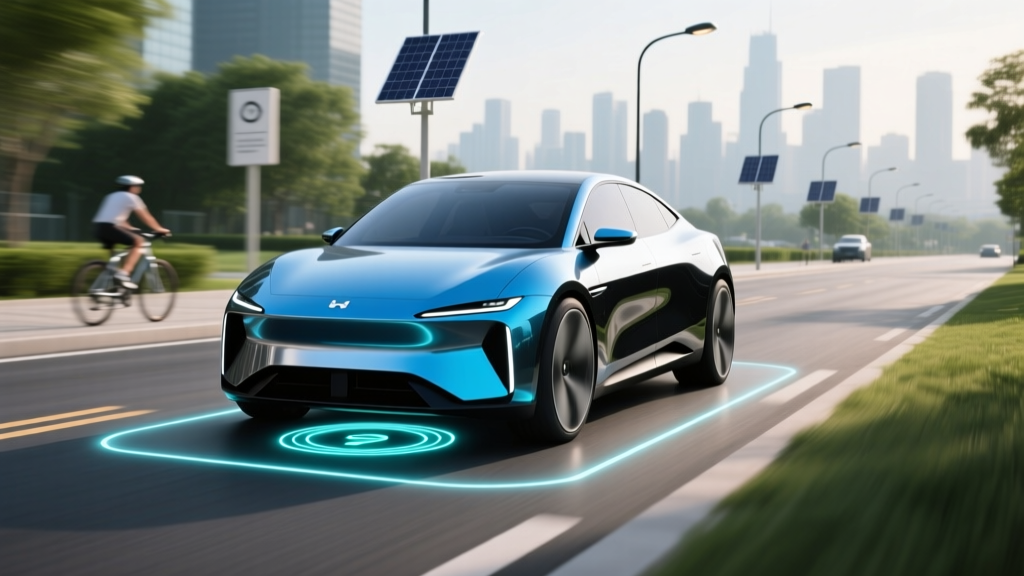
Charging roads embed transmitter coils beneath the pavement surface. A receiver coil mounted on the underside of an EV picks up electromagnetic energy via magnetic resonance coupling — the same principle used in wireless phone chargers, but scaled to deliver tens of kilowatts of power across a 6-to-10-inch air gap.
There are two categories:
- Static wireless charging: The vehicle parks over a pad (in a garage or parking spot) and charges without a cable. Companies like WiTricity and Plugless Power have demonstrated systems delivering 6.6–11 kW — comparable to a Level 2 home charger.
- Dynamic wireless charging (charging roads): Transmitter coils are embedded in long stretches of roadway, activating only when a compatible vehicle passes overhead. The goal is to extend range while driving, reduce the battery size needed, and eliminate range anxiety on highways.
The physics work. The challenge is infrastructure scale, vehicle compatibility, and cost.
Where Are Charging Roads Being Tested in 2026?
Several pilot projects have moved beyond the lab phase:
Indiana (I-70 / SR 144): Purdue University partnered with the Indiana Department of Transportation and German startup Magment to test a 1.2-mile segment of electrified roadway. Early testing demonstrated power transfer of up to 200 kW to a heavy-duty truck at highway speed — enough to sustain or slowly increase state of charge during cruising. The project expanded in 2025 to include passenger-vehicle testing.
Detroit, Michigan (Jefferson Avenue): A quarter-mile dynamic wireless charging segment installed by Electreon in 2023 was the first public-road deployment in the U.S. A Ford E-Transit van equipped with a receiver successfully drew approximately 20 kW while driving at 25–35 mph. The project demonstrated feasibility but also highlighted the modest power levels relative to DC fast charging.
Sweden (E20 corridor): Sweden's Transport Administration has tested multiple approaches including conductive rail and inductive coil systems. The eRoadArlanda project used a conductive rail that delivers up to 300 kW to modified trucks, though this approach requires a physical arm contact and is not wireless.
South Korea (OLEV system): KAIST's Online Electric Vehicle program in Gumi and later Seoul has operated dynamic wireless charging buses since 2013. The buses draw roughly 60–100 kW from roadway segments covering about 5–15% of their routes, using smaller 24 kWh batteries to keep vehicle weight down.
Charging Roads vs. Plugging In: Speed and Efficiency Compared
To put charging-road power levels in perspective, here's how conventional charging stacks up. This is what you actually need to know as an EV owner today:
| Charging Level | Voltage | Power (kW) | Miles of Range Added Per Hour | Typical Use Case |
|---|---|---|---|---|
| Level 1 (120V outlet) | 120V AC | 1.0–1.4 kW | 3–5 mi/hr | Overnight top-up, PHEVs |
| Level 2 (240V home/public) | 240V AC | 7.2–19.2 kW | 25–65 mi/hr | Home daily charging, workplaces |
| DC Fast Charging | 400–800V DC | 50–350 kW | 150–900+ mi/hr (peak) | Road trips, rapid top-ups |
| Dynamic Wireless (pilot) | N/A (inductive) | 20–200 kW | Varies by speed | Highway range extension |
A critical distinction: kW (kilowatts) measures power — how fast energy flows. kWh (kilowatt-hours) measures energy — the total amount stored in your battery. A 77 kWh battery charged at 11.5 kW (Level 2) takes roughly 6.7 hours from empty to full. A 350 kW DC fast charger can refill that same battery from 10–80% in approximately 18 minutes, though the charge curve tapers significantly above 80% state of charge to protect battery health.
Wireless charging introduces an efficiency penalty. Inductive transfer across an air gap typically operates at 85–93% efficiency, meaning 7–15% of the energy is lost as heat. A wired Level 2 charger operates at roughly 95–98% efficiency. On a per-kWh basis, wireless charging wastes slightly more electricity — a cost that matters at highway scale.
What This Means for Your Home Charging Setup
Charging roads are years away from wide deployment. Your daily EV charging will still happen at home, and getting that setup right is the single most impactful ownership decision you'll make.
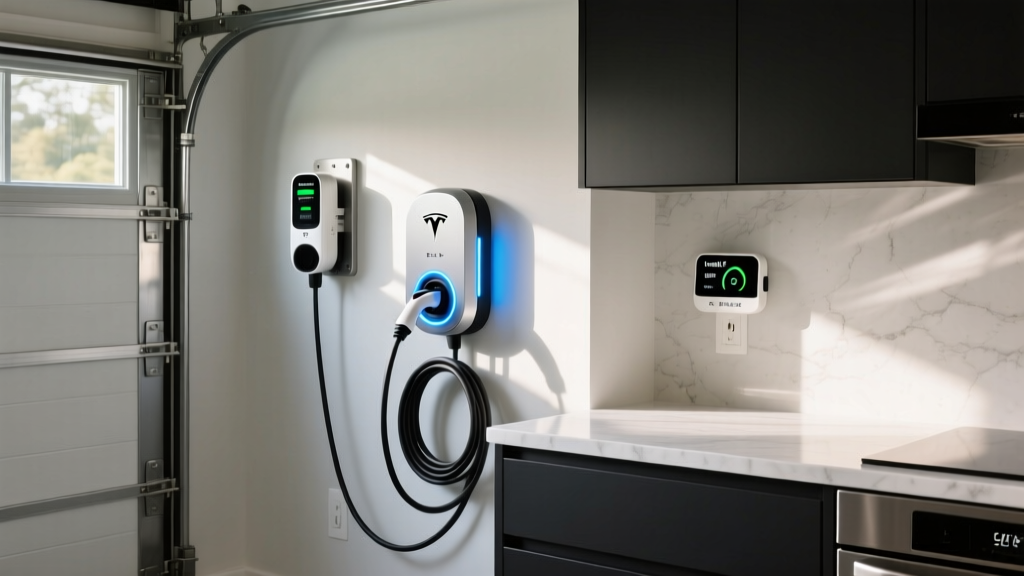
Electrical Requirements for a Level 2 Home Charger
A proper Level 2 installation requires a dedicated 240V circuit, typically rated at 40A or 50A. This delivers 9.6 kW or 12.0 kW respectively (though your charger will draw about 80% of the circuit's rated capacity per the National Electrical Code continuous-load rule — so a 50A circuit supports a 40A / 9.6 kW charger).
Key requirements:
- Dedicated circuit: Your charger must be on its own breaker — not shared with an dryer, HVAC, or other heavy appliance.
- GFCI protection: NEC 2020 and later require ground-fault circuit-interrupter protection for EV charging outlets.
- Outdoor rating: If your charger is installed outside (driveway, carport), the enclosure and receptacle must carry a NEMA 3R or NEMA 4 rating for weather resistance.
- Panel capacity: Your main electrical panel must have enough spare amperage to support the new circuit. A 200A panel with existing loads near capacity may need an upgrade to 400A — a significant cost factor in older homes.
How Much Does It Cost to Install a Home EV Charger?
Installation costs vary enormously depending on your home's electrical infrastructure. Here's a realistic breakdown:
| Cost Component | Simple Install (panel nearby) | Complex Install (panel upgrade needed) |
|---|---|---|
| Level 2 charger (hardware) | $400–$700 | $400–$700 |
| Electrician labor (240V circuit) | $500–$1,200 | $1,500–$3,000 |
| Permit and inspection | $100–$300 | $150–$500 |
| Panel upgrade (if needed) | N/A | $1,500–$4,000 |
| Conduit/wiring (long runs) | $100–$400 | $300–$800 |
| Total estimated cost | $1,100–$2,600 | $3,850–$9,000 |
The IRS Alternative Fuel Vehicle Refueling Property Credit (Form 8911) covers 30% of home charging equipment and installation costs, up to $1,000, for installations in eligible census tracts. Check your eligibility with a tax professional — the census-tract requirement eliminates many suburban and rural addresses.
Connector Compatibility: NACS, CCS, and CHAdeMO
When charging roads do arrive, vehicles will need dedicated receiver hardware. But for conventional charging, connector standards have largely consolidated around the North American Charging Standard (NACS), originally developed by Tesla and now adopted by Ford, GM, Rivian, Hyundai, Kia, BMW, and most other major automakers for 2025+ models.
| Connector | Used By | Max DC Fast Charge Rate | Adapter Needed? |
|---|---|---|---|
| NACS (Tesla/J3400) | Tesla (all), Ford, GM, Rivian, Hyundai, Kia, BMW, others (2025+) | Up to 350 kW (varies by vehicle) | CCS-to-NACS adapter for older CCS vehicles |
| CCS1 | Legacy VW ID.4, older BMW iX, Porsche Taycan (pre-2025), Stellantis | Up to 350 kW | NACS-to-CCS adapter for Tesla Superchargers |
| CHAdeMO | Nissan LEAF (legacy only — discontinued) | Up to 100 kW | Limited adapter options; network shrinking |
If you're buying a new EV in 2026, prioritize NACS-equipped models for the broadest access to Tesla Superchargers and the growing NACS public charging network. CCS1 vehicles can use adapters, but adapter reliability and charge-session handshake issues remain occasional frustrations.
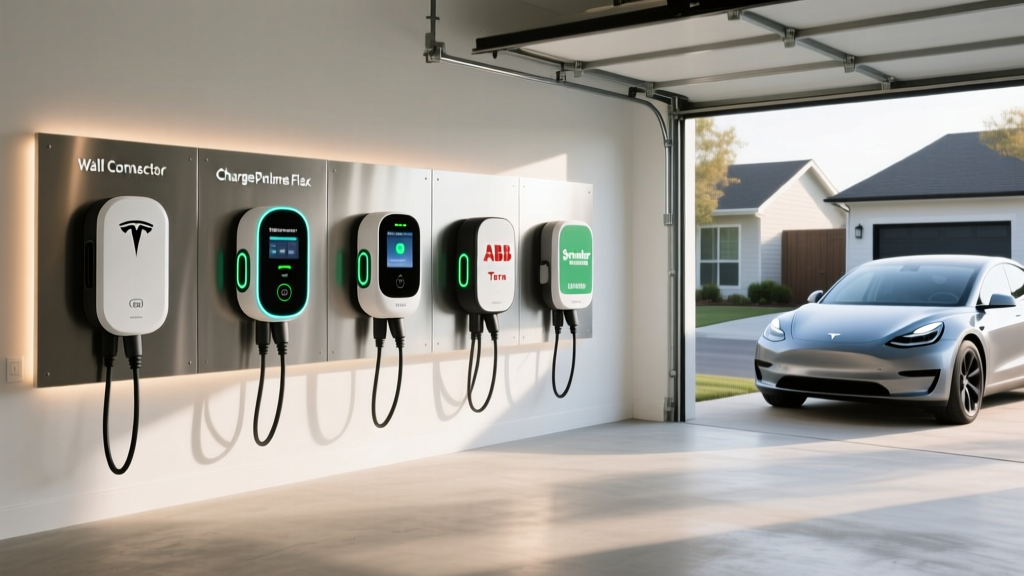
Level 2 Home Charger Recommendations
Based on power output, cable length, smart features, build quality, and real-world reliability, these are the chargers we recommend for home installation:
ChargePoint Home Flex
- Power: Up to 12.0 kW (50A circuit) — adjustable down to 16A for lower-capacity panels
- Connector: NACS (native); CCS adapter available
- Cable length: 23 feet
- Smart features: Wi-Fi, ChargePoint app scheduling, energy tracking, Alexa integration
- Price: ~$549
Tesla Wall Connector
- Power: Up to 11.5 kW (48A on a 60A circuit)
- Connector: NACS native; J1772 adapter included in box
- Cable length: 24 feet
- Smart features: Wi-Fi, over-the-air updates, power-sharing for multi-unit installs, Tesla app integration
- Price: ~$475
Emporia Level 2 EV Charger
- Power: Up to 11.5 kW (48A)
- Connector: J1772 (NACS adapter included with 2025+ models)
- Cable length: 24 feet
- Smart features: Wi-Fi, Emporia app, solar-integration scheduling, energy monitoring, TOU rate optimization
- Price: ~$399
Cost to Charge: Electricity vs. Gas Per Mile
One of the strongest arguments for EV ownership is fuel-cost savings — and it holds true regardless of whether charging roads ever materialize. Here's how costs break down across common charging scenarios:
| Scenario | Rate ($/kWh) | Cost to Add 200 Miles* | Cost Per Mile |
|---|---|---|---|
| Home charging (off-peak TOU) | $0.08–$0.14 | $5.60–$9.80 | $0.028–$0.049 |
| Home charging (flat rate, national avg) | $0.17 | $11.90 | $0.060 |
| Public Level 2 (ChargePoint, EVgo) | $0.25–$0.49 | $17.50–$34.30 | $0.088–$0.172 |
| DC fast charging (Electrify America, Tesla) | $0.30–$0.55 | $21.00–$38.50 | $0.105–$0.193 |
| Gas vehicle (28 MPG, $3.40/gal) | N/A | $24.29 | $0.121 |
*Based on 3.5 mi/kWh efficiency (typical for a mid-size EV SUV like the Hyundai Ioniq 5 or Tesla Model Y).
Home charging at off-peak rates delivers the lowest per-mile cost of any option — roughly one-quarter to one-half the cost of gasoline. Even public DC fast charging is often competitive with gas on a per-mile basis. The key variable is whether you can charge at home; apartment dwellers and street-parkers face higher costs relying on public infrastructure.
Charging Time Examples: 10–80% for Common Battery Sizes
Here's what charging actually looks like in real-world use for popular 2026 EV battery sizes:
| Battery Size (usable kWh) | Level 2 at 11.5 kW (0–100%) | DC Fast 10–80% (peak rate) | Example Vehicles |
|---|---|---|---|
| 58 kWh | ~5.0 hours | ~18 min at 175 kW | VW ID.4 Standard |
| 77 kWh | ~6.7 hours | ~18 min at 250 kW | Tesla Model Y LR, Ioniq 5 |
| 95 kWh | ~8.3 hours | ~20 min at 270 kW | Rivian R1T, BMW iX xDrive50 |
| 123 kWh | ~10.7 hours | ~25 min at 350 kW | GMC Hummer EV, Silverado EV |
Remember that the charge curve tapers above 80% SoC. The last 20% can take as long as the first 80% on DC fast charging. For battery longevity, most EVs default to an 80% daily charge limit, reserving 100% for road trips. LFP (lithium iron phosphate) batteries, found in base-model Teslas and some Ford models, can be charged to 100% daily without degradation concerns — but they charge more slowly on DC fast chargers due to lower peak C-rates.
So — Will Charging Roads Replace Your Home Charger?
Not anytime soon. Dynamic wireless charging is real technology demonstrated in controlled pilots, but widespread deployment faces enormous hurdles:
- Infrastructure cost: Embedding coils in roadways costs an estimated $1.5–$4 million per lane-mile — feasible for short highway corridors but prohibitive at national scale.
- Vehicle compatibility: No mass-market EV sold in the U.S. in 2026 includes a dynamic wireless receiver. Retrofitting is possible but adds weight, cost, and underbody complexity.
- Grid demand: Supplying hundreds of kilowatts to dozens of vehicles simultaneously on a highway segment requires substations and distribution upgrades that don't exist along most corridors.
- Maintenance: Road resurfacing, snow plowing, and heavy-truck wear all threaten embedded electronics in ways that don't affect overhead wires or stationary chargers.
The practical takeaway: invest in a solid Level 2 home charging setup now. It will serve you for the life of your current and next EV. If charging roads reach your commute corridor in the 2030s, that infrastructure will complement — not replace — the convenience of plugging in at home overnight.
Frequently Asked Questions
How much does it cost to install a home EV charger?
A straightforward Level 2 installation with an adequate electrical panel typically runs $1,100–$2,600 including the charger hardware, electrician labor, and permits. If your home needs a panel upgrade from 100A or 200A to 400A, total costs can reach $3,850–$9,000. Always get a site assessment from a licensed electrician before purchasing equipment.
How fast will each charging level add range?
Level 1 (120V) adds 3–5 miles per hour — adequate for PHEVs with small batteries but impractical for BEVs. Level 2 (240V, 40–50A) adds 25–65 miles per hour, fully recharging most EVs overnight. DC fast charging at 150–350 kW can add 100–250+ miles in 15–20 minutes, though the charge curve tapers above 80% SoC.
Which connector is compatible with my EV?
For 2025+ model-year vehicles, most new EVs now use NACS (the Tesla-derived J3400 standard). Older EVs from VW, Porsche, and Stellantis may still have CCS1. The Nissan LEAF (now discontinued) used CHAdeMO. Check your vehicle's charge port or the EPA's fueleconomy.gov listing for your specific model and year.
How much does EV charging cost per mile vs. gas?
Home charging at off-peak rates costs roughly $0.03–$0.05 per mile — about one-quarter to one-third the cost of gasoline at $3.40/gallon in a 28 MPG vehicle ($0.12/mile). Even public DC fast charging at $0.40/kWh works out to about $0.11–$0.14 per mile, competitive with or cheaper than gas.
What electrical upgrades might I need for a home charger?
The most common upgrade is a panel capacity increase. If your main panel is 100A or a heavily loaded 200A, adding a 40–50A dedicated circuit may exceed safe capacity, requiring an upgrade to 200A or 400A service. Other potential needs include running new conduit for long wire runs (garage far from the panel), upgrading the meter base, or adding a NEC-compliant GFCI breaker. Your electrician will assess this during a site visit.
Are wireless charging roads safe?
Pilot systems comply with electromagnetic field (EMF) exposure limits set by the International Commission on Non-Ionizing Radiation Protection. The magnetic fields are contained within inches of the road surface and are shielded by the vehicle's underbody. No public health concerns have been identified in peer-reviewed studies of existing deployments, though long-term large-scale exposure data does not yet exist.
Will my EV work with future charging roads?
No current production EV includes a dynamic wireless charging receiver. If charging roads scale, automakers would need to offer receiver-equipped models or aftermarket kits. This is likely a 2030s proposition at the earliest for consumer vehicles — commercial fleets on dedicated routes may adopt the technology sooner.