If you've been searching for wireless charging BMW solutions, you're not alone. The idea of parking over a pad and walking away — no cables, no connectors, no cold-weather fumbling — is one of the most compelling promises in EV ownership. BMW was an early mover in this space, offering an inductive charging option for the 530e iPerformance plug-in hybrid back in 2019. But where does the technology stand today, and how does it stack up against a conventional plug-in Level 2 home charger?
This guide covers the current state of wireless EV charging for BMW vehicles, walks through the fundamentals of Level 1, Level 2, and DC fast charging, and provides the exact numbers you need to plan a home charging setup — including electrical requirements, installation costs, connector compatibility, and per-mile cost comparisons against gasoline.
Where Wireless Charging for BMW Stands Today
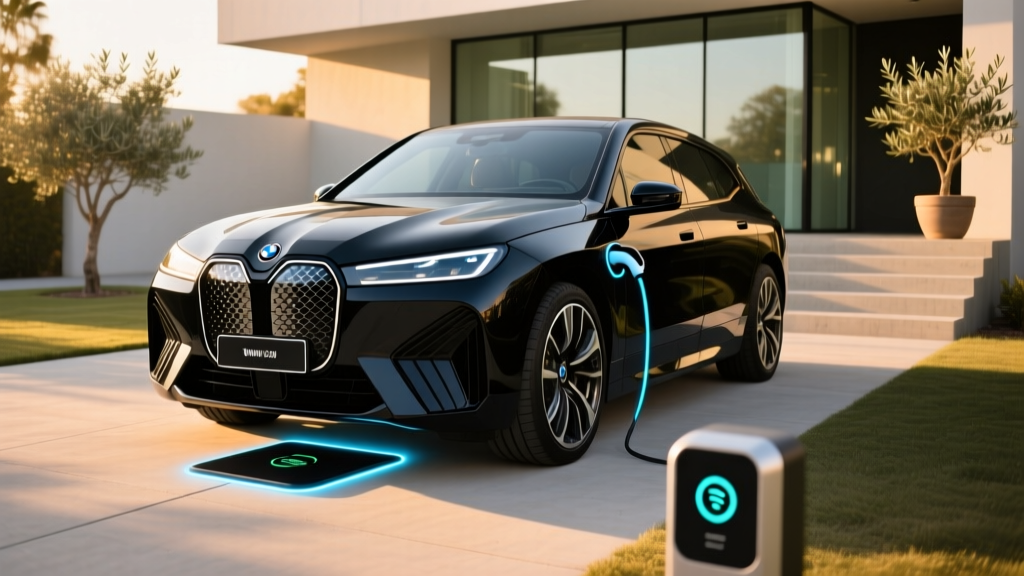
BMW's inductive charging system, developed with WiTricity, debuted as a $2,500 option on the 2019 BMW 530e. It delivered 3.2 kW of power — roughly equivalent to a low-end Level 2 charger — and required a ground-mounted or garage-floor induction pad paired with a vehicle-mounted receiver. The system worked, but with significant caveats: charging was slow (a full charge of the 530e's 12 kWh battery took roughly 3.5 hours), the pad required precise parking alignment within about an inch, and it was limited to a single PHEV model.
As of 2026, BMW does not offer a factory wireless charging option on its current BEV lineup (i4, i5, i7, iX, iX1, iX3). The technology has not been abandoned — the SAE J2954 standard for wireless EV charging was finalized, and companies like WiTricity, Plugless Power (Evatran), and others continue to develop higher-power systems. However, no major automaker currently sells a wireless charging package for a battery-electric vehicle in the US market.
What this means for BMW owners: If you want wireless charging today, your options are limited to aftermarket solutions (where available) or waiting for future model-year integration. For practical, fast, and reliable home charging, a plug-in Level 2 charger remains the standard — and the economics strongly favor it.
Charging Levels Explained: Speed, Power, and Real-World Range Added
Before comparing wireless to wired, it's essential to understand the three charging levels available to EV owners. The critical distinction: kW (kilowatts) measures power — the rate at which energy flows. kWh (kilowatt-hours) measures energy — the total amount stored in your battery. A 100 kWh battery charged at 10 kW would take 10 hours from empty to full (ignoring losses and taper).
| Level | Voltage | Power (kW) | Miles of Range Added per Hour | Typical Use Case |
|---|---|---|---|---|
| Level 1 | 120V AC | 1.0–1.4 kW | 3–5 mi/hr | Overnight trickle; PHEVs, low-mileage drivers |
| Level 2 (Home/Public) | 240V AC | 3.3–19.2 kW | 12–75 mi/hr | Daily home charging; workplace; destination |
| DC Fast Charging | 400–800V DC | 50–350 kW | 150–1,200+ mi/hr (peak) | Road trips; rapid top-ups at highway stations |
BMW's original wireless system at 3.2 kW sits at the low end of Level 2. For comparison, a modern BMW i4 eDrive40 with its 81.5 kWh (usable) battery would take roughly 25 hours from 0–100% on a 3.2 kW wireless pad — making it impractical for BEV use, though adequate for a PHEV with a smaller battery.
Home Level 2 Charger Installation: Electrical Requirements and Cost Breakdown
Since wireless charging for BMW BEVs isn't currently a factory option, most BMW EV owners will install a plug-in Level 2 home charger. Here's what that involves electrically and financially.
Electrical Requirements
A typical home Level 2 charger requires a 240-volt dedicated circuit. The most common configurations:
- 40-amp circuit / 32-amp continuous draw: Delivers up to 7.7 kW. This is the most popular residential setup and sufficient for most daily charging needs. Requires a NEMA 14-50 outlet or hardwired connection.
- 50-amp circuit / 40-amp continuous: Delivers up to 9.6 kW. Requires a NEMA 14-50 or 6-50 outlet, or hardwiring. Ideal for larger batteries like the iX's 105.2 kWh (usable) pack.
- 60-amp circuit / 48-amp continuous: Delivers up to 11.5 kW. Hardwired only. Requires a 60A breaker and 6 AWG copper wire. Not all homes can support this without a panel upgrade.
- 80-amp circuit / 64-amp continuous: Delivers up to 15.2–19.2 kW depending on the charger. Hardwired only. Requires 4 AWG copper and a panel with sufficient capacity. Most beneficial for vehicles that accept high AC charge rates, though most BMW BEVs cap AC charging at 11 kW (the iX accepts up to 11 kW on single-phase).
Panel upgrade reality: Many older homes have 100-amp or 125-amp main service panels. Adding a 40A or 50A EV circuit may push total calculated load beyond 80% of panel capacity (the NEC continuous-load rule), requiring a panel upgrade to 200 amps. This is a significant cost factor that many online guides gloss over.
Installation Cost Breakdown
| Component | Low-End (Simple Install) | High-End (Complex Install) |
|---|---|---|
| Level 2 Charger (Equipment) | $350 (basic 32A unit) | $750 (smart 48A Wi-Fi unit) |
| Electrician Labor (2–6 hours) | $300 | $1,200 |
| Electrical Materials (wire, conduit, breaker) | $100 | $500 |
| Permit and Inspection | $50 | $300 |
| Panel Upgrade (if needed) | $0 (not required) | $2,000–$4,000 |
| Total (Without Panel Upgrade) | $800 | $2,750 |
| Total (With Panel Upgrade) | $2,800 | $6,750 |
Factors driving cost toward the high end: long wire runs from panel to garage (over 50 feet), conduit requirements, attic or crawlspace routing, sub-panel installation, and local permit fees. According to data compiled by the U.S. Department of Energy, the national average for a standard Level 2 installation (without panel upgrade) falls between $1,000 and $2,500.
Federal incentive note: The Alternative Fuel Vehicle Refueling Property Credit (§30C) was extended and modified under recent legislation. As of 2026, check current IRS guidance for eligibility on home charging equipment — credit amounts, income caps, and geographic restrictions (census-tract based) apply. Always consult a tax professional for your specific situation.
Connector Compatibility: NACS, CCS, and What BMW Uses
The connector landscape has shifted dramatically. Here's what BMW EV owners need to know for 2026 model-year vehicles:
| Model | AC Charging Connector | DC Fast Charging Connector | Tesla Supercharger Access |
|---|---|---|---|
| BMW i4 (2026) | J1772 (NACS adapter available) | CCS1 | Via BMW-provided NACS adapter (DC) |
| BMW i5 (2026) | J1772 | CCS1 | Via adapter |
| BMW i7 (2026) | J1772 | CCS1 | Via adapter |
| BMW iX (2026) | J1772 | CCS1 | Via adapter |
Key takeaway: BMW continues to use CCS1 for DC fast charging on its 2026 models, though the industry-wide shift toward NACS (the Tesla connector, now SAE J3400) means adapters are essential for Supercharger access. For home Level 2 charging, any J1772-compatible charger will work with all BMW EVs. If you purchase a charger with a NACS (Tesla-style) connector, you'll need a J1772-to-NACS adapter — or choose a charger that ships with J1772.
CHAdeMO is effectively discontinued in the US market and is not relevant for BMW vehicles.
Level 2 Charger Equipment Recommendations for BMW EVs
Based on power output, reliability, cable management, and smart features, here are top picks for BMW i4, i5, i7, and iX owners in 2026:
ChargePoint Home Flex
- Power: Up to 12 kW (50A circuit, 48A continuous) — configurable down to 16A
- Connector: J1772 (standard)
- Cable Length: 23 feet
- Smart Features: Wi-Fi, app scheduling, Alexa integration, energy tracking
- Price: ~$599
- Best For: Flexible amperage for older panels; excellent app ecosystem
Emporia Vue Level 2 Charger
- Power: Up to 11.5 kW (60A circuit, 48A continuous)
- Connector: J1772
- Cable Length: 24 feet
- Smart Features: Wi-Fi, energy monitoring (pairs with Emporia Vue panel monitor), solar integration
- Price: ~$399
- Best For: Budget-conscious buyers who want energy monitoring and solar awareness
Wallbox Pulsar Plus
- Power: Up to 11.5 kW (48A)
- Connector: J1772
- Cable Length: 25 feet
- Smart Features: Wi-Fi + Bluetooth, load balancing, Power Sharing (daisy-chain two units on one circuit)
- Price: ~$549
- Best For: Two-EV households (Power Sharing avoids panel upgrade)
Note for BMW iX owners: The iX accepts up to 11 kW AC charging. Any of the chargers above at 48A will max out the iX's onboard charger. Running a 48A-capable charger on a 60A circuit is the optimal pairing.
Charging Time Examples: How Long to Charge a BMW EV at Home
Real-world charging times depend on battery size, state of charge, and charger power. Here's what to expect for popular BMW BEV models on a typical 40A circuit (32A continuous, ~7.7 kW):
- BMW i4 eDrive40 (81.5 kWh usable): 10–80% in approximately 7.5 hours. A full overnight session easily replenishes a day's driving.
- BMW i5 eDrive40 (81.2 kWh usable): 10–80% in approximately 7.5 hours. Similar to the i4 due to comparable battery size.
- BMW iX xDrive50 (105.2 kWh usable): 10–80% in approximately 9.5 hours on 7.7 kW. On an 11 kW charger, this drops to ~6.5 hours.
- BMW i7 xDrive60 (101.7 kWh usable): 10–80% in approximately 9.2 hours on 7.7 kW.
Wireless charging comparison: At BMW's original 3.2 kW wireless rate, that same i4 would take roughly 17 hours for a 10–80% charge — making it impractical for a BEV that needs daily replenishment. This is why plug-in Level 2 remains the standard.
Cost to Charge: Per-Mile Comparison vs. Gasoline
One of the strongest arguments for home charging is economics. Here's how BMW EV charging costs compare to fueling an equivalent gasoline BMW:
| Scenario | Cost per kWh | Vehicle Efficiency | Cost per Mile |
|---|---|---|---|
| Home Charging (off-peak, national avg) | $0.13/kWh | 3.0 mi/kWh (i4 avg) | $0.043/mi |
| Home Charging (peak rate, high-cost state) | $0.28/kWh | 3.0 mi/kWh | $0.093/mi |
| Public Level 2 (ChargePoint, avg) | $0.25/kWh | 3.0 mi/kWh | $0.083/mi |
| DC Fast Charging (Electrify America, avg) | $0.48/kWh | 3.0 mi/kWh | $0.160/mi |
| Gasoline BMW 330i (28 MPG combined, $3.50/gal) | — | 28 MPG | $0.125/mi |
| Gasoline BMW X5 xDrive40i (22 MPG, $3.50/gal) | — | 22 MPG | $0.159/mi |
The bottom line: Home off-peak charging at $0.043/mile is roughly one-third the per-mile fuel cost of a comparable gasoline BMW. Even peak-rate home charging undercuts gasoline. DC fast charging on the road approaches gasoline costs — which is why home Level 2 is the economic sweet spot.
According to fueleconomy.gov, the BMW i4 eDrive40 achieves an EPA-estimated 109 MPGe combined, translating to roughly 31 kWh per 100 miles. Your actual efficiency will vary with driving style, temperature, and terrain — expect 10–20% range reduction in sustained cold weather (below 32°F) due to battery resistance and cabin heating demands.
Safety, Code, and Installation Best Practices
Home EV charging involves high-voltage, high-amperage circuits running for hours at a time. Safety and code compliance are non-negotiable:
- Dedicated circuit required: Your EV charger must be on its own dedicated breaker — never shared with other appliances. The NEC requires that continuous loads (defined as running 3+ hours) use no more than 80% of the breaker's rated capacity. A 40A breaker supports 32A continuous; a 50A breaker supports 40A continuous.
- GFCI protection: The 2020 NEC (and most 2023/2026 adoptions) requires GFCI protection for outdoor receptacles used for EV charging. Hardwired chargers may have different requirements — your electrician will determine this based on local code adoption.
- Outdoor rating: If your charger is mounted outdoors (carport, driveway), it must carry a NEMA 4 or NEMA 4X rating for weather resistance. All three chargers recommended above are outdoor-rated.
- Permit and inspection: Most jurisdictions require an electrical permit for a new 240V circuit. The inspection ensures proper wire gauge, breaker sizing, grounding, and GFCI compliance. Do not skip this — it protects your home and is required for insurance coverage of electrical fires.
- Load calculation: A licensed electrician will perform a NEC Article 220 load calculation to verify your panel can handle the new circuit. If your calculated load exceeds 80% of panel capacity with the EV charger added, a panel upgrade is mandatory — not optional.
Avoid: Using extension cords, adapter chains, or portable generators for EV charging. Always hire a licensed electrician — EV charging circuits carry enough current to cause serious fire or shock hazards if improperly installed.
Will Wireless Charging for BMW Ever Be Practical?
The SAE J2954 standard supports up to 11 kW for light-duty vehicles, and demonstrations by WiTricity and others have shown 90–93% efficiency at these power levels — approaching the 94–96% efficiency of a good plug-in Level 2 charger. The barriers are no longer technical but commercial:
- Cost: Wireless pad systems currently cost $2,000–$4,000+ (equipment alone), versus $350–$750 for a plug-in Level 2 unit.
- Installation complexity: The ground pad must be precisely positioned, often embedded in or bolted to a concrete floor, with its own 240V supply.
- Vehicle integration: The car needs a factory-installed receiver coil. Without OEM support, aftermarket retrofit is impractical for most vehicles.
- Power ceiling: Current wireless systems top out around 11 kW. As DC fast charging pushes toward 350 kW, wireless cannot compete for road-trip use — it will remain a home/garage convenience technology.
For BMW owners today, the practical path is clear: install a quality plug-in Level 2 charger, take advantage of off-peak electricity rates, and enjoy per-mile costs that gasoline cannot match. If wireless charging becomes a factory option on future BMW i-models, it will complement — not replace — the plug-in infrastructure you've already built.
Frequently Asked Questions
How much does it cost to install a home EV charger for my BMW?
Without a panel upgrade, expect $800–$2,750 total (equipment, electrician labor, materials, and permit). If your home needs a 200-amp panel upgrade, add $2,000–$4,000, bringing the total to $2,800–$6,750. Get 2–3 quotes from licensed electricians — costs vary significantly by region and wire-run length.
How fast will each charging level add range to my BMW EV?
Level 1 (120V): 3–5 miles per hour. Level 2 at 7.7 kW (40A circuit): approximately 23 miles per hour for a BMW i4. Level 2 at 11 kW: approximately 33 miles per hour. DC fast charging at 200 kW peak: up to 400+ miles per hour at peak, though the charge curve tapers significantly above 80% state of charge.
Which connector and charger is compatible with my BMW EV?
All 2026 BMW EVs use J1772 for AC (Level 1 and Level 2) charging and CCS1 for DC fast charging. Any J1772-equipped Level 2 home charger will work. For Tesla Supercharger access, BMW offers a NACS adapter. CHAdeMO is not supported on any BMW vehicle.
How much does charging cost per mile vs. gasoline?
Home off-peak charging averages $0.04–$0.05 per mile for a BMW i4 — roughly one-third the cost of fueling a gasoline BMW 330i at $0.125/mile. Even public DC fast charging at $0.16/mile is comparable to gasoline. The savings are greatest when you can charge at home on time-of-use rates during off-peak hours.
What electrical upgrades might I need for a home Level 2 charger?
The most common upgrade is a panel replacement from 100A or 125A to 200A service ($2,000–$4,000). You may also need a new 240V circuit with appropriate wire gauge (6 AWG for 50A, 4 AWG for 60A), conduit if wiring runs outdoors or through unfinished spaces, and a GFCI breaker if required by local code. A licensed electrician's load calculation will determine exactly what's needed.
Can I use wireless charging with my 2026 BMW i4, i5, or iX?
No. BMW does not currently offer a factory wireless (inductive) charging option on any 2026 battery-electric model. The technology was available on the 2019 530e PHEV at 3.2 kW but has not been extended to the current BEV lineup. A plug-in Level 2 home charger is the standard and far faster solution.