Plug-free charging sounds like the ultimate EV convenience: pull into your garage, park over a pad, and let the electrons flow without ever touching a cable. Wireless charger electric car technology has moved from concept to real-world product, with companies like WiTricity, Plugless Power (Evatran), and Plugless delivering SAE J2954-compliant induction systems for select vehicles. But before you rip out your Level 2 wall connector, you need to understand the trade-offs — lower power delivery, efficiency losses of 7-12%, and installation costs that can exceed $4,000.
This guide covers where wireless EV charging stands today, how it compares to traditional plug-in Level 2 and DC fast charging, what your electrical panel needs to support, and whether the convenience premium is justified for your situation.
How Wireless EV Charging Actually Works
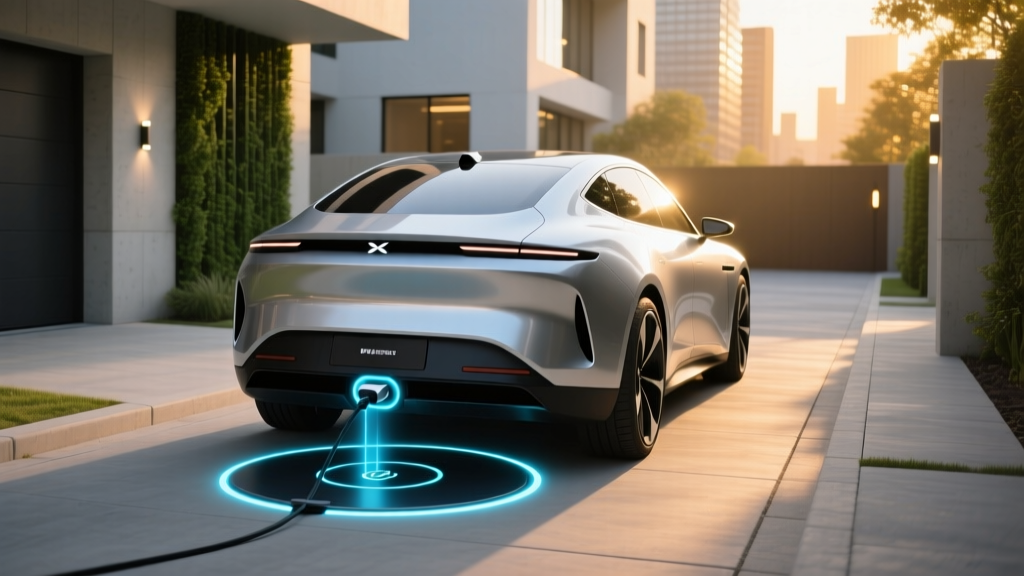
Wireless electric car charging uses magnetic induction — the same principle behind your smartphone's Qi charger, scaled up to deliver kilowatts of power. A transmitter pad installed on your garage floor (or driveway) creates an alternating magnetic field. A receiver pad mounted to the underside of your EV converts that field back into electricity, which feeds the vehicle's onboard charger and then the battery.
The SAE J2954 standard, finalized and updated through 2024, defines power classes and alignment tolerances for light-duty wireless EV charging. Current commercial systems operate at:
- SAE J2954 W/ZC3 class: 3.6 kW to 11 kW power transfer
- Typical efficiency: 88-93% (compared to 95-98% for a hardwired Level 2 plug-in charger)
- Ground clearance tolerance: 100-250mm gap between pads, with lateral alignment tolerance of ±75-150mm depending on the system
The efficiency gap matters. If you're transferring 7.2 kW wirelessly at 90% efficiency, you're drawing roughly 8.0 kW from your panel but only putting 7.2 kW into the battery. Over a year of daily charging, that 8-10% loss translates to roughly $40-$80 in wasted electricity for the average driver — not catastrophic, but not free either.
Charging Levels Explained: Where Wireless Fits In
To understand where wireless charging sits in the EV ecosystem, here's how all charging levels compare in real-world speed:
| Level | Voltage | Max Power (kW) | Miles of Range Added/Hour | Typical Use |
|---|---|---|---|---|
| Level 1 (120V) | 120V AC | 1.4-1.9 kW | 3-5 mi/hr | Emergency / overnight trickle |
| Level 2 (240V plug-in) | 240V AC | 7.2-11.5 kW | 20-44 mi/hr | Home daily charging |
| Level 2 (240V wireless) | 240V AC | 3.6-11 kW | 12-38 mi/hr | Home, no-plug convenience |
| DC Fast Charging | 200-900V DC | 50-350 kW | 150-1,000+ mi/hr | Road trips, rapid top-ups |
A wireless Level 2 system delivering 7.2 kW will add roughly 24-28 miles of range per hour to a midsize EV like the Tesla Model Y or Hyundai Ioniq 5. That's comparable to a plug-in Level 2 charger running at the same power — but the wireless system's efficiency losses mean it draws more from your electrical panel to achieve it.
For context, a 75 kWh battery (like the Ford Mustang Mach-E Extended Range) charging from 10% to 80% on a 7.2 kW wireless system takes approximately 8.5-9.5 hours, accounting for efficiency losses and the charge-curve taper above 80%. The same session on a hardwired 11.5 kW plug-in charger completes in roughly 5.5-6 hours.
Home Installation: Electrical Requirements and Costs
Installing a wireless EV charger at home is more involved than mounting a plug-in wall connector. You're dealing with two physical components — a ground pad (transmitter) and a vehicle-mounted receiver — plus the electrical infrastructure to support them.
Electrical Requirements
Most residential wireless charging systems delivering 7.2-11 kW require:
- Circuit: Dedicated 240V circuit, 40A to 60A depending on system power
- Wire gauge: 6 AWG copper for 40A; 4 AWG for 50-60A runs
- Breaker: Double-pole, appropriately sized (125% of continuous load per NEC Article 625)
- Disconnect: Some jurisdictions require a visible disconnect switch within sight of the pad
The control electronics box (which converts grid AC to the high-frequency AC needed for the transmitter pad) typically mounts on a garage wall and connects to both your electrical panel and the ground pad via buried conduit.
Panel Upgrade Considerations
This is where costs can escalate. If your home has a 100A electrical panel — common in houses built before 1990 — adding a 40-60A dedicated EV circuit may exceed your panel's capacity, especially if you're also running central AC, an electric dryer, and an electric oven simultaneously.
A licensed electrician will perform a NEC Article 220 load calculation to determine whether your existing panel can handle the additional load. If not, you're looking at a panel upgrade to 200A service, which typically costs $1,500-$3,500 before any EV charger work begins.
Installation Cost Breakdown
| Component | Cost Range | Notes |
|---|---|---|
| Wireless charging system (ground pad + control unit) | $2,500-$4,500 | Vehicle receiver pad sold separately or included depending on OEM partnership |
| Vehicle receiver pad (if not OEM-installed) | $1,500-$3,000 | Aftermarket retrofit; requires underbody mounting |
| Electrical work (240V circuit, conduit, breaker) | $800-$2,500 | Varies with run distance from panel to pad location |
| Permit and inspection | $100-$400 | Required in most jurisdictions for new 240V circuits |
| Panel upgrade (if needed) | $1,500-$3,500 | Only if existing panel lacks capacity |
| Concrete cutting/repair (for embedded pad) | $300-$800 | Optional; some pads are surface-mounted |
| Total (no panel upgrade) | $3,500-$7,200 | Typical range for most installations |
| Total (with panel upgrade) | $5,000-$10,700 | Older homes with 100A service |
Compare this to a plug-in Level 2 home charger: a quality wall connector like the ChargePoint Home Flex or Tesla Wall Connector costs $500-$750, with installation running $500-$2,000 for a total of $1,000-$2,750 in most cases. The wireless premium is substantial.
Wireless vs. Plug-In Level 2: Equipment Comparison
If you're evaluating whether to go wireless or stick with a traditional plug-in Level 2 charger, here's how the leading options stack up:
Wireless: WiTricity HALO (7.2 kW)
- Power output: 7.2 kW (W/ZC3 class)
- Efficiency: ~90-92%
- Connector: None (induction pad)
- Vehicle compatibility: Requires OEM or aftermarket receiver pad; partnerships with select automakers
- Smart features: App monitoring, automatic start on parking alignment
- Ground pad dimensions: ~24" x 36"
- System price: ~$3,500-$4,500 (ground pad + controller)
- Cable length: N/A (pad-to-controller conduit, typically 15-25 ft)
Plug-In: ChargePoint Home Flex (up to 11.5 kW)
- Power output: Up to 11.5 kW (48A) on 60A circuit; configurable down to 16A
- Efficiency: ~96-98%
- Connector: J1772 (NACS adapter available for Tesla vehicles)
- Vehicle compatibility: All EVs with J1772 inlet; Tesla via adapter
- Smart features: Wi-Fi, app scheduling, Alexa, load sharing
- Unit dimensions: 11.5" x 7.5" x 5.5"
- Equipment price: ~$550-$699
- Cable length: 23 ft (standard)
Plug-In: Tesla Wall Connector (11.5 kW)
- Power output: Up to 11.5 kW (48A)
- Efficiency: ~97-98%
- Connector: NACS (native Tesla); J1772 adapter included for non-Tesla EVs
- Vehicle compatibility: Tesla vehicles natively; all others via included adapter
- Smart features: Wi-Fi, OTA updates, Power Sharing with multiple units
- Equipment price: ~$425-$475
- Cable length: 24 ft
Plug-In: Emporia Vue Level 2 (11.5 kW)
- Power output: Up to 11.5 kW (48A)
- Efficiency: ~96-97%
- Connector: J1772 (NACS adapter available)
- Vehicle compatibility: All J1772-equipped EVs; Tesla via adapter
- Smart features: Energy monitoring, solar integration, load management with Emporia panel sensors
- Equipment price: ~$450-$599
- Cable length: 24 ft
Connector Compatibility: What Plugs Into What
Wireless charging sidesteps the connector question entirely — there's no physical plug. But if you're comparing wireless to plug-in options, or if you want a backup plug-in charger alongside a wireless pad, here's the connector landscape for 2026:
| Connector | Used By | Notes |
|---|---|---|
| NACS (North American Charging Standard) | Tesla (native); Ford, GM, Rivian, Hyundai, Kia, Volvo, and most major brands as of 2025+ | Now the dominant standard; compact, no locking pin required |
| J1772 (Type 1) | Older Nissan Leaf, Mitsubishi Outlander PHEV, pre-2025 models from several brands | Being phased out in favor of NACS; adapters widely available |
| CCS1 (Combined Charging System) | Legacy DC fast charging on pre-NACS vehicles; some public stations | Still available at many public DC fast stations; adapters to NACS exist |
| CHAdeMO | Nissan Leaf (older), Mitsubishi Outlander PHEV | Declining availability; largely superseded by CCS1 and NACS |
| Wireless (SAE J2954) | Select vehicles with OEM or aftermarket receiver pads | No physical connector; requires matching transmitter/receiver pair |
If you drive a 2025+ Ford, GM, Rivian, Hyundai, or Kia EV, your vehicle uses NACS natively. A J1772-to-NACS adapter (typically $100-$200) lets you use older J1772 public chargers. For wireless charging, the vehicle must have a compatible receiver pad — either factory-installed (limited OEM offerings) or retrofitted by an authorized installer.
Cost to Charge: Wireless vs. Plug-In vs. Gas
Electricity costs vary by region, time of day, and charging location. Here's a realistic breakdown using national averages for 2026:
| Scenario | Avg. $/kWh | Cost Per Mile (3.5 mi/kWh EV) | Notes |
|---|---|---|---|
| Home, off-peak (wireless, 90% efficiency) | $0.12-$0.15 (effective $0.13-$0.17 after loss) | $0.037-$0.049 | Time-of-use rates; efficiency loss adds ~10% to grid cost |
| Home, off-peak (plug-in L2, 97% efficiency) | $0.12-$0.15 (effective $0.12-$0.15) | $0.034-$0.043 | Minimal efficiency loss |
| Public Level 2 (ChargePoint, EVgo) | $0.25-$0.45 | $0.071-$0.129 | Varies widely by network and location |
| DC Fast Charging (Electrify America, Tesla Supercharger) | $0.30-$0.55 | $0.086-$0.157 | Peak rates in urban areas can exceed $0.60/kWh |
| Gasoline (25 MPG combined, $3.40/gal) | N/A | $0.136 | Baseline ICE comparison |
For a driver covering 12,000 miles per year, home wireless charging at off-peak rates costs roughly $444-$588 annually. The same mileage on a plug-in Level 2 charger costs $408-$516. The wireless efficiency penalty adds approximately $36-$72 per year — meaningful but not prohibitive for most budgets.
Compared to gasoline at 25 MPG combined, even wireless home charging saves $1,188-$1,460 per year. The EV economic advantage holds regardless of charging method, as long as you're primarily charging at home.
Charging Time Examples for Common EV Battery Sizes
How long does a wireless charger actually take to replenish common EV batteries? These estimates assume a 7.2 kW wireless system at 90% efficiency, charging from 10% to 80% state of charge:
- Tesla Model Y Long Range (75 kWh usable): ~8.5-9 hours (10-80%). Sufficient for overnight charging if you arrive home by 10 PM and leave by 7 AM.
- Hyundai Ioniq 5 (77.4 kWh usable): ~9-9.5 hours (10-80%). Tight for overnight if you need a full charge; 80% SoC target is recommended for battery longevity anyway.
- Ford F-150 Lightning Extended Range (131 kWh usable): ~15-16 hours (10-80%). Wireless charging at 7.2 kW is impractical for this battery size unless you drive less than 50 miles daily and only need a partial replenishment.
- Chevrolet Equinox EV (85 kWh usable): ~10-11 hours (10-80%). Workable for overnight with a standard sleep schedule.
- BMW i4 eDrive40 (81.5 kWh usable): ~9.5-10 hours (10-80%). Similar to the Ioniq 5.
Note that these times assume the charger sustains its rated output. In practice, ambient temperature, battery thermal state, and the vehicle's onboard charge management can extend sessions by 5-15%. In cold weather (below 32°F), a cold-soaked battery may accept power more slowly until it warms, adding 20-40 minutes to the session.
Safety, Code, and Practical Considerations
Wireless EV charging systems must comply with NEC Article 625 (Electric Vehicle Charging System Equipment) and local electrical codes. Key safety considerations include:
- Dedicated circuit: The wireless charger control unit requires its own dedicated 240V circuit — it cannot share with other appliances.
- GFCI protection: NEC 2023 and later require GFCI protection for all EV charging circuits, including wireless systems. Your electrician should install a GFCI breaker or ensure the control unit includes integrated ground-fault protection.
- Outdoor rating: If the ground pad is installed outdoors (driveway rather than garage), it must carry an appropriate IP rating (IP67 or higher for submersion and weather resistance). Most commercial pads meet this standard, but verify with the manufacturer.
- Foreign object detection (FOD): SAE J2954 requires systems to detect metallic objects between the pads that could overheat. Quality systems include FOD and living object protection (LOP) to shut down if a pet or child is detected near the active pad.
- EMF exposure: Independent testing has shown that SAE J2954-compliant systems produce electromagnetic fields well within ICNIRP guidelines at typical standing distances. The field strength drops rapidly beyond the pad perimeter.
- Permit and inspection: Most jurisdictions require an electrical permit for any new 240V circuit. The inspection ensures proper wire gauge, breaker sizing, grounding, and GFCI compliance. Budget $100-$400 and 1-3 weeks for this process.
One practical note: if you plan to sell your home, a wireless charging pad embedded in the garage floor may not appeal to all buyers, especially if their EV doesn't have a compatible receiver. A plug-in Level 2 wall connector is universally compatible and easily removable.
Who Should Consider a Wireless Charger for Their Electric Car?
Wireless EV charging isn't for everyone — but it fills a genuine niche. Here's a decision framework:
Choose wireless charging if:
- You have a dedicated garage parking spot with consistent alignment
- Your daily driving is under 60 miles (so 7.2 kW overnight is sufficient)
- Physical plug-in is difficult (mobility limitations, tight garage geometry)
- You value automation — the system starts charging the moment you park
- Your EV has an OEM-compatible receiver pad available
- Budget allows $4,000-$7,000+ for the complete system and installation
Choose plug-in Level 2 instead if:
- You need maximum charging speed (11.5 kW vs. wireless 7.2 kW)
- You drive a large-battery EV (F-150 Lightning, Rivian R1T) and need faster overnight replenishment
- Budget is a primary concern ($1,000-$2,750 total for plug-in vs. $4,000-$10,000+ for wireless)
- Your EV doesn't have a compatible wireless receiver pad
- You want universal compatibility for future vehicle purchases
- You charge outdoors in a driveway where pad alignment is less reliable
Frequently Asked Questions
How much does it cost to install a wireless home EV charger?
Expect $3,500-$7,200 for a complete wireless charging system and installation if your electrical panel has sufficient capacity. If you need a panel upgrade from 100A to 200A service, add $1,500-$3,500, bringing the total to $5,000-$10,700. This compares to $1,000-$2,750 for a plug-in Level 2 charger installation.
How fast will each charging level add range to my EV?
Level 1 (120V) adds 3-5 miles of range per hour. Plug-in Level 2 (240V) adds 20-44 miles per hour depending on amperage (7.2-11.5 kW). Wireless Level 2 adds 12-38 miles per hour depending on system power (3.6-11 kW). DC fast charging adds 150-1,000+ miles per hour at 50-350 kW. For daily driving under 60 miles, even wireless Level 2 is sufficient overnight.
Which connector or charger is compatible with my EV?
For plug-in charging: if your EV is a 2025+ model from Tesla, Ford, GM, Rivian, Hyundai, Kia, or most major brands, it uses NACS. Older EVs may use J1772 or CHAdeMO; adapters are available. For wireless charging, your vehicle must have a compatible SAE J2954 receiver pad — either factory-installed (limited availability) or retrofitted by an authorized installer. Check with your automaker or the wireless charging system manufacturer (e.g., WiTricity) for vehicle compatibility lists.
How much does EV charging cost per mile compared to gas?
Home Level 2 charging (plug-in) costs $0.034-$0.043 per mile at off-peak electricity rates. Wireless home charging adds roughly 10% due to efficiency losses: $0.037-$0.049 per mile. Gasoline at 25 MPG combined and $3.40/gallon costs $0.136 per mile. Even at public DC fast charging rates ($0.086-$0.157/mi), EVs are competitive with or cheaper than gasoline.
What electrical upgrades might I need for a wireless EV charger?
A wireless system drawing 7.2-11 kW needs a dedicated 40-60A, 240V circuit. If your home has a 100A electrical panel (common in pre-1990 construction), you may need a panel upgrade to 200A ($1,500-$3,500). A licensed electrician will perform a NEC Article 220 load calculation to determine your panel's capacity. You'll also need an electrical permit ($100-$400) and inspection in most jurisdictions.
Can I install a wireless EV charger in an outdoor driveway?
Yes, provided the ground pad carries an outdoor-rated IP67 (or higher) enclosure rating and is properly sealed against water, snow, and debris. Most commercial wireless pads meet this standard. However, outdoor installation may require concrete cutting and embedding the pad flush with the driveway surface ($300-$800 additional), and alignment can be less consistent than in a fixed garage parking spot.
Does the §30D federal tax credit apply to wireless EV chargers?
The IRS Alternative Fuel Vehicle Refueling Property Credit (Section 30C, not 30D — which applies to vehicle purchases) covers home EV charging equipment, including wireless systems, at 30% of the cost up to $1,000. This credit has income limits and must be installed at your primary residence. Consult a tax professional for eligibility, as rules around census-tract eligibility and sourcing requirements apply. The credit is claimed on IRS Form 8911.
Sources: fueleconomy.gov (EPA range and efficiency data), IRS.gov Section 30C credit guidance, SAE J2954 wireless charging standard documentation.