If you drive a full-size electric truck, a heavy-duty SUV, or any vehicle with a wide track width, you already know that standard parking spaces and narrow garage bays can be a headache. But there's another fitment issue that rarely gets discussed until the charger is bolted to the wall: charger wide body compatibility — meaning the physical clearance, cable reach, connector ergonomics, and electrical capacity required to reliably charge a large-format EV at home or in a public lot.
This guide breaks down everything a wide-body EV owner needs to know about home charging infrastructure in 2026: charging levels and real speeds, home installation costs (including panel upgrades), connector compatibility across NACS, CCS1, and CHAdeMO, per-mile charging costs versus gas, and the best wall-mounted and portable Level 2 equipment that actually accommodates a wide stance and large battery pack.
Charging Levels Explained: Speeds in kW and Miles Per Hour
Before selecting any equipment, you need to understand the three charging tiers available to EV owners. The distinction between kW (power — how fast energy flows) and kWh (energy — how much the battery holds) is the single most important concept in EV ownership. A 80 kW charger delivering power to a 100 kWh battery is like a garden hose filling a swimming pool: the flow rate (kW) determines how long the fill takes, not the pool size alone.
| Level | Voltage | Max Power (kW) | Miles of Range Added Per Hour | Typical Use Case |
|---|---|---|---|---|
| Level 1 | 120V AC | 1.4–1.9 kW | 3–5 mi/hr | Overnight trickle; emergency top-ups |
| Level 2 | 240V AC | 7.2–19.2 kW | 20–70 mi/hr | Home daily charging; workplace; destination |
| DC Fast Charging | 400–800V DC | 50–350+ kW | 150–1,000+ mi/hr (peak) | Road trips; highway corridors |
For wide-body EVs with large battery packs — the Ford F-150 Lightning Extended Range at 131 kWh usable, the Rivian R1T Dual-Motor at 128.9 kWh, or the Chevrolet Silverado EV at 200+ kWh — Level 2 home charging is the daily workhorse. A 48-amp (11.5 kW) Level 2 unit will add roughly 35–40 miles of range per hour to an F-150 Lightning, meaning a full 10–80% charge on that 131 kWh pack takes approximately 9–10 hours overnight. That's perfectly practical for most owners who plug in when they get home.
DC fast charging is where battery size really matters. The F-150 Lightning peaks at 150 kW on a DC fast charger, achieving a 10–80% charge in about 41 minutes. The Rivian R1T Gen 2 with its newer architecture can accept up to 225 kW, cutting that 10–80% window to roughly 25 minutes. But remember: peak kW is not sustained kW. Charging curves taper significantly above 80% state of charge (SoC) to protect battery health. Expect the average sustained rate across a 10–80% session to be 60–75% of the advertised peak.
Home Charger Installation: Electrical Requirements and Real Costs
Wide-body EVs draw serious power, and their large batteries reward you for investing in a high-amperage Level 2 circuit. Here's what a proper home installation requires:
Electrical Specifications
- Circuit amperage: A 60-amp dedicated circuit is the sweet spot for wide-body EVs. Per the National Electrical Code (NEC), continuous loads must not exceed 80% of circuit capacity, so a 60A breaker supports a 48A continuous charger output (11.5 kW at 240V).
- Wire gauge: 6 AWG copper for runs up to ~50 feet; 4 AWG for longer runs to minimize voltage drop.
- Outlet vs. hardwired: A NEMA 14-60 outlet offers flexibility (you can unplug the charger and take it if you move), but hardwired installations are often preferred for 48A+ units because many jurisdictions no longer require GFCI breakers on hardwired EV circuits — reducing nuisance trips.
- Panel capacity: Most modern homes with a 200-amp main panel can accommodate a 60A EV circuit. Older homes with 100A or 150A service may need a panel upgrade — a significant added cost.
Installation Cost Breakdown
Installation costs vary enormously depending on your home's existing electrical infrastructure. Based on 2026 electrician rates and equipment pricing, here's what to budget:
| Component | Simple Install (Panel Nearby) | Complex Install (Long Run / Panel Upgrade) |
|---|---|---|
| Level 2 Charger Unit (40–48A) | $400–$700 | $400–$700 |
| Electrician Labor | $300–$600 | $1,200–$2,500 |
| Materials (Wire, Conduit, Breaker) | $100–$250 | $300–$800 |
| Permit & Inspection | $50–$200 | $50–$200 |
| Panel Upgrade (if needed: 100A → 200A) | N/A | $1,500–$3,500 |
| Total Estimated Cost | $850–$1,750 | $3,450–$7,700 |
The panel upgrade is the wildcard that catches many homeowners off guard. If your home was built before the 1990s and still has 100-amp service, adding a 60A EV circuit may push your total calculated load beyond code limits. A licensed electrician will perform a load calculation per NEC Article 220 to determine whether an upgrade is necessary. Some utilities and state programs offer rebates that offset panel-upgrade costs — check DSIRE for your local incentives.
Connector Compatibility: NACS, CCS1, and CHAdeMO for Wide-Body EVs
The North American Charging Standard (NACS), originally developed by Tesla and now adopted by nearly every major automaker, has become the dominant connector for 2025–2026 model-year EVs. But if you own an earlier-model wide-body EV or plan to charge at legacy public stations, connector compatibility matters.
| Vehicle | Native Connector | Adapter Needed for Legacy CCS? | Adapter Needed for Tesla Superchargers? |
|---|---|---|---|
| Ford F-150 Lightning (2025+) | NACS | No (NACS native) | No |
| Ford F-150 Lightning (2022–2024) | CCS1 | No | Yes — Ford-provided NACS adapter |
| Rivian R1T / R1S (2025+) | NACS | No | No |
| Rivian R1T / R1S (2022–2024) | CCS1 | No | Yes — Rivian NACS adapter |
| Chevrolet Silverado EV | NACS | No | No |
| GMC Hummer EV | CCS1 | No | Yes — GM NACS adapter (2025+) |
| Nissan Ariya / Leaf | CCS1 / CHAdeMO (Leaf) | Varies | Yes — adapter available |
For home Level 2 charging, virtually all wall-mounted chargers in 2026 ship with a NACS connector as standard, and CCS1 adapters are widely available for $100–$200. The physical connector size is the same regardless of vehicle width — the real clearance issue is cable reach and mounting position, which we address in the equipment section below.
Cost to Charge: Per-Mile Economics vs. Gasoline
One of the strongest arguments for electrifying a wide-body truck or SUV is the per-mile fuel savings, especially given that these vehicles are notoriously thirsty in gasoline form. Here's how the numbers compare in 2026:
| Scenario | Cost per kWh | Vehicle Efficiency | Cost Per Mile |
|---|---|---|---|
| Home charging (off-peak utility rate) | $0.09–$0.14/kWh | 2.0–2.5 kWh/mi (F-150 Lightning) | $0.04–$0.06/mi |
| Home charging (standard residential rate) | $0.16–$0.22/kWh | 2.0–2.5 kWh/mi | $0.07–$0.11/mi |
| Public Level 2 (ChargePoint, EVgo, etc.) | $0.25–$0.49/kWh | 2.0–2.5 kWh/mi | $0.10–$0.24/mi |
| DC Fast Charging (Electrify America, Tesla Supercharger) | $0.32–$0.56/kWh | 2.0–2.5 kWh/mi | $0.13–$0.28/mi |
| Gas equivalent (Ford F-150 3.5L EcoBoost, 20 MPG combined) | $3.20/gal ÷ 20 MPG | $0.16/mi | |
| Gas equivalent (Chevy Silverado 5.3L V8, 17 MPG combined) | $3.20/gal ÷ 17 MPG | $0.19/mi | |
At home on off-peak rates, an F-150 Lightning owner pays roughly $0.04–$0.06 per mile — about one-third the cost of fueling a comparable gas F-150. Even on public DC fast chargers at the highest rates, the per-mile cost is roughly comparable to or slightly above gasoline. The economics strongly favor home charging, which is why a reliable Level 2 installation is the single most impactful investment a wide-body EV owner can make.
For a driver covering 15,000 miles per year, home-charging an F-150 Lightning at $0.13/kWh costs approximately $1,300 annually in electricity. The equivalent gas F-150 at 20 MPG and $3.20/gallon costs $2,400. That's $1,100 in annual fuel savings — and the gap widens if your utility offers time-of-use rates with cheaper overnight charging.
Equipment Recommendations: Level 2 Chargers for Wide-Body EVs
Wide-body vehicles need chargers with specific physical and electrical characteristics: long cables (25 feet minimum to reach from a wall-mounted unit to a vehicle parked in a wide bay), robust power output (40–48A for large batteries), and durable connectors rated for outdoor use. Here are our top picks for 2026:
1. ChargePoint Home Flex (NACS) — Best Overall
- Power output: Up to 12 kW (50A on a 60A circuit), adjustable down to 16A
- Connector: NACS (native); CCS1 adapter available
- Cable length: 23 feet (standard); adequate for most single-wide garages
- Smart features: Wi-Fi, app scheduling, utility demand-response integration, Alexa/Google Home
- Price: ~$650 (unit only)
- Best for: Owners who want flexible amperage settings and robust app control
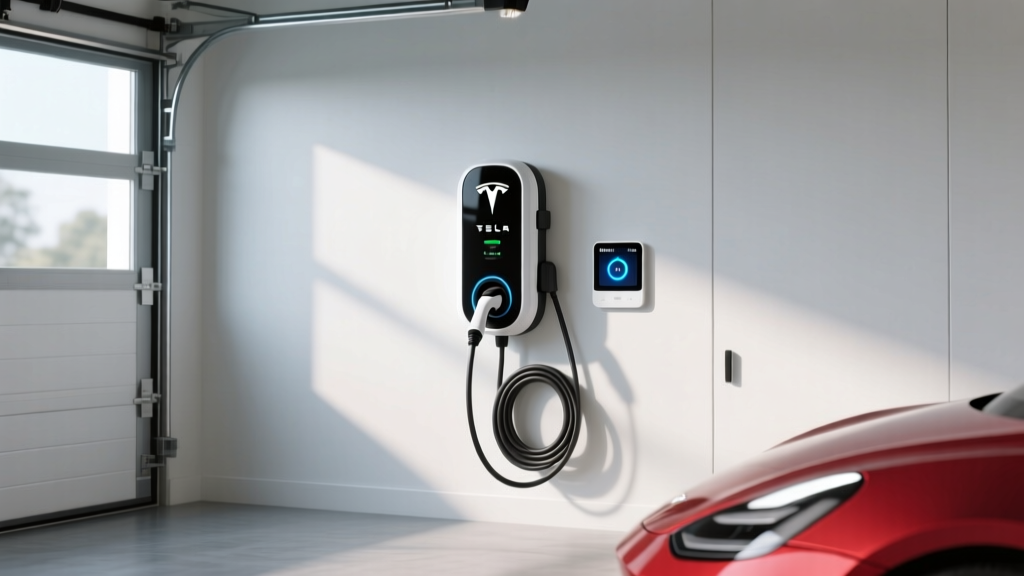
2. Tesla Wall Connector (NACS) — Best Value
- Power output: Up to 11.5 kW (48A on a 60A circuit)
- Connector: NACS (native); CCS1 adapter sold separately by Tesla
- Cable length: 24 feet
- Smart features: Wi-Fi, over-the-air updates, Power Sharing (link up to 6 units on one circuit), load management
- Price: ~$450
- Best for: Tesla and NACS-native vehicle owners; multi-EV households
3. Emporia Vue Level 2 Charger — Best Budget Smart Charger
- Power output: Up to 11.5 kW (48A on a 60A circuit)
- Connector: NACS or J1772 (configurable)
- Cable length: 24 feet
- Smart features: Energy monitoring, solar integration, time-of-use scheduling, load management with Emporia Vue panel monitor
- Price: ~$350–$400
- Best for: Solar-equipped homes; budget-conscious buyers who still want smart features
4. Grizzl-E Smart (United Chargers) — Most Durable for Outdoor/Garage Use
- Power output: Up to 10 kW (40A on a 50A circuit)
- Connector: NACS or J1772 (specify at order)
- Cable length: 24 feet
- Smart features: Wi-Fi, OCPP compatibility, adjustable amperage
- Price: ~$550
- Best for: Outdoor installs in extreme climates (rated to -40°F); built in Canada
Wide-Body Charging in Public: What to Expect
Public charging infrastructure is gradually adapting to larger vehicles, but the reality in 2026 is still mixed. Tesla Supercharger stalls are typically designed with pull-through lanes or angled parking that accommodates trucks with trailers, but many Electrify America and ChargePoint stations in urban retail lots have standard-width spaces that make door-opening difficult in a wide-body EV.
When planning road trips, use apps like PlugShare or A Better Routeplanner (ABRP) and filter for stations with pull-through or oversized-vehicle-designated spots. Truck-stop chargers (Love's, Pilot, Flying J) increasingly feature high-power 350 kW CCS/NACS stalls with generous clearance — ideal for wide-body EVs on long hauls. Expect to pay $0.35–$0.56/kWh at these corridor chargers.
One practical note: many wide-body EVs have charge ports on the driver-side front fender (Rivian R1T) or the driver-side rear quarter panel (F-150 Lightning). Know your port location before pulling into a public stall — backing in versus pulling through depends entirely on where your port sits relative to the charger pedestal.
Safety, Code Compliance, and Best Practices
A home EV charger is a major electrical appliance that draws continuous high current for hours. Cutting corners on installation is both dangerous and illegal. Here are the non-negotiable safety requirements:
- Dedicated circuit: Your Level 2 charger must be on its own dedicated breaker — never shared with other appliances. A 48A charger on a 60A circuit is correct; sharing that circuit with a dryer or welder is a code violation and a fire risk.
- GFCI protection: The 2023 NEC revision removed the GFCI breaker requirement for hardwired EV chargers in many jurisdictions (the charger's internal ground-fault protection is deemed sufficient). However, if you install a NEMA 14-60 receptacle, a GFCI breaker may still be required by your local inspector. Check with your AHJ (Authority Having Jurisdiction).
- Outdoor rating: If your charger is mounted outside or in an unconditioned garage, ensure it carries a NEMA 4 or IP65 rating for weather resistance. All units listed above meet this standard.
- UL listing: Only purchase chargers that are UL-listed (or ETL-listed to UL standards). Avoid uncertified imports from marketplace sellers — they may lack overcurrent and thermal protection.
- Permit and inspection: Most municipalities require an electrical permit for a new 240V circuit. The inspection ensures your wire gauge, breaker sizing, and grounding meet code. A permitted install also protects your homeowner's insurance coverage in the event of an electrical incident.
Frequently Asked Questions
How much does it cost to install a home EV charger?
For a straightforward installation with a nearby 200A panel, expect $850–$1,750 total (equipment + electrician + permit). If your home needs a panel upgrade from 100A to 200A service, total costs can reach $3,450–$7,700. Always get at least two quotes from licensed electricians who have EV charger installation experience.
How fast will each charging level add range to my wide-body EV?
Level 1 (120V) adds 3–5 miles per hour — essentially useless for a 131 kWh battery unless you're maintaining a full charge. Level 2 at 48A (11.5 kW) adds roughly 35–40 miles per hour to an F-150 Lightning, fully replenishing a depleted pack overnight. DC fast charging at 150 kW adds approximately 200 miles in 20 minutes under ideal conditions, but real-world sustained rates are lower due to charge-curve taper above 80% SoC.
Which connector and charger is compatible with my EV?
For 2025–2026 model-year vehicles, NACS is the standard connector on Ford, Rivian, GM, Tesla, Hyundai, Kia, and most other brands. If your EV is a 2022–2024 model with CCS1, you'll need a NACS adapter (typically $100–$200, sometimes provided free by the automaker) to access Tesla Superchargers. For home Level 2, purchase a charger with the connector that matches your vehicle natively to avoid adapter clutter.
How much does charging cost per mile compared to gas?
Home-charging an F-150 Lightning at average residential rates ($0.13/kWh) costs approximately $0.06–$0.07 per mile. A gas F-150 EcoBoost at 20 MPG and $3.20/gallon costs $0.16 per mile. That's a 55–60% per-mile savings with electric — and the gap widens further with off-peak utility rates or rooftop solar.
What electrical upgrades might I need for a wide-body EV charger?
The most common upgrade is a panel capacity increase. Homes with 100A or 150A service may need a 200A panel upgrade ($1,500–$3,500) to safely support a 60A EV circuit alongside existing loads. Some utilities offer load-management devices (like the Emporia Vue or Span smart panel) that allow an EV circuit to coexist with existing service by dynamically reducing charger power when other appliances draw heavily. Ask your electrician about this option — it can save thousands on a panel upgrade.