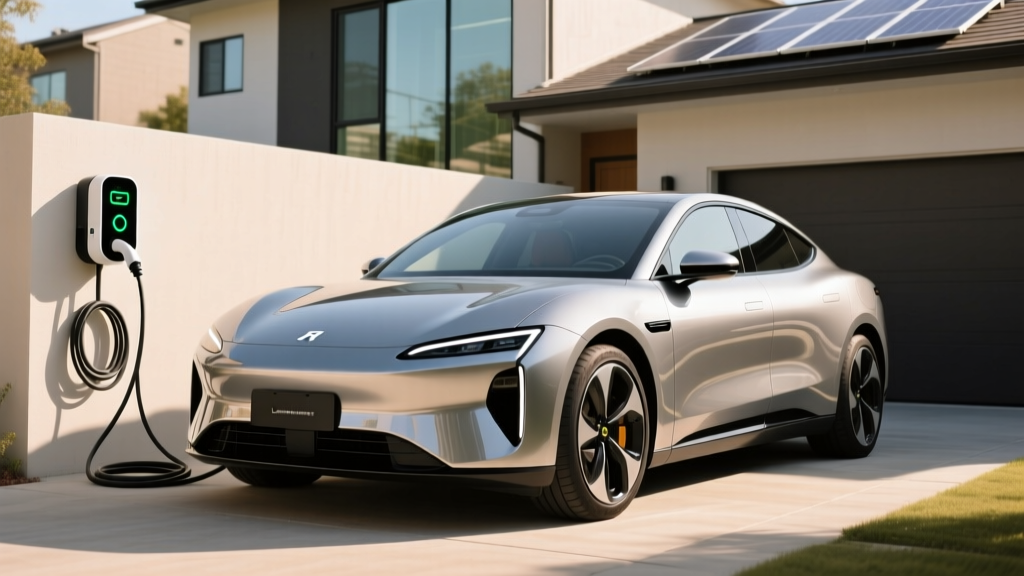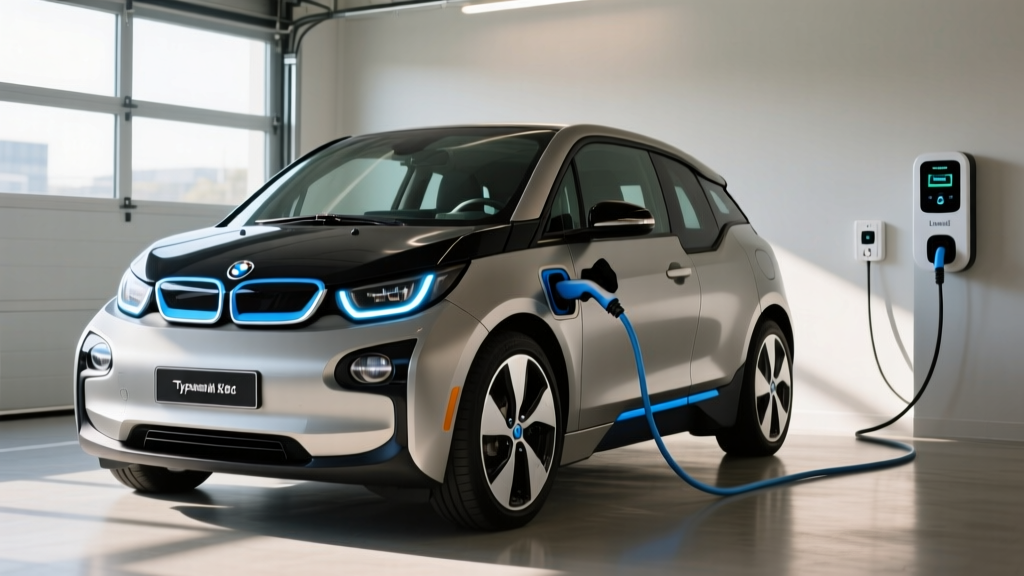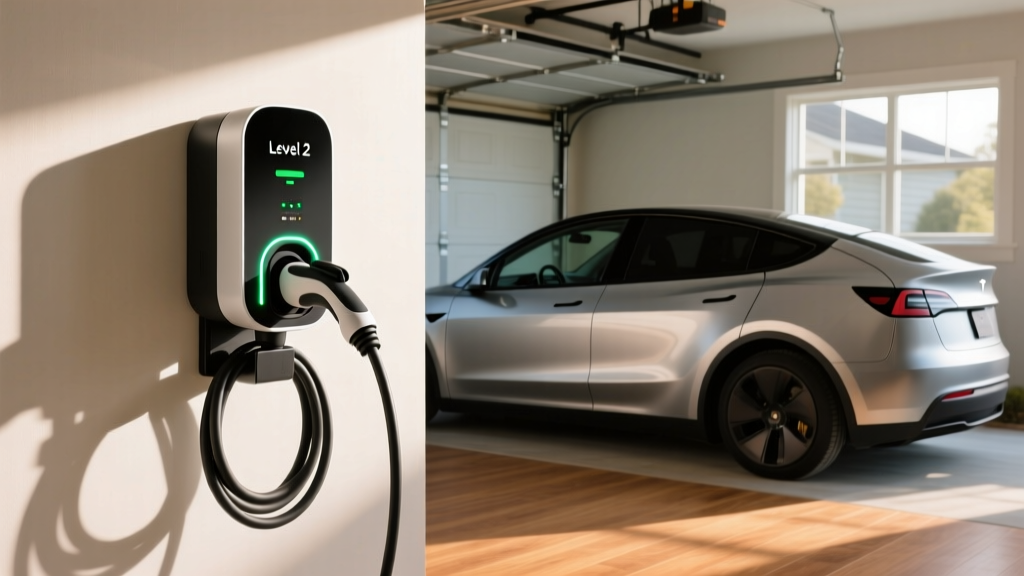
If you've ordered an EV or plug-in hybrid and started researching home charging, you've likely hit a wall of jargon: Level 1, Level 2, DC fast charging, kW, kWh, NACS, CCS. The single most important concept to nail down is Level 2 charging — it's the backbone of daily EV ownership and the setup most drivers rely on for 90% of their charging.
So, what is Level 2 charging? In plain terms, it's charging that uses a 240-volt AC circuit — the same voltage your electric dryer or oven uses — to deliver between 3 kW and 19.2 kW of power to your vehicle. That translates to roughly 12 to 75 miles of range added per hour of charging, depending on your car's onboard charger and the station's output. For context, a typical overnight session of 8–10 hours on a Level 2 charger will fully replenish most EV batteries from near-empty to full.
Charging Levels Compared: Level 1 vs. Level 2 vs. DC Fast
Before diving deeper into Level 2 specifics, it helps to see all three charging tiers side by side. A critical distinction every EV owner must understand: kW (kilowatts) measures power — the rate at which energy flows — while kWh (kilowatt-hours) measures energy — the total amount stored in your battery. Think of kW as the width of a hose and kWh as the size of the bucket you're filling.
| Level | Voltage | Power (kW) | Miles of Range Per Hour | Typical Use Case |
|---|---|---|---|---|
| Level 1 | 120V AC | 1.0–1.4 kW | 3–5 mi/hr | Emergency / PHEV overnight top-up |
| Level 2 | 240V AC | 3.3–19.2 kW | 12–75 mi/hr | Home, workplace, public destination |
| DC Fast (Level 3) | 400–800V DC | 50–350 kW | 150–1,000+ mi/hr | Road trips, highway corridors |
Level 1 charging comes standard with most EVs — just plug into a regular 120V household outlet. It's painfully slow for a battery-electric vehicle: adding 200 miles to a 75 kWh battery at 1.4 kW takes roughly 53 hours. For a plug-in hybrid with a 15 kWh battery, however, Level 1 is often sufficient for an overnight recharge.
DC fast charging bypasses your car's onboard AC-to-DC converter and pushes DC current directly into the battery at high power. Peak rates of 250–350 kW can add 10–80% charge in 15–25 minutes on compatible vehicles. But DC fast charging is expensive, not universally available, and sustained use accelerates battery degradation. It's a road-trip tool, not a daily strategy.
Level 2 occupies the sweet spot: fast enough to fully recharge overnight, gentle enough on the battery for daily use, and installable at home. This is where most EV owners spend the vast majority of their charging time.
Home Level 2 Installation: Electrical Requirements and Costs
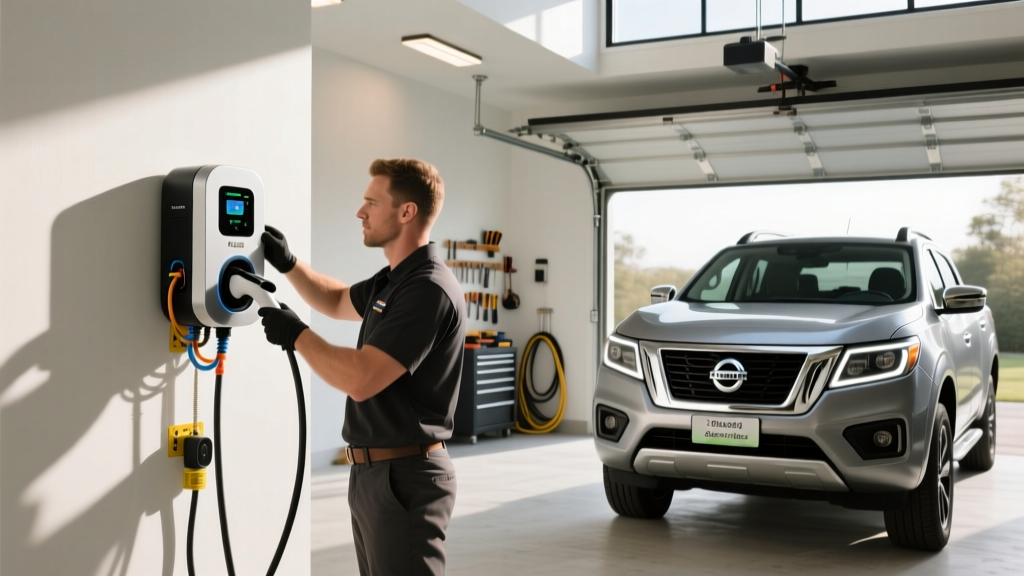
Installing a Level 2 charger at home requires a dedicated 240V circuit, similar to what powers an electric range or clothes dryer. The most common residential setups run at either 240V/40A (delivering up to 9.6 kW continuous) or 240V/48A (delivering up to 11.5 kW continuous). National Electrical Code (NEC) requires that continuous loads — and EV charging qualifies — not exceed 80% of a circuit breaker's rating. So a 50-amp breaker supports a 40-amp continuous charge; a 60-amp breaker supports 48 amps continuous.
Some homes, particularly those built before 2000 with 100-amp or 150-amp main electrical panels, may not have sufficient spare capacity for a new 40A or 50A circuit. In those cases, a panel upgrade to 200 amps may be necessary — and that's where costs escalate significantly.
| Item | Low End | High End | Notes |
|---|---|---|---|
| Level 2 charging equipment (hardwired or plug-in) | $300 | $700 | Smart chargers with Wi-Fi, load management at higher end |
| Electrician labor (new 240V circuit, 20–40 ft run) | $400 | $1,200 | Varies by region, wall/floor penetration, conduit length |
| Permit and inspection fees | $50 | $300 | Required by most jurisdictions; varies by municipality |
| Electrical panel upgrade (if needed) | $1,500 | $4,000 | 100A→200A upgrade; not needed in most newer homes |
| Total (no panel upgrade) | $750 | $2,200 | Typical scenario for homes with 200A panels |
| Total (with panel upgrade) | $2,250 | $6,200 | Older homes with insufficient panel capacity |
A few practical tips from real installations: if your garage is on the opposite side of the house from your electrical panel, expect labor costs to climb with every foot of conduit. Hardwired chargers avoid the need for a 240V receptacle (NEMA 14-50) and can sometimes deliver slightly higher amperage, but plug-in units offer portability if you move. Always pull a permit — it protects your homeowner's insurance coverage and ensures the work meets code.
Some utilities offer rebates of $200–$500 for home charger installation, and a few states provide additional incentives. Check your local utility's EV program page before scheduling work. The federal Residential Clean Energy Credit (IRC §25C) may also apply to certain energy-efficient home improvements, though EV charger eligibility has specific requirements — consult a tax professional.
How Fast Will Level 2 Charging Add Range?
Charge speed depends on two factors working together: the output of your Level 2 station (in kW) and the capacity of your vehicle's onboard charger (also in kW). Your car's onboard charger converts the AC power from your Level 2 station into DC power for the battery, and it has a maximum intake rate.
Most 2026 EVs have onboard chargers rated between 7.7 kW and 11.5 kW. A few, like the Ford F-150 Lightning (Pro Power Onboard equipped) and certain luxury models, accept up to 19.2 kW. If your station outputs 11.5 kW but your car's onboard charger maxes at 7.7 kW, you'll charge at 7.7 kW — the car is the bottleneck.
Here's what that looks like in practice for common battery sizes:
| Vehicle Example | Usable Battery | Onboard Charger | Station Output | 10–80% Time | Mi/ Hr Added |
|---|---|---|---|---|---|
| Tesla Model Y Long Range | 75 kWh | 11.5 kW | 11.5 kW (48A) | ~4.5 hours | ~44 mi/hr |
| Hyundai Ioniq 5 (RWD) | 74 kWh | 10.9 kW | 11.5 kW (48A) | ~4.7 hours | ~42 mi/hr |
| Chevrolet Equinox EV | 85 kWh | 11.5 kW | 11.5 kW (48A) | ~5.2 hours | ~44 mi/hr |
| Toyota RAV4 Prime (PHEV) | 14.9 kWh | 6.6 kW | 7.7 kW (32A) | ~1.6 hours | ~18 mi/hr (EV) |
| BMW iX xDrive50 | 105.2 kWh | 11.5 kW | 11.5 kW (48A) | ~6.4 hours | ~44 mi/hr |
For daily driving — say 30–50 miles of commuting — even a modest 7.7 kW Level 2 setup replenishes that usage in under two hours. Most owners plug in when they get home and wake up to a full battery every morning. You rarely need to charge from 10% to 80% in a single session at home; that scenario is more relevant to DC fast charging on road trips.
Connector Compatibility: NACS, CCS, and CHAdeMO
The EV industry has largely standardized around the North American Charging Standard (NACS) — the connector Tesla developed and opened to other automakers starting in 2024. By 2026, most new EVs from Ford, GM, Rivian, Hyundai, Kia, and others ship with native NACS charge ports. The Combined Charging System (CCS1) connector, which was the dominant non-Tesla standard, is being phased out on new vehicles but remains on millions of EVs already on the road.
CHAdeMO, used primarily by the Nissan Leaf and Mitsubishi Outlander PHEV, is effectively legacy in North America. New CHAdeMO-equipped vehicles are rare, and public CHAdeMO stations are declining.
| Connector | Brands Using It (New Vehicles) | Level 2 Home Charging? | Adapter Needed? |
|---|---|---|---|
| NACS (Tesla standard) | Tesla, Ford, GM, Rivian, Hyundai, Kia, Volvo, Polestar, BMW (2026+) | Yes — NACS wall connectors widely available | CCS→NACS adapter for older CCS cars at NACS stations |
| CCS1 | Legacy: VW ID.4 (pre-2025), older Bolt, Ioniq 5 (pre-2025) | Yes — J1772/CCS Level 2 chargers still sold | NACS→CCS adapter (e.g., Lectron, A2Z) for NACS home chargers |
| CHAdeMO | Nissan Leaf (discontinued), Mitsubishi Outlander PHEV | Yes — uses J1772 for Level 2 | N/A for Level 2 (J1772 is universal for AC) |
For Level 2 home charging specifically, the AC portion of all three connector families uses the J1772 protocol (or NACS, which carries J1772 signaling over its smaller pins). This means any J1772 Level 2 charger can charge any EV with the appropriate physical adapter — and most EVs ship with a J1772 adapter if they use a non-standard port. When buying a home charger, the safest bet in 2026 is a NACS-equipped unit, as that covers the largest and fastest-growing share of EVs.
Cost to Charge: Level 2 at Home vs. Public vs. Gas
The economic case for home Level 2 charging is strong, but it depends heavily on your local electricity rates and whether you can charge during off-peak hours. Here's a realistic cost breakdown using a mid-size EV averaging 3.0 miles per kWh (about 333 Wh/mi — typical for a Model Y or Ioniq 5).
| Scenario | Rate | Cost per kWh | Cost per Mile (3 mi/kWh) |
|---|---|---|---|
| Home Level 2 — off-peak (utility TOU rate) | $0.08–$0.12/kWh | $0.10 avg | $0.033 |
| Home Level 2 — standard rate | $0.14–$0.22/kWh | $0.18 avg | $0.060 |
| Public Level 2 (ChargePoint, EVgo, etc.) | $0.25–$0.49/kWh | $0.35 avg | $0.117 |
| DC fast charging (Electrify America, Tesla Supercharger) | $0.30–$0.55/kWh | $0.42 avg | $0.140 |
| Gas car (28 MPG combined, $3.40/gal) | $3.40/gallon | — | $0.121 |
The takeaway: home Level 2 charging at off-peak rates costs roughly 3–4 cents per mile, making it 3–4x cheaper than gasoline on a per-mile basis. Even at standard residential rates, you're saving 50% or more compared to gas. Public Level 2 and DC fast charging erode those savings — at some public DC stations, charging an EV can actually cost more per mile than driving a fuel-efficient gas car. This is why home charging access is the single biggest factor in EV satisfaction.
If your utility offers a time-of-use (TOU) rate plan, scheduling your Level 2 charger to run between 10 PM and 6 AM can cut your charging costs dramatically. Most smart Level 2 chargers support scheduled charging through their companion apps.
Recommended Level 2 Chargers for Home (2026 Picks)
Not all Level 2 chargers are equal. The best units combine reliable power output, adequate cable length (25 feet minimum for most garages), smart scheduling features, and safety certifications. Here are four proven options across price ranges:
Best Overall: ChargePoint Home Flex (NACS)
- Power output: Up to 12 kW (50A) on a 60A circuit; adjustable down to 16A for lower-capacity panels
- Connector: NACS (also available in J1772)
- Cable length: 23 feet
- Smart features: Wi-Fi, app scheduling, Alexa integration, energy tracking, load sharing with a second unit
- Price: ~$549
- Why it works: Flexible amperage lets you match the charger to your panel's capacity. UL-listed, indoor/outdoor rated.
Best Value: Emporia Level 2 EV Charger
- Power output: Up to 11.5 kW (48A) on a 60A circuit
- Connector: J1772 (NACS adapter included with most EVs)
- Cable length: 24 feet
- Smart features: Wi-Fi, app control, solar integration (pairs with Emporia Vue energy monitor), TOU scheduling
- Price: ~$349
- Why it works: Excellent price-to-performance ratio, especially if you have or plan to add solar.
Premium Pick: Tesla Wall Connector (NACS)
- Power output: Up to 11.5 kW (48A) on a 60A circuit
- Connector: NACS native
- Cable length: 24 feet
- Smart features: Wi-Fi, over-the-air updates, power sharing between multiple units, access control
- Price: ~$475
- Why it works: Cleanest integration for Tesla owners; also charges any NACS-equipped EV. Sleek, outdoor-rated design.
For Older Panels: Lectron V-BOX Pro (Adjustable)
- Power output: Adjustable from 16A to 48A (3.8–11.5 kW)
- Connector: J1772 (NACS adapter available separately)
- Cable length: 20 feet
- Smart features: Basic app, LED status display, no Wi-Fi scheduling
- Price: ~$279
- Why it works: Budget-friendly with adjustable amperage — dial it down to 24A or 32A if your panel is tight.
Safety, Code, and Common Installation Gotchas
Level 2 charging involves high-current, continuous-load electrical work. Cutting corners here risks fire, voided insurance, and failed home inspections. Here's what to get right:
- Dedicated circuit: Your Level 2 charger must be on its own dedicated breaker — not shared with other outlets or appliances. A 50A breaker for a 40A charger, or a 60A breaker for a 48A charger.
- GFCI protection: NEC 2020 and later require ground-fault circuit interrupter (GFCI) protection for EV charging outlets in garages and outdoor locations. Hardwired chargers often include built-in GFCI, but plug-in units on NEMA 14-50 receptacles may need a GFCI breaker (add ~$50–$80 to your panel cost).
- Outdoor rating: If your charger will be mounted outside (driveway, carport), ensure it carries a NEMA 4 or IP65 rating for weather resistance. All four chargers recommended above are outdoor-rated.
- Wire gauge: A 60A circuit typically requires 6 AWG copper wire; a 50A circuit requires 6 AWG or 8 AWG depending on run length and insulation type. Your electrician will spec this — don't DIY it.
- Permit and inspection: Most municipalities require an electrical permit for new 240V circuits. The inspection ensures the work meets NEC standards. Skipping this step can create problems when you sell your home or file an insurance claim.
- Load management: If your panel is near capacity but you don't want a full upgrade, consider a smart load-management device (like the Emporia Smart Load Center or Span panel) that dynamically reduces charger output when other high-draw appliances are running. This can avoid a $2,000+ panel upgrade.
One often-overlooked detail: NEMA 14-50 receptacles installed for EV charging should be industrial-grade (Hubbell or Bryant brand, ~$60–$90), not the $12 residential versions designed for occasional dryer use. EV charging draws maximum current for hours every night — cheap receptacles overheat and melt under sustained load. Your electrician should know this, but verify.
Frequently Asked Questions
How much does it cost to install a home Level 2 EV charger?
Expect $750–$2,200 for a typical installation (equipment, electrician labor, and permit) if your home has a 200-amp electrical panel with spare capacity. If a panel upgrade is needed — common in homes built before 2000 with 100A or 150A service — add $1,500–$4,000. Get at least two quotes from licensed electricians and verify they include permit costs.
How fast will each charging level add range to my EV?
Level 1 (120V) adds roughly 3–5 miles per hour. Level 2 (240V) adds 12–75 miles per hour depending on station output and your car's onboard charger. DC fast charging adds 150–1,000+ miles per hour at peak rates but tapers significantly above 80% state of charge. For daily driving, Level 2 is the practical standard.
Which connector and charger is compatible with my EV?
For Level 2 (AC) charging, all EVs use the J1772 protocol regardless of the physical plug shape. New 2025–2026 EVs from most brands use NACS connectors. Older non-Tesla EVs typically use CCS1 or J1772. Any Level 2 charger with the matching plug will work — or you can use an adapter. For home charging in 2026, a NACS-equipped charger covers the widest range of current and future EVs.
How much does EV charging cost per mile compared to gas?
Home Level 2 charging at off-peak electricity rates costs roughly 3–4 cents per mile for a typical EV (3 mi/kWh). Standard residential rates push that to about 6 cents. Public DC fast charging averages 12–14 cents per mile. A comparable gas car at 28 MPG and $3.40/gallon costs about 12 cents per mile. Home charging delivers the best economics by far.
What electrical upgrades might I need for Level 2 charging?
Most homes with 200-amp panels need only a new dedicated 240V circuit — no panel work required. Older homes with 100A or 150A panels may need a service upgrade to 200A ($1,500–$4,000). Alternatives include installing a lower-amperage circuit (e.g., 30A/24A continuous for 5.8 kW), using a smart load-management system to share capacity with other appliances, or pairing the charger with a home battery system. An electrician can assess your panel's spare capacity with a load calculation.