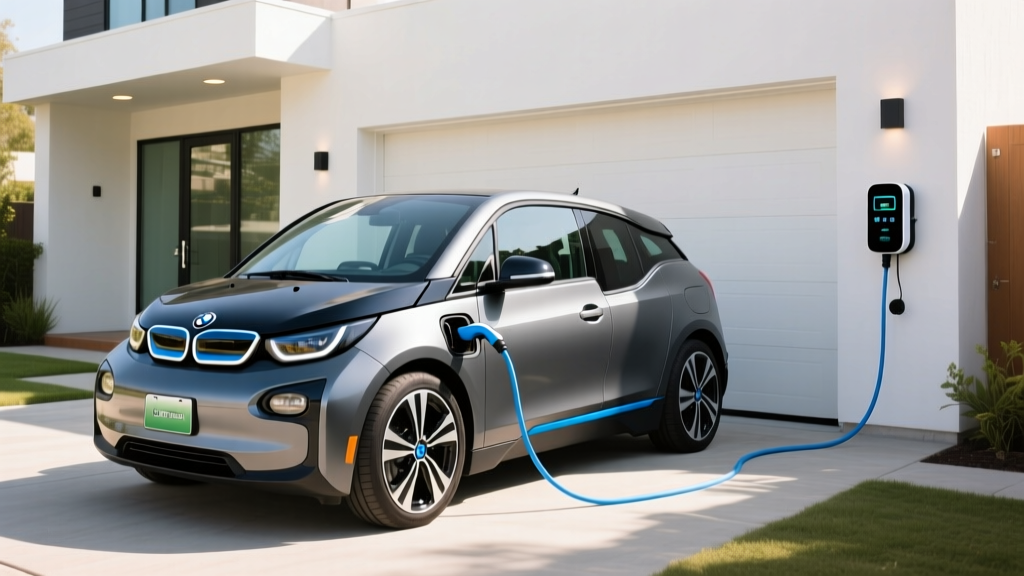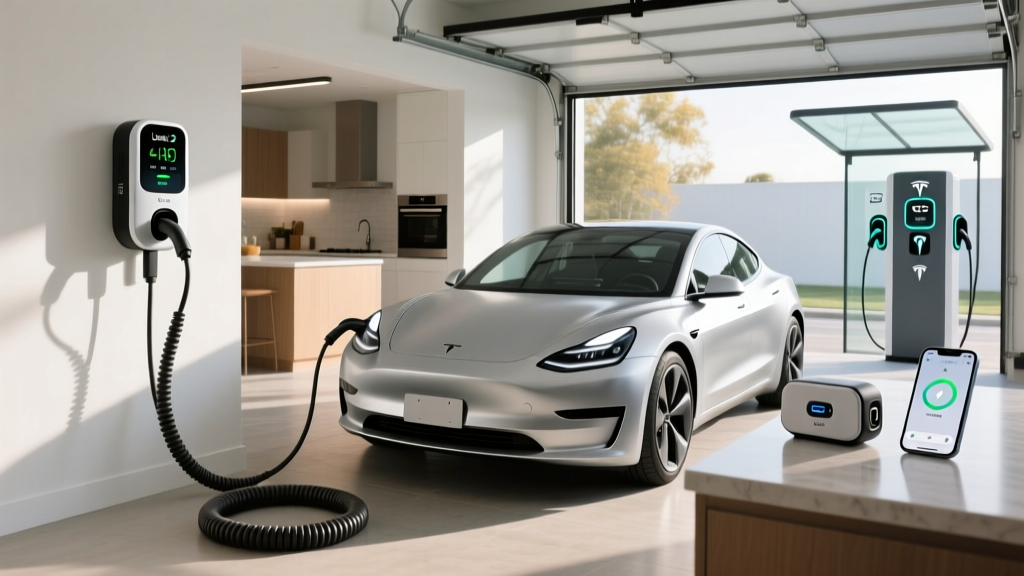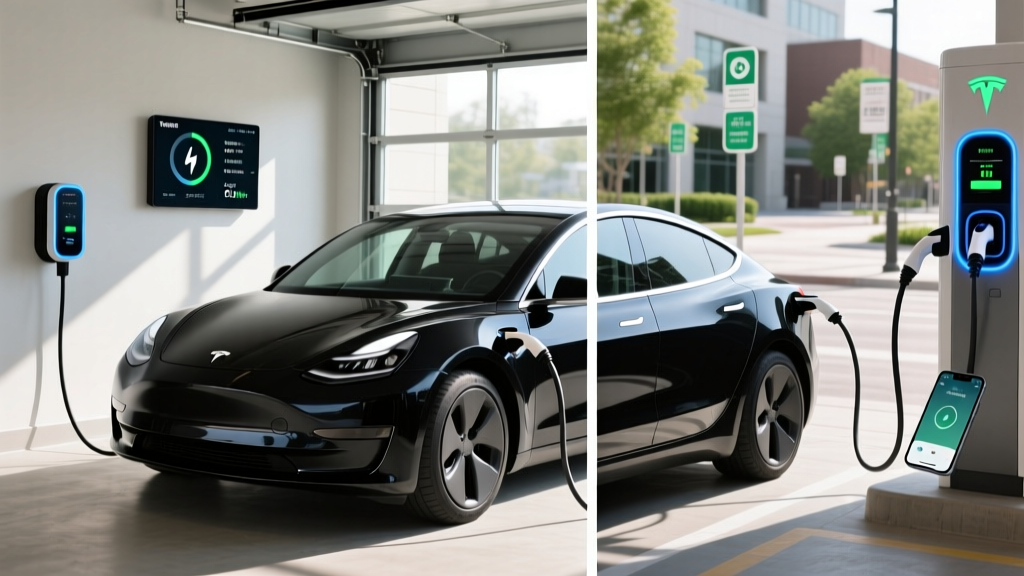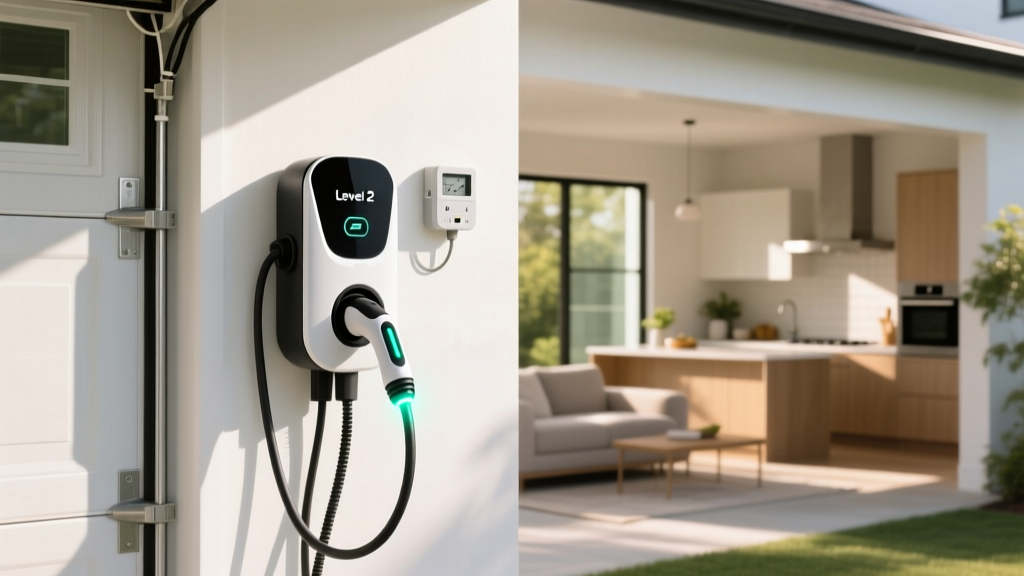
If you've ordered an electric vehicle or are seriously shopping for one, you've probably encountered the term "Level 2 charger" and wondered how it differs from plugging into a regular wall outlet or pulling up to a highway fast-charging station. The short answer: a Level 2 charger is the 240-volt AC charging equipment that serves as the backbone of daily EV ownership — fast enough to replenish a depleted battery overnight, practical enough to install in your garage or driveway, and far more cost-effective than relying on public DC fast charging.
But the details matter. Power output varies from 3.3 kW to 19.2 kW. Installation can cost $500 or $3,500 depending on your electrical panel. And picking the wrong connector in 2026 — as the industry transitions from CCS1 to NACS — could leave you needing adapters at every public station. This guide gives you the exact numbers, real-world expectations, and equipment recommendations you need to make the right call.
Charging Levels Explained: Level 1, Level 2, and DC Fast Charging
Before defining Level 2 specifically, it helps to understand the three tiers of EV charging. The critical distinction: kW (kilowatts) measures power — the rate at which electricity flows into your car. kWh (kilowatt-hours) measures energy — the total capacity of your battery, like gallons in a fuel tank. A 75 kWh battery charged at 7.5 kW would theoretically take 10 hours from empty to full.
| Level | Voltage | Power (kW) | Miles of Range Added per Hour | Typical Use Case |
|---|---|---|---|---|
| Level 1 | 120V AC | 1.2–1.9 kW | 3–5 miles | Emergency / overnight top-up, PHEVs |
| Level 2 | 240V AC | 3.3–19.2 kW | 12–75 miles | Daily home & workplace charging |
| DC Fast (Level 3) | 400–800V DC | 50–350 kW | 150–1,000+ miles | Road trips, highway corridors |
What Is a Level 2 Charger, Exactly?
A Level 2 charger operates on a 240-volt AC circuit — the same voltage your electric dryer or oven uses. The term "charger" is slightly misleading: the actual charging hardware (the onboard charger, or OBC) lives inside your vehicle and converts AC electricity from the wall into DC electricity for the battery. The box on your wall or garage post is technically called Electric Vehicle Supply Equipment (EVSE). It safely delivers AC power to the car and communicates the circuit's maximum amperage so the vehicle doesn't draw more than the wiring can handle.
Level 2 EVSE comes in several common amperages:
- 16A (3.8 kW): Entry-level, adds ~14 miles of range per hour
- 32A (7.7 kW): Most popular home setup, adds ~28 miles per hour
- 40A (9.6 kW): Requires a 50A circuit, adds ~35 miles per hour
- 48A (11.5 kW): Requires a 60A circuit, adds ~42 miles per hour
- 80A (19.2 kW): Requires a 100A circuit, adds ~65–75 miles per hour — mostly for large-battery trucks and vans
Most EVs have onboard chargers that max out between 7.7 kW and 11.5 kW, so installing a 48A EVSE covers nearly every passenger vehicle on the road in 2026. Higher-amperage units are primarily useful for vehicles with dual onboard chargers or very large batteries (e.g., the GMC Hummer EV's 212 kWh pack).
Charging Time Examples: How Long Does Level 2 Take?
Here's what Level 2 charging looks like in practice for popular 2026 EVs, measured from 10% to 80% state of charge (the practical daily charging window — charging above 80% slows significantly to protect battery health):
| Vehicle | Battery (kWh usable) | Onboard Charger | EVSE at 48A (11.5 kW) | EVSE at 32A (7.7 kW) |
|---|---|---|---|---|
| Tesla Model Y Long Range | 75 kWh | 11.5 kW | ~4.5 hours (10–80%) | ~6.8 hours |
| Hyundai Ioniq 5 (Standard Range) | 58 kWh | 10.9 kW | ~3.5 hours | ~5.3 hours |
| Chevrolet Equinox EV | 85 kWh | 11.5 kW | ~5.2 hours | ~7.7 hours |
| Ford F-150 Lightning (Extended) | 131 kWh | 19.2 kW (dual OBC) | ~8.0 hours | ~11.9 hours |
| BMW i4 eDrive40 | 81 kWh | 11 kW | ~4.9 hours | ~7.4 hours |
How Much Does It Cost to Install a Home Level 2 Charger?
Installation cost is where reality diverges sharply from marketing claims. A Level 2 EVSE unit itself typically costs $300–$700, but the total installed price depends entirely on your home's electrical infrastructure. Here's a realistic breakdown based on 2026 national averages:
| Cost Component | Simple Install (panel nearby, spare capacity) | Moderate Install (longer run, 50A circuit) | Complex Install (panel upgrade required) |
|---|---|---|---|
| EVSE unit (32A–48A) | $350–$600 | $350–$600 | $350–$700 |
| Electrician labor | $300–$600 | $600–$1,200 | $800–$1,500 |
| Materials (conduit, wire, breaker) | $100–$250 | $200–$500 | $300–$600 |
| Permit & inspection | $50–$150 | $50–$200 | $50–$200 |
| Electrical panel upgrade (if needed) | — | — | $1,500–$3,000+ |
| Total installed cost | $800–$1,600 | $1,200–$2,500 | $3,000–$6,000+ |
What Electrical Upgrades Might I Need?
A Level 2 charger requires a dedicated circuit on your electrical panel — meaning no other appliances share it. A 48A EVSE needs a 60A breaker (the National Electrical Code requires circuits to be rated at 125% of continuous load). Here's when upgrades come into play:
- 100A service panel: Common in older homes. May not have enough spare capacity for a 60A EV circuit alongside existing loads. A panel upgrade to 200A typically costs $1,500–$3,000.
- 200A service panel: Standard in most homes built after 2000. Usually has sufficient capacity for a 40A–60A EV circuit, but a load calculation by a licensed electrician is still required.
- Panel is far from the garage: Long wire runs (over 50 feet) require thicker-gauge wire, increasing material cost by $200–$500.
- No 240V outlet near parking spot: The electrician will need to run new conduit and wire from the panel — the most common scenario.
Always hire a licensed electrician who pulls a permit. Unpermitted EVSE installations can void homeowner's insurance claims and create fire hazards. The National Electrical Contractors Association maintains a directory of certified installers.
Connector Compatibility: NACS, CCS1, and CHAdeMO in 2026
The connector landscape has shifted dramatically. Tesla's North American Charging Standard (NACS) has been adopted by nearly every major automaker for 2025–2026 models. Here's where things stand:
| Connector | Brands Using It (2026 models) | Home Charging | Public DC Fast Charging |
|---|---|---|---|
| NACS (J3400) | Tesla (all), Ford, GM, Rivian, Hyundai, Kia, BMW, Mercedes, Volvo, Polestar | NACS-equipped EVSE widely available | Tesla Supercharger network (17,000+ stalls), plus growing third-party NACS stations |
| CCS1 | Volkswagen ID.4 (some 2025 carry-over), Stellantis, some legacy models | CCS1 EVSE still sold; adapters available | Electrify America, EVgo, ChargePoint — CCS1 stalls remain widespread |
| CHAdeMO | Nissan Leaf (discontinued 2025), Mitsubishi Outlander PHEV (legacy) | CHAdeMO home units rare; use J1772 adapter | Limited and declining availability |
Key decision point: If you're buying a new EV in 2026, it almost certainly uses NACS. Buy a NACS-equipped Level 2 home charger. If you own an older CCS1 vehicle, you can purchase a CCS-to-NACS adapter ($150–$250) for public Supercharger access, but keep a CCS1 home EVSE or use a J1772 adapter. The J1772 connector — the legacy AC charging standard — is now being phased out in favor of NACS for home and public Level 2 charging as well.
Cost to Charge: Level 2 at Home vs. Public vs. Gas
One of the strongest arguments for Level 2 home charging is cost. Electricity rates vary widely, but home charging is almost always cheaper than public DC fast charging and dramatically cheaper than gasoline on a per-mile basis.
| Scenario | Rate ($/kWh) | Cost to Add 200 Miles* | Cost per Mile |
|---|---|---|---|
| Home Level 2 (off-peak utility rate) | $0.09–$0.14 | $5.40–$8.40 | $0.027–$0.042 |
| Home Level 2 (standard rate, no TOU) | $0.15–$0.22 | $9.00–$13.20 | $0.045–$0.066 |
| Public Level 2 (workplace, retail) | $0.20–$0.35 | $12.00–$21.00 | $0.060–$0.105 |
| DC Fast Charging (Electrify America, EVgo) | $0.35–$0.55 | $21.00–$33.00 | $0.105–$0.165 |
| Gasoline vehicle (28 MPG combined, $3.40/gal) | — | $24.29 | $0.121 |
*Assumes EV efficiency of 3.3 mi/kWh (30 kWh/100mi), typical for a midsize crossover like the Hyundai Ioniq 5 or Tesla Model Y.
The math is clear: home Level 2 charging at off-peak rates costs roughly one-quarter to one-third what gasoline costs per mile. Even standard-rate home charging undercuts gas by 50% or more. Public DC fast charging, however, can approach or exceed gas costs — which is why home Level 2 is the economic sweet spot for EV ownership.
Recommended Level 2 Home Chargers for 2026
Based on reliability, feature sets, and compatibility with the 2026 EV landscape, here are top picks across different budgets and needs:
Best Overall: ChargePoint Home Flex (NACS)
- Power: Up to 11.5 kW (48A, requires 60A circuit)
- Connector: NACS (J3400)
- Cable length: 23 feet
- Smart features: Wi-Fi, app scheduling, energy tracking, Alexa integration
- Price: ~$599
- UL listed, ENERGY STAR certified
Best Value: Emporia Level 2 EV Charger
- Power: Up to 11.5 kW (48A)
- Connector: J1772 (NACS adapter available)
- Cable length: 24 feet
- Smart features: Wi-Fi, app with real-time cost tracking, solar integration
- Price: ~$399
- UL listed
Premium Pick: Tesla Wall Connector (NACS)
- Power: Up to 11.5 kW (48A)
- Connector: NACS native
- Cable length: 24 feet
- Smart features: Wi-Fi updates, power sharing between multiple units, load management
- Price: ~$475
- Works with all NACS vehicles, not just Tesla
For Older CCS1 Vehicles: Grizzl-E Smart
- Power: Up to 9.6 kW (40A, 50A circuit)
- Connector: J1772 (CCS1 compatible)
- Cable length: 24 feet
- Smart features: OCPP-compatible, adjustable amperage, extreme-weather rated (-40°F)
- Price: ~$449
- UL listed, built in Canada
Every charger listed above is UL-listed (Underwriters Laboratories safety certified), which is essential for insurance compliance and safe operation. Avoid uncertified units sold on marketplace sites — they may lack critical safety protections like ground-fault interruption.
Safety, Electrical Code, and Installation Best Practices
Level 2 charging involves sustained high-current draw — often 8+ hours continuously. This makes proper installation non-negotiable:
- Dedicated circuit: Your EVSE must have its own breaker — no shared circuits with laundry, HVAC, or other loads.
- GFCI protection: The NEC (2023 edition and later) requires GFCI (ground-fault circuit interrupter) protection for all EVSE outlets. Hardwired units may have GFCI built into the EVSE itself — confirm with your electrician.
- Outdoor rating: If installing outside, the EVSE must carry a NEMA 4 or IP65 rating for weather resistance. All four units recommended above are outdoor-rated.
- Wire gauge: A 60A circuit requires 6 AWG copper wire (or 4 AWG aluminum). Longer runs may need upsized wire to prevent voltage drop.
- Hardwired vs. plug-in: Hardwired installations (no outlet) eliminate the NEMA 14-50 receptacle as a potential failure point and are generally preferred for 48A+ circuits. A NEMA 14-50 outlet is fine for 40A units and offers portability if you move.
- Permit and inspection: Most jurisdictions require an electrical permit for new 240V circuits. The inspection ensures the installation meets NEC code. Skipping this step risks insurance denial in the event of an electrical fire.
Federal Tax Credit for Home Charging Equipment
The IRS §30C Alternative Fuel Vehicle Refueling Property Credit covers 30% of the cost of home EV charging equipment and installation, up to $1,000. Key eligibility rules for 2026:
- Credit amount: 30% of hardware + installation costs, capped at $1,000 per tax year
- Income limits: No income cap for §30C (unlike the §30D vehicle credit)
- Location requirement: Equipment must be installed at your primary residence in the U.S.
- Eligible equipment: Must be UL-listed EVSE that meets applicable safety standards
- Census tract requirement: Property must be in a qualifying census tract (non-urban or low-income area) — check the IRS §30C page for the current tract locator tool
- Point-of-sale: Unlike §30D, §30C is claimed on your tax return (Form 8911) — no point-of-sale transfer option
Consult a tax professional to confirm eligibility. Rules and qualifying census tracts are subject to change.
Frequently Asked Questions
Can I just use a regular 120V outlet instead of installing Level 2?
Yes, but Level 1 charging (120V) adds only 3–5 miles of range per hour. If you drive 30+ miles daily, Level 1 won't keep up unless your EV has a small battery (like a PHEV with 15–25 kWh). For any battery-electric vehicle with 60+ kWh, Level 2 is strongly recommended for practical daily use.
Will a Level 2 charger work with any EV?
Any Level 2 EVSE with the correct connector will work with any EV. In 2026, most new EVs use the NACS connector. Older CCS1 or J1772 vehicles can use adapters. The EVSE simply delivers AC power — the car's onboard charger determines how much it can accept.
Does Level 2 charging degrade my battery faster than Level 1?
No. Battery degradation is driven primarily by temperature extremes, sustained high state of charge (above 90%), and DC fast charging heat. Level 2 charging at home generates minimal thermal stress compared to DC fast charging, and modern EVs have thermal management systems that keep the battery in a safe temperature range during AC charging.
How fast will each charging level add range?
Level 1 (120V): 3–5 miles per hour. Level 2 (240V, 48A/11.5 kW): roughly 30–42 miles per hour for a typical midsize EV. DC fast charging (150+ kW): 150–400+ miles in 20–30 minutes, depending on the vehicle's charge curve and battery preconditioning.
Do I need a smart charger, or will a basic unit work?
A basic (non-smart) Level 2 EVSE will charge your car just fine. Smart features — Wi-Fi connectivity, scheduling, energy monitoring — are useful if you want to charge during off-peak utility hours (saving money), track charging costs, or integrate with solar panels. The price premium for smart features is typically $50–$150.
Can my utility company help with installation costs?
Many utilities offer rebates of $250–$1,000 for home Level 2 charger installation, and some offer time-of-use (TOU) rate plans that reduce off-peak electricity to $0.06–$0.09/kWh. Check with your local utility — programs vary by state and provider. Some utilities also offer managed-charging programs that provide a free or discounted EVSE in exchange for allowing the utility to briefly pause charging during peak demand.
Level 2 home charging is the single biggest quality-of-life upgrade in EV ownership. You start every morning with a full battery, pay a fraction of what gas costs per mile, and eliminate routine visits to filling stations. The upfront investment — $800 to $2,500 for most homes — typically pays for itself within 2–4 years through fuel savings alone. Get a quote from a licensed electrician, confirm your panel capacity, pick a UL-listed NACS charger, and you'll never look back.