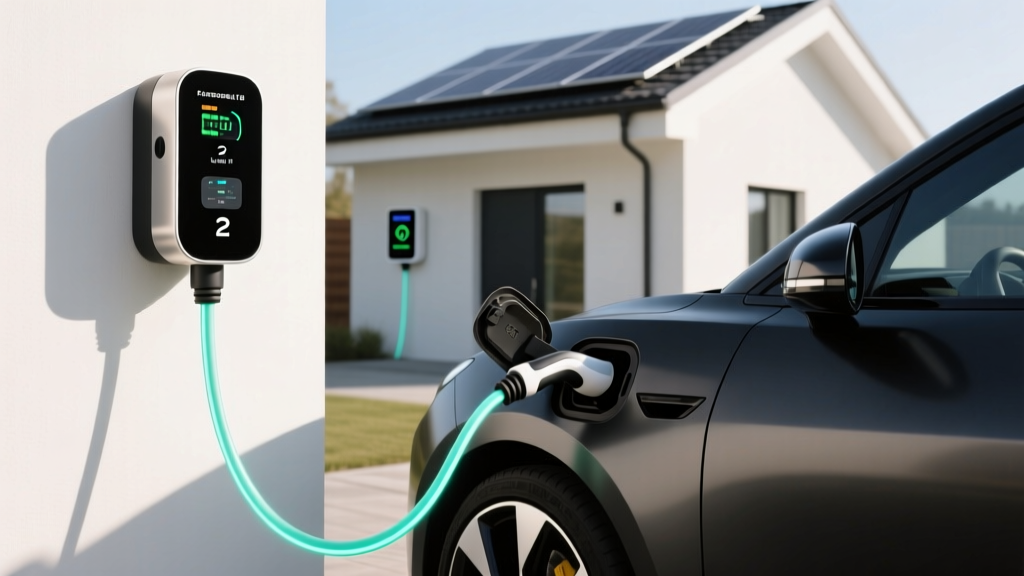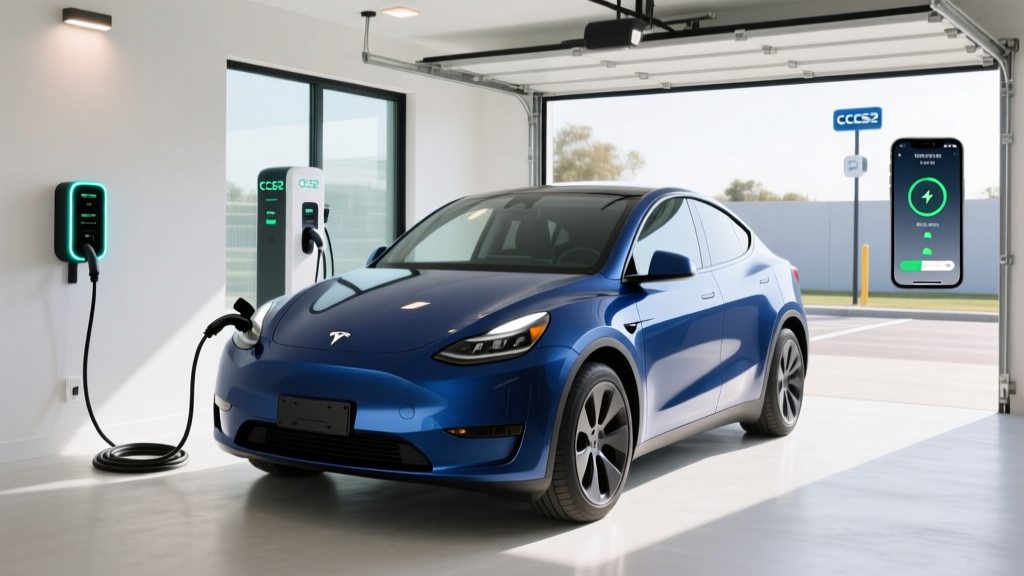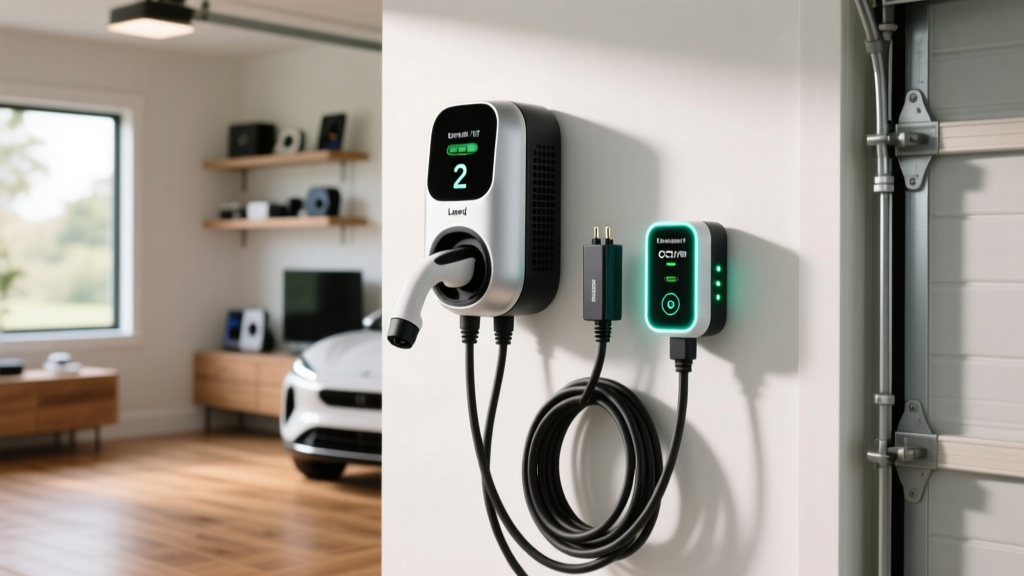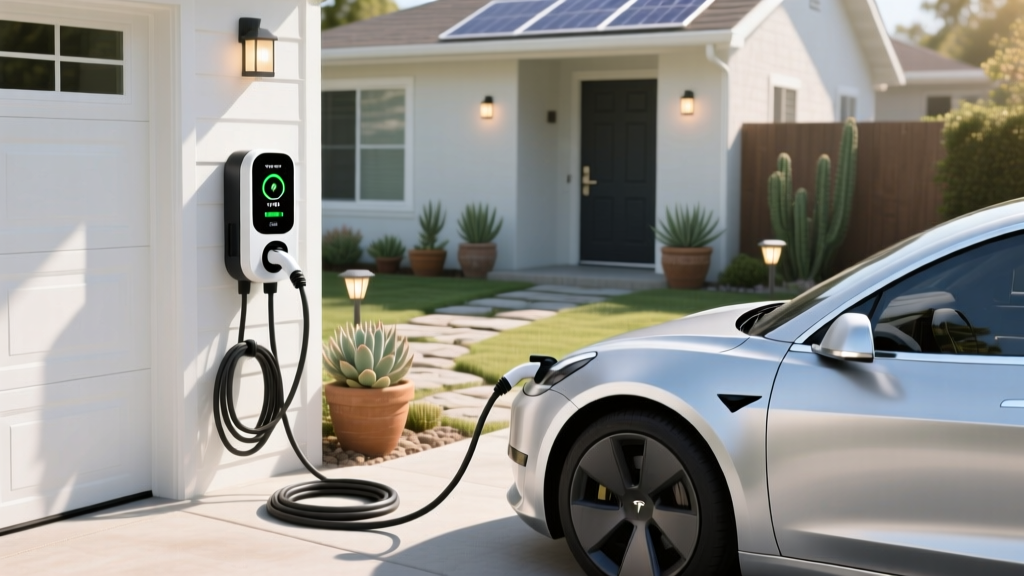
If you're shopping for your first electric vehicle—or already own one and are tired of relying on public stations—understanding exactly what an EV charger is (and isn't) will save you thousands of dollars and hours of frustration. The term "EV charger" is actually a slight misnomer: the device on your wall or the pedestal at a gas station is technically called Electric Vehicle Supply Equipment (EVSE). The actual charger—the component that converts AC electricity from the grid into DC current your battery can store—lives inside the car itself. The EVSE simply delivers power safely to the vehicle and communicates with it to manage the flow.
That distinction matters because it explains why your car might accept 11.5 kW at home but peak at 250 kW on a highway DC fast charger: the car's onboard charger caps AC charging, while DC fast chargers bypass it entirely and feed the battery directly. Below, we'll map out every charging level, what home installation really costs in 2026, which connector your EV uses, and how charging economics compare to gasoline.
The Three EV Charging Levels Explained
Every EV sold in the U.S. can charge at Level 1. Most buyers will want a Level 2 home setup. DC fast charging (Level 3) is reserved for road trips and quick top-ups. Here's how they compare in real-world terms:
| Level | Voltage | Power (kW) | Miles of Range per Hour | Typical Use |
|---|---|---|---|---|
| Level 1 | 120V AC | 1.0–1.9 kW | 3–5 mi/hr | Overnight top-up, low-mileage drivers |
| Level 2 | 240V AC | 3.3–19.2 kW | 12–75 mi/hr | Home daily charging, workplace |
| DC Fast (Level 3) | 400–800V DC | 50–350+ kW | 150–1,200+ mi/hr | Highway road trips, rapid top-ups |
kW vs. kWh—the critical distinction: Kilowatts (kW) measure power—how fast electricity flows. Kilowatt-hours (kWh) measure energy—how much your battery holds. Think of kW as the width of a hose and kWh as the size of the bucket. A 75 kWh battery charged at 7.5 kW takes roughly 10 hours from empty; at 150 kW DC, it takes about 30 minutes to 80%.
Real-world charging times depend heavily on the charge curve. No EV sustains its peak charge rate for the entire session. A vehicle advertising "250 kW peak" typically holds that speed only between roughly 10–30% State of Charge (SoC), then tapers progressively. By 80%, most EVs have slowed to 50 kW or less to protect battery longevity. That's why manufacturers quote 10–80% times rather than 0–100%.
How Fast Will Each Charging Level Add Range?
Charging speed in miles-per-hour depends on both the charger's output and your vehicle's efficiency. A more efficient EV (like a Tesla Model 3 at ~25 kWh/100mi) gains more miles per kW than a heavier, less efficient one (like a GMC Hummer EV at ~47 kWh/100mi). Here's what typical sessions look like:
Level 1: The Emergency Backup
Plugging into a standard 120V household outlet delivers about 1.4 kW (on a 15A circuit). For a Hyundai Ioniq 5 with its 77.4 kWh usable battery and 3.5 mi/kWh efficiency, that's roughly 5 miles of range per hour. A full overnight session (10 hours) nets about 50 miles—enough for many commutes, but inadequate if you drive 200+ miles per week. Level 1 is best as a fallback or for PHEV owners with smaller batteries (10–18 kWh).
Level 2: The Daily Workhorse
A 48A Level 2 station on a 240V circuit delivers up to 11.5 kW. That same Ioniq 5 gains roughly 40 miles per hour. A 10–80% charge on a 77.4 kWh pack (needing ~54 kWh) takes about 5–6 hours—perfect for overnight charging. Many home chargers run at 32A (7.7 kW), adding about 27 miles per hour, which still covers 90% of daily needs.
DC Fast Charging: Road-Trip Speed
Modern DC fast chargers range from 50 kW legacy units to 350 kW chargers on Electrify America and Tesla's latest V4 Superchargers. The Ioniq 5, with its 800V architecture, can peak at 233 kW and charge from 10–80% in approximately 18 minutes. A Tesla Model Y on a V3 Supercharger (250 kW peak) does 10–80% in about 22–25 minutes. Expect real-world sessions to add 150–250 miles in 20–30 minutes on a capable charger.
How Much Does It Cost to Install a Home EV Charger?
Home Level 2 installation costs vary enormously depending on your electrical panel's capacity, the distance from the panel to the charger location, and local permitting requirements. Here's a realistic breakdown for a typical 48A hardwired Level 2 charger in 2026:
| Component | Low End | High End | Notes |
|---|---|---|---|
| Level 2 EVSE (hardware) | $350 | $750 | 32A–48A smart charger, 18–25 ft cable |
| Electrician labor | $400 | $1,500 | Depends on run length, conduit, drywall work |
| Electrical permit | $50 | $250 | Varies by municipality |
| Panel upgrade (if needed) | $1,500 | $4,500 | 100A→200A service upgrade for older homes |
| Total (no panel upgrade) | $800 | $2,500 | Most homes with 200A panels |
| Total (with panel upgrade) | $2,300 | $7,000 | Homes with 100A or maxed-out panels |
What Electrical Upgrades Might I Need?
A 48A Level 2 charger requires a dedicated 60A, 240V circuit (the National Electrical Code requires circuits to be rated 125% above continuous load, so 48A × 1.25 = 60A). Your electrician will check whether your panel has enough spare capacity. Homes built after 2000 typically have 200A service with room to spare. Older homes with 100A panels or panels already near capacity (electric range, dryer, HVAC) may need a service upgrade.
Before paying for a panel upgrade, ask your electrician about a load-management device (like the Emporia V2 with smart panel monitoring or a Tesla Wall Connector with load-sharing). These devices dynamically throttle the charger when other high-draw appliances kick on, potentially avoiding a costly panel upgrade entirely. Some utilities also offer rebates of $250–$1,000 for smart charger installations—check with your local provider.
The federal Residential Clean Energy Credit does not cover EV chargers for most taxpayers after 2022; however, the Alternative Fuel Vehicle Refueling Property Credit (§30C) may provide up to $1,000 for home charger equipment and installation if you live in an eligible census tract. Consult a tax professional and verify eligibility on IRS.gov.
Which Connector Is Compatible With My EV?
The connector landscape shifted dramatically between 2023 and 2026. After Ford, GM, Rivian, Volvo, and nearly every major automaker adopted Tesla's North American Charging Standard (NACS), the legacy CCS1 connector is being phased out on new vehicles. Here's where things stand for 2026 models:
| Connector | Brands Using It (Native) | Adapter Needed for Tesla Superchargers? |
|---|---|---|
| NACS (J3400) | Tesla, Ford, GM, Rivian, Volvo, Polestar, Mercedes, Nissan (2026+), Hyundai/Kia (select 2026+) | No—native NACS port |
| CCS1 | Hyundai/Kia (2025 and earlier), BMW, VW, legacy models | Yes—CCS-to-NACS adapter (~$200–$300) for Supercharger access |
| CHAdeMO | Nissan Leaf (legacy, discontinued 2025), Mitsubishi Outlander PHEV | Limited network; CHAdeMO infrastructure declining |
Adapter reality check: If you own a CCS-equipped EV, adapters from companies like Lectron or the official Ford/Tesla adapter allow access to Tesla's Supercharger network. However, adapters add a point of failure, and some CCS vehicles cannot precondition their batteries for Supercharger stops (since the car's navigation doesn't recognize Tesla stalls), which can reduce charging speeds by 15–30% in cold weather. When buying a new EV in 2026, native NACS is strongly preferred.
Charging Cost Per Mile vs. Gasoline
The economic advantage of electric fueling depends on where and when you charge. Home charging on off-peak rates is dramatically cheaper than gasoline; exclusive reliance on DC fast charging narrows the gap considerably.
| Scenario | Rate | Cost per Mile* | Annual Fuel Cost (12,000 mi) |
|---|---|---|---|
| Home Level 2 (off-peak utility rate) | $0.09/kWh | $0.026 | $312 |
| Home Level 2 (national avg. residential) | $0.17/kWh | $0.049 | $588 |
| Public Level 2 (ChargePoint, EVgo) | $0.30/kWh | $0.086 | $1,032 |
| DC Fast Charging (Electrify America, EA Pass) | $0.48/kWh | $0.137 | $1,644 |
| Gasoline car (28 MPG combined, $3.40/gal) | — | $0.121 | $1,457 |
*Based on an EV averaging 29 kWh/100mi (e.g., Tesla Model Y, Hyundai Ioniq 5). Your actual efficiency varies by vehicle, temperature, and driving style. Source: fueleconomy.gov
The takeaway: home charging saves $800–$1,100 annually versus gasoline. But if you never charge at home and rely exclusively on DC fast chargers at $0.48/kWh, you may actually spend more per mile than a fuel-efficient gas car. This is why home charging access is the single biggest factor in EV satisfaction. Before buying an EV, confirm you can install a Level 2 charger or have reliable, affordable workplace charging.
Recommended Home EV Chargers for 2026
We evaluate home chargers on five criteria: power output, cable length, smart features (scheduling, load management, energy tracking), connector type, and build quality. Here are our top picks across budgets:
Best Overall: ChargePoint Home Flex
Power: Up to 12 kW (50A) on a 240V/60A circuit
Cable: 23 feet
Connector: NACS (J3400) or CCS1, configurable
Smart features: Wi-Fi, app scheduling, Alexa integration, energy reports, load sharing between two units
Price: ~$599
Why: Flexible amperage (16A–50A via DIP switches) lets you match any circuit without overspending on electrical work. UL-listed, indoor/outdoor rated.
Best Value: Emporia Level 2 EV Charger
Power: Up to 11.5 kW (48A) on a 240V/60A circuit
Cable: 24 feet
Connector: NACS or J1772 (with J1772-to-NACS adapter for older vehicles)
Smart features: Real-time energy monitoring, solar integration, time-of-use scheduling, load management with Emporia Vue panel monitor
Price: ~$399
Why: Best-in-class energy monitoring and the only charger with native solar-excess charging (pair with Emporia Vue to charge only when your solar panels produce surplus). Excellent for solar-equipped homes.
Best for Tesla Owners: Tesla Wall Connector
Power: Up to 11.5 kW (48A) on a 240V/60A circuit
Cable: 24 feet
Connector: NACS native
Smart features: Wi-Fi, over-the-air updates, power sharing between multiple Wall Connectors, vehicle authentication (restrict access)
Price: ~$450
Why: Sleek design, reliable firmware, and seamless Tesla app integration. Power-sharing lets you install two connectors on a single 60A circuit—ideal for two-EV households. Also works with non-Tesla NACS vehicles.
Best Portable/No-Install Option: Lectron V-BOX Pro
Power: Up to 9.6 kW (40A) on 240V NEMA 14-50 plug, or 1.9 kW on 120V
Cable: 21 feet
Connector: NACS or J1772
Smart features: Basic LCD display, no Wi-Fi/app (simplicity is the feature)
Price: ~$299
Why: Plug into an existing 240V dryer outlet (NEMA 14-50) with zero installation cost. Ideal for renters or those who want portability between home and a cabin. Note: NEMA 14-50 outlets should be installed by an electrician with an industrial-grade receptacle (Hubbell or Bryant) to prevent overheating.
Safety, Electrical Code & Installation Best Practices
EV charging draws sustained high current for hours—unlike any other household appliance. This makes proper installation non-negotiable. Key safety requirements under the National Electrical Code (NEC Article 625) include:
- Dedicated circuit: Your Level 2 charger must have its own breaker—no sharing with other outlets or appliances.
- GFCI protection: Outdoor installations require Ground Fault Circuit Interrupter protection (built into most hardwired EVSEs; required at the breaker for receptacle-based installations).
- Wire gauge: A 60A circuit requires 6 AWG copper wire (or 4 AWG aluminum) for runs up to ~100 feet. Longer runs may need thicker wire to prevent voltage drop.
- Outdoor rating: If mounting outside, ensure the EVSE is rated NEMA 4 (weather-resistant). All units listed above carry this rating.
- Permit and inspection: Most jurisdictions require an electrical permit and a post-installation inspection. Skipping this can void your homeowner's insurance in the event of a fire.
- Hardwired vs. plug-in: Hardwired installations (no plug) are generally safer and allow higher amperage. NEMA 14-50 plug-in setups are convenient but limited to 40A continuous (50A breaker) and require a high-quality receptacle.
Hire a licensed electrician experienced with EVSE installations. Ask whether they'll perform a load calculation on your panel before recommending a circuit size—any electrician who skips this step is cutting a critical corner.
Charging Time Examples for Common EV Battery Sizes
Charge times below assume the vehicle can accept the charger's full output (some older EVs have lower onboard charger limits) and account for typical charge-curve tapering above 80%.
| Vehicle (Battery Size) | Level 2 at 11.5 kW | DC Fast at 150 kW | DC Fast at 250 kW |
|---|---|---|---|
| Tesla Model 3 LR (75 kWh usable) | ~4.5 hours | ~28 min | ~22 min |
| Hyundai Ioniq 5 (77.4 kWh) | ~4.7 hours | ~25 min | ~18 min |
| Ford F-150 Lightning Ext. (131 kWh) | ~8 hours | ~42 min | ~35 min |
| Chevrolet Equinox EV (85 kWh) | ~5.2 hours | ~32 min | ~27 min |
| Toyota RAV4 PHEV (18.1 kWh) | ~1.2 hours | N/A (no DC fast) | N/A |
Preconditioning matters: If your EV supports battery preconditioning (Tesla, Hyundai/Kia E-GMP, GM Ultium vehicles), navigating to a DC fast charger in the car's navigation system will warm or cool the battery to optimal temperature before you arrive. Without preconditioning, a cold battery may charge at half its rated speed for the first 10–15 minutes. In winter testing at 25°F, an un-preconditioned Hyundai Ioniq 5 peaked at just 95 kW instead of its rated 233 kW until the battery warmed up 12 minutes into the session.
Frequently Asked Questions
Can I charge my EV with a regular household outlet?
Yes—every EV comes with a Level 1 cord that plugs into a standard 120V outlet. However, at 3–5 miles of range per hour, it takes 40–60+ hours to fully charge a long-range EV. Level 1 is practical only for plug-in hybrids (small batteries) or BEV drivers who travel under 30 miles daily and can charge every night.
Do I need a 200-amp electrical panel for a Level 2 charger?
Not necessarily. A 200A panel is standard in most homes built after 2000 and typically has enough spare capacity for a 48A (60A circuit) charger. Homes with 100A panels may need an upgrade, but a load-management device or a lower-amperage charger (32A on a 40A circuit) can often avoid this. Your electrician's load calculation is the definitive answer.
Is it cheaper to charge at home or at public stations?
Home charging is almost always cheaper. At the national average residential rate of ~$0.17/kWh, you'll pay about $0.05/mile. Public DC fast chargers average $0.35–$0.55/kWh ($0.10–$0.16/mile), and some networks charge idle fees if you remain plugged in after reaching your target SoC. The economics overwhelmingly favor home charging.
Will frequent DC fast charging damage my battery?
Modern EV battery management systems are sophisticated enough to mitigate most fast-charging degradation. Data from Recurrent Auto shows that Tesla vehicles using frequent Supercharging degraded only ~1–2% more over 100,000 miles than those charging primarily at home. The bigger degradation factors are consistently charging to 100%, letting the battery sit at high SoC in extreme heat, and deep discharges below 10%. For daily driving, charge to 80% (or 100% for LFP batteries, which tolerate full charges better) and use DC fast charging without worry.
What's the difference between kW and kWh?
kW (kilowatt) is the rate of power flow—how fast you're charging. kWh (kilowatt-hour) is total energy—how much your battery holds. A 75 kWh battery charged at 7.5 kW takes 10 hours to fill. Your EV's efficiency is measured in kWh/100mi (like MPG for gas cars, but inverted—lower is better). A Tesla Model 3 uses about 25 kWh per 100 miles; a Ford F-150 Lightning uses about 47 kWh per 100 miles.