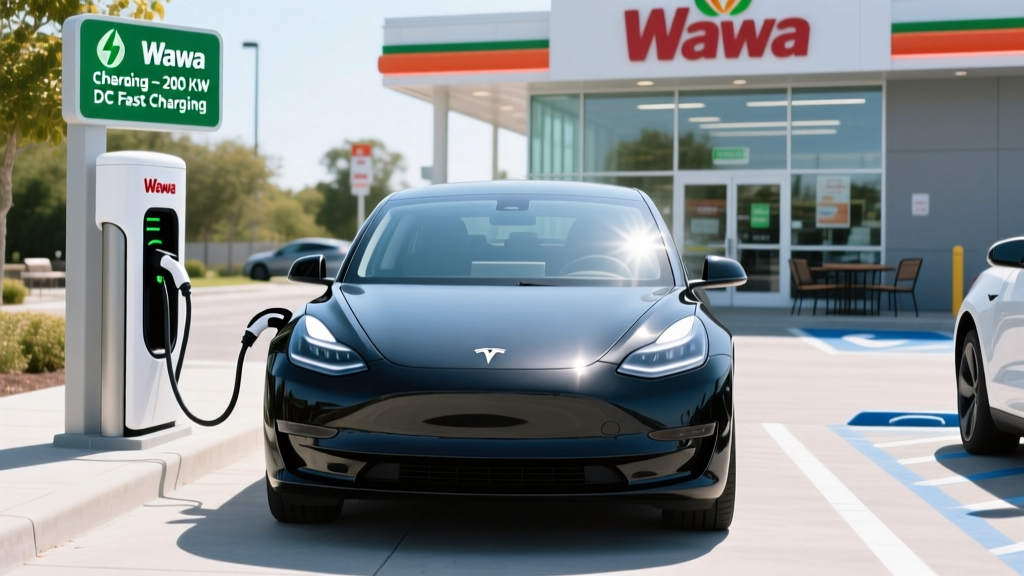
If you've searched for "Wawa Tesla charging" while planning a road trip down the East Coast, you're not alone. Wawa has aggressively expanded its EV charging footprint across Pennsylvania, New Jersey, Delaware, Maryland, Virginia, and Florida — and a growing number of those stations now serve Tesla drivers directly. This guide breaks down exactly where you can charge a Tesla at Wawa, what speeds to expect, how the connector landscape has shifted in 2026, and what you'll actually pay per mile.
Why Wawa Is a Popular EV Charging Stop
Wawa's appeal for EV drivers goes beyond the hoagies. Most Wawa locations with chargers are situated along high-traffic corridors, offer 24/7 convenience store access, clean restrooms, and prepared food — the exact combination that makes a 20-30 minute DC fast-charging stop tolerable. Wawa partnered with Electrify America early on to install DC fast chargers at select locations, and as the NACS (North American Charging Standard) connector has become the dominant plug in 2026, Tesla compatibility has expanded significantly at these sites.
As of early 2026, dozens of Wawa locations across six states feature DC fast-charging stalls. Not every Wawa has chargers, and not every charger-equipped Wawa has NACS connectors, so route planning remains essential.
Charging Levels Explained: What You'll Find at Wawa and at Home
Before we get into Wawa-specific details, let's clarify the three charging levels you'll encounter as a Tesla owner — and the critical difference between kW (kilowatts, a measure of charging power/speed) and kWh (kilowatt-hours, a measure of battery energy capacity). Confusing these two is the single most common EV literacy mistake.
| Level | Voltage | Typical Power (kW) | Miles of Range Added Per Hour | Where You'll Find It |
|---|---|---|---|---|
| Level 1 | 120V AC | 1.0–1.4 kW | 3–5 miles | Standard household outlet |
| Level 2 | 240V AC | 7.2–19.2 kW | 25–75 miles | Home wall connector, public Level 2 stations |
| DC Fast Charging | 400–800V DC | 50–350 kW | 150–1,000+ miles (equivalent) | Wawa/Electrify America, Tesla Superchargers |
At Wawa locations equipped with Electrify America hardware, you'll typically find DC fast chargers rated at 150 kW or 350 kW. Tesla vehicles can also use the Tesla Supercharger network, which operates separately from Wawa's third-party chargers — but Wawa is not a Supercharger host. What Wawa offers is an alternative DC fast-charging option for Tesla drivers, particularly useful in areas where Supercharger density is lower or when you want the convenience of Wawa's amenities.
Wawa Tesla Charging: Connector Compatibility in 2026
The connector landscape has shifted dramatically since Tesla opened its Supercharger network and the NACS plug was standardized as SAE J3400. Here's where things stand for Tesla charging at Wawa in 2026:
| Tesla Model | Native Connector | Wawa/Electrify America Plug Available | Adapter Required? |
|---|---|---|---|
| Model 3 (2025+ refresh) | NACS (J3400) | NACS at select Wawa EA stalls | No — if stall has NACS cable |
| Model Y (2025+ refresh) | NACS (J3400) | NACS at select Wawa EA stalls | No — if stall has NACS cable |
| Model 3 (pre-2025) | Tesla proprietary (now NACS-compatible) | CCS1 at most EA stalls | Yes — Tesla CCS adapter (included with newer deliveries, ~$175 aftermarket) |
| Model S / Model X | Tesla proprietary | CCS1 at most EA stalls | Yes — Tesla CCS adapter required |
| Cybertruck | NACS (J3400) | NACS at select stalls | No — if stall has NACS cable |
Key takeaway: If you drive a 2025+ Tesla with a native NACS port, you can use NACS-equipped Electrify America stalls at Wawa without an adapter. If you drive an older Tesla, you'll need the Tesla CCS adapter to use the CCS1 cables that most Electrify America stalls still provide. Always check the Electrify America app for the specific connector types available at your target Wawa location before you arrive.
Charging Speeds: What to Expect at Wawa DC Fast Chargers
Wawa's Electrify America chargers are typically rated at 150 kW or 350 kW. But here's where real-world charging knowledge matters: peak rated power is not sustained power. Your Tesla's actual charge rate depends on its battery chemistry, state of charge (SoC), battery temperature, and the vehicle's onboard charge curve.
Here's what to expect for common Tesla models at a Wawa Electrify America station:
| Vehicle | Battery Capacity (usable) | Peak Charge Rate | 10–80% Time (est.) | Notes |
|---|---|---|---|---|
| Model 3 Long Range (2025) | ~75 kWh (NMC) | ~250 kW | ~25–30 minutes | Charges fastest on NACS stalls; CCS adapter may cap slightly lower |
| Model 3 Standard Range (LFP) | ~57 kWh (LFP) | ~170 kW | ~28–35 minutes | LFP chemistry accepts charge well at high SoC; can charge to 100% regularly |
| Model Y Long Range (2025) | ~75 kWh (NMC) | ~250 kW | ~25–30 minutes | Similar curve to Model 3 LR |
| Cybertruck AWD | ~123 kWh (NMC) | ~250 kW | ~40–50 minutes | Larger battery means longer session despite high peak rate |
Real-world charging curve reality: Your Tesla will only hit peak kW at a low state of charge (typically 10–30% SoC). As the battery fills, the charge rate tapers — significantly above 80% SoC. This is why 10–80% is the standard benchmark. Charging from 80–100% can take as long as the 10–80% session. For road trips, plan to charge to 80% and move on; it's the most time-efficient strategy.
One more factor: battery preconditioning. If you navigate to the Wawa charging station using your Tesla's built-in navigation, the car will automatically warm or cool the battery to optimize charge acceptance. Arriving without preconditioning — especially in cold weather — can add 5–10 minutes to your session and reduce peak kW.
How Much Does Charging at Wawa Cost?
Wawa's Electrify America chargers use per-kWh pricing, which varies by state, location, and time of day. As of early 2026, expect the following ranges:
| Scenario | Typical $/kWh | Cost to Add 200 Miles (Model 3 LR, ~3.5 mi/kWh) | Cost Per Mile |
|---|---|---|---|
| Home Level 2 (national avg. electricity) | $0.13–$0.17/kWh | $7.40–$9.70 | $0.037–$0.049 |
| Home Level 2 (off-peak TOU rate) | $0.07–$0.10/kWh | $4.00–$5.70 | $0.020–$0.029 |
| Wawa / Electrify America (guest rate) | $0.43–$0.56/kWh | $24.60–$32.00 | $0.123–$0.160 |
| Wawa / Electrify America (EA Pass+ member) | $0.33–$0.42/kWh | $18.90–$24.00 | $0.095–$0.120 |
| Tesla Supercharger (avg. national) | $0.28–$0.36/kWh | $16.00–$20.60 | $0.080–$0.103 |
| Gas car (28 MPG avg., $3.30/gal) | — | $23.60 | $0.118 |
For a Tesla Model 3 Long Range averaging roughly 3.5 miles per kWh (about 115 MPGe combined per fueleconomy.gov), charging at home on an off-peak rate is dramatically cheaper than any public option. Even at guest rates on Electrify America at Wawa, the per-mile cost is competitive with a gas car averaging 28 MPG — and with an EA Pass+ subscription ($4/month), you can undercut gas costs on road trips.
Compared to Tesla Superchargers, Wawa's Electrify America chargers tend to be slightly more expensive per kWh. The trade-off is convenience: Wawa's food and facilities can make the stop more pleasant than a standalone Supercharger lot.
Home Charging Setup: The Real Cost and What You Need
Most Tesla owners do the vast majority of their charging at home. A Level 2 home charger is the single best investment for EV ownership — it's faster, cheaper, and more convenient than any public network. But installation costs vary enormously based on your home's electrical infrastructure.
Electrical Requirements for a Tesla Wall Connector
The Tesla Wall Connector (Gen 3) supports up to 48 amps of continuous draw, which requires a 60-amp dedicated circuit on a 240V line. Here's what that means in practice:
- Ideal setup: 240V / 60A dedicated circuit → 48A continuous → up to 11.5 kW → ~44 miles of range per hour for a Model 3
- Common compromise: 240V / 40A dedicated circuit → 32A continuous → up to 7.7 kW → ~30 miles of range per hour
- Minimum viable: 240V / 20A circuit (e.g., existing dryer outlet) → 16A continuous → up to 3.8 kW → ~14 miles per hour
If your electrical panel is already near capacity (common in homes built before 2000 with 100A service), you may need a panel upgrade to 200A, which is the single largest variable in home charger installation cost.
| Component | Simple Install (panel has capacity, short run) | Moderate Install (longer wire run, conduit) | Complex Install (panel upgrade needed) |
|---|---|---|---|
| Charger equipment (Tesla Wall Connector) | $475 | $475 | $475 |
| Electrician labor | $400–$800 | $800–$1,500 | $1,200–$2,000 |
| Wire, conduit, breakers | $100–$250 | $250–$600 | $300–$600 |
| Electrical permit | $50–$150 | $50–$200 | $50–$200 |
| Panel upgrade (if needed) | $0 | $0 | $1,500–$3,500 |
| Total range | $1,025–$1,675 | $1,575–$2,775 | $3,525–$6,775 |
Always hire a licensed electrician and pull a permit. Unpermitted electrical work can void your homeowner's insurance and create fire risk. The National Electrical Code (NEC) requires EV chargers to be on a dedicated circuit with appropriate overcurrent protection. For outdoor installations, ensure your Wall Connector is rated for outdoor use (the Gen 3 Tesla Wall Connector is NEMA 4 rated and suitable for outdoor mounting).
Recommended Home Charging Equipment
| Charger | Max Output | Connector | Cable Length | Smart Features | Price |
|---|---|---|---|---|---|
| Tesla Wall Connector (Gen 3) | 11.5 kW (48A) | NACS (native Tesla) | 24 ft | Wi-Fi, OTA updates, load sharing, access control | $475 |
| ChargePoint Home Flex | 12 kW (50A) | NACS or CCS (configurable) | 23 ft | App scheduling, Alexa, energy reports | $549–$599 |
| Emporia Vue Level 2 | 11.5 kW (48A) | NACS (J3400) | 24 ft | Energy monitoring, solar integration, app control | $399 |
| Grizzl-E Smart | 10 kW (40A) | NACS or J1772 | 24 ft | Smart app, OCPP, durable outdoor build | $499 |
For Tesla-only households, the Tesla Wall Connector is the obvious default — native NACS plug, seamless integration, and competitive pricing. If you have a mixed fleet (Tesla + a non-Tesla EV), the ChargePoint Home Flex or a dual-connector setup gives you flexibility without adapters.
Safety and Code Considerations for Home Charging
EV charging draws sustained high current for hours — more like a welder than a typical household appliance. This makes code compliance non-negotiable:
- Dedicated circuit: Your EV charger must be on its own dedicated breaker. Sharing a circuit with other appliances is a code violation and a fire hazard.
- GFCI protection: NEC 2020 and later require GFCI protection for outdoor receptacles used for EV charging. Hardwired Wall Connectors may not require a GFCI breaker in all jurisdictions — check with your local inspector.
- Outdoor rating: If mounting outdoors, use equipment rated NEMA 4 or higher. The Tesla Wall Connector Gen 3 is rated for both indoor and outdoor use.
- Wire gauge: A 60A circuit typically requires 6 AWG copper wire (THHN in conduit) or 4 AWG NM-B cable. Your electrician will size wire based on run length and local code.
- Permit and inspection: Most jurisdictions require an electrical permit for EV charger installation. The inspection ensures the work meets NEC and local amendments. Don't skip this — it protects your home and your insurance coverage.
Finding Wawa Tesla Charging Locations: Route Planning Tips
Not every Wawa has EV chargers, and connector availability varies by site. Here's how to plan effectively:
- Use the Electrify America app: Filter by NACS or CCS connector type, check real-time stall availability, and see pricing before you drive there. The EA app shows which Wawa locations have active chargers.
- Tesla in-app navigation: Your Tesla's navigation will route you to Superchargers by default. Wawa/Electrify America stations won't appear as native navigation targets unless you add them manually or use a third-party app like PlugShare.
- PlugShare or A Better Routeplanner (ABRP): These third-party tools let you filter by network (Electrify America), connector type, and location — useful for finding Wawa chargers along your route.
- Precondition your battery: Add the Wawa/Electrify America stop to your Tesla navigation (even as a waypoint) so the car begins preconditioning the battery before arrival.
- Have a backup: Public chargers can be out of service. Always identify a backup charging option within 5–10 miles of your target Wawa, especially in rural stretches.
For the latest on Wawa charging locations, check Electrify America's station locator and filter by Wawa-branded sites.
Wawa vs. Tesla Supercharger: Which Should You Use?
Wawa's Electrify America chargers and the Tesla Supercharger network serve the same fundamental purpose — DC fast charging on the go — but the experience differs:
- Superchargers offer native Tesla integration: the car routes you there, preconditions automatically, and billing is seamless via your Tesla account. Pricing averages $0.28–$0.36/kWh nationally, with off-peak discounts at some urban stations.
- Wawa/Electrify America offers better amenities (food, restrooms, convenience store) and can be a strong alternative when Superchargers are occupied, out of service, or not conveniently located. Pricing is typically higher at guest rates, but competitive with an EA Pass+ subscription.
The practical answer: use Superchargers as your primary road-trip network, and use Wawa chargers as a convenient supplement or backup — especially when you want a quality food stop during your charge session.
Frequently Asked Questions
Does Wawa have Tesla Superchargers?
No. Wawa hosts Electrify America DC fast chargers, not Tesla Superchargers. However, with the NACS connector now standard on new Teslas and available at select Electrify America stalls, Tesla drivers can charge at Wawa without an adapter at NACS-equipped locations. Older Teslas need a CCS adapter for most EA stalls.
How much does it cost to charge a Tesla at Wawa?
Expect to pay $0.43–$0.56/kWh at guest rates, or $0.33–$0.42/kWh with an Electrify America Pass+ subscription. For a Tesla Model 3 Long Range adding 200 miles, that's roughly $25–$32 at guest rates or $19–$24 with a subscription.
How fast will I charge at a Wawa Electrify America station?
Most Wawa EA chargers are 150 kW or 350 kW units. A Tesla Model 3 Long Range will typically charge from 10–80% in 25–30 minutes. The Cybertruck, with its larger ~123 kWh battery, takes closer to 40–50 minutes for the same session.
Do I need an adapter to charge my Tesla at Wawa?
If your Tesla has a native NACS port (2025+ models) and the Wawa EA stall has a NACS cable, no adapter is needed. For older Teslas or stalls with CCS1 cables, you'll need a Tesla CCS adapter.
How much does it cost to install a home EV charger?
A simple installation with adequate panel capacity runs $1,025–$1,675 including the Tesla Wall Connector, electrician labor, materials, and permit. If your home needs a 200A panel upgrade, total cost can reach $3,525–$6,775. Always get a quote from a licensed electrician who will perform a load calculation first.
Is it cheaper to charge at home or at Wawa?
Home charging is dramatically cheaper. At the national average electricity rate of ~$0.15/kWh, adding 200 miles to a Model 3 costs about $8.60. The same 200 miles at Wawa's Electrify America guest rate costs $25–$32. Home charging with an off-peak time-of-use rate can drop the cost below $5.
Sources: EPA efficiency data via fueleconomy.gov; Electrify America pricing and station data via electrifyamerica.com; Tesla Wall Connector specs via Tesla's official product pages.