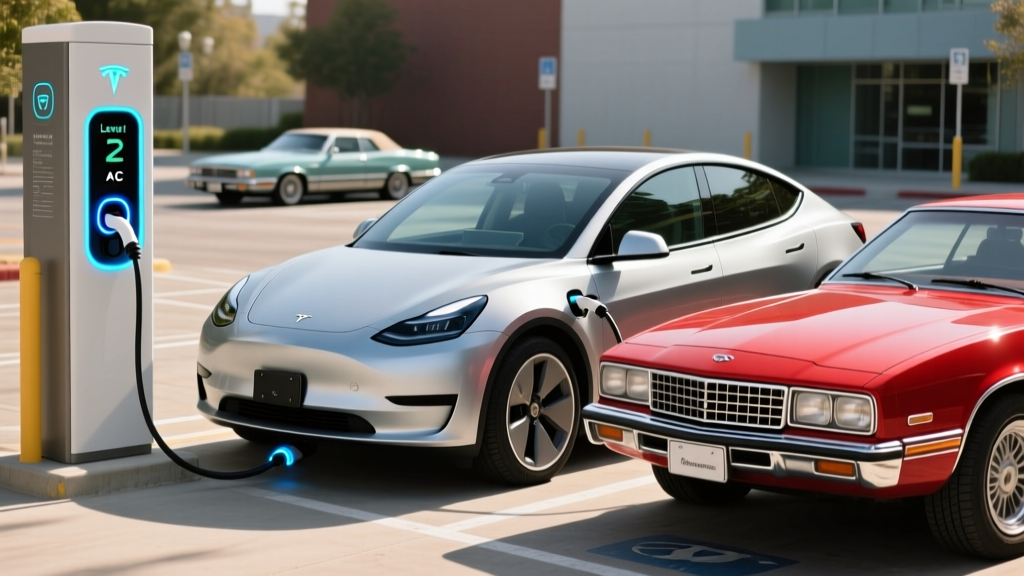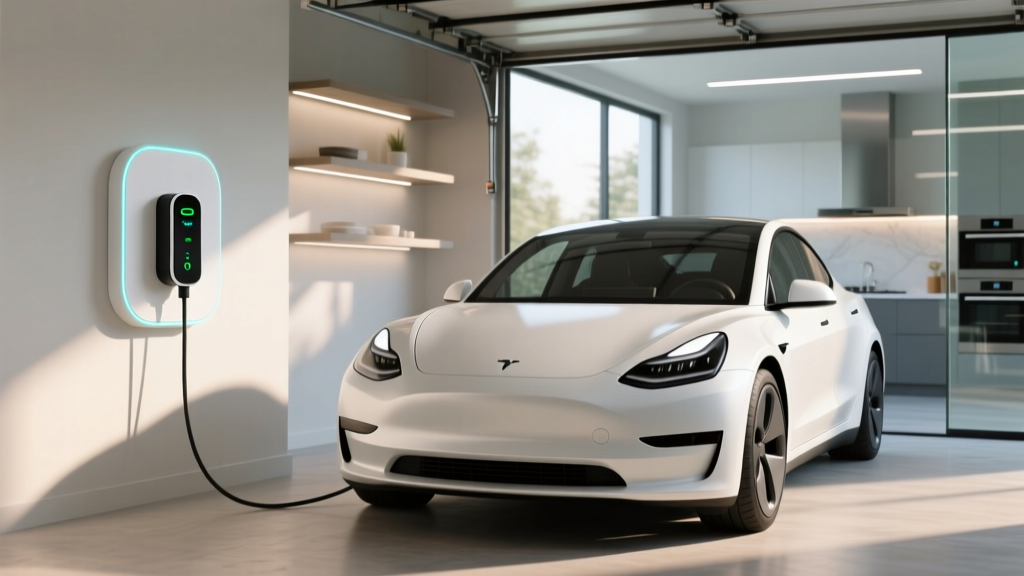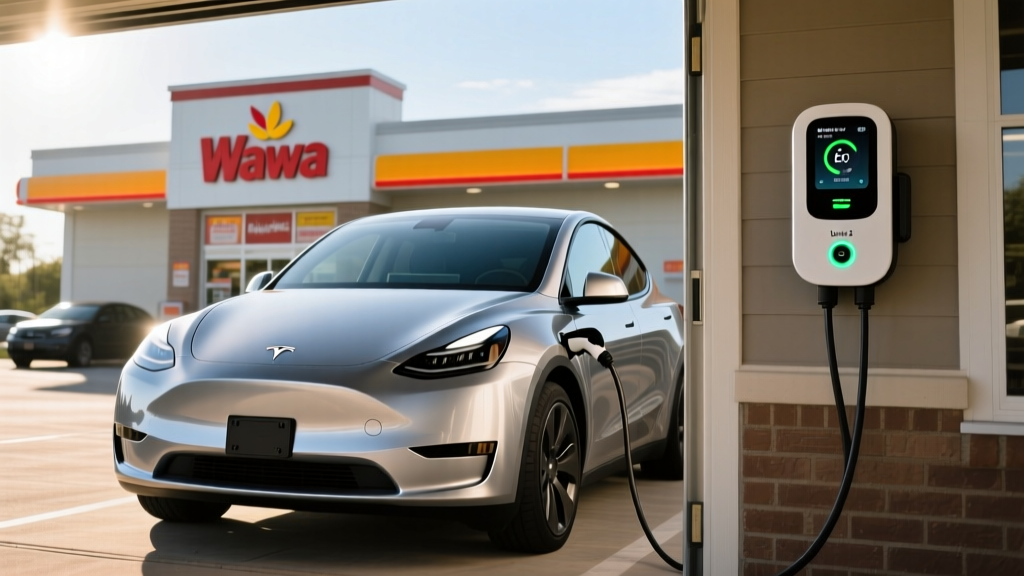
If you've searched for Wawa Tesla chargers while planning a road trip down the East Coast, you're not alone. Wawa's partnership with Tesla has brought Supercharger stalls to select convenience store locations across Pennsylvania, New Jersey, Delaware, Maryland, Virginia, and Florida — pairing fast DC charging with hot coffee and hoagies. But relying solely on public fast charging is expensive and hard on your battery long-term. This guide covers what you'll find at Wawa Supercharger sites, how public DC fast charging actually works, and how to set up a far cheaper Level 2 home charger that adds range overnight while you sleep.
Wawa Tesla Supercharger Locations: What's Actually There
As of early 2026, Wawa hosts Tesla Supercharger stalls at dozens of locations across its six-state footprint. Most sites feature V3 Superchargers capable of delivering up to 250 kW of peak DC power, though some newer installations include V4 cabinets with integrated CCS connectors — meaning non-Tesla EVs with CCS1 ports can charge without an adapter at those specific stalls.
Here's what a typical Wawa Supercharger stop looks like in practice:
- Peak power: 250 kW (V3 stalls)
- 10–80% charge time: ~15–25 minutes depending on vehicle (e.g., Tesla Model Y Long Range: ~22 min; Model 3 Highland: ~18 min)
- Connector: NACS (Tesla native); CCS1 at select V4 sites
- Amenities: Full convenience store, fuel, food service, restrooms
- Pricing: Typically $0.31–$0.48/kWh depending on location and time-of-use; Tesla members pay lower rates
To find specific Wawa Supercharger locations, use the in-car Tesla navigation (which routes through Superchargers automatically) or check Tesla's Supercharger map and filter by Wawa. You can also search directly in the Tesla app under the Charging tab.
Charging Levels Explained: Speeds, Power, and Range Added
Understanding EV charging requires one critical distinction: kW (kilowatts) measures power — how fast energy flows into your battery. kWh (kilowatt-hours) measures energy — the total capacity of your battery, like gallons in a gas tank. A 75 kWh battery charged at 7.5 kW takes roughly 10 hours from empty. Confusing these two is the single most common EV literacy gap.
| Level | Voltage / Power | Miles of Range Added per Hour | Best For |
|---|---|---|---|
| Level 1 (120V household) | 120V / 1.4–1.9 kW | 3–5 miles/hr | Overnight top-ups, PHEVs, emergency use |
| Level 2 (240V home/public) | 240V / 7.2–19.2 kW | 20–60 miles/hr | Daily home charging, workplace, destinations |
| DC Fast Charging (public) | 400–800V / 50–350 kW | 150–300+ miles/hr (peak) | Road trips, quick top-ups, commercial fleets |
For context, a Tesla Model Y Long Range with a ~75 kWh usable battery charging at home on a 48-amp Level 2 circuit (11.5 kW) will add roughly 44 miles of range per hour — enough to go from 20% to 80% overnight in about 5 hours. That same vehicle at a Wawa V3 Supercharger can add ~200 miles in 15 minutes.
Home Level 2 Charger Installation: Requirements and Costs
While Wawa Tesla chargers are convenient on the road, most EV owners do 80%+ of their charging at home. A Level 2 home charger running on a dedicated 240V circuit is the single highest-impact upgrade you can make for EV ownership — it eliminates range anxiety, slashes your per-mile fuel cost, and is gentler on battery health than daily DC fast charging.
Electrical Requirements
A typical home Level 2 installation requires:
- Circuit: Dedicated 240V circuit, typically 40A, 50A, or 60A breaker
- Continuous load rule: NEC requires EV chargers to use no more than 80% of circuit capacity — a 48A charger needs a 60A breaker
- Wire gauge: 6 AWG copper for 50A; 4 AWG for 60A (your electrician will size this)
- Panel capacity: Most modern 200A service panels can accommodate a 40–60A EV circuit. Older 100A panels often cannot.
Panel Upgrade: The Hidden Cost
If your home has a 100-amp electrical panel — common in homes built before the 1990s — adding a 50A or 60A EV circuit may exceed your panel's capacity. A panel upgrade to 200A service typically costs $1,500–$3,500 depending on your utility, local labor rates, and whether a new meter base or service drop is needed. This is the single biggest variable in home charger installation cost and one that online calculators routinely underestimate.
Some homes can avoid a panel upgrade by using a lower-amperage charger (e.g., 32A on a 40A circuit draws only 7.7 kW — still adequate for overnight charging) or by installing a smart panel-level load manager like the Emporia VUE with automatic curtailment.
| Component | Low End | High End | Notes |
|---|---|---|---|
| Level 2 charger (hardwired or NEMA 14-50) | $350 | $750 | 40A–48A Wi-Fi-enabled unit |
| Licensed electrician labor | $400 | $1,500 | Varies by run length, conduit, wall material |
| Electrical permit | $50 | $200 | Required in most jurisdictions; inspection included |
| Panel upgrade (if needed) | $1,500 | $3,500 | 100A → 200A service; not always required |
| Total (no panel upgrade) | $800 | $2,450 | Most homes with 200A service |
| Total (with panel upgrade) | $2,300 | $5,950 | Older homes with 100A service |
Always hire a licensed electrician and pull a permit. Unpermitted EV charger installations can void home insurance claims and create fire risk — a dedicated GFCI-protected circuit with proper wire sizing is non-negotiable per NEC Article 625.
Connector Compatibility: NACS, CCS1, and CHAdeMO
The connector landscape has consolidated significantly since Tesla opened its North American Charging Standard (NACS) to other automakers. Here's where things stand in 2026:
| Connector | Brands Using It (Native) | Adapter Needed for Tesla Superchargers? |
|---|---|---|
| NACS (Tesla) | Tesla, Ford (2025+), GM (2025+), Rivian, Volvo/Polestar (2025+), Hyundai/Kia (2026+ models) | No — native at all Superchargers |
| CCS1 | VW, BMW, Mercedes, Hyundai/Kia (pre-2026), most legacy non-Tesla EVs | Yes — Tesla provides a CCS-to-NACS adapter (~$250); some V4 Superchargers have native CCS cables |
| CHAdeMO | Nissan Leaf (legacy), Mitsubishi Outlander PHEV | Not compatible with Superchargers; use Electrify America or EVgo networks |
If you drive a non-Tesla EV with a CCS1 port, you can access Tesla Superchargers (including those at Wawa) that have been opened to non-Tesla vehicles via Tesla's Magic Dock adapter built into newer stalls, or by purchasing Tesla's CCS adapter. Check the Tesla app for station-by-station non-Tesla access before you drive there.
Charging Cost: Home vs. Wawa Supercharger vs. Gas
The economics of EV charging depend heavily on where you charge. Home charging on off-peak utility rates is dramatically cheaper than public DC fast charging — and both are usually cheaper than gasoline.
| Scenario | Rate | Cost per Mile* | Annual Cost (12,000 mi) |
|---|---|---|---|
| Home Level 2 (off-peak utility rate) | $0.09–$0.14/kWh | $0.03–$0.04 | $360–$480 |
| Home Level 2 (standard rate, no TOU) | $0.15–$0.22/kWh | $0.05–$0.07 | $600–$840 |
| Wawa Tesla Supercharger (DC fast) | $0.31–$0.48/kWh | $0.10–$0.16 | $1,200–$1,920 |
| Gasoline vehicle (28 MPG avg, $3.40/gal) | $3.40/gallon | $0.12 | $1,457 |
*Based on a Tesla Model Y Long Range averaging 3.0 miles/kWh (EPA combined 28 kWh/100mi). Your efficiency varies with temperature, speed, and terrain.
The takeaway: if you charge exclusively at Wawa Superchargers, your "fuel" cost can approach or even exceed gasoline. Home charging is where EV economics shine — cutting per-mile cost to one-quarter to one-third of gas. For PHEV owners with smaller batteries (10–20 kWh), Level 1 charging from a standard 120V outlet may actually suffice for daily electric-only driving.
Best Home Level 2 Chargers for 2026
Here are our top equipment picks based on reliability, smart features, connector flexibility, and value. All units listed support NACS natively or via included adapter.
Tesla Wall Connector (Gen 3)
- Power output: Up to 11.5 kW (48A on 60A circuit)
- Connector: NACS native; J1772 adapter included
- Cable length: 24 feet
- Smart features: Wi-Fi, OTA updates, power-sharing between two units, Tesla app integration
- Price: ~$475
- Best for: Tesla owners who want seamless integration and don't need third-party scheduling
ChargePoint Home Flex
- Power output: Up to 12 kW (50A, configurable from 16A–50A)
- Connector: NACS or J1772 (select at purchase); NACS version available 2025+
- Cable length: 23 feet
- Smart features: Wi-Fi, ChargePoint app scheduling, Alexa integration, detailed energy tracking
- Price: ~$550–$650
- Best for: Multi-EV households with non-Tesla vehicles; excellent app and scheduling
Emporia Level 2 EV Charger
- Power output: Up to 11.5 kW (48A on 60A circuit)
- Connector: J1772 native; NACS adapter included
- Cable length: 24 feet
- Smart features: Wi-Fi, Emporia app, integrates with Emporia VUE energy monitor for solar-aware and load-managed charging
- Price: ~$399
- Best for: Budget-conscious buyers and homes with solar panels or panel-capacity concerns
Grizzl-E Smart (United Chargers)
- Power output: Up to 10 kW (40A on 50A circuit)
- Connector: J1772 or NACS (select at purchase)
- Cable length: 24 feet
- Smart features: Wi-Fi, OCPP-compatible (works with utility demand-response programs), extreme cold-rated to -40°F
- Price: ~$499
- Best for: Cold-climate garages and outdoor installations; rugged aluminum build
For most Tesla owners, the Tesla Wall Connector at 48A is the default recommendation — it charges faster than any competitor at the same circuit amperage, and the power-sharing feature lets you install two units on a single 60A circuit. For households with mixed EV brands, the ChargePoint Home Flex with NACS connector offers the best combination of flexibility and smart scheduling.
Safety, Code, and Installation Best Practices
EV charging draws sustained high current for hours — unlike a dryer or oven that cycles on and off. This makes proper installation critical:
- Dedicated circuit: Your EV charger must have its own dedicated breaker — never share a circuit with other appliances.
- GFCI protection: NEC 2020 and later requires GFCI protection for all EV charging outlets (hardwired units may have built-in GFCI; receptacle-based installations need a GFCI breaker).
- Outdoor rating: If installing outside, ensure the charger carries a NEMA 4 or IP65 rating. All units listed above are outdoor-rated.
- NEMA 14-50 vs. hardwired: A NEMA 14-50 receptacle offers portability (take the charger when you move) but requires a GFCI breaker (~$100–$150 extra). Hardwired installations eliminate the receptacle failure point and are preferred for permanent installations.
- Permit and inspection: Always pull an electrical permit. The inspection verifies wire sizing, breaker rating, grounding, and GFCI compliance — protecting you from fire risk and insurance disputes.
Charging Time Examples: 10–80% for Common EVs
How long does a charging session actually take? Here are 10–80% estimates for popular 2025–2026 EVs across charging levels:
| Vehicle | Battery (usable kWh) | Level 2 at 11.5 kW | DC Fast (peak kW) | 10–80% DC Fast Time |
|---|---|---|---|---|
| Tesla Model Y Long Range | 75 kWh (NMC) | ~4.5 hours | 250 kW | ~22 minutes |
| Tesla Model 3 Highland LR | 75 kWh (NMC) | ~4.5 hours | 250 kW | ~18 minutes |
| Ford F-150 Lightning Ext. Range | 131 kWh (NMC) | ~8 hours | 150 kW | ~41 minutes |
| Hyundai Ioniq 5 (Long Range) | 77.4 kWh (NMC) | ~5 hours | 240 kW (800V) | ~18 minutes |
| Chevrolet Equinox EV 3RS | 85 kWh (NMC) | ~5.5 hours | 150 kW | ~30 minutes |
| Tesla Model Y (LFP Standard Range) | 57.5 kWh (LFP) | ~3.5 hours | 170 kW | ~25 minutes |
Note that LFP (lithium iron phosphate) batteries, like those in the Standard Range Model Y, have slower peak charge rates than NMC chemistries but can be charged to 100% daily without degradation concerns — a trade-off worth understanding when choosing a trim level.
Frequently Asked Questions
Are there Tesla Superchargers at Wawa locations?
Yes. Wawa hosts Tesla Supercharger stalls at select locations across Pennsylvania, New Jersey, Delaware, Maryland, Virginia, and Florida. Most feature V3 Superchargers at up to 250 kW. Use the Tesla app or in-car navigation to find specific Wawa Supercharger sites and check real-time stall availability.
How much does it cost to install a home EV charger?
Expect $800–$2,450 for a standard Level 2 installation in a home with adequate 200A panel capacity (charger + electrician + permit). If your home needs a panel upgrade from 100A to 200A service, add $1,500–$3,500, bringing the total to $2,300–$5,950. Always get 2–3 quotes from licensed electricians.
Can non-Tesla EVs charge at Wawa Superchargers?
Some Wawa Supercharger sites with V4 stalls offer native CCS1 connectors for non-Tesla EVs. Additionally, Tesla's Magic Dock adapter (built into select V3 stalls) allows CCS-equipped vehicles to charge. Check the Tesla app for non-Tesla access at each specific station.
How fast will a Level 2 home charger add range?
A 48A Level 2 charger on a 60A circuit delivers 11.5 kW, adding approximately 35–45 miles of range per hour for most EVs (efficiency varies by vehicle). This means a full overnight charge from 20% to 80% takes roughly 4–5 hours — more than sufficient for daily driving needs.
Is daily DC fast charging at Wawa bad for my battery?
Frequent DC fast charging accelerates battery degradation modestly — studies show ~2–3% additional capacity loss over 100,000 miles compared to exclusive Level 2 charging. Tesla's thermal management system mitigates this, but for long-term battery health, home Level 2 charging should be your primary routine with DC fast charging reserved for road trips.
Do I qualify for a tax credit on home charger installation?
The federal Alternative Fuel Vehicle Refueling Property Credit (IRS Form 8911) covers up to 30% of home EV charger equipment and installation costs, capped at $1,000. However, eligibility is restricted to census tracts classified as low-income or non-urban. Check IRS guidelines and consult a tax professional to confirm your eligibility based on your specific address.
What electrical upgrades might I need for a home charger?
The most common upgrade is a panel capacity increase from 100A to 200A service ($1,500–$3,500). Other potential needs include: a new conduit run from panel to garage/carport, upgrading from a 3-prong dryer outlet to a NEMA 14-50 receptacle, or adding a whole-home surge protector. Your electrician will assess panel load calculations before recommending upgrades.
Whether you're topping up at a Wawa Tesla Supercharger on I-95 or plugging in at home every night, understanding your charging options — and their real costs — is the key to confident EV ownership. Prioritize a home Level 2 install for daily charging, use DC fast chargers like those at Wawa for road trips, and your per-mile fuel cost will stay firmly in the single-digit cents.