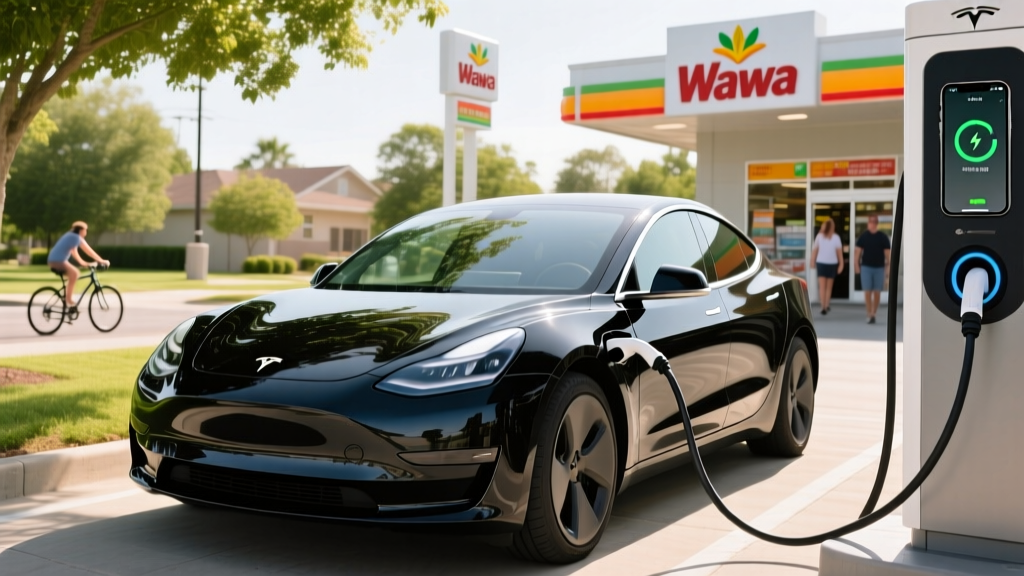
If you've searched for a Wawa Tesla charger, you've likely noticed that the convenience-store chain has become an unexpected player in the EV charging landscape. Over the past few years, Wawa has partnered with Tesla to install Supercharger stalls at select locations across the Mid-Atlantic and Southeast — combining 250 kW DC fast charging with made-to-order food and coffee. But how widespread are these stations, and how do they fit into a broader EV charging strategy that includes home Level 2 setups and other public networks?
This guide covers everything: where Wawa Tesla chargers exist, how Level 1, Level 2, and DC fast charging actually work (with real numbers), what a home installation costs down to the permit, and exactly what you'll pay per mile compared to gasoline.
Wawa Tesla Charger: Where Are They and What to Expect
Wawa began hosting Tesla Supercharger stalls at high-traffic locations primarily in Pennsylvania, New Jersey, Delaware, Maryland, Virginia, North Carolina, and Florida. These installations typically feature V3 Supercharger cabinets capable of delivering up to 250 kW peak to compatible vehicles using the NACS (North American Charging Standard) connector.
Here's what that means in practice for popular Tesla models:
- Model 3 Long Range (82 kWh usable, NMC): 10–80% in approximately 25–30 minutes at a 250 kW stall, adding roughly 175 miles of EPA range.
- Model Y Long Range (81 kWh usable, NMC): 10–80% in approximately 27–32 minutes, adding roughly 165 miles.
- Model S (100 kWh usable): 10–80% in approximately 30–38 minutes, adding roughly 200 miles.
Non-Tesla EVs with NACS ports (Ford F-150 Lightning, Rivian R1S/R1T, and newer GM EVs with native NACS) can also access these Superchargers via the Tesla app. CCS-equipped vehicles need a Tesla NACS-to-CCS adapter (approximately $250) to connect.
Charging Levels Explained: Speeds, kW, and Miles Per Hour
The single most important distinction in EV charging is between kW (kilowatts) — the rate of power delivery — and kWh (kilowatt-hours) — the total energy stored in your battery. Think of kW as how fast water flows through a hose, and kWh as the size of the bucket you're filling. Confusing these two is the most common EV literacy gap.
| Level | Voltage / Amperage | Power (kW) | Miles of Range Added Per Hour | Best For |
|---|---|---|---|---|
| Level 1 | 120V / 12A | 1.4 kW | 3–5 mi/hr | Overnight top-ups, PHEVs, low-mileage drivers |
| Level 2 | 240V / 32–48A | 7.7–11.5 kW | 25–44 mi/hr | Daily home charging, full overnight replenishment |
| DC Fast (Level 3) | 400–800V DC | 50–350 kW | 150–1,000+ mi/hr (peak) | Road trips, rapid replenishment, commercial fleets |
For context, a typical EV with a 75 kWh battery and 3.5 mi/kWh efficiency will fully recharge from 10% to 100% on a 48A Level 2 home charger in roughly 7–8 hours. That same 10–80% session on a 250 kW DC fast charger takes approximately 20–28 minutes, depending on battery chemistry and thermal management.
Home Level 2 Charger Installation: Electrical Requirements and Costs
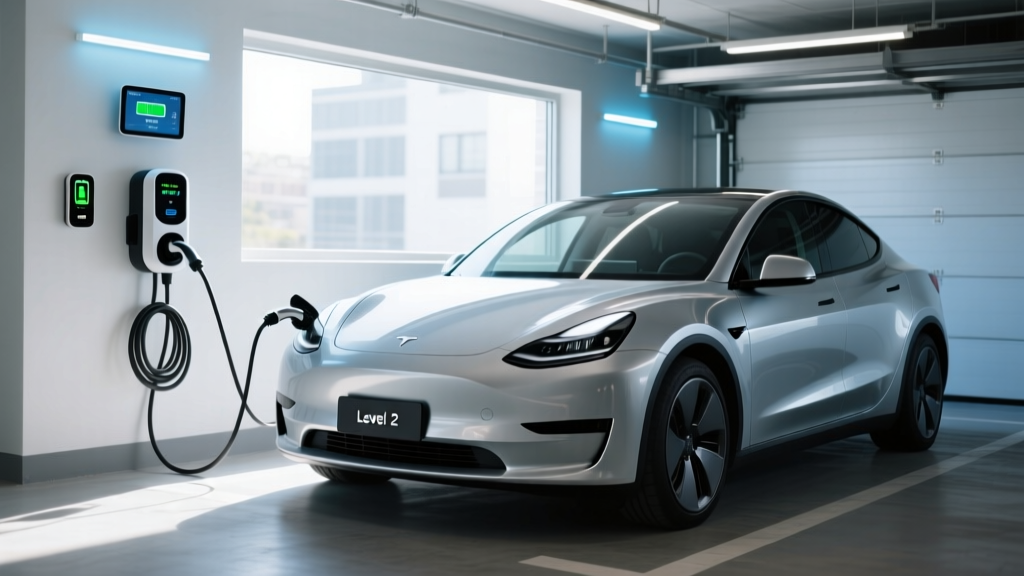
Installing a Level 2 home charger is the single highest-impact upgrade for EV ownership. You'll need a dedicated 240V circuit — typically 40A or 50A — run from your electrical panel to your garage or driveway.
Electrical Requirements
- Circuit: Dedicated 240V, 40A or 50A breaker (NEC requires the circuit be rated 125% of the continuous load, so a 40A circuit supports a 32A charger; a 50A circuit supports a 40A charger)
- Wire gauge: 6 AWG copper for 50A circuits; 8 AWG for 40A
- Outlet vs. hardwired: NEMA 14-50 outlet offers portability; hardwired units allow higher amperage and eliminate GFCI nuisance tripping common with 14-50 receptacles
- GFCI protection: Required by NEC 2020+ for receptacle installations; hardwired units have internal ground-fault protection
- Outdoor rating: If installed outside, the charger must carry a NEMA 4 (weatherproof) rating
Panel Upgrade: The Hidden Cost
Most modern homes with 200A electrical service can accommodate a 40–50A EV circuit without a panel upgrade. However, older homes with 100A service — common in homes built before 1990 — may require a panel upgrade to 200A. A licensed electrician will perform a load calculation per NEC Article 220 to determine whether your existing panel has sufficient headroom.
| Component | Low Estimate | High Estimate | Notes |
|---|---|---|---|
| Level 2 charger (equipment) | $350 | $750 | 40–48A smart chargers; Wi-Fi enabled |
| Electrician labor + materials | $400 | $1,800 | Varies by run length, conduit, wall penetration |
| Permit + inspection | $50 | $300 | Required by most jurisdictions; varies by municipality |
| Panel upgrade (if needed) | $1,500 | $4,000 | 100A → 200A service upgrade; not always required |
| Total (no panel upgrade) | $800 | $2,850 | Most homeowners pay $1,200–$1,800 |
| Total (with panel upgrade) | $2,300 | $6,850 | Older homes with 100A service |
The federal Residential Clean Energy Credit covers 30% of home charging equipment and installation costs (up to $1,000) through 2032. Some utilities and states offer additional rebates — check with your local provider, as these vary significantly by jurisdiction.
Connector Compatibility: NACS, CCS, and CHAdeMO
The connector landscape has consolidated significantly since 2023, when Ford, GM, Rivian, Volvo, and most major automakers committed to adopting the NACS (North American Charging Standard) — the connector Tesla developed and opened to the industry.
| Connector | Vehicles Using It (2025–2026) | Network Access | Adapter Needed? |
|---|---|---|---|
| NACS (Tesla) | Tesla (all), Ford, GM, Rivian, Volvo, Polestar, Mercedes, newer Hyundai/Kia | Tesla Superchargers + growing NACS stations on EA, ChargePoint | No (native); CCS→NACS adapter for legacy CCS vehicles (~$200–$250) |
| CCS1 | Legacy VW ID.4, older Hyundai Ioniq 5/6, BMW iX, pre-2025 models | Electrify America, EVgo, ChargePoint, Ionity (EU) | NACS→CCS adapter needed for Tesla Superchargers |
| CHAdeMO | Nissan Leaf (legacy); essentially discontinued for new vehicles | Declining network; some EA and EVgo stations retain connectors | Limited adapter options; consider trade-in |
For home Level 2 charging, all vehicles use the J1772 connector (or NACS, which includes J1772 AC pins). Tesla ships a J1772-to-NACS adapter with every vehicle, so any Level 2 charger with a J1772 plug will charge a Tesla.
Cost to Charge: Home vs. Public vs. Gas
The economics of EV charging depend heavily on where you charge. Home charging on a time-of-use (TOU) plan is dramatically cheaper than public DC fast charging — and both are typically cheaper than gasoline on a per-mile basis.
| Scenario | $/kWh | Vehicle Efficiency | Cost Per Mile | Cost for 300 Miles |
|---|---|---|---|---|
| Home (off-peak TOU) | $0.09 | 3.5 mi/kWh | $0.026 | $7.71 |
| Home (standard rate) | $0.16 | 3.5 mi/kWh | $0.046 | $13.71 |
| Public Level 2 (workplace/mall) | $0.25 | 3.5 mi/kWh | $0.071 | $21.43 |
| DC Fast (Electrify America, EVgo) | $0.48 | 3.5 mi/kWh | $0.137 | $41.14 |
| Tesla Supercharger (avg.) | $0.32 | 3.5 mi/kWh | $0.091 | $27.43 |
| Gasoline (28 MPG avg., $3.40/gal) | $3.40/gal | 28 MPG | $0.121 | $36.43 |
The takeaway: home charging is 3–5× cheaper than gasoline per mile, while exclusive reliance on DC fast charging can approach or exceed gas costs. This is why home Level 2 installation pays for itself quickly — often within the first year of ownership for a 12,000-mile/year driver.
Recommended Home Level 2 Chargers
Not all Level 2 chargers are equal. Below are three well-regarded options spanning different budgets and feature sets. All use the J1772 connector (compatible with every EV via adapter for NACS vehicles) unless otherwise noted.
Tesla Wall Connector (Gen 3) — Best for Tesla/NACS Owners
- Power output: Up to 11.5 kW (48A) on a 60A circuit
- Connector: NACS native; includes J1772 adapter in box
- Cable length: 24 feet
- Smart features: Wi-Fi, OTA firmware updates, load sharing with up to 6 units, power-sharing for multi-stall garages
- Price: ~$475
- Outdoor rating: NEMA 4 (indoor/outdoor)
ChargePoint Home Flex — Best Universal Smart Charger
- Power output: Up to 12 kW (50A) on a 60A circuit; adjustable 16–50A via DIP switch
- Connector: J1772 (NACS adapter included for Tesla owners)
- Cable length: 23 feet
- Smart features: Wi-Fi, Alexa integration, detailed app with scheduling, energy tracking, and TOU optimization
- Price: ~$650
- Outdoor rating: NEMA 4 (indoor/outdoor)
Emporia Level 2 EV Charger — Best Budget Smart Option
- Power output: Up to 11.5 kW (48A) on a 60A circuit
- Connector: J1772
- Cable length: 24 feet
- Smart features: Wi-Fi, app-based scheduling, integrates with Emporia Vue energy monitor for solar-aware charging
- Price: ~$350
- Outdoor rating: NEMA 4 (indoor/outdoor)
Charging Times by Battery Size: 10–80% Estimates
Charging time depends on battery capacity (kWh), peak charge rate (kW), and the charge curve profile. Most EVs charge fastest between 10–50% SoC, then taper progressively. Below are realistic 10–80% times for common battery sizes.
| Battery Size | Example Vehicles | Level 2 (11.5 kW) 10–80% | DC Fast (150 kW peak) 10–80% | DC Fast (250 kW peak) 10–80% |
|---|---|---|---|---|
| 60 kWh (usable) | Chevy Equinox EV, base Model 3 RWD | ~3.5 hours | ~28 min | ~20 min |
| 75 kWh (usable) | Ford Mustang Mach-E Extended Range | ~4.5 hours | ~32 min | ~22 min |
| 82 kWh (usable) | Tesla Model 3 LR, Hyundai Ioniq 5 | ~5 hours | ~35 min | ~25 min |
| 100 kWh (usable) | Tesla Model S/X, GMC Sierra EV | ~6 hours | ~42 min | ~30 min |
| 131 kWh (usable) | Ford F-150 Lightning Extended Range | ~8 hours | ~55 min | ~41 min |
Note that 800V-architecture vehicles (Hyundai Ioniq 5/6, Kia EV6/EV9, Porsche Taycan, Audi e-tron GT) sustain higher charge rates longer due to lower current at equivalent power, yielding faster real-world 10–80% times than their peak kW figure alone would suggest.
Safety, Permits, and Code Considerations
A Level 2 EV charger is a significant continuous electrical load — the NEC defines it as running for 3+ hours continuously. This triggers specific code requirements:
- Dedicated circuit: Your EV charger must have its own breaker — it cannot share a circuit with other appliances or outlets.
- 125% rule: The circuit breaker must be rated at 125% of the charger's maximum draw. A 40A charger requires a 50A breaker; a 48A charger requires a 60A breaker.
- Permit required: Virtually all jurisdictions require an electrical permit for EV charger installation. The permit ensures the work is inspected and meets NEC standards. Skipping this step can void homeowner's insurance coverage for electrical fires.
- GFCI: NEC 2020 and later requires GFCI protection for 240V receptacles used for EV charging (625.54). Hardwired installations bypass this requirement as the charger contains internal ground-fault protection.
- Outdoor installations: Must use a charger rated NEMA 4 or higher, with weatherproof conduit and fittings. The disconnect must be within sight of the charger.
Frequently Asked Questions
How much does it cost to install a home EV charger?
A typical Level 2 home charger installation costs $800–$2,850 when no panel upgrade is needed — that includes the charger ($350–$750), electrician labor and materials ($400–$1,800), and permit fees ($50–$300). If your home has 100A electrical service and needs a panel upgrade to 200A, total costs can range from $2,300 to $6,850. The federal Residential Clean Energy Credit covers 30% of equipment and installation costs up to $1,000.
How fast will each charging level add range?
Level 1 (120V) adds roughly 3–5 miles of range per hour. Level 2 (240V, 40–48A) adds 25–44 miles per hour, sufficient to fully replenish most EVs overnight. DC fast charging (50–350 kW) can add 150–1,000+ miles per hour at peak rates, though sustained speeds are lower due to charge-curve taper above 50% SoC.
Which connector is compatible with my EV?
If you drive a Tesla, Ford (2025+), GM (2025+), Rivian, or newer Hyundai/Kia, your vehicle likely has a NACS port. Older CCS-equipped vehicles (VW ID.4, pre-2025 Hyundai/Kia) use CCS1. The Nissan Leaf uses CHAdeMO. For home Level 2 charging, all EVs charge via J1772 or NACS — Tesla includes a J1772 adapter, and most universal chargers work with all vehicles.
How much does charging cost per mile vs gas?
Home charging on off-peak electricity (~$0.09/kWh) costs approximately $0.026 per mile for an EV averaging 3.5 mi/kWh — roughly 4.5× cheaper than gasoline at $3.40/gal and 28 MPG ($0.121/mile). Even standard-rate home electricity ($0.16/kWh) costs just $0.046/mile. Public DC fast charging ($0.32–$0.48/kWh) ranges from $0.09–$0.14/mile, approaching gas costs.
What electrical upgrades might I need?
Homes with 200A electrical service typically need only a new dedicated 240V circuit (40–60A breaker, appropriate wire gauge, and conduit run). Homes with 100A service — common in pre-1990 construction — may require a full panel upgrade to 200A, adding $1,500–$4,000 to the project. Your electrician will perform a load calculation to determine whether your panel can handle the additional continuous load.
Can I charge at a Wawa Tesla Supercharger if I don't drive a Tesla?
Yes — if your EV has a native NACS port (Ford, GM, Rivian, and others with NACS as of 2025–2026), you can use Tesla Superchargers including those at Wawa locations via the Tesla app. If your vehicle has a CCS port, you'll need a Tesla-purchased NACS-to-CCS DC adapter (approximately $250) to physically connect.