Why Walmart Became a Charging Destination
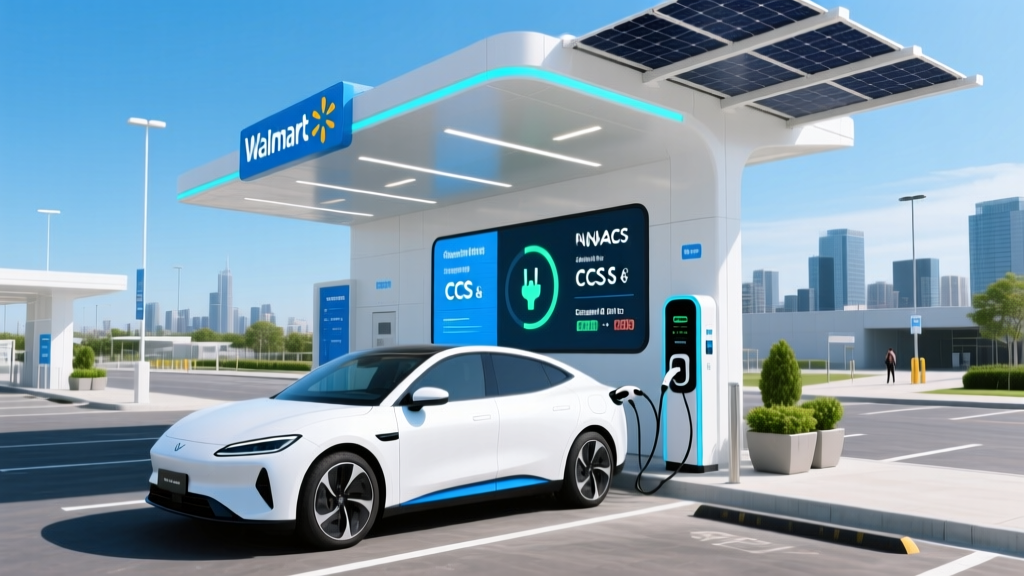
Walmart has quietly assembled one of the largest retail-hosted EV charging footprints in the United States. Through partnerships with Electrify America, EVgo, and Tesla Superchargers, the Walmart EV charging network spans hundreds of locations across 40+ states — typically positioned in high-traffic parking lots where a 20- to 30-minute charge aligns with a typical shopping trip. For EV owners without reliable home charging access, or road-trippers threading through suburban corridors, Walmart stations have become a practical fallback.
But retail charging comes with trade-offs: variable uptime, peak-hour pricing, and connector availability that differs by site. This guide breaks down what you'll actually find at a Walmart charger in 2026, how fast you can charge, what you'll pay, and how it compares to a home Level 2 setup.
Charging Levels Explained: Speeds, Power, and Range Added
Before evaluating any public station, it helps to ground yourself in the three charging tiers. Power is measured in kilowatts (kW); energy stored in your battery is measured in kilowatt-hours (kWh). A 75 kWh battery charged at 150 kW will theoretically add 75 kWh in 30 minutes — but real-world charge curves, thermal limits, and taper above 80% State of Charge (SoC) mean actual times are longer.
| Level | Voltage / Power | Typical kW Output | Miles of Range Added per Hour | Best For |
|---|---|---|---|---|
| Level 1 | 120V AC | 1.4–1.9 kW | 3–5 mi/hr | Overnight top-up for PHEVs or low-mileage drivers |
| Level 2 | 240V AC | 7.2–19.2 kW | 20–60 mi/hr | Home daily charging, workplace, retail parking |
| DC Fast Charge | 400–800V DC | 50–350 kW | 150–1,000+ mi/hr (peak) | Road trips, quick top-ups, fleet turnaround |
Most Walmart locations host DC fast chargers in the 150–350 kW range. A handful of older installations still operate at 50 kW. Level 2 stations (typically 7–11 kW) are occasionally available at Supercenters but are far less common.
What You'll Find at a Walmart Charger: Networks, Connectors, and Speeds
Walmart does not operate its own charging hardware. Instead, it leases parking-lot space to established networks. The three dominant partners in 2026:
- Electrify America (EA): Typically 150 kW and 350 kW CCS1 stalls, increasingly adding NACS connectors. EA's Hyperchargers (up to 350 kW) appear at higher-volume Supercenters.
- EVgo: A mix of 100 kW and 350 kW chargers. Many EVgo Walmart sites now feature NACS cables alongside CCS1.
- Tesla Superchargers: Select Walmart locations host Supercharger stalls (250 kW peak). Post-2024, many of these have opened to non-Tesla EVs via the built-in Magic Dock NACS adapter, though availability varies by site.
| Connector | Vehicles That Use It | Adapter Needed? |
|---|---|---|
| NACS (Tesla) | Tesla (all), Ford, Rivian, GM, Volvo, Polestar, others adopting 2025–2026 | CCS-to-NACS adapter for non-Tesla at Superchargers |
| CCS1 | Hyundai, Kia, BMW, VW, most legacy non-Tesla EVs | NACS-to-CCS adapter if station is NACS-only |
| CHAdeMO | Nissan Leaf (older), Mitsubishi Outlander PHEV | Largely discontinued at new installations; carry a CHAdeMO adapter |
Real-world note: CHAdeMO infrastructure is shrinking. If you drive a Nissan Leaf or older CHAdeMO-equipped EV, verify connector availability in your charging app before driving to a Walmart site — many stations have removed CHAdeMO handles during upgrades.
Charging Time Expectations: 10–80% Scenarios
DC fast charging follows a tapering curve: peak power is sustained only between roughly 10% and 50% SoC, after which the battery management system throttles intake to protect cell health. Here's what typical 10–80% sessions look like at Walmart-class chargers:
| Battery Size | 50 kW Charger | 150 kW Charger | 350 kW Charger (capable vehicle) |
|---|---|---|---|
| 60 kWh (e.g., base Nissan Ariya) | ~84 min | ~28 min | ~18 min |
| 77 kWh (e.g., Ford Mustang Mach-E Extended Range) | ~108 min | ~36 min | ~22 min |
| 84 kWh (e.g., Hyundai Ioniq 5 Long Range) | ~118 min | ~34 min | ~18 min |
| 100 kWh (e.g., Tesla Model S, Rivian R1S Max Pack) | ~140 min | ~45 min | ~25 min |
Vehicles with 800V architectures (Hyundai Ioniq 5/6, Kia EV6/EV9, Porsche Taycan, Audi e-tron GT) can sustain higher charge rates longer and benefit most from 350 kW stalls. Older 400V vehicles will peak around 150 kW even on a 350 kW charger.
Cold-weather caveat: In sub-40°F conditions, expect 10–80% charge times to increase by 20–40% due to battery preconditioning overhead and reduced ion mobility in NMC/LFP cells. Always precondition your battery via the vehicle's nav-routed charging feature when heading to a DC fast charger.
Cost to Charge at Walmart vs. Home vs. Gas
Pricing at the Walmart EV charging network depends entirely on the operating partner. Electrify America and EVgo set per-kWh rates, and Walmart does not subsidize or cap them. Here's the landscape:
| Scenario | Rate | Cost for 60 kWh Fill | Cost per Mile (4 mi/kWh vehicle) |
|---|---|---|---|
| Home Level 2, off-peak utility rate | $0.08–0.14/kWh | $4.80–$8.40 | $0.02–$0.035 |
| Home Level 2, standard residential rate | $0.14–0.18/kWh | $8.40–$10.80 | $0.035–$0.045 |
| Walmart DC fast (Electrify America / EVgo) | $0.35–$0.55/kWh | $21.00–$33.00 | $0.09–$0.14 |
| Tesla Supercharger (open network) | $0.28–$0.40/kWh | $16.80–$24.00 | $0.07–$0.10 |
| Gasoline equivalent (25 MPG, $3.40/gal) | $0.136/mile | $20.40 (equiv.) | $0.136 |
The takeaway: Home Level 2 charging at off-peak rates is 3–5x cheaper per mile than DC fast charging at Walmart. But even at peak public rates, EV charging typically undercuts gasoline on a per-mile basis — unless your local utility rates are exceptionally high and the DC charger is at the top of its pricing band.
Several networks offer subscription plans (EA's Pass+, EVgo's Plus) that reduce per-kWh rates by 15–25% for a monthly fee. If you rely on the Walmart EV charging network more than twice a week, a subscription typically pays for itself.
Home Level 2 Charging: The Setup Most Owners Prefer
The economics and convenience of EV ownership tilt decisively toward home charging. Here's what a Level 2 installation actually requires — and what it costs.
Electrical Requirements
- Voltage: 240V AC (same as a dryer or oven circuit)
- Amperage: 40A circuit for a 32A continuous charger (NEC requires 125% overhead); 60A circuit for a 48A charger
- Dedicated circuit: Required — no sharing with other appliances
- GFCI protection: Required by NEC 2020 and later for all EVSE installations
- Outdoor rating: NEMA 4 or 4X enclosure if mounted outside; NEMA 1 acceptable for indoor garage
Panel Upgrade Considerations
Homes with 100A service panels may need a panel upgrade to 200A before adding a 40–60A EV circuit, particularly if you already run electric HVAC, a dryer, and an electric range. A panel upgrade adds $1,500–$3,500 to your total project cost. Homes with existing 200A panels usually have sufficient headroom.
Some utilities offer managed charging programs (e.g., smart thermostats for your charger) that allow a lower-amperage install without a panel upgrade. Ask your utility before committing to an electrical scope.
| Component | Typical Cost Range | Notes |
|---|---|---|
| Level 2 EVSE hardware (32A–48A) | $350–$750 | Smart Wi-Fi models at upper end |
| Electrician labor (240V circuit run) | $600–$2,500 | Depends on panel-to-charger distance, wall/foundation penetration |
| Permit and inspection | $50–$300 | Varies by municipality; some jurisdictions waive EV permits |
| Panel upgrade (if needed) | $1,500–$3,500 | Only for homes with insufficient service capacity |
| Total (no panel upgrade) | $1,000–$3,550 | Most homes fall in $1,200–$2,200 range |
| Total (with panel upgrade) | $2,500–$7,050 | Older homes with 100A service |
The federal Alternative Fuel Vehicle Refueling Property Credit covers up to 30% of home charger hardware and installation costs (capped at $1,000) for installations in qualifying census tracts. Check IRS Form 8911 for current eligibility.
Recommended Home Chargers for Every Budget
Emporia Level 2 Smart Charger — Best Value
- Power: 48A (11.5 kW at 240V)
- Connector: NACS (J3400) with CCS adapter available
- Cable length: 24 ft
- Smart features: Wi-Fi scheduling, solar integration, energy dashboard
- Price: ~$399
ChargePoint Home Flex — Best for Flexibility
- Power: Configurable 16A–50A (up to 12 kW)
- Connector: NACS or J1772 (configurable at purchase)
- Cable length: 23 ft
- Smart features: Alexa integration, amperage adjustment via app, load-sharing for multi-charger installs
- Price: ~$649
Tesla Wall Connector — Best for Tesla Owners
- Power: 48A (11.5 kW at 240V)
- Connector: NACS native; J1772 adapter version available
- Cable length: 24 ft
- Smart features: Wi-Fi updates, Power-Share for dual installs, integrates with Tesla app
- Price: ~$475
All three units are hardwired (no plug), UL-listed, and rated for indoor/outdoor use. For NEMA 14-50 plug-in installations, verify your receptacle is rated for continuous 40A+ duty — cheap 14-50 outlets have caused thermal failures under sustained EV charging loads.
Safety, Code, and Installation Best Practices
- Always hire a licensed electrician. DIY 240V work is dangerous and may void your homeowner's insurance in the event of a fire.
- Use a dedicated circuit. Sharing a 240V circuit with a dryer or welder violates NEC and risks tripped breakers mid-charge.
- Verify GFCI compliance. NEC 625.54 mandates GFCI protection for all EVSE. Your electrician should install a GFCI breaker or use an EVSE with integrated ground-fault protection.
- Check outdoor ratings. If your charger mounts outside, the enclosure and cable must carry a NEMA 4 rating. UV exposure degrades unrated cables within 2–3 years.
- Permit and inspect. Unpermitted work can block home sales, insurance claims, and utility rebate eligibility.
When Walmart Charging Makes Sense (and When It Doesn't)
Use the Walmart EV charging network when:
- You live in an apartment or condo without Level 2 access
- You're on a road trip and need a 20–30 minute DC fast stop
- Your home circuit is under repair or upgrade
- You need to combine charging with a planned errand
Rely on home Level 2 charging when:
- You drive under 80 miles daily (covers most commutes)
- Your utility offers time-of-use rates below $0.12/kWh
- You want to precondition your battery for optimal health and range
- You want the lowest per-mile fuel cost available
Frequently Asked Questions
How much does it cost to install a home EV charger?
Most homes with a 200A panel pay $1,000–$2,200 for a complete Level 2 installation (hardware, electrician labor, permit). Homes needing a panel upgrade to 200A should budget $2,500–$7,000 total. The federal refueling property credit can offset up to $1,000 of that cost in qualifying census tracts.
How fast will each charging level add range?
Level 1 (120V) adds roughly 3–5 miles per hour. Level 2 (240V, 32A–48A) adds 20–60 miles per hour depending on your vehicle's onboard charger capacity. DC fast charging at 150 kW adds approximately 150–250 miles in a 20-minute session, while 350 kW chargers with compatible 800V vehicles can add 200+ miles in 15 minutes.
Which connector or charger is compatible with my EV?
Tesla, Ford, GM, Rivian, Volvo, and Polestar vehicles built for the 2025–2026 model years use the NACS connector. Most other EVs (Hyundai, Kia, BMW, VW) still use CCS1, though many are transitioning to NACS by 2026–2027. Nissan Leaf uses CHAdeMO. Check your owner's manual or the charge-port door for your connector type, and carry the appropriate adapter if your vehicle is CCS and you plan to use Tesla Superchargers.
How much does charging cost per mile vs. gas?
Home Level 2 charging at typical residential rates ($0.12–$0.18/kWh) costs $0.03–$0.045 per mile for an EV averaging 3.5–4 mi/kWh. DC fast charging at public rates ($0.35–$0.55/kWh) costs $0.09–$0.14 per mile. A comparable gas vehicle at 25 MPG with $3.40/gallon fuel costs $0.136 per mile. Home-charged EVs cost 65–75% less per mile than gasoline.
What electrical upgrades might I need?
If your home has a 100A service panel, you'll likely need a panel upgrade to 200A ($1,500–$3,500) before adding a 40A–60A EV circuit. Homes with 200A panels usually have enough spare capacity. Your electrician will perform a load calculation per NEC Article 220 to determine whether your existing panel can handle the additional circuit.
Are Walmart EV chargers reliable?
Reliability varies by network and site age. Electrify America and EVgo have improved uptime significantly since 2023, but individual stalls can be offline. Check the network's app for real-time stall status before driving to a location. Sites with 4+ stalls have better redundancy than single-stall locations.