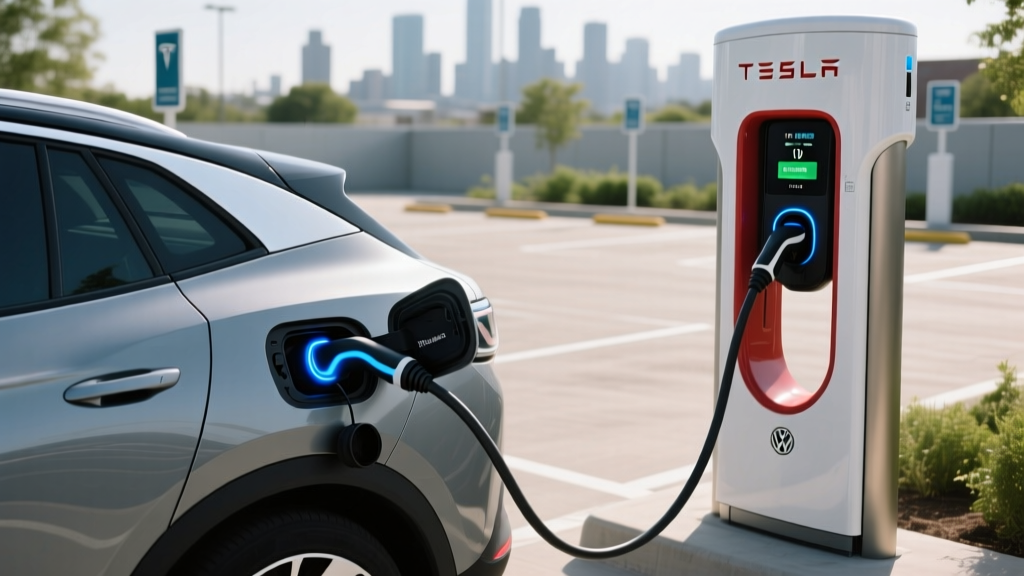
For years, Volkswagen ID.4 owners have relied on the Electrify America network for DC fast charging. That changed when Volkswagen joined the industry-wide shift to the North American Charging Standard (NACS). Today, VW ID.4 drivers can tap into Tesla's Supercharger network — the largest and most reliable fast-charging ecosystem in North America — using a CCS-to-NACS adapter. If you're researching VW Tesla Supercharger access, this guide walks you through exactly how it works, what equipment you need, and what it costs both on the road and at home.
VW's NACS Transition: What Changed for ID.4 Owners
Starting with the 2025 model year, Volkswagen began equipping new ID.4 vehicles with the NACS charge port natively. For owners of 2021–2024 ID.4 models — which use the CCS1 connector — VW approved third-party CCS-to-NACS adapters that enable Supercharger access. This adapter pathway opened up more than 6,000 Tesla Supercharger stalls across the U.S. and Canada that have NACS-equipped cables, dramatically expanding route-planning options for VW EV drivers.
The ID.4 (2024–2026 model years) carries a usable battery capacity of 77 kWh (NMC chemistry) on Pro and Pro S trims, with an EPA-estimated range of up to 275 miles on the rear-wheel-drive Pro S. All-wheel-drive Pro S models are rated at 263 miles. Real-world highway driving at 70+ mph typically yields 230–250 miles; add cold-weather conditions (below 30°F) and expect a further 15–25% reduction, dropping effective range to roughly 190–215 miles on AWD trims.
- EPA sticker: 275 miles
- Real-world highway (65–70 mph): ~235–250 miles
- Cold-weather highway (20°F): ~190–215 miles
- City/mixed moderate climate: ~260–275 miles (regen braking recovers energy)
Charging Levels Explained: Speeds in kW and Miles Per Hour
Before we get into Supercharger specifics, let's clarify the three charging tiers. Power is measured in kW (kilowatts) — the rate at which energy flows. Energy stored in the battery is measured in kWh (kilowatt-hours) — the total capacity. Think of kW as how fast water flows from a hose, and kWh as the size of the bucket.
| Level | Voltage / Amperage | Max Power (kW) | Miles Added per Hour | Typical Use Case |
|---|---|---|---|---|
| Level 1 | 120V / 12A | 1.4 kW | 3–5 mi/hr | Emergency / overnight trickle |
| Level 2 | 240V / 32–48A | 7.7–11.5 kW | 22–38 mi/hr | Home daily charging, workplace |
| DC Fast (CCS/NACS) | 400–800V DC | 50–350 kW | 150–800+ mi/hr (peak) | Road trips, highway corridors |
The VW ID.4 supports a peak DC fast-charge rate of 135 kW on 2021–2023 models and up to 175 kW on 2024–2026 models with the updated battery management software. At a Tesla V3 Supercharger (250 kW max), the ID.4 will peak around its own onboard limit — roughly 170–175 kW — then taper as the state of charge climbs.
Using a Tesla Supercharger With Your VW ID.4: Step by Step
Here's the practical sequence for VW Tesla Supercharger access on a CCS1-equipped ID.4:
- Acquire an approved CCS-to-NACS adapter. Lectron, A2Z EV, and Tesla's own CCS adapter (for non-Tesla vehicles, where available) are common options. Confirm VW's official compatibility list before purchasing — using an unapproved adapter may void warranty coverage on the charge port.
- Download the Tesla app and create an account. Non-Tesla EV drivers access Superchargers through Tesla's "Charge Your Non-Tesla Vehicle" feature within the app.
- Locate compatible Superchargers. Not every Supercharger stall supports non-Tesla vehicles. In the Tesla app, filter for stations that list your vehicle or show the "Charge Your Non-Tesla Vehicle" option. Most V3 and V4 Superchargers in the U.S. now participate.
- Plug in. Attach the adapter to the CCS1 port on your ID.4, then connect the Supercharger's NACS cable. Initiate the session via the Tesla app.
- Monitor the charge curve. Expect peak rates of 155–175 kW between 10–30% state of charge, tapering to ~90 kW by 50%, and ~50 kW past 70%. A 10–80% session typically takes 28–34 minutes on a V3 stall.
Connector Compatibility: NACS, CCS1, and Adapters
| Connector Type | Used By | AC Level 2? | DC Fast? | Adapter Needed for Supercharger? |
|---|---|---|---|---|
| NACS (native) | Tesla, 2025+ VW ID.4, Ford, Rivian, GM, Hyundai (2025+) | Yes | Yes | No — plug directly |
| CCS1 | 2021–2024 VW ID.4, most legacy non-Tesla EVs | Yes (via J1772 upper section) | Yes | Yes — CCS-to-NACS adapter |
| CHAdeMO | Nissan Leaf, older Mitsubishi | No | Yes | Not compatible with Superchargers |
If you're buying a 2025 or 2026 VW ID.4, it ships with a native NACS port — no adapter required for Supercharger access. For 2021–2024 owners, budget $150–$280 for a quality CCS-to-NACS adapter. Brands like Lectron and the official Tesla CCS adapter (where sold for non-Tesla use) have proven reliable in long-term testing.
How Much Does Charging Cost Per Mile vs. Gas?
Charging economics vary enormously depending on where and when you charge. Here's a realistic cost breakdown for a VW ID.4 (averaging 3.0–3.3 miles per kWh, or roughly 115 MPGe combined per fueleconomy.gov):
| Scenario | $/kWh | Cost to Add 200 Miles | Cost Per Mile |
|---|---|---|---|
| Home, off-peak utility rate | $0.08–$0.12 | $4.85–$7.27 | $0.024–$0.036 |
| Home, standard residential rate | $0.14–$0.18 | $8.48–$10.91 | $0.042–$0.055 |
| Tesla Supercharger (non-Tesla pricing) | $0.30–$0.48 | $18.18–$29.09 | $0.091–$0.145 |
| Electrify America / public DCFC | $0.35–$0.56 | $21.21–$33.94 | $0.106–$0.170 |
| Gas equivalent (25 MPG, $3.40/gal) | — | $27.20 | $0.136 |
The takeaway: home charging on off-peak rates costs roughly one-quarter to one-fifth of gasoline per mile. Public DC fast charging — including Superchargers — is more expensive and, on many routes, approaches or exceeds the per-mile cost of gas. The economic case for EV ownership rests heavily on consistent home or workplace Level 2 access.
Home Charger Installation: Costs, Electrical Requirements, and Equipment
Installing a Level 2 home charger is the single highest-impact upgrade for EV ownership. Here's what's involved for a VW ID.4 owner.
Electrical Requirements
The ID.4's onboard charger accepts up to 11 kW (48A) on 2024–2026 models and 7.2 kW (32A) on earlier models. To maximize charge speed, you'll want a 240V circuit rated for at least 40A (delivering 32A continuous, which is 80% of circuit capacity per National Electrical Code). For the full 48A/11 kW rate, you'll need a 60A dedicated circuit.
Panel upgrade reality: Most homes built after 1990 have a 200A main panel, which typically accommodates a 40–60A EV circuit without issue. Older homes with 100A panels often require a panel upgrade ($1,500–$3,500) or a load-management device that throttles the charger when household demand spikes. Always get a licensed electrician's load calculation before assuming your panel has headroom.
| Component | Cost Range | Notes |
|---|---|---|
| Level 2 charger (hardware) | $350–$750 | Varies by brand, power output, smart features |
| Electrician labor (standard install) | $500–$1,500 | Assumes panel is nearby, conduit run <30 ft |
| Permit & inspection | $100–$350 | Required in most jurisdictions |
| Panel upgrade (if needed) | $1,500–$3,500 | 100A → 200A service upgrade |
| Total (no panel upgrade) | $950–$2,600 | Typical scenario for modern homes |
| Total (with panel upgrade) | $2,450–$6,100 | Older homes with 100A service |
Safety and Code Considerations
- Dedicated circuit: Your EV charger must have its own breaker — never share a circuit with other high-draw appliances.
- GFCI protection: NEC 2020 and later require GFCI breakers for outdoor receptacles and many indoor EV installations. Budget an extra $50–$80 for a GFCI breaker if your panel requires one.
- Outdoor rating: If your charger mounts outside, confirm it carries a NEMA 4 or IP65 weather rating. All recommendations below meet this standard.
- Hardwired vs. plug: Hardwired installations (no NEMA 14-50 outlet) are generally safer for continuous 40A+ loads and avoid the ~$50–$100 cost of an industrial-grade receptacle. If you use a 14-50 outlet, ensure your electrician installs a commercial-grade (not residential-grade) receptacle rated for daily plug/unplug cycles.
Equipment Recommendations: Top Level 2 Chargers for the ID.4
ChargePoint Home Flex
- Power output: Up to 11.5 kW (48A) on a 60A circuit; configurable down to 16A
- Connector: J1772 (native for ID.4 Level 2)
- Cable length: 18 ft or 23 ft options
- Smart features: Wi-Fi, scheduling, Alexa integration, utility demand-response programs
- Price: ~$549–$649
Emporia Level 2 EV Charger
- Power output: Up to 11.5 kW (48A)
- Connector: J1772 (NACS version available for 2025+ ID.4)
- Cable length: 24 ft
- Smart features: Wi-Fi, solar integration, real-time energy monitoring via Emporia app, load management
- Price: ~$399–$449
Tesla Wall Connector (with J1772 adapter or NACS native)
- Power output: Up to 11.5 kW (48A)
- Connector: NACS (use a NACS-to-J1772 adapter for 2021–2024 ID.4, or plug directly for 2025+ models)
- Cable length: 18 ft or 24 ft
- Smart features: Wi-Fi updates, power-sharing between multiple units, access control
- Price: ~$425–$475 (adapter sold separately, ~$50–$200)
Grizzl-E Smart
- Power output: Up to 10 kW (40A)
- Connector: J1772
- Cable length: 24 ft
- Smart features: OCPP-compatible, works with third-party apps, built in Canada for extreme cold
- Price: ~$449–$549
For most ID.4 owners, the Emporia offers the best value — full 48A output at a budget price with excellent energy-monitoring software. The ChargePoint Home Flex is the most widely compatible with utility rebate programs. If you plan to upgrade to a NACS-native EV within a few years, the Tesla Wall Connector future-proofs your garage.
Supercharger Charging Times: What to Expect on the Road
At a Tesla V3 Supercharger (250 kW max), the VW ID.4 Pro S (77 kWh usable, 2024+ with 175 kW peak capability) delivers the following real-world charging times:
- 10–80% state of charge: ~28–34 minutes
- 10–50% (quick top-up): ~14–17 minutes (peak 170+ kW sustained in this window)
- 80–100%: ~30–40 additional minutes (charge rate drops to 15–25 kW to protect the battery)
The charge curve is the critical detail most first-time EV owners miss. Peak kW ratings are sustained only briefly at low states of charge. Above 50% SoC, the ID.4's battery management system progressively reduces charge rate to manage cell temperature and longevity. On road trips, plan to charge from roughly 10–80% and skip the slow 80–100% top-up unless you're stopping overnight.
For comparison, on an Electrify America 150 kW CCS stall, expect 10–80% in roughly 33–38 minutes — slightly slower due to lower peak station output and occasional CCS handshake delays that Superchargers have largely eliminated.
Frequently Asked Questions
How much does it cost to install a home EV charger for my VW ID.4?
A typical Level 2 home installation runs $950–$2,600 if your electrical panel has sufficient capacity. This includes $350–$750 for the charger hardware, $500–$1,500 for electrician labor, and $100–$350 for permits. Homes with older 100A panels may need a $1,500–$3,500 panel upgrade, pushing the total to $2,450–$6,100. Always get a professional load calculation first.
How fast will each charging level add range to the ID.4?
Level 1 (120V standard outlet) adds roughly 3–5 miles of range per hour — useful only for overnight trickle charging or emergencies. Level 2 (240V home charger at 40A) adds approximately 26–30 miles per hour, fully replenishing the 77 kWh battery in about 8–9 hours. DC fast charging at a Supercharger adds up to 150+ miles in 15 minutes at peak rates, though the charge curve tapers significantly above 50% SoC.
Which connector and charger are compatible with my VW ID.4?
Model years 2021–2024 use the CCS1 connector for DC fast charging and J1772 for AC Level 2. Model years 2025–2026 use the native NACS connector for both. To access Tesla Superchargers with a CCS1-equipped ID.4, you need a CCS-to-NACS adapter ($150–$280). For Level 2 home charging, any J1772 charger works on all model years; a NACS-to-J1772 adapter lets you use a Tesla Wall Connector on older models.
How much does charging cost per mile compared to gas?
Home off-peak charging costs roughly $0.02–$0.04 per mile in the ID.4. Standard residential rates bring this to $0.04–$0.06 per mile. Public DC fast charging (Superchargers, Electrify America) ranges from $0.09–$0.17 per mile. A comparable gas SUV at 25 MPG and $3.40/gallon costs about $0.14 per mile. The cost advantage of EVs is strongest when you charge at home consistently.
What electrical upgrades might I need for a home charger?
If your home has a 200A electrical panel (most homes built after 1990), you likely have capacity for a 40–60A dedicated EV circuit without a panel upgrade. Homes with 100A panels — common in pre-1990 construction — often require a service upgrade to 200A, costing $1,500–$3,500. An alternative is a smart load-management device (like the Emporia VUE with automatic load shedding) that dynamically reduces charger amperage when other appliances draw heavy current, potentially avoiding a panel upgrade altogether. A licensed electrician should perform a NEC Article 220 load calculation to determine your options. You can also check IRS guidelines for any applicable energy-related tax provisions that may offset installation costs.
Does using a CCS-to-NACS adapter affect my VW warranty?
Volkswagen has acknowledged the use of approved CCS-to-NACS adapters for Supercharger access. However, damage to the charge port or onboard charger caused by a non-approved or defective adapter may not be covered under the standard 4-year/50,000-mile bumper-to-bumper warranty or the 8-year/100,000-mile battery warranty. Stick to adapters from established manufacturers and retain your purchase documentation.