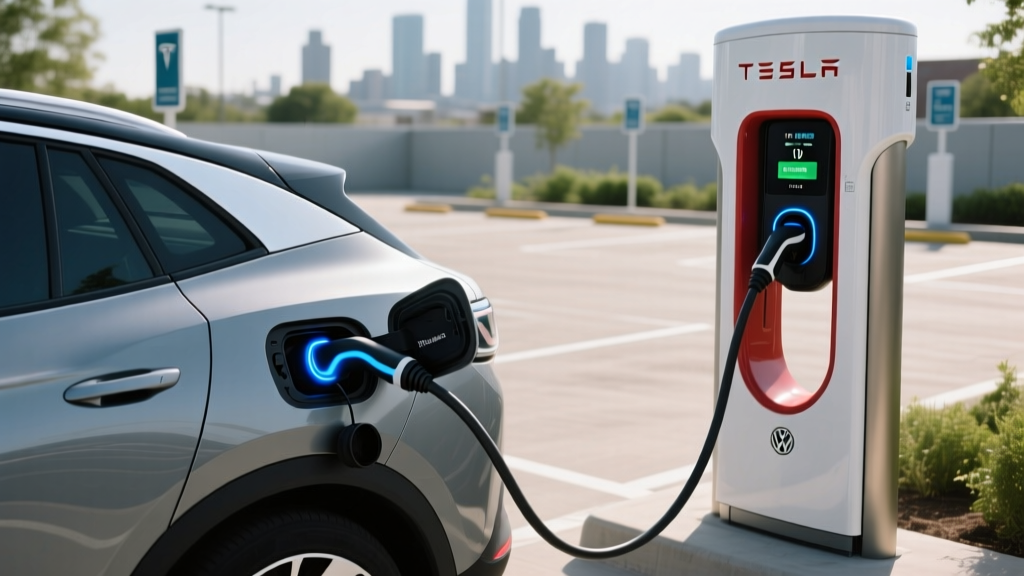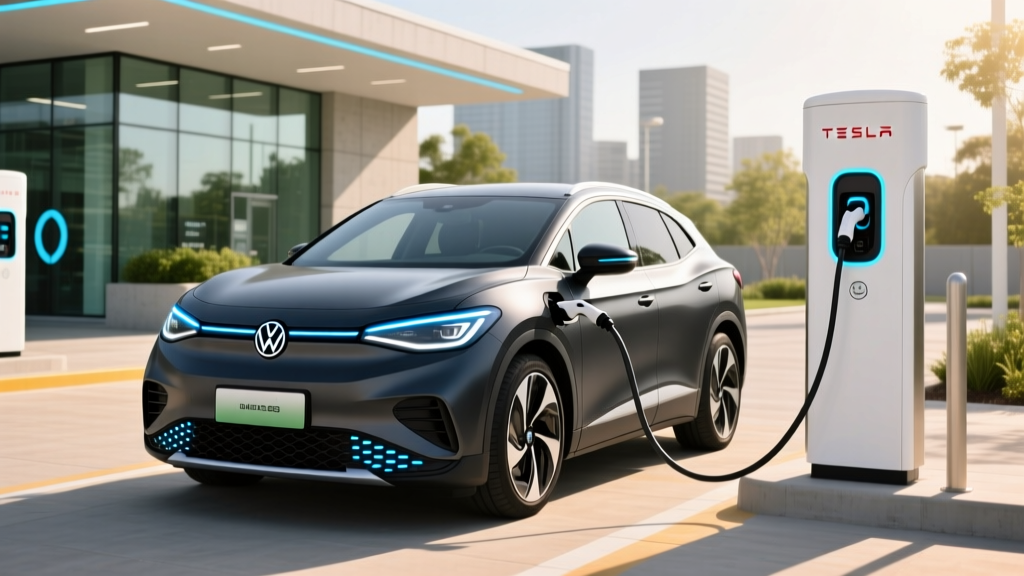
Volkswagen's transition to Tesla's Supercharger network marks one of the most significant charging-infrastructure shifts for non-Tesla EV owners. If you drive a VW ID.4, the upcoming ID.7, or any Volkswagen electric vehicle, understanding exactly how VW Supercharger access works — including adapter requirements, charging speeds, and real-world costs — is essential for road-trip planning and daily ownership.
This guide covers the connector transition from CCS1 to NACS, what hardware you need, how fast VW models actually charge on Superchargers, and the home-charging setup that makes public charging a supplement rather than a necessity.
Why VW Supercharger Access Matters Now
Volkswagen's current US EV lineup — led by the ID.4 (82 kWh usable battery, EPA-estimated 291 miles for the Pro S AWD) and the forthcoming ID.7 sedan — launched with CCS1 (Combined Charging System) ports. Tesla's Supercharger network, the largest and most reliable DC fast-charging network in North America with over 6,000 stations and 30,000+ stalls, historically used the proprietary NACS (North American Charging Standard) connector.
Starting in 2025, Volkswagen joined the wave of automakers granting owners access to Tesla Superchargers via a NACS adapter. By 2026, VW has begun transitioning new vehicles to native NACS ports. Here's where things stand:
- 2024 and earlier ID.4 models: CCS1 port. Require a CCS-to-NACS adapter for Supercharger access.
- 2025 ID.4 models: CCS1 port with included or available OEM NACS adapter; software-enabled Supercharger access.
- 2026 ID.4 and ID.7: Transitioning to native NACS ports on new production (verify with your dealer by VIN).
The practical result: VW owners can now tap into the Supercharger network, which consistently posts higher uptime and better-maintained stalls than many third-party CCS networks, according to fueleconomy.gov and owner surveys.
Charging Levels Explained: Speeds in kW and Miles Per Hour
Before we break down Supercharger performance, it's critical to understand the three charging levels and the difference between kW (kilowatts, the rate of power delivery) and kWh (kilowatt-hours, the battery's energy capacity). Think of kW as how fast water flows from a hose, and kWh as the size of the bucket.
| Level | Voltage | Max Power (kW) | Miles of Range Added Per Hour | Best Use Case |
|---|---|---|---|---|
| Level 1 (120V) | 120V AC | 1.4–1.9 kW | 3–5 mi/hr | Overnight trickle; PHEVs |
| Level 2 (240V) | 240V AC | 7.2–19.2 kW | 20–60 mi/hr | Home daily charging |
| DC Fast Charging | 400–800V DC | 50–350 kW | 150–1,000+ mi/hr (peak) | Road trips, highway corridors |
The VW ID.4 supports up to 175 kW peak DC fast charging on compatible stations. On a Tesla V3 Supercharger (250 kW capable), the ID.4 will peak at its own vehicle-limited maximum of ~170–175 kW. On a V4 Supercharger cabinet, speeds are the same — the car, not the stall, is the bottleneck.
Connector Compatibility: NACS, CCS1, and What You Need
Connector compatibility is the single most important detail for VW Supercharger access. Here's the landscape for 2026:
| Connector Type | Physical Standard | VW Models Using It | Supercharger Access |
|---|---|---|---|
| CCS1 | J1772 + 2 DC pins | 2021–2025 ID.4 | Requires CCS-to-NACS adapter |
| NACS (native) | Tesla-style compact plug | Late 2025+ ID.4, ID.7 (new production) | Direct plug-in at Superchargers |
| CHAdeMO | Legacy DC standard | Not used on VW EVs | N/A — not compatible |
Adapter Requirements and Options
If your VW has a CCS1 port, you need a CCS-to-NACS adapter to use Tesla Superchargers. Here are your options:
- VW OEM Adapter: Volkswagen offers a certified CCS-to-NACS adapter (typically $200–$300 through dealerships or the VW accessories store). This is the safest choice, as it's validated for VW's charging protocol and warranty.
- Tesla CCS Adapter: Tesla sells a CCS adapter, but it is designed for Tesla vehicles to use CCS stations — not the reverse. Do not use this adapter for VW Supercharger access.
- Third-party adapters: Brands like Lectron and A2Z offer CCS-to-NACS adapters ($150–$250). Verify UL certification and compatibility with your specific model year before purchasing.
For VW models with a native NACS port (2026 production), no adapter is needed — simply plug directly into any Supercharger stall.
Supercharger Charging Speeds for VW Models
Here's what VW owners can actually expect at Tesla Superchargers in real-world conditions:
| Vehicle | Battery (kWh Usable) | Peak DC Rate (kW) | Supercharger Gen | 10–80% Time | Miles Added in 15 Min |
|---|---|---|---|---|---|
| ID.4 Pro (2025) | 82 kWh | 175 kW | V3 (250 kW) | ~28–33 min | ~120–140 mi |
| ID.4 Pro S AWD (2025) | 82 kWh | 175 kW | V3 (250 kW) | ~28–33 min | ~115–135 mi |
| ID.7 (2026, est.) | 86 kWh (est.) | 200 kW (est.) | V4 (350 kW) | ~25–30 min | ~140–160 mi |
Important context: the ID.4's 400V architecture limits peak charging compared to 800V vehicles like the Hyundai Ioniq 5 or Kia EV6 (which can sustain 230+ kW). VW's charge curve is respectable but not class-leading. On a road trip, plan for 30-minute stops every 180–200 miles of real-world driving to keep charging sessions efficient and avoid the steep taper above 80% SoC.
How Much Does Charging Cost: Supercharger vs Home vs Gas
Charging costs vary dramatically depending on where and when you plug in. Here's a breakdown using the ID.4 Pro S AWD (EPA-estimated 275 miles, 82 kWh battery) as our reference vehicle:
| Charging Scenario | Rate ($/kWh) | Cost for 10–80% (57.4 kWh) | Cost Per Mile (est.) |
|---|---|---|---|
| Home Level 2 (off-peak utility rate) | $0.08–$0.12 | $4.59–$6.89 | $0.02–$0.03/mi |
| Home Level 2 (standard residential avg) | $0.16 | $9.18 | $0.04/mi |
| Tesla Supercharger (avg US) | $0.28–$0.36 | $16.07–$20.66 | $0.07–$0.09/mi |
| Electrify America / public DC fast | $0.35–$0.48 | $20.09–$27.55 | $0.09–$0.12/mi |
| Gas equivalent (25 MPG avg, $3.40/gal) | — | — | $0.14/mi |
Even at Supercharger rates, VW owners pay roughly half the per-mile cost of a comparable gas vehicle. Home charging at off-peak rates drops the cost to pennies per mile. For a driver covering 12,000 miles per year, the difference between home charging and gas can save $1,200–$1,500 annually.
Note: Tesla Supercharger pricing varies by station, time of day, and whether your VW qualifies for introductory rates through VW's charging partnerships. Check the Tesla app or your VW in-car navigation for station-specific pricing before you arrive.
Home Charging Setup: Installation Costs and Electrical Requirements
While VW Supercharger access is invaluable for road trips, 80–90% of EV charging happens at home. Here's what it takes to install a Level 2 home charger for your Volkswagen EV.
Electrical Requirements for Level 2 Charging
A Level 2 home charger requires a 240V dedicated circuit, similar to what powers an electric dryer or oven. Key specifications:
- Circuit amperage: 40A minimum for 32A continuous charging; 50A for 40A continuous; 60A for 48A continuous (the ID.4's onboard charger maxes at 11 kW / ~48A)
- Wire gauge: 6 AWG copper for 50A circuits; 4 AWG for 60A circuits
- Breaker: Must be rated 125% above the continuous load (e.g., 40A charger needs a 50A breaker)
- Panel capacity: Your main electrical panel must have sufficient spare amperage. Most homes need a 200A main panel for a 48A EV charger alongside existing loads.
Panel Upgrade Considerations
Older homes with 100A or 150A electrical service may require a panel upgrade to 200A before adding a Level 2 charger. This is one of the most overlooked costs in EV ownership. A licensed electrician will perform a load calculation per NEC Article 220 to determine if your panel can handle the additional draw.
| Component | Cost Range | Notes |
|---|---|---|
| Level 2 charger equipment | $300–$750 | Varies by brand, power output, smart features |
| Electrician labor (standard install) | $500–$1,500 | Short run from panel to garage; longer runs cost more |
| Permit and inspection | $50–$300 | Varies by municipality; some areas waive EV permits |
| Electrical panel upgrade (if needed) | $1,500–$4,000 | 100A → 200A service upgrade; not required in most newer homes |
| Total (no panel upgrade) | $850–$2,550 | Typical range for most homeowners |
| Total (with panel upgrade) | $2,350–$6,550 | Older homes with 100A service |
Always hire a licensed electrician and pull permits. Unpermitted work can void your homeowner's insurance and create fire hazards. The IRS also requires proper installation documentation if you claim the Residential Clean Energy Credit (30% of equipment and installation, up to applicable limits — consult a tax professional for eligibility).
Recommended Home Chargers for VW EVs
The ID.4's 11 kW onboard AC charger means you'll benefit from a 48A Level 2 station. Here are top picks for VW owners:
ChargePoint Home Flex
- Power: Up to 12 kW (50A) — adjustable via DIP switches
- Connector: J1772 (NACS version available for 2026 VW models)
- Cable length: 23 feet
- Smart features: Wi-Fi, scheduling, energy tracking, Alexa integration
- Price: $550–$650
- Best for: Flexible amperage adjustment for older panels
Emporia Level 2 EV Charger
- Power: Up to 11.5 kW (48A)
- Connector: J1772 (NACS version available)
- Cable length: 24 feet
- Smart features: Real-time energy monitoring, solar integration, load management
- Price: $400–$500
- Best for: Budget-conscious buyers who want energy data
Grizzl-E Smart
- Power: Up to 10 kW (40A)
- Connector: J1772 or NACS
- Cable length: 24 feet
- Smart features: OCPP-compatible, app scheduling, outdoor-rated (NEMA 4)
- Price: $450–$550
- Best for: Outdoor installations and cold-climate durability
Tesla Wall Connector
- Power: Up to 11.5 kW (48A)
- Connector: NACS (native) — CCS1 VW owners need an adapter for home use
- Cable length: 24 feet
- Smart features: Wi-Fi, OTA updates, power sharing between units
- Price: $475
- Best for: VW owners with native NACS ports (2026+ models)
Safety and Code Considerations
- Dedicated circuit: Your EV charger must be on its own breaker — no shared circuits with other appliances.
- GFCI protection: Required for outdoor installations and in some jurisdictions for indoor garage outlets (NEC 2020+). Hardwired chargers with built-in GFCI are preferred over plug-in units on GFCI breakers to avoid nuisance tripping.
- Outdoor rating: If mounting outside, ensure the charger is rated NEMA 4 (weatherproof) or NEMA 4X (corrosion-resistant).
- Cable management: Use a holster or retractable reel to keep cables off the ground and prevent trip hazards.
Using VW Supercharger Access on the Road: Practical Tips
Once you're set up at home, here's how to maximize your Supercharger experience on road trips:
- Download the Tesla app and create an account. Most VW models access Superchargers through the Tesla app for payment, not via the VW in-car system.
- Precondition your battery by navigating to a Supercharger in the ID.4's built-in navigation (if equipped with the feature). This warms the battery to optimal charging temperature, reducing session time by up to 15% in cold weather.
- Charge to 80%, then move on. The charge curve above 80% SoC drops to under 50 kW, making the last 20% painfully slow. Plan your route with 80% charge stops rather than waiting for a full battery.
- Check stall compatibility. Not all Supercharger stalls support non-Tesla vehicles. In the Tesla app, look for stations labeled "Open to Non-Tesla EVs" and verify the stall has adequate cable reach for your VW's charge port location (driver-side rear on the ID.4).
- Carry your adapter at all times if your VW requires one. A CCS-to-NACS adapter is a $200–$300 piece of hardware that you cannot afford to leave in the garage on a road trip.
Frequently Asked Questions
How much does it cost to install a home EV charger for my VW?
A standard Level 2 home charger installation costs $850–$2,550 including equipment, electrician labor, and permits — assuming your electrical panel has sufficient capacity. Homes needing a panel upgrade from 100A to 200A should budget $2,350–$6,550 total.
How fast will each charging level add range to my ID.4?
Level 1 (120V) adds 3–5 miles per hour. Level 2 (240V, 48A) adds approximately 35–40 miles per hour. DC fast charging at a Supercharger adds roughly 120–140 miles in 15 minutes at peak rate, though this varies with battery temperature and state of charge.
Which connector does my VW EV use, and do I need an adapter for Superchargers?
2021–2025 VW ID.4 models use the CCS1 connector and require a CCS-to-NACS adapter (sold separately, $200–$300) for Tesla Supercharger access. Late 2025 and 2026 models are transitioning to native NACS ports, which plug directly into Superchargers without an adapter.
How much does charging cost per mile compared to gas?
Home Level 2 charging at average US electricity rates ($0.16/kWh) costs about $0.04 per mile in a VW ID.4. Supercharger rates ($0.28–$0.36/kWh) bring the cost to $0.07–$0.09 per mile. A comparable gas vehicle at 25 MPG and $3.40/gallon costs roughly $0.14 per mile — making even public DC fast charging cheaper than gasoline.
What electrical upgrades might I need for a home charger?
Most homes with a 200A electrical panel can support a 48A Level 2 charger without upgrades. Homes with 100A or 150A service may need a panel upgrade ($1,500–$4,000). A licensed electrician will perform an NEC Article 220 load calculation to determine your specific requirements.
Can I use Electrify America stations instead of Superchargers with my VW?
Yes. The VW ID.4's native CCS1 port works directly with Electrify America, EVgo, and other CCS-equipped public chargers without any adapter. EA stations offer up to 350 kW, though the ID.4 will peak at ~175 kW regardless of stall capability.
Does VW Supercharger access require a subscription or membership?
No subscription is required. VW owners pay per-session pricing at Superchargers through the Tesla app. Pricing varies by station and time of day. Some VW models may include complimentary Supercharger credits as a purchase incentive — check your dealer for current promotions.