If you own a Volkswagen ID.4 or are considering one, understanding how to charge it efficiently is the single biggest factor in whether you enjoy the vehicle's advertised efficiency. The EPA estimates the 2026 VW ID.4 range at up to 291 miles for the Pro S trim with the larger battery pack, but real-world results depend heavily on how and where you charge. A proper home charging setup doesn't just replenish the battery; it preserves long-term battery health (State of Health, or SoH) and ensures you start every day with a full pack.
This guide breaks down the electrical requirements, installation costs, and equipment you need to keep your ID.4 charged, comparing the 77 kWh (Standard Range) and 82 kWh (Pro/Pro S) usable battery configurations.
The ID.4 Battery: Usable kWh vs. Gross Capacity
Before selecting a charger, you must understand the energy capacity you are refilling. Volkswagen lists the ID.4 battery in two primary configurations for the current model year. It is critical to distinguish between gross capacity (the total physical energy the cells can hold) and usable capacity (the energy available to the driver, accounting for a protective buffer that prevents deep discharge and prolongs battery life).
- Standard Range (Base): ~62 kWh usable capacity (NMC chemistry).
- Pro / Pro S / AWD: ~77 kWh usable capacity (NMC chemistry) — Note: Some 2026 model-year updates push the larger pack closer to 82 kWh usable in global markets, but the US-spec remains centered around the 77-79 kWh usable threshold.
When we discuss charging speeds below, we are calculating based on refilling these usable kWh amounts from a 10% State of Charge (SoC) to 80%.
Charging Levels: Speeds and Range Added
Charging speed is measured in kilowatts (kW), which represents power (the rate of flow). The battery capacity is measured in kilowatt-hours (kWh), which represents energy (the total volume stored). Confusing these two is the most common mistake new EV owners make.
| Level | Power Source | Max Power (kW) | Miles of Range Added per Hour | Best Use Case |
|---|---|---|---|---|
| Level 1 | 120V AC (Standard Outlet) | ~1.4 kW | 3 - 5 miles | Emergency / Overnight top-up for low-mileage drivers |
| Level 2 | 240V AC (Home/Public) | 11.5 kW (ID.4 onboard limit) | 32 - 37 miles | Daily home charging; the 'gold standard' for ownership |
| DC Fast | 400V+ DC (Public Stations) | 170 kW (Peak) | ~200+ miles in 30 mins | Road trips; 10-80% in ~30-36 minutes |
Real-World Note: The VW ID.4 has an onboard AC charger limit of 11.5 kW (some older 2021-2022 models were limited to 10.9 kW). Even if you install a 19.2 kW home charger, the ID.4 will only accept 11.5 kW. However, installing a higher-capacity charger is still recommended for future-proofing your home for other EVs.
Home Installation: Electrical Requirements and Costs
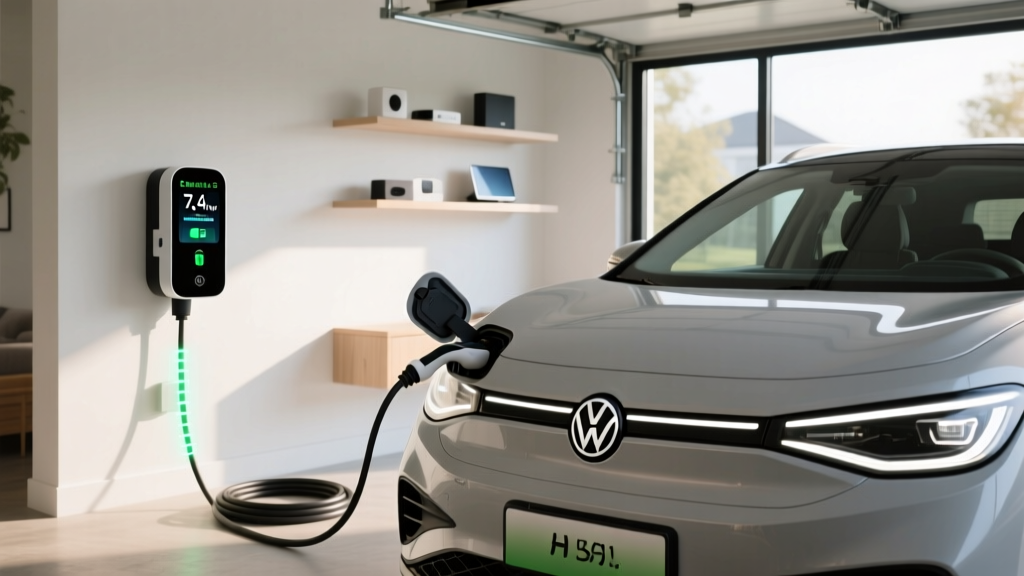
Installing a Level 2 home charger requires a dedicated 240V circuit. For an 11.5 kW charge rate, you need a 60-amp breaker (the National Electrical Code requires the continuous load to be 80% of the breaker rating, so a 48-amp charger requires a 60-amp breaker).
Do I Need a Panel Upgrade?
Most modern homes have a 200-amp electrical panel. If your panel is already near capacity (running electric heat, an electric oven, a dryer, and AC), adding a 60-amp EV circuit may require a panel upgrade to 300-400 amps or the installation of an automated load-management device. This is a significant cost variable.
| Component | Low-End Estimate | High-End Estimate | Notes |
|---|---|---|---|
| Level 2 Charger (Hardware) | $400 | $750 | 48-Amp smart charger (Hardwired recommended) |
| Electrician Labor & Materials | $600 | $1,800 | Depends on distance from panel to garage |
| Permit & Inspection | $100 | $350 | Required by most local jurisdictions |
| Panel Upgrade (If needed) | $2,000 | $4,500 | Only if existing panel lacks capacity |
| Total (No Panel Upgrade) | $1,100 | $2,900 | Average install is ~$1,500 |
Connector Compatibility: CCS vs. NACS
The 2026 VW ID.4 is at the center of the industry's connector transition. Volkswagen has begun equipping new ID.4 models with the NACS (North American Charging Standard) port, previously exclusive to Tesla. However, many ID.4s on the road and some remaining dealer inventory still use the CCS1 port.
- NACS Port: Grants native access to the Tesla Supercharger network (now branded as Tesla Superchargers with Magic Dock or native NACS cables).
- CCS1 Port: Requires a VW-approved NACS adapter to use Tesla Superchargers. Native to Electrify America, EVgo, and ChargePoint networks.
Equipment Tip: If buying a home charger in 2026, we recommend purchasing a NACS-connector charger if your ID.4 has the NACS port. If your ID.4 is CCS1, buy a CCS1 charger or use a high-quality adapter. Avoid cheap, unbranded adapters, which can overheat.
Charging Costs: ID.4 vs. Gasoline
The ID.4 achieves an EPA-estimated 104 MPGe (combined). In terms of efficiency, it consumes roughly 32 kWh per 100 miles of driving. Here is how that translates to cost:
| Scenario | Energy Price | Cost per 100 Miles | Cost per Mile |
|---|---|---|---|
| Home Charging (Off-Peak) | $0.13 / kWh | $4.16 | $0.042 |
| Home Charging (Peak/Std) | $0.22 / kWh | $7.04 | $0.070 |
| Public DC Fast Charging | $0.45 / kWh | $14.40 | $0.144 |
| Gas SUV (25 MPG) | $3.40 / Gallon | $13.60 | $0.136 |
Even at peak residential rates, the ID.4 is roughly half the cost of a gas SUV per mile. However, relying exclusively on public DC fast charging can make EV ownership more expensive than gas.
Recommended Equipment for the VW ID.4
Based on the ID.4's 11.5 kW onboard limit and the need for reliability, these are our top picks for 2026:
- Emporia Vue / Emporia Level 2 Charger: 48-amp output, excellent energy monitoring, ~$400. Great for budget-conscious installs.
- ChargePoint Home Flex (NACS or CCS): Up to 50-amp output, robust app, ~$550. The industry standard for reliability.
- Tesla Wall Connector (Universal): 48-amp output, built-in Magic Dock (adapter for CCS cars), ~$600. Best for mixed-EV households.
Safety and Code: The GFCI Requirement
The National Electrical Code (NEC) 2026 update continues to require GFCI (Ground Fault Circuit Interrupter) protection for outdoor outlets, but hardwired chargers often bypass this requirement at the breaker level because the charger itself has internal ground-fault protection. We strongly recommend hardwiring your charger over using a plug (like a NEMA 14-50) to avoid nuisance tripping and to ensure the highest safety standard.
FAQ: VW ID.4 Range and Charging
Why is my ID.4 range lower than the EPA sticker?
The EPA 291-mile estimate assumes a mix of city and highway driving at moderate temperatures. Highway driving at 75+ mph can reduce range by 15-20% due to aerodynamic drag. In freezing weather, expect a 20-30% loss due to battery resistance and cabin heating demands, even with the ID.4's heat pump.
How long does it take to charge from 10% to 80%?
On a 170 kW DC fast charger, the 77 kWh pack takes approximately 30-36 minutes. On a Level 2 home charger (11.5 kW), a full 0-100% charge takes about 7.5 to 8.5 hours.
Does the ID.4 qualify for the Federal Tax Credit?
Eligibility for the §30D credit depends on the specific battery sourcing and your income. As of 2026, many ID.4 trims are eligible for up to $7,500, which can be transferred to the dealer at the point of sale. Check the latest IRS guidance for VIN-specific eligibility.