If you bought a new 2022 Volkswagen ID.4, you likely signed on the dotted line with a compelling perk in mind: three years of unlimited free DC fast charging on the Electrify America network. That was a massive offset to the upfront cost of going electric. But as we navigate 2026, those original three-year complimentary plans have officially expired for the vast majority of 2022 model-year owners.
While Volkswagen has occasionally offered extension promos or loyalty credits for newer model years, the era of the 'free lunch' for the 2022 ID.4 is largely over. This means 2026 is the year many ID.4 owners are transitioning to paid public charging or, more smartly, investing in a robust home Level 2 charging setup. This guide covers the current state of ID.4 public charging and provides a data-driven blueprint for installing a home charger, including electrical requirements, costs, and equipment picks.
The End of the Free Ride: ID.4 Public Charging in 2026
For 2022 ID.4 owners, the 3-year / unlimited kWh Electrify America (EA) benefit was a staple of the ownership experience. According to Volkswagen's historical press releases, this benefit was tied to the vehicle's VIN and the original in-service date. By mid-2025, most of these plans sunset.
Today, charging an ID.4 on the EA network requires a subscription or pay-as-you-go rates. As of early 2026, EA's Pass+ plan (approx. $4.99/month) offers rates around $0.25–$0.31 per kWh, while guest rates can exceed $0.48 per kWh. The ID.4 uses the CCS1 connector natively, which remains the standard for EA stations, though the industry-wide shift toward the NACS (Tesla-style) connector means adapters are becoming a necessary accessory for broader network access.
Charging Speeds: Level 1 vs. Level 2 vs. DC Fast
Understanding the difference between power (kW) and energy (kWh) is the first step in EV literacy. Think of kW as the speed of the water flowing from a hose, and kWh as the total volume of water in the bucket. The VW ID.4 features an 82 kWh gross battery pack (approx. 77 kWh usable). Here is how fast you can expect to fill it.
| Level | Power (kW) | Voltage/Amps | Miles of Range per Hour | 0-100% Time (77 kWh usable) |
|---|---|---|---|---|
| Level 1 (Trickle) | 1.2 kW - 1.9 kW | 120V / 12A-16A | 3 - 5 miles | 45+ hours |
| Level 2 (Home/Public) | 7.2 kW - 11.5 kW | 240V / 32A-48A | 22 - 35 miles | 7 - 11 hours |
| DC Fast Charging | 50 kW - 135 kW | 400V+ Architecture | 150 - 250+ miles | 10-80% in ~34 mins |
Note: The RWD ID.4 is limited to 11 kW on Level 2 AC, while the AWD Pro S models can accept slightly higher rates depending on the onboard charger configuration. DC Fast charging peaks at 135 kW for most 2022-2024 models, though it tapers significantly after 80% State of Charge (SoC) to protect battery health.
Home Installation: Electrical Requirements & Costs
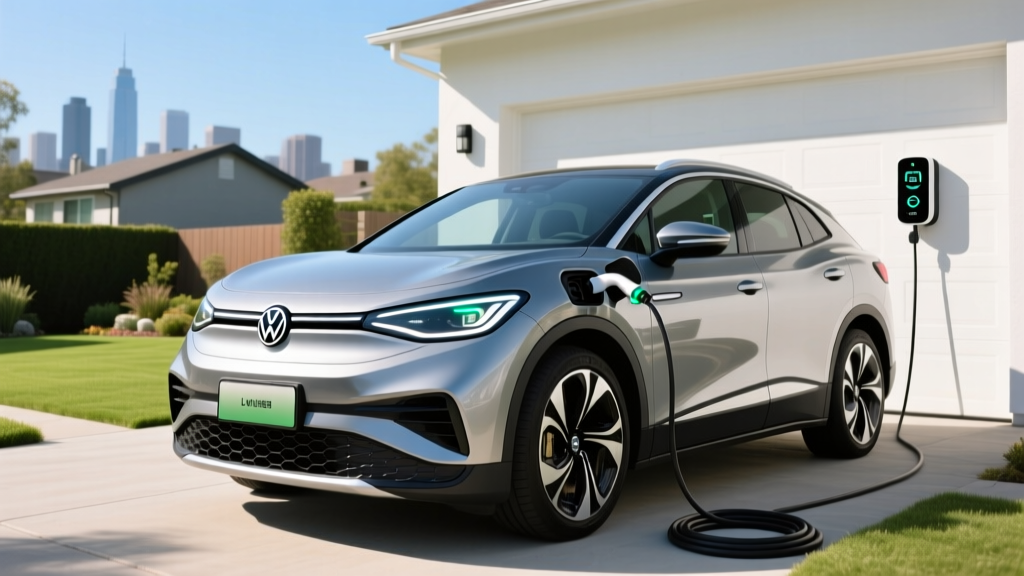
Most ID.4 owners will want a Level 2 home charger to wake up to a 'full tank' every morning. To achieve the maximum 11.5 kW charge rate, you need a 240V circuit rated for at least 50 Amps (which provides 40 Amps of continuous power).
Installation costs vary wildly based on your home's existing electrical panel. If you have a modern 200-Amp panel with spare capacity, the run might be simple. If you have an older 100-Amp panel, you may need a 'service upgrade' or a smart load-management system to avoid overloading the house.
| Item | Estimated Cost Range | Notes |
|---|---|---|
| Level 2 Charger Hardware | $400 - $750 | Smart Wi-Fi enabled, 48A models |
| Electrician Labor & Materials | $600 - $1,500 | Based on 10-40ft wire run |
| Permit & Inspection Fees | $100 - $300 | Required by most local codes |
| Panel Upgrade (If Needed) | $1,500 - $3,500+ | Upgrading to 200A service |
| Total (Standard Install) | $1,100 - $2,550 | Excluding major panel work |
Connector Compatibility: CCS1 vs. NACS
The 2022 VW ID.4 was built with the CCS1 (Combined Charging System) port. However, the EV industry has shifted toward the NACS (North American Charging Standard) pioneered by Tesla. While VW has committed to NACS for future models, current ID.4 owners need an adapter to access the Tesla Supercharger network, which is now opening up to non-Tesla vehicles via the 'Open Supercharging' initiative.
| Network | Native Connector | ID.4 Access Method |
|---|---|---|
| Electrify America / EVgo | CCS1 | Native (Plug and Play) |
| Tesla Superchargers | NACS | CCS-to-NACS Adapter ($150-$250) |
| Home Level 2 Chargers | J1772 / NACS | J1772 native; NACS requires adapter |
The Economics: Cost Per Mile vs. Gas
Is it still cheaper to charge than to fill up a gas tank in 2026? The answer depends on where you plug in. According to the EPA, the RWD ID.4 achieves roughly 104 MPGe combined. In energy terms, it consumes about 32 kWh per 100 miles.
| Scenario | Rate | Cost per 100 Miles |
|---|---|---|
| Home (Off-Peak Utility Rate) | $0.12 / kWh | $3.84 |
| Home (National Avg. Residential) | $0.17 / kWh | $5.44 |
| Public DC Fast (EA Pass+) | $0.31 / kWh | $9.92 |
| Gasoline SUV (25 MPG) | $3.20 / gallon | $12.80 |
Even at public DC fast-charging rates, the ID.4 remains more cost-effective per mile than a comparable gas-powered SUV. However, to maximize savings, home charging during off-peak hours is essential. Many utilities now offer 'Time of Use' (TOU) plans that reward EV owners for charging between 11 PM and 6 AM.
Top Equipment Picks for 2026
To get the most out of your ID.4's 11.5 kW onboard charger, we recommend 48-Amp hardwired units. These provide the fastest possible Level 2 speeds and are generally safer for continuous high-load use than plug-in NEMA 14-50 outlets.
1. ChargePoint Home Flex (Hardwired)
Power: Up to 11.5 kW (48A)
Features: Excellent app scheduling, utility TOU integration, and a 23-foot cable.
Price: ~$550
Verdict: The best all-rounder for ID.4 owners who want to optimize for cheap overnight rates.
2. Emporia Vue EV Charger
Power: Up to 11.5 kW (48A)
Features: Integrated energy monitoring for the whole home, solar integration.
Price: ~$400
Verdict: The data-nerd's choice. Perfect if you want to see exactly how many kWh are going to the car vs. the house.
Safety and Code Considerations
EV charging is a continuous load that can run for 8-10 hours at maximum amperage. According to the National Electrical Code (NEC), a circuit must be rated for 125% of the continuous load. Therefore, a 48-Amp charger requires a 60-Amp breaker and 6-AWG copper wire. Always hire a licensed electrician and pull a local permit; unpermitted work can void home insurance in the event of an electrical fire.
Frequently Asked Questions
Can I use the mobile charger that came with my ID.4?
Yes, but it is limited to Level 1 (1.2 kW) on a standard 120V outlet. It will add only 3-4 miles of range per hour, which is sufficient for PHEVs but inadequate for a 275-mile range BEV like the ID.4 unless your daily commute is under 20 miles.
Does the federal tax credit cover home charger installation?
The §30D tax credit applies to the vehicle. However, the Alternative Fuel Vehicle Refueling Property Credit may cover up to 30% of hardware and installation costs (max $1,000). This credit is subject to specific census-tract and sourcing requirements for 2026.
What happens if my battery runs out on the road?
Modern EV route-planning in the ID.4's infotainment system will automatically suggest DC fast-charging stops. However, real-world range at 70+ MPH or in sub-40°F weather can be 15-20% lower than the EPA sticker of 275 miles. Always plan for a 20% buffer.