If you own or are shopping for a Volkswagen ID.4, you already know the SUV comes with complimentary charging on the Electrify America network. But knowing your DC fast-charging allocation and actually extracting the best charging experience from it are two different things. This guide breaks down exactly how the 2026 VW ID.4 charges at home and on the road — with real numbers, real costs, and the equipment you need to make ownership effortless.
VW ID.4 Charging Specs at a Glance
The 2026 VW ID.4 is offered with two battery configurations. Understanding the difference between kW (power — how fast energy flows) and kWh (energy — how much the battery holds) is essential before we go further.
| Spec | Standard Range (62 kWh) | Pro / AWD (82 kWh) |
|---|---|---|
| Usable battery capacity | 62 kWh (NMC) | 82 kWh (NMC) |
| EPA range | ~206 mi | ~275 mi (RWD) / ~263 mi (AWD) |
| Max DC fast-charge rate | 135 kW peak | 175 kW peak |
| 10–80% DC fast charge | ~30 min | ~28 min |
| Level 2 onboard charger | 11 kW (48A @ 240V) | 11 kW (48A @ 240V) |
| Level 2 full charge time | ~6.5 hours | ~8.5 hours |
| Connector (2026 model year) | CCS1 (NACS adapter available) | CCS1 (NACS adapter available) |
| Electrify America free charging | 3 years / unlimited (new vehicle promo varies by MY) | 3 years / unlimited (new vehicle promo varies by MY) |
Real-world range caveat: The EPA figures above assume moderate temperatures and mixed driving. Expect ~15–25% range reduction in sustained highway driving at 75+ mph, and up to 30% loss in sub-freezing weather without preconditioning. On a cold winter road trip, a 275-mile EPA ID.4 Pro may realistically deliver 190–210 miles between stops.
Understanding Charging Levels: How Fast Will Each Add Range?
Every EV owner needs to understand the three charging tiers. Here's how they apply to the ID.4 specifically:
| Level | Power (kW) | Voltage / Amps | Miles of Range Added per Hour | Best Use Case |
|---|---|---|---|---|
| Level 1 (120V household) | ~1.4 kW | 120V / 12A | ~4–5 mi/hr | Emergency / trickle top-up |
| Level 2 (240V home/work) | Up to 11 kW | 240V / 48A | ~30–37 mi/hr | Daily home charging |
| DC Fast Charge | Up to 175 kW | 400–500V DC | ~200+ mi/hr (at peak) | Road trips, Electrify America |
Key insight: Level 1 charging on a standard 120V outlet is essentially useless as a primary strategy for the ID.4's 82 kWh battery — a full charge would take over 55 hours. Level 2 at home is the backbone of daily ownership. DC fast charging is your road-trip tool, and the ID.4's 175 kW peak rate on the 82 kWh model puts it in the competent-but-not-class-leading category.
Charging the ID.4 on Electrify America: What to Expect
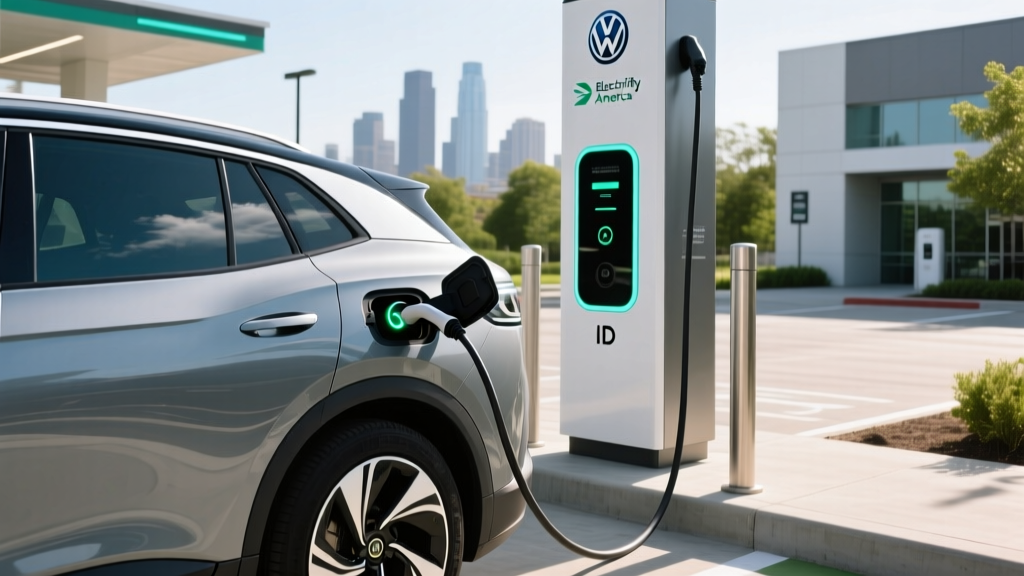
Volkswagen's relationship with Electrify America is foundational — VW's dieselgate settlement funded the network's creation. For 2026 ID.4 buyers, the included free charging period (typically 3 years of unlimited sessions, though promotional terms vary by model year and trim) makes EA your go-to public network.
The Charging Curve Reality
Electrify America stations commonly offer 150 kW and 350 kW chargers. The ID.4 Pro (82 kWh) peaks at 175 kW, meaning a 350 kW cabinet will not push the car faster than its onboard limit. Here's the real-world charge curve you'll experience:
- 10–30% SoC: Ramps quickly to ~170–175 kW peak
- 30–60% SoC: Sustains ~140–165 kW — this is the sweet spot
- 60–80% SoC: Tapers to ~90–110 kW as battery management protects cells
- Above 80%: Drops sharply to ~40–50 kW — never wait past 80% on a road trip
The published 10–80% time of ~28 minutes for the 82 kWh model is achievable under ideal conditions: battery preconditioned to optimal temperature (above 68°F / 20°C), station not power-sharing with another vehicle, and starting at exactly 10% SoC. In colder weather without preconditioning, expect 35–45 minutes for the same session.
Preconditioning: The Hidden Speed Boost
The ID.4's navigation system can precondition the battery when you set an Electrify America station as your destination. This warms the NMC cells to the ideal charging temperature, enabling the car to hit peak kW sooner and sustain it longer. In winter testing, preconditioned ID.4s have shown 15–20% faster 10–80% times versus unplugged arrivals. Always set your charger as a nav destination.
Connector Compatibility: CCS1, NACS, and Adapters
The 2026 ID.4 ships with a CCS1 (Combined Charging System) port. However, Volkswagen has been transitioning its lineup toward NACS (North American Charging Standard, the Tesla connector) for future model years. Here's where things stand and what you need to know:
| Connector | Native Support? | Networks Accessible | Adapter Needed? |
|---|---|---|---|
| CCS1 | Yes (built-in) | Electrify America, EVgo, ChargePoint, most non-Tesla networks | None |
| NACS (Tesla) | No (via adapter) | Tesla Supercharger network (15,000+ stalls) | VW-approved CCS-to-NACS adapter (~$200–$250) |
| CHAdeMO | No | Largely legacy / discontinued | Not recommended |
Practical advice: Your included Electrify America charging means CCS1 is your primary connector for the first years of ownership. However, purchasing a NACS adapter is strongly recommended for road-trip flexibility — Tesla Superchargers remain the most reliable and widespread DC fast-charging network in North America. Check VW's official parts channel or your dealer for the approved adapter to ensure warranty compliance.
Home Charger Installation: Costs, Requirements & Electrical Upgrades
How much does it cost to install a home EV charger? The answer depends on your home's electrical panel, the distance from panel to charger location, and local permit fees. Here's a realistic breakdown for a 2026 installation:
| Component | Typical Range | Notes |
|---|---|---|
| Level 2 charger equipment (40A–48A) | $400–$750 | Smart Wi-Fi chargers cost more |
| Electrician labor (standard install) | $500–$1,500 | Varies by run length, wall type, conduit |
| Electrical permit | $50–$200 | Required in most jurisdictions |
| Panel upgrade (if needed: 100A → 200A) | $1,500–$3,500 | Older homes with 100A service |
| Total (no panel upgrade) | $950–$2,450 | Most newer homes with 200A panel |
| Total (with panel upgrade) | $2,450–$5,950 | Homes built before ~2000 |
Electrical Requirements for the ID.4
The ID.4's 11 kW onboard charger can accept up to 48 amps at 240 volts. To deliver this, you need a dedicated 60-amp circuit (the National Electrical Code requires circuits to be rated at 125% of continuous load — 48A × 1.25 = 60A breaker). If you install a 40A charger, a 50-amp circuit suffices.
Panel upgrade reality check: If your home has a 100-amp main panel and you're already running central A/C, an electric dryer, and an electric oven, adding a 60A EV circuit may overload your service. A licensed electrician will perform a load calculation per NEC Article 220. Budget for a panel upgrade if your home was built before the early 2000s. Some utilities offer rebates of $200–$500 for panel upgrades tied to EV adoption — check your local provider.
Safety & Code Considerations
- Dedicated circuit: Your Level 2 charger must be on its own dedicated breaker — never share a circuit with other appliances.
- GFCI protection: NEC 2020 and later require GFCI (Ground Fault Circuit Interrupter) protection for EV charging outlets. Hardwired chargers often have built-in GFCI; plug-in units require a GFCI breaker.
- Outdoor rating: If installing outside, use a NEMA 4-rated enclosure and a charger rated for outdoor use (IP55 or higher).
- Hardwired vs. plug-in (NEMA 14-50): Hardwired installations support the full 48A and eliminate the outlet as a failure point. A NEMA 14-50 outlet (50A) limits you to 40A continuous but offers portability if you move.
Level 2 Home Charger Recommendations for the ID.4
Here are three chargers well-matched to the ID.4's 11 kW / 48A onboard charger. All use the CCS1/J1772 connector natively compatible with your VW.
Emporia Level 2 Smart Charger
- Power output: 48A / 11.5 kW (hardwired) or 40A / 9.6 kW (NEMA 14-50)
- Cable length: 24 ft
- Smart features: Wi-Fi, energy monitoring, scheduling, solar integration
- Price: ~$400 (hardwired) / ~$350 (plug-in)
- Best for: Budget-conscious owners who want smart scheduling and energy data
ChargePoint Home Flex
- Power output: Up to 50A / 12 kW (hardwired); configurable via DIP switch down to 16A
- Cable length: 23 ft
- Smart features: Wi-Fi, app scheduling, Alexa integration, energy reports
- Price: ~$550–$650
- Best for: Flexibility — adjustable amperage means it works on almost any circuit
Grizzl-E Smart
- Power output: 40A / 9.6 kW (NEMA 14-50) or 48A / 11.5 kW (hardwired)
- Cable length: 24 ft
- Smart features: Wi-Fi, OCPP support, extreme-cold rated (-40°F)
- Price: ~$450–$550
- Best for: Cold-climate owners — built in Canada, rugged aluminum enclosure
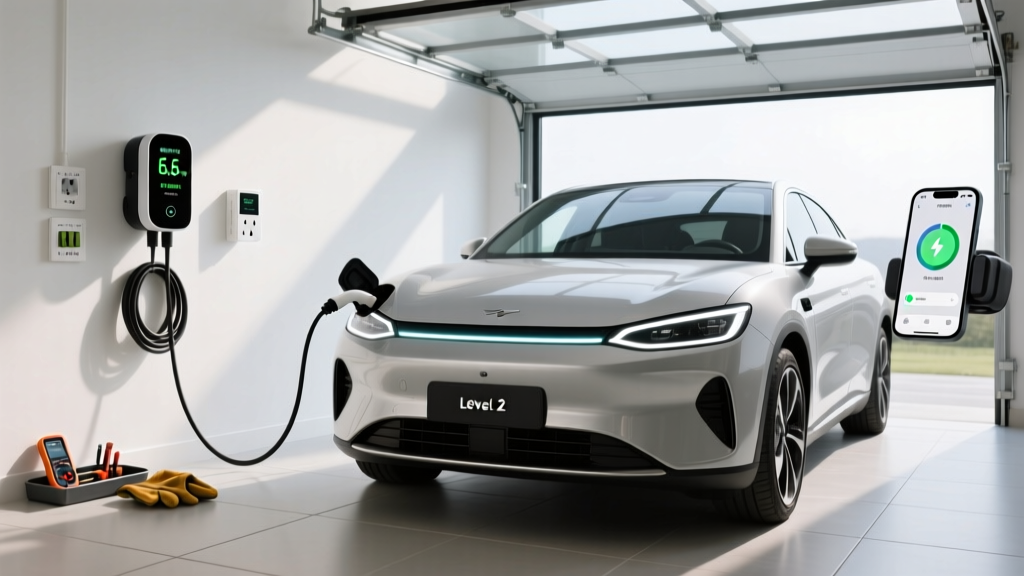
Our pick for ID.4 owners: The ChargePoint Home Flex at 48A hardwired maximizes the ID.4's 11 kW onboard charger. At 11 kW, you'll add roughly 33–37 miles of range per hour — enough to fully replenish an 82 kWh battery overnight in ~8.5 hours.
Cost to Charge: Home vs. Electrify America vs. Gas
How much does charging cost per mile vs gas? Let's run real numbers for the ID.4 Pro (82 kWh, 275 mi EPA, efficiency of ~3.0 mi/kWh or ~104 MPGe combined per fueleconomy.gov).
| Scenario | Rate | Cost for Full 82 kWh Charge | Cost Per Mile (est.) |
|---|---|---|---|
| Home (off-peak utility rate) | $0.10/kWh | $8.20 | $0.030 |
| Home (average US residential) | $0.17/kWh | $13.94 | $0.051 |
| Electrify America (free period) | $0.00/kWh | $0.00 | $0.000 |
| Electrify America (post-free, guest rate) | $0.37–$0.48/kWh | $30.34–$39.36 | $0.110–$0.143 |
| Gas SUV (25 MPG combined, $3.40/gal) | — | — | $0.136 |
The takeaway: During your included Electrify America period, road-trip charging is essentially free. At home on off-peak rates, the ID.4 costs roughly 3 cents per mile — a quarter of what a comparable gas SUV (like the Tiguan at ~25 MPG) costs. Even after your free EA charging expires, home charging remains dramatically cheaper than gasoline. Public DC fast charging at guest rates, however, can approach or exceed gas costs per mile — another reason home Level 2 installation is the single best investment an ID.4 owner can make.
For reference, the IRS §30D clean vehicle credit may apply to your ID.4 purchase (up to $7,500, subject to MSRP caps, buyer income limits, and battery-sourcing requirements). Additionally, some states and utilities offer rebates of $250–$1,000 specifically for home charger installation — check afdc.energy.gov for local incentives.
Frequently Asked Questions
How much does it cost to install a home EV charger for my ID.4?
Expect $950–$2,450 for a standard installation (equipment, electrician, permit) if your home has a 200-amp electrical panel. If you need a panel upgrade from 100A to 200A, add $1,500–$3,500, bringing the total to $2,450–$5,950. Always get a load calculation from a licensed electrician before committing.
How fast will each charging level add range to the ID.4?
Level 1 (120V) adds about 4–5 miles per hour — impractical as a daily solution. Level 2 (240V, 48A) adds approximately 30–37 miles per hour, fully charging the 82 kWh battery in ~8.5 hours. DC fast charging on Electrify America at 175 kW peak can add 150+ miles in 15 minutes during the optimal 20–60% SoC window.
Which connector does the ID.4 use, and do I need an adapter?
The 2026 ID.4 uses CCS1 natively, which works directly with Electrify America, EVgo, ChargePoint, and most public networks. For Tesla Supercharger access, you'll need a VW-approved CCS-to-NACS adapter (~$200–$250). CHAdeMO is not supported and is largely obsolete in North America.
How much does charging the ID.4 cost per mile compared to gas?
At home on average US electricity ($0.17/kWh), the ID.4 costs about $0.051/mile. A comparable 25 MPG gas SUV at $3.40/gallon costs $0.136/mile. During your free Electrify America period, road-trip charging costs nothing. After the free period, EA guest rates ($0.37–$0.48/kWh) bring cost per mile to $0.11–$0.14, which is close to gas.
What electrical upgrades might I need for a Level 2 charger?
The ID.4's 48A onboard charger requires a dedicated 60-amp circuit at 240V. If your home has a 100-amp main panel (common in homes built before ~2000), you'll likely need a panel upgrade to 200A to safely accommodate the EV circuit alongside existing loads. A licensed electrician will perform a NEC Article 220 load calculation to determine this. Budget $1,500–$3,500 for the upgrade if required.
Should I charge to 100% on Electrify America during road trips?
No. The charge curve tapers dramatically above 80% SoC — going from 80% to 100% can take as long as the 10–80% session. For road trips, charge to 80% and drive on. You'll reach your next stop faster. Reserve 100% charges for overnight home Level 2 sessions before a long trip, and even then, VW recommends 80% daily to preserve long-term NMC battery health.