VW ID.7 Range: What the EPA Number Actually Means on the Road
The 2026 Volkswagen ID.7 is VW's flagship electric sedan in the US market, built on the MEB platform with an updated APP550 drive motor and a choice of battery packs. Buyers searching for VW ID.7 range figures will find an EPA-estimated 342 miles for the Pro S trim equipped with the 86 kWh (usable) NMC battery pack, while the base Pro trim with the 77 kWh pack delivers an EPA-estimated 291 miles. The GTX performance variant with dual motors and the 86 kWh pack is rated at approximately 302 miles EPA.
EPA estimates assume a mix of city and highway driving at moderate temperatures. In our experience with MEB-platform VWs, expect the following adjustments:
- Highway-only at 75 mph: ~275–295 mi (Pro S) — aerodynamic drag dominates at speed
- Cold weather (below 30°F): ~235–260 mi — battery heating and cabin HVAC draw significant energy
- City/suburban with regen: ~320–345 mi — regenerative braking recovers energy in stop-and-go
The ID.7's heat pump (standard on Pro S, optional on Pro) recovers waste heat from the drivetrain to warm the cabin, reducing cold-weather range loss by roughly 10–15% compared to resistive heating alone.
| Spec | Pro (77 kWh) | Pro S (86 kWh) | GTX AWD (86 kWh) |
|---|---|---|---|
| EPA Range | 291 mi | 342 mi | 302 mi |
| Battery (usable) | 77 kWh NMC | 86 kWh NMC | 86 kWh NMC |
| Horsepower | 282 hp | 282 hp | 335 hp |
| 0–60 mph | 6.2 sec | 6.3 sec | 5.2 sec |
| Peak DC Charge Rate | 175 kW | 200 kW | 200 kW |
| 10–80% DC Fast Charge | ~28 min | ~26 min | ~26 min |
| Level 2 AC Charge Rate | 11 kW | 11 kW | 11 kW |
| MPGe (combined) | 114 MPGe | 118 MPGe | 105 MPGe |
| MSRP (before incentives) | ~$52,995 | ~$57,495 | ~$62,995 |
| Battery/Powertrain Warranty | 8 yr / 100,000 mi | 8 yr / 100,000 mi | 8 yr / 100,000 mi |
Source: fueleconomy.gov and Volkswagen USA.
Charging Levels Explained: How Fast Will Each Level Add Range to the ID.7?
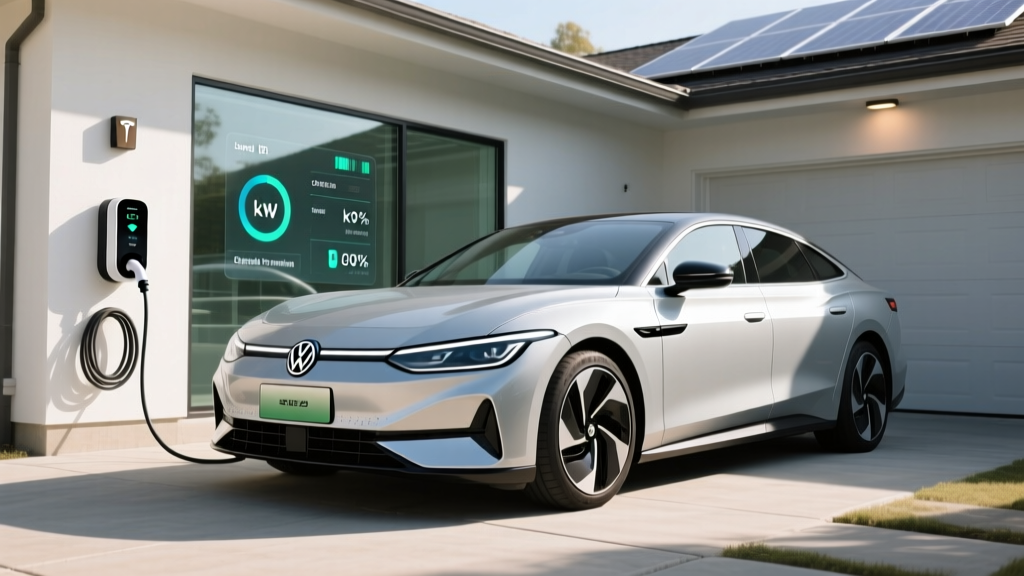
Understanding charging speed requires distinguishing kW (kilowatts) — the rate of energy delivery — from kWh (kilowatt-hours) — the total energy stored in the battery. Think of kW as how fast water flows from a hose, and kWh as the size of the bucket. The ID.7's battery holds 77 or 86 kWh of energy; the charger's kW rating determines how quickly that battery fills.
| Level | Voltage / Amps | Power (kW) | Miles of Range per Hour | 0–100% Time (86 kWh) |
|---|---|---|---|---|
| Level 1 (standard outlet) | 120V / 12A | ~1.4 kW | ~4–5 mi/hr | ~61 hours |
| Level 2 (home/public AC) | 240V / 48A | 11.5 kW | ~34–38 mi/hr | ~8 hours |
| Level 2 (home 40A circuit) | 240V / 40A | 9.6 kW | ~28–32 mi/hr | ~9.5 hours |
| DC Fast Charging | 400V+ DC | up to 200 kW peak | ~200+ mi in 15 min (10–50%) | 10–80% in ~26 min |
The ID.7's onboard charger caps AC charging at 11 kW, meaning even a 48A (11.5 kW) Level 2 station won't push more than 11 kW into the car. For DC fast charging, the Pro S and GTX accept up to 200 kW at compatible CCS stations, though sustained rates taper as the battery fills — expect roughly 175–200 kW from 10–40% SoC, then a gradual taper to ~80 kW by 70%, and ~40 kW by 85%. This charge-curve taper is why manufacturers quote 10–80% times rather than 0–100%.
Home Charger Installation: Electrical Requirements, Costs & Panel Considerations
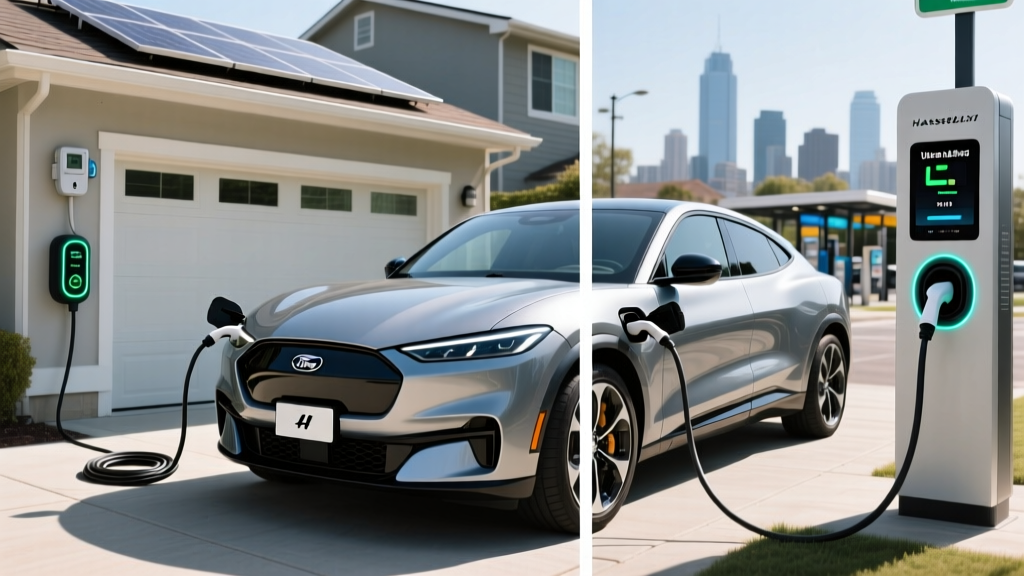
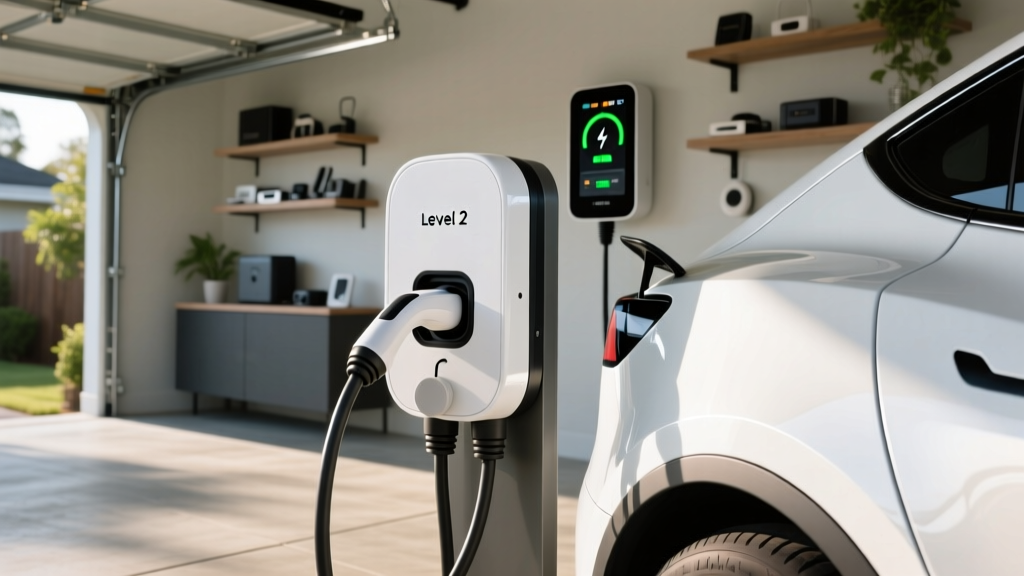
Installing a Level 2 home charger is the single most impactful upgrade for ID.7 ownership. Overnight charging at home means you start every morning with a full battery — no detours to gas stations or public chargers. But the installation cost varies dramatically based on your home's electrical infrastructure.
Electrical Requirements for the ID.7
The ID.7's 11 kW AC acceptance means you want a charger on a 240V / 60A dedicated circuit (which delivers up to 48A continuous to the vehicle per NEC 80% rule) or a 240V / 50A circuit (40A continuous, ~9.6 kW). Most ID.7 owners find a 60A circuit ideal, filling the 86 kWh battery in roughly 8 hours overnight.
Your electrician will evaluate:
- Panel capacity: A 200A main panel typically supports a 60A EV circuit. Homes with 100A service may need a panel upgrade ($1,500–$3,500) or a load-management device.
- Wire run distance: Longer runs from panel to garage/driveway require thicker (more expensive) copper wire. Runs over 50 feet can add $200–$600 in material.
- Permit requirements: Most jurisdictions require an electrical permit for new 240V circuits ($50–$200).
| Component | Simple Install (short run, 200A panel) | Complex Install (long run or panel upgrade) |
|---|---|---|
| Level 2 Charger (hardware) | $400–$700 | $400–$700 |
| Electrician labor (2–6 hrs) | $400–$800 | $800–$2,000 |
| Wire, conduit, breaker | $100–$250 | $300–$800 |
| Electrical permit | $50–$150 | $100–$200 |
| Panel upgrade (if needed) | $0 | $1,500–$3,500 |
| TOTAL | $950–$1,900 | $3,100–$7,200 |
The federal Alternative Fuel Vehicle Refueling Property Credit (IRS Form 8911) covers 30% of home charger hardware and installation costs, up to $1,000, subject to income and census-tract eligibility. Check with a tax professional for your specific situation.
Safety & Code Considerations
NEC Article 625 governs EV charging installations. Key requirements for ID.7 owners:
- Dedicated circuit: The EV charger must be on its own breaker — no sharing with other loads.
- GFCI protection: Outdoor installations require GFCI breakers; many modern EVSEs (chargers) have built-in ground-fault protection, but your electrician will verify code compliance.
- NEMA 14-50 vs. hardwired: A NEMA 14-50 outlet offers portability (take the charger when you move) but requires a GFCI breaker in most jurisdictions. Hardwired installations skip the receptacle and are often $100–$200 cheaper in labor while supporting higher continuous amperage.
- Outdoor rating: If your charger mounts outside, ensure it carries a NEMA 4 or IP55+ weather rating.
Which Connector Is Compatible With the VW ID.7?
The 2026 VW ID.7 sold in North America comes equipped with a CCS1 (Combined Charging System) port for both AC Level 2 and DC fast charging. However, the connector landscape has shifted dramatically since Tesla opened its Supercharger network via the NACS (North American Charging Standard).
| Connector | Native on ID.7? | Adapter Available? | Network Access |
|---|---|---|---|
| CCS1 | Yes (native) | N/A | Electrify America, EVgo, ChargePoint DC |
| NACS (Tesla) | No | Yes — CCS-to-NACS adapter (~$200–$300) | Tesla Superchargers (V3/V4) |
| CHAdeMO | No | Rare, not recommended | Legacy — mostly discontinued |
| J1772 (AC) | Yes (CCS includes J1772) | N/A | All public Level 2 stations |
Key recommendation: Purchase a CCS-to-NACS adapter from a reputable manufacturer (Lectron, A2Z, or Tesla's official CCS adapter if compatible with your model year) to unlock Tesla Supercharger access. The ID.7's 200 kW peak charge rate works well on Tesla V3 Superchargers (250 kW capable) and Electrify America's 350 kW stations, though the car will only draw its rated maximum.
Volkswagen has confirmed that 2026 ID.7 models retain the CCS1 port. VW has announced a future transition to NACS, but as of the 2026 model year, CCS1 remains the native standard. VW's partnership with Electrify America typically includes a complimentary charging credit (check your purchase agreement for current terms).
Charging Cost Per Mile: ID.7 vs. Gasoline Sedan
One of the strongest economic arguments for the ID.7 is its low cost per mile, particularly when charging at home on off-peak utility rates. Let's compare the ID.7 Pro S against a similarly sized gasoline sedan averaging 30 MPG combined.
| Charging/Fuel Scenario | Rate | Cost per Mile (ID.7) | Cost per Mile (Gas, $3.50/gal) |
|---|---|---|---|
| Home off-peak (utility rate) | $0.12/kWh | $0.034 | $0.117 |
| Home standard rate | $0.18/kWh | $0.051 | $0.117 |
| Public Level 2 | $0.35/kWh | $0.100 | $0.117 |
| DC Fast Charging | $0.48/kWh | $0.137 | $0.117 |
The ID.7 Pro S consumes approximately 29 kWh per 100 miles (or roughly 3.45 mi/kWh) in mixed driving per fueleconomy.gov. At home off-peak rates of $0.12/kWh, that translates to just 3.4 cents per mile — roughly a 70% savings over a 30 MPG gas sedan at $3.50/gallon.
However, note that exclusive reliance on DC fast charging ($0.48/kWh national average at Electrify America and EVgo stations) can push the ID.7's per-mile cost slightly above a fuel-efficient gas car. The economics strongly favor home charging. If your daily commute is under 60 miles, a single overnight charge on a Level 2 home station covers multiple days of driving.
Recommended Home Chargers for the VW ID.7
Given the ID.7's 11 kW AC acceptance rate, you want a Level 2 charger that delivers at least 40A (9.6 kW) to take full advantage. Here are top picks for 2026:
Emporia Vue Level 2 EV Charger
- Power: 48A / 11.5 kW (240V)
- Connector: J1772 (CCS-compatible)
- Cable: 24 ft
- Smart features: Wi-Fi, app scheduling, solar integration, energy monitoring
- Price: ~$399
- Best for: Budget-conscious owners wanting smart scheduling
ChargePoint Home Flex
- Power: Up to 50A / 12 kW (240V, adjustable)
- Connector: J1772 (CCS-compatible)
- Cable: 23 ft
- Smart features: Wi-Fi, Alexa, app scheduling, flexible amperage
- Price: ~$549
- Best for: Adjustable amperage to match your circuit capacity
Tesla Wall Connector (with J1772 adapter)
- Power: 48A / 11.5 kW (240V)
- Connector: NACS native (J1772 adapter included for ID.7)
- Cable: 24 ft
- Smart features: Wi-Fi, OTA updates, power-sharing for multi-charger setups
- Price: ~$450 (+ adapter)
- Best for: Multi-EV households with both Tesla and CCS vehicles
All three chargers will max out the ID.7's 11 kW onboard charger. The ChargePoint Home Flex stands out for its adjustable amperage — if your panel can only support a 50A circuit (40A continuous), you can set the charger to 40A without replacing hardware.
Maximizing Your ID.7's Charging Speed: Preconditioning & Best Practices
The ID.7's battery management system performs best when the pack is preconditioned before DC fast charging. Here's how to optimize:
- Use navigation to route to a charger: When you enter a DC fast charging station into the ID.7's navigation system, the car automatically begins preconditioning the battery — warming it to the optimal temperature for maximum charge acceptance. This can add 20–40 kW to your initial charge rate on cold days.
- Charge between 10–80% for fastest speeds: The ID.7's charge curve peaks early (10–40% SoC) and tapers significantly above 80%. For road trips, plan shorter stops charging from 10% to 80% rather than one long stop to 100%.
- Set departure timers for home charging: Use the ID.7's infotainment system or VW app to schedule charging during off-peak utility hours (typically 10 PM – 6 AM). This saves money and reduces grid strain.
- Daily charging to 80%: For NMC batteries like those in the ID.7, VW recommends setting the charge limit to 80% for daily use and reserving 100% for road trips. This practice helps preserve long-term battery health. VW's battery warranty guarantees at least 70% capacity retention over 8 years / 100,000 miles.
Frequently Asked Questions
How much does it cost to install a home EV charger for the VW ID.7?
A straightforward Level 2 home charger installation on an existing 200A panel with a short wire run typically costs $950–$1,900 including equipment, electrician labor, and permit. If your home needs a panel upgrade (common in homes with 100A service), costs can rise to $3,100–$7,200. Always get a quote from a licensed electrician who can assess your specific panel capacity and wire-run distance.
How fast will each charging level add range to the ID.7?
Level 1 (120V outlet) adds roughly 4–5 miles per hour — adequate only for overnight top-ups of 40–50 miles. Level 2 (240V, 48A) adds 34–38 miles per hour, fully charging the 86 kWh battery in about 8 hours. DC fast charging at a 200 kW station adds approximately 200 miles in 15 minutes during the 10–50% SoC window, with a 10–80% charge taking about 26 minutes.
Which connector and charger is compatible with my VW ID.7?
The 2026 ID.7 uses a CCS1 connector natively. This works directly with Electrify America, EVgo, ChargePoint DC fast stations, and all public J1772 Level 2 stations. To access Tesla Superchargers, you'll need a CCS-to-NACS adapter ($200–$300). For home charging, any J1772 Level 2 charger rated 40A or above will work.
How much does charging the ID.7 cost per mile compared to gas?
At home off-peak rates ($0.12/kWh), the ID.7 costs approximately $0.034 per mile — roughly 70% less than a 30 MPG gas car at $3.50/gallon ($0.117/mi). At standard home rates ($0.18/kWh), it's about $0.051/mi. Public DC fast charging at $0.48/kWh brings the cost to ~$0.137/mi, slightly above gas. The economic case for the ID.7 is strongest when you charge at home.
What electrical upgrades might I need for a home charger?
The most common upgrade is a panel upgrade from 100A to 200A service ($1,500–$3,500) if your home's electrical panel lacks spare capacity for a 60A dedicated circuit. Other potential needs include: a new conduit run from panel to garage ($200–$600 for long runs), a GFCI breaker for outdoor outlets ($50–$120), and in some cases, a utility service upgrade if your home's incoming supply is limited. A licensed electrician can evaluate your panel's available amperage during a site visit.
Does the VW ID.7 qualify for the federal EV tax credit?
As of 2026, the ID.7's eligibility for the §30D Clean Vehicle Credit (up to $7,500) depends on battery component and critical-mineral sourcing requirements, buyer income caps ($150K single / $300K joint), and the vehicle's MSRP falling under the $55,000 sedan cap. The Pro trim (~$52,995) may qualify; the Pro S (~$57,495) and GTX (~$62,995) exceed the sedan MSRP cap and may not. Point-of-sale transfer is available if eligible. Always verify current eligibility on the IRS website and consult a tax professional, as sourcing rules are updated periodically.