The Volkswagen e-Golf was discontinued after the 2019 model year, but thousands remain on the road as reliable, practical daily-driver EVs. If you own one — or are shopping the used market — understanding how to charge it efficiently is the single biggest factor in whether the car's EPA-rated range actually fits your life. The later (2017–2019) e-Golf carries a 35.8 kWh battery pack (roughly 31.5 kWh usable) and an EPA range of 125 miles. Earlier 2015–2016 models with the 24.2 kWh pack are rated at just 83 miles. Either way, a smart home charging setup turns that modest range into a seamless daily experience.
This guide walks through every charging option available to e-Golf owners in 2026: what each level delivers in real-world miles per hour, what your home electrical panel needs to support Level 2, which connectors and adapters apply, what charging actually costs per mile, and which specific equipment earns our recommendation.
Understanding the VW e-Golf Electric Range You're Working With
Before choosing a charger, anchor your expectations to real numbers. The U.S. Department of Energy's fueleconomy.gov lists the 2017–2019 e-Golf at 125 miles EPA combined, with an efficiency rating of 119 MPGe (29 kWh per 100 miles). That efficiency figure is critical: it tells you exactly how many kWh you'll burn to add miles back, which drives both your charging-speed expectations and your electricity cost.
- EPA sticker (2017–2019): 125 miles combined
- Real-world highway (65–75 mph, mild weather): ~100–110 miles
- Real-world winter (30°F and below, heater on): ~75–90 miles
- City/regen-heavy driving (mild weather): ~120–130 miles
The e-Golf lacks a heat pump (resistive cabin heater only), so cold-weather range loss is significant — often 25–35%. Plan your charging setup around the worst-case scenario, not the best.
With a usable battery of about 31.5 kWh, you're refilling a relatively small pack. That's actually good news for home charging: even modest Level 2 equipment can replenish the e-Golf from empty to full overnight with hours to spare.
Charging Levels Explained: Speeds in kW and Miles Per Hour
EV charging comes in three tiers. The key distinction to internalize: kW (kilowatts) measures power — how fast energy flows into the car. kWh (kilowatt-hours) measures energy — the total amount stored in the battery. Think of kW as the width of a hose and kWh as the size of the bucket. A wider hose (higher kW) fills the bucket faster, but the bucket size (kWh) doesn't change.
| Level | Voltage | Max Power (kW) | Miles of Range Added Per Hour | Full Charge Time (31.5 kWh usable) |
|---|---|---|---|---|
| Level 1 (standard outlet) | 120V AC | 1.2–1.4 kW | ~4–5 miles/hr | ~24–26 hours |
| Level 2 (home/public AC) | 240V AC | 3.6–7.2 kW | ~12–25 miles/hr | ~4.5–9 hours |
| DC Fast Charging | 400V+ DC | Up to 50 kW (CCS) | ~150–170 miles/hr (peak) | 10–80% in ~30–35 min |
Level 1 is the included portable cordset plugged into a standard 120V household outlet. At roughly 1.2 kW continuous, it adds about 4–5 miles of range per hour to the e-Golf. That's adequate if you drive under 40 miles daily and can plug in for 10+ hours overnight, but it won't recover a heavily depleted battery in time for a second-day road trip.
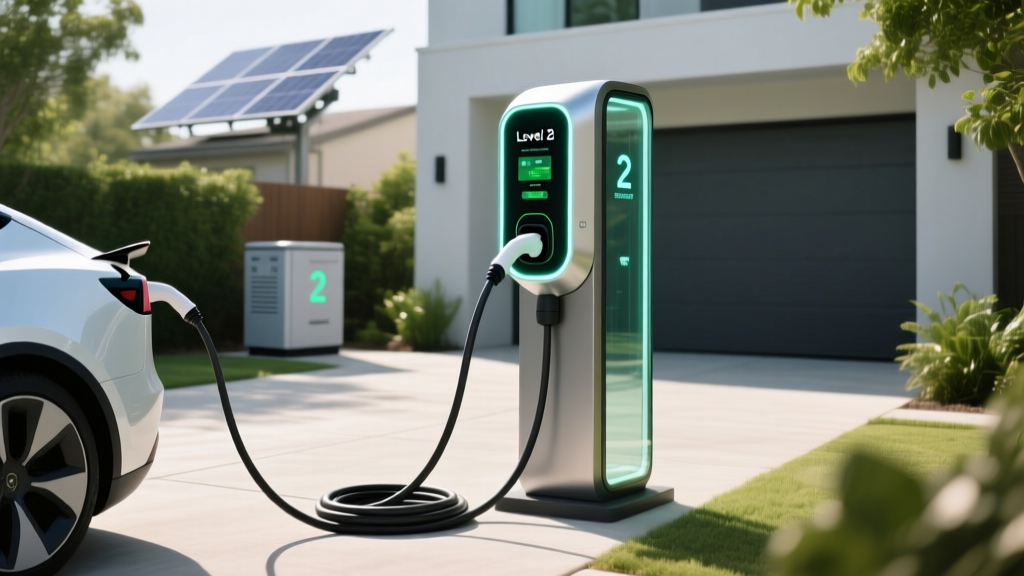
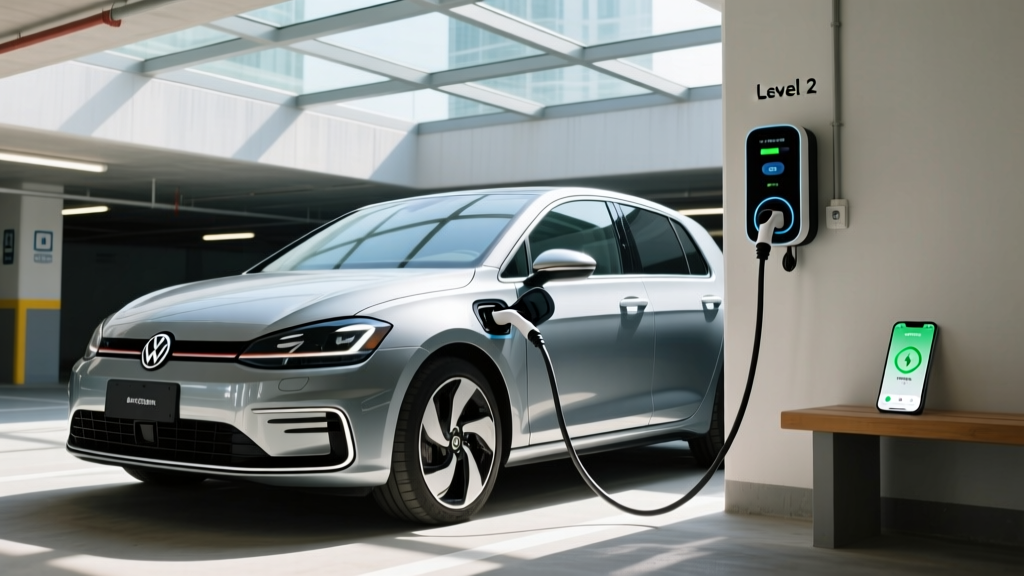
Level 2 is the home-charging standard and where most e-Golf owners should invest. The e-Golf's onboard charger is rated at 7.2 kW (2017–2019 models), meaning it can accept the full output of a 32-amp, 240V circuit. At 7.2 kW, you'll add roughly 25 miles of range per hour — enough to fully recharge from empty in under 5 hours. Earlier 2015–2016 e-Golfs have a 3.6 kW onboard charger, capping Level 2 speed at roughly 12 miles per hour regardless of how powerful your home unit is.
DC Fast Charging bypasses the onboard charger entirely, sending DC current straight to the battery. The 2017–2019 e-Golf supports CCS1 DC fast charging at up to 50 kW (some early 2015–2016 models were limited to CHAdeMO or lacked DC fast charging entirely — verify your specific VIN). At 50 kW peak, a 10–80% charge takes roughly 30–35 minutes. However, the e-Golf's charge curve tapers significantly above 80% SoC, so charging from 80–100% on DC fast can take nearly as long as the first 70%. Reserve DCFC for road trips; don't use it as your daily routine, as frequent high-power DC sessions accelerate battery degradation over time.
Home Charger Installation: Electrical Requirements and Costs
Installing a Level 2 home charger is the highest-impact upgrade an e-Golf owner can make. Here's what's involved electrically and financially.
Electrical Requirements
A 7.2 kW Level 2 charger (matching the e-Golf's onboard charger maximum) requires a 240V circuit rated at 40 amps. The National Electrical Code (NEC) requires that continuous loads — which EV charging qualifies as — not exceed 80% of a circuit's rated capacity. So a 40A circuit delivers up to 32A continuous (7.7 kW), which fully saturates the e-Golf's 7.2 kW acceptance rate.
If your electrical panel has spare capacity (typically two adjacent breaker slots and at least 40A of unused amperage on a 200A service), the installation is straightforward: an electrician runs conduit and wire from the panel to your garage or driveway, installs a 40A double-pole breaker, and mounts either a hardwired charger or a NEMA 14-50 receptacle.
When You Need a Panel Upgrade
Homes with 100A service, older wiring, or panels already near capacity may require a service upgrade to 200A before adding a 40A EV circuit. This is the single biggest cost variable in home charging installation. Signs you may need an upgrade:
- Your panel is 100A or 125A total service
- You have no open breaker slots
- An electrician's load calculation shows your existing circuits already consume 80%+ of panel capacity
- You have a Federal Pacific or Zinsco panel (these are flagged as fire hazards and must be replaced regardless)
Installation Cost Breakdown
| Component | Typical Cost Range | Notes |
|---|---|---|
| Level 2 charger unit (hardware) | $350–$700 | Smart Wi-Fi-enabled 32–40A units |
| Electrician labor (simple install) | $500–$1,200 | Short wire run, panel has capacity |
| Electrician labor (complex install) | $1,200–$2,500 | Long conduit run, trenching, sub-panel |
| Permit and inspection | $50–$250 | Varies by municipality |
| Panel upgrade (if needed) | $1,500–$3,500 | 100A → 200A service upgrade |
| Total (no panel upgrade) | $900–$2,150 | Most common scenario |
| Total (with panel upgrade) | $2,400–$5,950 | Older homes with 100A service |
Always hire a licensed electrician and pull a permit. Unpermitted EV charger installations can void homeowners insurance claims and create fire risk. The National Electrical Contractors Association maintains a directory of qualified installers.
Federal and Utility Incentives for Home Charging
Under the IRS §30D-adjacent Alternative Fuel Vehicle Refueling Property Credit (IRC §30C), homeowners may qualify for a tax credit covering up to 30% of home charging equipment and installation costs, capped at $1,000. Eligibility depends on census-tract requirements and your tax liability. Many utilities also offer rebates of $250–$500 for installing a smart Level 2 charger — check your local utility's EV programs. Consult a tax professional for your specific eligibility.
Connector Compatibility: What Plugs Into an e-Golf?
The e-Golf uses two connectors depending on charging type:
| Charging Type | Connector | Standard on e-Golf? | Notes |
|---|---|---|---|
| Level 1 / Level 2 (AC) | J1772 | Yes — all model years | Universal North American AC connector |
| DC Fast Charging | CCS1 (Combo) | Yes — 2017–2019 (most trims) | Some 2015–2016 models: CHAdeMO or no DCFC |
| Tesla Supercharger (NACS) | NACS | No — adapter needed | Tesla Magic Dock or third-party CCS-to-NACS adapter required |
For home Level 2 charging, any J1772 charger will plug directly into the e-Golf. No adapter needed.
For public DC fast charging, the CCS1 connector is standard at Electrify America, EVgo, and most non-Tesla networks. If you need access to Tesla Superchargers (which now use the NACS connector), you'll need a CCS-to-NACS adapter. Tesla's Magic Dock (built into some Supercharger stalls) allows CCS vehicles to charge without a separate adapter, but availability varies by station. Third-party adapters from companies like Lectron or A2Z EV are available for $150–$300 and work with most NACS Supercharger stalls — but verify firmware compatibility before purchasing.
The legacy CHAdeMO connector (found on some early e-Golfs and the Nissan LEAF) is being phased out across U.S. networks. If your 2015–2016 e-Golf has CHAdeMO only, your public DCFC options are shrinking.
Charging Cost Per Mile: e-Golf vs. Gas Car
The e-Golf's 29 kWh/100mi efficiency rating (per EPA data on fueleconomy.gov) makes it one of the more efficient EVs on the road — and that translates directly into low per-mile costs.
| Charging Scenario | Rate ($/kWh) | Cost Per 100 Miles | Cost Per Mile |
|---|---|---|---|
| Home (off-peak utility rate) | $0.10–$0.14 | $2.90–$4.06 | $0.03–$0.04 |
| Home (average U.S. residential) | $0.16–$0.17 | $4.64–$4.93 | $0.05 |
| Public Level 2 (network pricing) | $0.25–$0.49 | $7.25–$14.21 | $0.07–$0.14 |
| DC Fast Charging (public) | $0.35–$0.55 | $10.15–$15.95 | $0.10–$0.16 |
| Gas car comparison (28 MPG, $3.40/gal) | — | $12.14 | $0.12 |
At home on off-peak rates, the e-Golf costs roughly 3–4 cents per mile to "fuel" — about one-quarter the cost of a 28 MPG gas car at $3.40/gallon. Even on public DC fast chargers at the high end ($0.55/kWh), the e-Golf's efficiency keeps per-mile costs competitive with gasoline. The economic case for home charging is overwhelming: if you drive 12,000 miles per year, home charging at $0.13/kWh costs about $450 annually versus roughly $1,460 for gas.
Maximize savings by enrolling in your utility's time-of-use (TOU) plan and scheduling charging sessions for off-peak overnight hours (typically 11 PM – 6 AM).
Recommended Level 2 Chargers for the VW e-Golf
Since the 2017–2019 e-Golf accepts a maximum of 7.2 kW (32A at 240V), you don't need a 48A or 80A charger. A quality 32–40A unit with a J1772 connector is the ideal match. Here are three units we recommend based on reliability, features, and value:
ChargePoint Home Flex (up to 50A)
- Power output: Up to 12 kW (50A) — set to 32A/7.7 kW for e-Golf match
- Connector: J1772 (25-foot cable)
- Smart features: Wi-Fi, app scheduling, Alexa/Google integration, energy tracking
- Installation: Hardwired or NEMA 14-50 plug
- Price: ~$550–$650
- Best for: e-Golf owners who want detailed app data and may upgrade to a higher-power EV later
Emporia Level 2 EV Charger (48A)
- Power output: Up to 11.5 kW (48A) — configurable to 32A
- Connector: J1772 (24-foot cable)
- Smart features: Wi-Fi, real-time energy monitoring, solar-integration capable, TOU scheduling
- Installation: Hardwired or NEMA 14-50 plug
- Price: ~$350–$400
- Best for: Budget-conscious buyers who want smart features and energy monitoring at the lowest price point
Grizzl-E Smart (40A)
- Power output: Up to 9.6 kW (40A)
- Connector: J1772 (24-foot cable)
- Smart features: Wi-Fi, OCPP-compatible, adjustable amperage via app
- Installation: Hardwired or NEMA 14-50 plug
- Price: ~$400–$500
- Best for: Cold-climate and outdoor installations — built in Canada, rated to -40°F, rugged aluminum enclosure
All three units are UL-listed, support the J1772 connector the e-Golf requires, and deliver more than enough power to max out the car's 7.2 kW onboard charger. Choose based on your budget and whether you prioritize app features (ChargePoint), value (Emporia), or extreme-weather durability (Grizzl-E).
Safety, Code, and Installation Best Practices
EV charging draws sustained high current for hours — this is not the same as plugging in a dryer. Follow these non-negotiable safety requirements:
- Dedicated circuit: Your Level 2 charger must be on its own dedicated double-pole breaker. Never share the circuit with other appliances.
- GFCI protection: NEC 2020 and later requires GFCI protection for outdoor receptacles used for EV charging. Hardwired installations may have different requirements depending on jurisdiction — your electrician will know local code.
- Outdoor rating: If your charger is installed outdoors or in an unenclosed carport, ensure the unit carries a NEMA 4 (weatherproof) rating. All three chargers recommended above are rated for outdoor use.
- Wire gauge: A 40A circuit requires minimum 8 AWG copper wire (6 AWG for runs over 50 feet to reduce voltage drop). Your electrician will size wire based on run length and local code.
- NEMA 14-50 vs. hardwired: A NEMA 14-50 outlet gives you portability (take the charger when you move), but some jurisdictions require GFCI breakers for receptacles, adding $100–$150 to the install. Hardwired connections are simpler and often cheaper to permit.
- Cable management: Mount a holster or cable organizer to keep the charging cable off the ground, preventing trip hazards and connector damage.
Charging Time Examples for the e-Golf
Here's how long common charging scenarios take with the 2017–2019 e-Golf's 31.5 kWh usable battery:
| Scenario | Charger Power | Time (Approximate) |
|---|---|---|
| Overnight top-up (30% → 100%) | 7.2 kW Level 2 | ~3 hours |
| Near-empty to full (5% → 100%) | 7.2 kW Level 2 | ~4.5 hours |
| 10% → 80% DC fast charge | 50 kW CCS | ~30–35 minutes |
| 80% → 100% DC fast charge | 50 kW CCS (tapered) | ~25–30 additional minutes |
| Overnight trickle (20% → 100%) | 1.2 kW Level 1 | ~21 hours |
The takeaway: a Level 2 home charger makes the e-Golf's modest battery a non-issue for daily driving. Plug in when you get home, and the car is full by morning — every morning, regardless of how depleted you left it. DC fast charging is viable for road trips but plan stops around the 30-minute 10–80% window, not the full charge.
Frequently Asked Questions
How much does it cost to install a home EV charger for my e-Golf?
For most homes with a 200A panel and spare capacity, expect to pay $900–$2,150 total (charger unit + electrician labor + permit). If your home needs a panel upgrade from 100A to 200A, add $1,500–$3,500, bringing the total to $2,400–$5,950. Always get a load calculation from a licensed electrician before committing.
How fast will each charging level add range to the e-Golf?
Level 1 (120V): ~4–5 miles per hour. Level 2 (240V, 32A): ~25 miles per hour — the e-Golf's 7.2 kW onboard charger is the limiting factor. DC Fast (CCS, 50 kW peak): ~150–170 miles per hour at peak, but the e-Golf's small battery means a 10–80% session takes about 30–35 minutes regardless.
Which connector and charger is compatible with my e-Golf?
All e-Golf model years use the J1772 connector for AC charging (Level 1 and Level 2). Any J1772 home charger will work. For DC fast charging, 2017–2019 models use CCS1; some 2015–2016 models use CHAdeMO or have no DCFC capability. For Tesla Supercharger access, a CCS-to-NACS adapter is required.
How much does charging the e-Golf cost per mile vs. gas?
At the U.S. average residential electricity rate (~$0.165/kWh), the e-Golf costs about $0.05 per mile. A comparable 28 MPG gas car at $3.40/gallon costs $0.12 per mile. Home charging on off-peak rates drops to $0.03–$0.04 per mile — roughly 70% cheaper than gasoline.
What electrical upgrades might I need for a Level 2 charger?
You need a 240V, 40A dedicated circuit with two open breaker slots. If your panel is 100A service, near capacity, or uses outdated breaker technology (Federal Pacific, Zinsco), you'll likely need a full panel upgrade to 200A — a $1,500–$3,500 job. An electrician's load calculation will determine this before any work begins.
Will frequent DC fast charging hurt my e-Golf's battery?
Occasional DCFC use (road trips, a few times per month) has minimal impact. However, daily DC fast charging accelerates lithium-ion degradation due to sustained high temperatures and high C-rates. For battery longevity, rely on Level 2 home charging as your daily routine and reserve DCFC for when you genuinely need it.
Is the VW e-Golf still a good EV to own in 2026?
As a city commuter and second car, absolutely. Its 125-mile EPA range covers most daily driving, efficiency is excellent at 119 MPGe, and VW build quality holds up well. The limitations are road-trip practicality (small battery, 50 kW max DCFC) and cold-weather range loss (no heat pump). If your daily round trip is under 80 miles and you can charge at home, the e-Golf remains a solid, affordable used EV — typically $10,000–$16,000 on the used market depending on mileage and battery health.