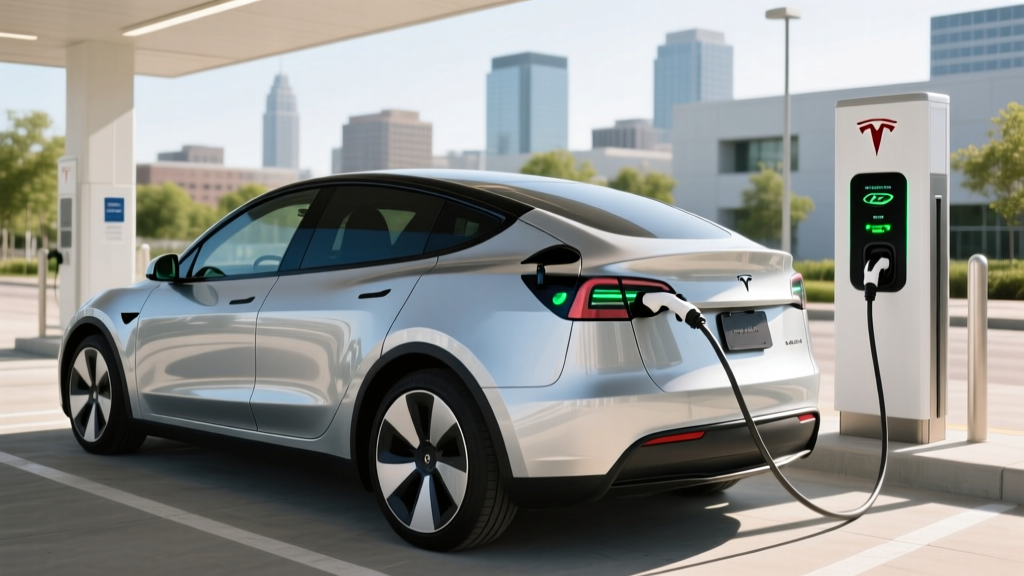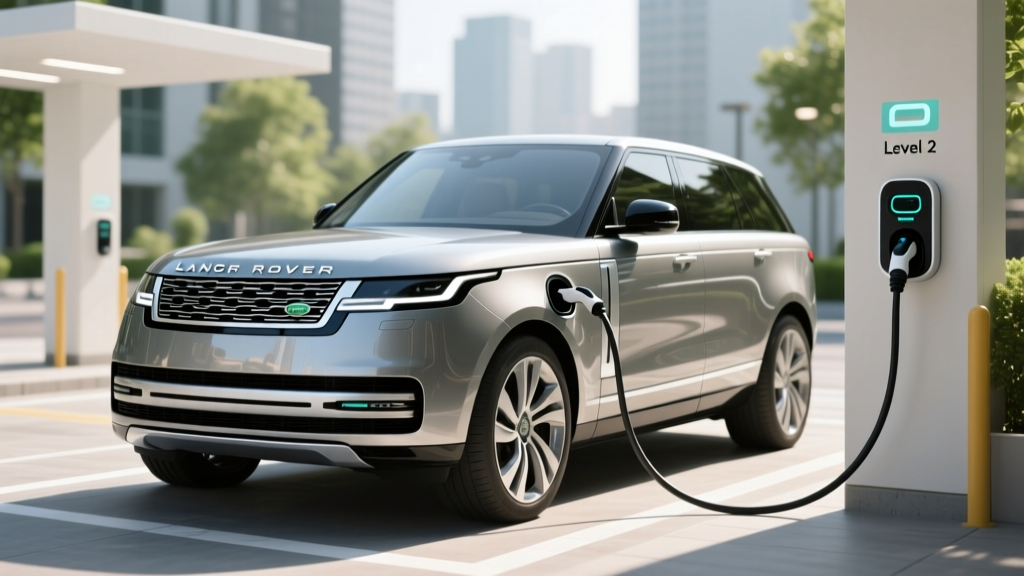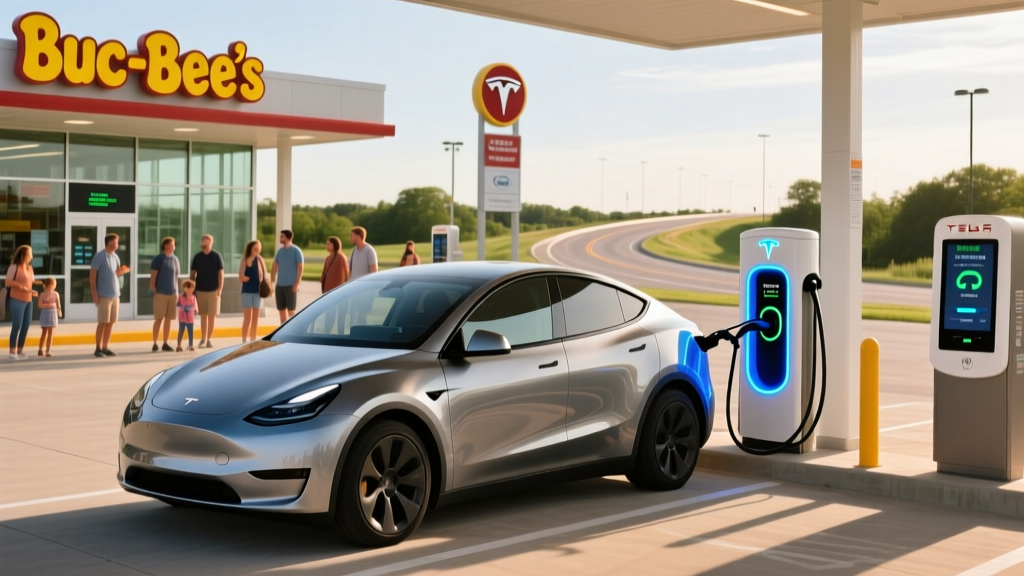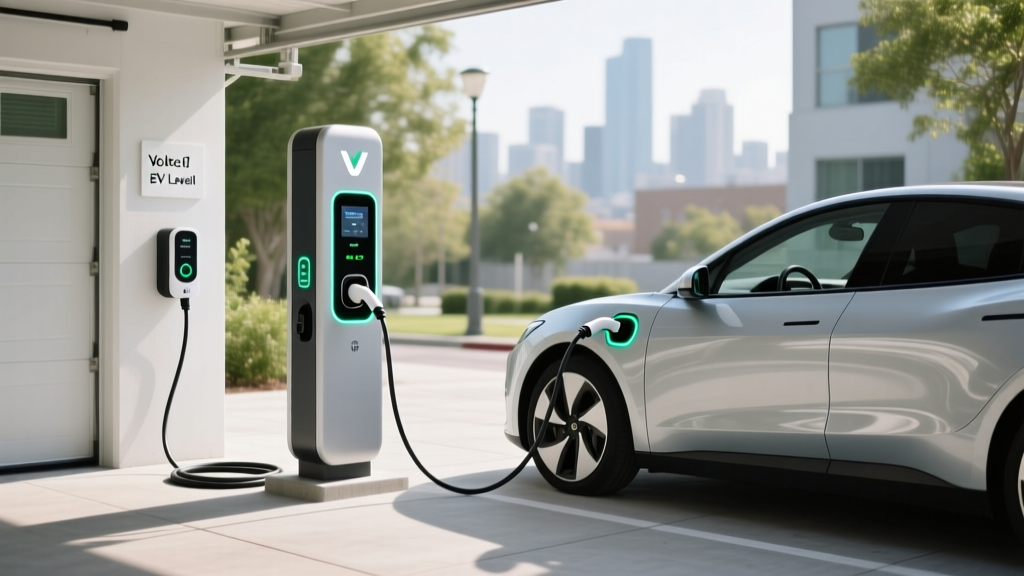
If you've driven past a shopping center, movie theater, or grocery store in the last few years, you've likely spotted a bright red-and-white charging pedestal with a massive digital billboard on top. That's a Volta EV charging station — part of a network that carved out a unique niche by offering free (or heavily subsidized) Level 2 and DC fast charging funded by advertising revenue. Shell acquired Volta in 2023, and as of 2026, the Volta-branded stations continue operating within the Shell Recharge ecosystem, though the long-term branding and pricing model is evolving.
Whether you're relying on Volta stations as your primary public charging option or simply want to understand how they fit into a broader EV charging strategy, this guide covers what Volta offers, how it compares to paid networks, and everything you need to set up reliable charging at home.
What Are Volta EV Charging Stations?
Volta stations are advertising-supported EV chargers placed in high-traffic retail locations — think Whole Foods parking lots, AMC theaters, and big-box store plazas. The business model is straightforward: brands pay for prominent video and static ad placements on the charger housing, and that revenue subsidizes (or fully covers) the electricity delivered to your vehicle.
In practice, most Volta locations offer Level 2 charging at no cost to the driver. Select high-traffic corridors also feature DC fast chargers, though the free-vs-paid split has shifted since the Shell acquisition. As of 2026, many Volta-branded DC fast stations charge a per-kWh rate, while Level 2 pedestals remain largely free — but always check the Shell Recharge app before assuming a session is complimentary.
Volta stations typically deliver Level 2 power at 6.6 kW to 19.2 kW, depending on the pedestal generation and the site's electrical infrastructure. The DC fast units, where available, peak between 50 kW and 150 kW — adequate for a quick top-up during a shopping trip, but not competitive with 350 kW stations from Electrify America or Tesla Superchargers for rapid road-trip charging.
Charging Levels Explained: kW Speeds and Range Per Hour
Before comparing Volta to other networks — or deciding what to install at home — you need a clear picture of the three charging levels. Remember: kW (kilowatts) measures power — how fast energy flows into your battery. kWh (kilowatt-hours) measures energy — how much your battery holds. Confusing the two is the single most common EV literacy mistake.
| Level | Power Source | Typical kW Output | Miles of Range Added Per Hour | Best Use Case |
|---|---|---|---|---|
| Level 1 | 120V household outlet | 1.2–1.9 kW | 3–5 miles | Overnight trickle charge; PHEVs with small batteries |
| Level 2 | 240V (home or public) | 3.3–19.2 kW | 12–75 miles | Daily home charging; destination charging (Volta, workplaces, hotels) |
| DC Fast Charging | 480V+ three-phase | 50–350 kW | 150–1,200+ miles (equivalent rate) | Road trips; rapid top-ups (10–80% in 15–40 min) |
At a typical Volta Level 2 station delivering 6.6 kW, a vehicle like the Hyundai Ioniq 5 (with its 77.4 kWh usable battery and roughly 3.5 mi/kWh efficiency) gains about 23 miles of range per hour. At a Volta station with a newer 19.2 kW pedestal, that same vehicle picks up roughly 67 miles per hour — enough to fully replenish during a two-hour movie.
For context, a 60 kWh battery (like the base Nissan Ariya or Chevrolet Equinox EV) charging from 10% to 80% at 6.6 kW takes roughly 6.5 hours. At 19.2 kW, that same 10–80% session drops to about 2.2 hours. That's why knowing the specific kW output of the Volta station you're heading to matters — not all pedestals are equal.
Connector Compatibility: Will a Volta Station Fit Your EV?
Volta stations historically equipped their pedestals with J1772 connectors for Level 2 (the universal standard for non-Tesla EVs in North America) and CCS1 connectors for DC fast charging. Tesla owners have always been able to use Volta Level 2 stations with a J1772-to-Tesla adapter (included with every Tesla vehicle).
The connector landscape is shifting rapidly in 2026. Ford, GM, Rivian, Volvo, and dozens of other automakers have transitioned to the NACS (North American Charging Standard) connector — Tesla's design, now standardized as SAE J3400. New vehicles shipping in 2025–2026 increasingly arrive with NACS ports natively, and legacy CCS vehicles can use NACS adapters to access Tesla Superchargers and NACS-equipped public stations.
| Connector | Used By | Volta Compatibility | Adapter Needed? |
|---|---|---|---|
| J1772 | All non-Tesla EVs (pre-2025 models); standard Level 2 | Native on most Volta Level 2 stations | None for J1772-port vehicles |
| NACS (J3400) | Tesla (all years); Ford, GM, Rivian, Hyundai, Kia (2025+ models) | J1772-to-NACS adapter required at older Volta stations | Yes — adapter typically included with vehicle |
| CCS1 | Legacy non-Tesla DC fast standard (pre-2025 EVs) | Available on Volta DC fast stations | None for CCS-port vehicles |
| CHAdeMO | Nissan Leaf (older), Mitsubishi Outlander PHEV | Not supported on Volta stations | No practical adapter; use other networks |
If you drive a 2026 model with a native NACS port, carry a NACS-to-J1772 adapter in your frunk so you can use the large installed base of J1772 public chargers — including Volta. The Lectron or A2Z EV adapters run $80–$150 and weigh under a pound.
Home EV Charger Installation: Costs, Electrical Requirements, and Panel Upgrades
Public charging — Volta or otherwise — is a supplement. For most EV owners, the economic and convenience case lives or dies on home charging. A Level 2 home charger plugged in overnight means a full battery every morning at the cheapest per-kWh rates available.
Here's what a home Level 2 installation actually requires:
Electrical requirements: A dedicated 240V circuit on a 40-amp to 60-amp breaker is standard for modern home EV chargers. A 40A circuit delivers up to 9.6 kW (32A continuous draw, per NEC 80% derating rule). A 60A circuit supports up to 11.5 kW continuous (48A). Most homes with a 200-amp electrical panel can accommodate a 40A or 50A EV circuit without a panel upgrade — but homes with 100A service, older wiring, or panels already near capacity will need an upgrade.
Panel upgrade reality: Upgrading from a 100A to a 200A panel typically costs $1,500–$3,000. If your panel is already 200A but lacks available breaker slots or is at 80%+ load capacity, a licensed electrician may recommend a panel replacement or a sub-panel installation ($800–$1,800). Some jurisdictions now allow a managed charging device that monitors household load and throttles the charger to avoid overloading the panel — potentially avoiding an upgrade entirely.
| Component | Low Estimate | High Estimate | Notes |
|---|---|---|---|
| Level 2 charger hardware (hardwired or NEMA 14-50 plug) | $300 | $750 | 40A–48A smart charger (ChargePoint, Emporia, Wallbox) |
| Electrician labor (circuit run, breaker, wiring) | $400 | $1,500 | Varies by distance from panel to garage/parking spot |
| Permit and inspection | $50 | $250 | Required in most jurisdictions; varies by city/county |
| Panel upgrade (if needed) | $1,500 | $3,000 | 100A to 200A upgrade; not always required |
| Total (no panel upgrade) | $750 | $2,500 | Typical scenario for modern homes |
| Total (with panel upgrade) | $2,250 | $5,500 | Older homes or high-load panels |
The federal Residential Clean Energy Credit (IRS Form 5695) covers 30% of home EV charger hardware and installation costs, up to $1,000, through 2032. This applies to both the charger and the electrical work — but not the panel upgrade itself. Always confirm eligibility with a tax professional, as income and property-type restrictions may apply.
Cost to Charge: Volta vs. Home vs. Paid DC Fast Networks
The economic advantage of EVs over gasoline vehicles hinges on charging cost. Here's how the common scenarios compare on a per-mile basis, using a vehicle averaging 3.0 miles per kWh (roughly the efficiency of a Tesla Model Y or Hyundai Ioniq 5):
| Charging Scenario | Typical $/kWh | Cost Per Mile (at 3.0 mi/kWh) | Equivalent Gas MPG (at $3.50/gal) |
|---|---|---|---|
| Home charging (off-peak utility rate) | $0.08–$0.14 | $0.03–$0.05 | 70–117 MPG |
| Home charging (standard residential rate) | $0.14–$0.20 | $0.05–$0.07 | 50–70 MPG |
| Volta Level 2 (free stations) | $0.00 | $0.00 | ∞ |
| Paid public Level 2 (ChargePoint, EVgo) | $0.25–$0.49 | $0.08–$0.16 | 22–44 MPG |
| DC fast charging (Electrify America, EVgo) | $0.35–$0.58 | $0.12–$0.19 | 18–29 MPG |
| Gasoline vehicle (28 MPG combined) | — | $0.13 | 28 MPG (baseline) |
The takeaway: home charging at off-peak rates delivers fuel costs roughly one-quarter to one-third of gasoline. Volta's free Level 2 stations, when available, are obviously unbeatable on price — but availability is the constraint. There are roughly 1,500 Volta-branded locations nationwide, concentrated in metro areas and specific retail corridors. For daily charging, you still need a home or workplace solution.
Recommended Home EV Chargers (2026)
After testing and tracking reliability data across the major brands, here are the home Level 2 chargers that deliver the best combination of power, smart features, build quality, and value for 2026 EV buyers:
Emporia Vue Level 2 Charger
Power: 48A / 11.5 kW (hardwired) or 40A / 9.6 kW (NEMA 14-50 plug)
Connector: J1772 (NACS adapter available)
Cable length: 24 feet
Smart features: Wi-Fi, scheduling, energy monitoring, integrates with Emporia home energy panel
Price: ~$399
Best for: Budget-conscious buyers who want smart scheduling and energy tracking without a subscription
ChargePoint Home Flex
Power: Up to 50A / 12 kW (adjustable 16A–50A via DIP switch)
Connector: J1772 or NACS (order specific model)
Cable length: 23 feet
Smart features: Wi-Fi, app scheduling, Alexa integration, amperage flexibility for older panels
Price: ~$599
Best for: Homes with limited panel capacity (can dial down to 16A/32A circuit)
Tesla Wall Connector
Power: 48A / 11.5 kW (hardwired, 60A circuit required)
Connector: NACS native (J1772 adapter available for non-Tesla use)
Cable length: 24 feet
Smart features: Wi-Fi, over-the-air updates, power-sharing (link multiple units on one circuit), load management
Price: ~$475
Best for: Tesla owners or households with NACS-port vehicles wanting native connector without adapter
Regardless of which unit you choose, hardwired installation is preferable to a NEMA 14-50 plug for safety and code compliance in most jurisdictions. A hardwired connection eliminates the failure point of a receptacle and avoids the NEC requirement for GFCI breakers on receptacle circuits (which can cause nuisance tripping with some EV chargers).
Safety, Electrical Code, and Outdoor Installation
EV chargers draw sustained high current for hours — a fundamentally different load profile than an oven or dryer that cycles on and off. This makes proper installation non-negotiable:
- Dedicated circuit: Your EV charger must be on its own dedicated breaker — never shared with other appliances. NEC Article 625 governs EV charging equipment specifically.
- Continuous load derating: Under NEC rules, a circuit must be rated at 125% of the continuous load. A 48A charger requires a 60A breaker and appropriately sized wire (6 AWG copper or 4 AWG aluminum for most runs).
- GFCI protection: Outdoor installations and receptacle-based (plug-in) installations require GFCI protection. Hardwired indoor installations in garages generally do not require GFCI under current NEC — but local amendments vary, so confirm with your inspector.
- Outdoor rating: If your charger is mounted outside (carport, driveway, exterior wall), ensure the unit carries a NEMA 4 or IP65 weather rating. All three chargers recommended above are outdoor-rated.
- Cable management: Use a holster or cable retractor to keep the cord off the ground. Dragging a 240V cable across wet concrete or a gravel driveway accelerates insulation wear and creates a shock hazard over time.
Always pull a permit and schedule an inspection. Unpermitted EV charger installations can void homeowner's insurance claims in the event of an electrical fire and may cause issues during a home sale.
Frequently Asked Questions
How much does it cost to install a home EV charger?
A typical Level 2 home charger installation runs $750–$2,500 when no panel upgrade is needed, covering the charger unit ($300–$750), electrician labor ($400–$1,500), and permit fees ($50–$250). If your home requires a 100A-to-200A panel upgrade, add $1,500–$3,000. The federal Residential Clean Energy Credit covers 30% of charger hardware and installation, up to $1,000.
How fast will each charging level add range?
Level 1 (120V) adds 3–5 miles per hour. Level 2 (240V) adds 12–75 miles per hour depending on the kW output of the charger and your vehicle's onboard charger capacity. DC fast charging adds the equivalent of 150–1,200+ miles per hour at peak rates, though the charge curve tapers significantly above 80% State of Charge — which is why 10–80% times (typically 15–40 minutes) are the more useful metric.
Which connector and charger is compatible with my EV?
If your EV has a J1772 port (most pre-2025 non-Tesla vehicles), any J1772 Level 2 charger works natively — including most Volta stations. If your EV has a NACS port (Tesla, and 2025+ models from Ford, GM, Hyundai, Kia, Rivian), you'll need a J1772-to-NACS adapter for older public stations. For DC fast charging, CCS1 is the legacy standard and NACS is the emerging standard — check your vehicle's port and carry the appropriate adapter.
How much does EV charging cost per mile compared to gasoline?
Home charging at off-peak utility rates ($0.08–$0.14/kWh) costs $0.03–$0.05 per mile for an efficient EV — roughly one-quarter the $0.13/mile cost of a 28 MPG gasoline vehicle at $3.50/gallon. Free Volta stations cost nothing. Paid DC fast charging ($0.35–$0.58/kWh) costs $0.12–$0.19 per mile, which approaches or slightly exceeds gasoline costs — making it a road-trip convenience, not a daily strategy.
What electrical upgrades might I need for a home charger?
Homes with a 200A panel and available breaker capacity typically need no upgrade — just a dedicated 40A–60A circuit run from the panel to the charger location. Homes with 100A service, older panels, or panels already near capacity may need a panel upgrade ($1,500–$3,000) or a smart load-management device that dynamically throttles charger power to stay within the panel's total capacity. A licensed electrician can perform a load calculation to determine your specific needs.
Are Volta EV charging stations really free?
Most Volta Level 2 stations remain free to use in 2026, funded by advertising revenue. However, Volta-branded DC fast chargers increasingly charge a per-kWh rate following the Shell acquisition. Always verify pricing in the Shell Recharge app before plugging in — the free-vs-paid status varies by location and can change without notice.