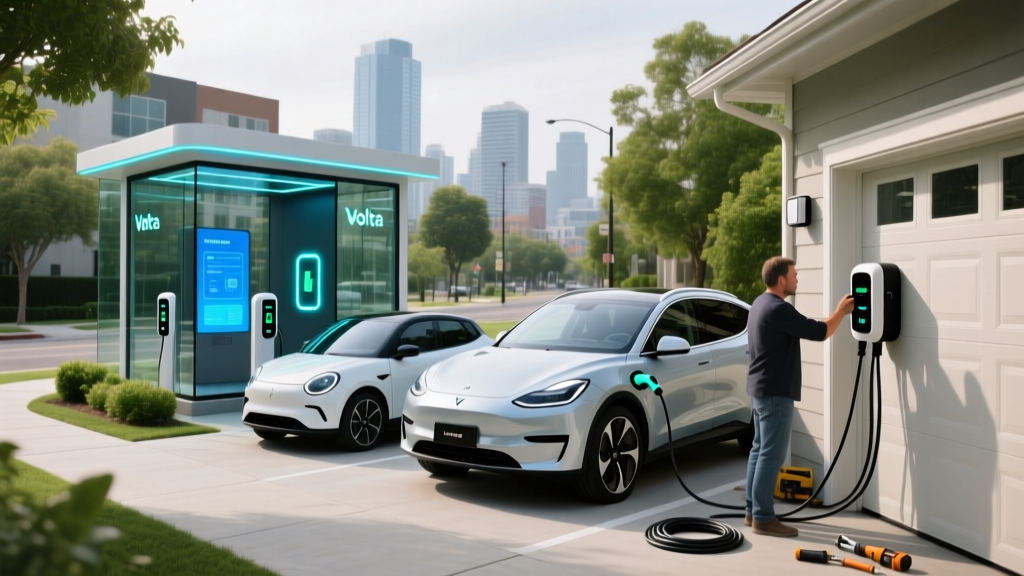
If you have ever pulled into a shopping center and spotted a bright, screen-wrapped charging pedestal, you have likely encountered a Volta EV charger. Volta built its reputation on offering free, advertising-supported Level 2 charging in high-traffic retail locations across the United States. In 2023, Shell acquired Volta and began integrating the network into its broader EV charging portfolio, and by 2026 the landscape has shifted: some stations remain free, others have transitioned to paid sessions, and Shell has expanded select locations with DC fast-charging hardware alongside the legacy Level 2 units.
This guide breaks down exactly what the Volta network offers today, how its charging speeds compare to home Level 2 and DC fast charging, what equipment you would need to replicate a similar setup at home, and the real cost-per-mile math that determines whether free public charging or a home install makes more financial sense.
What Is a Volta EV Charger and Where Can You Find One?
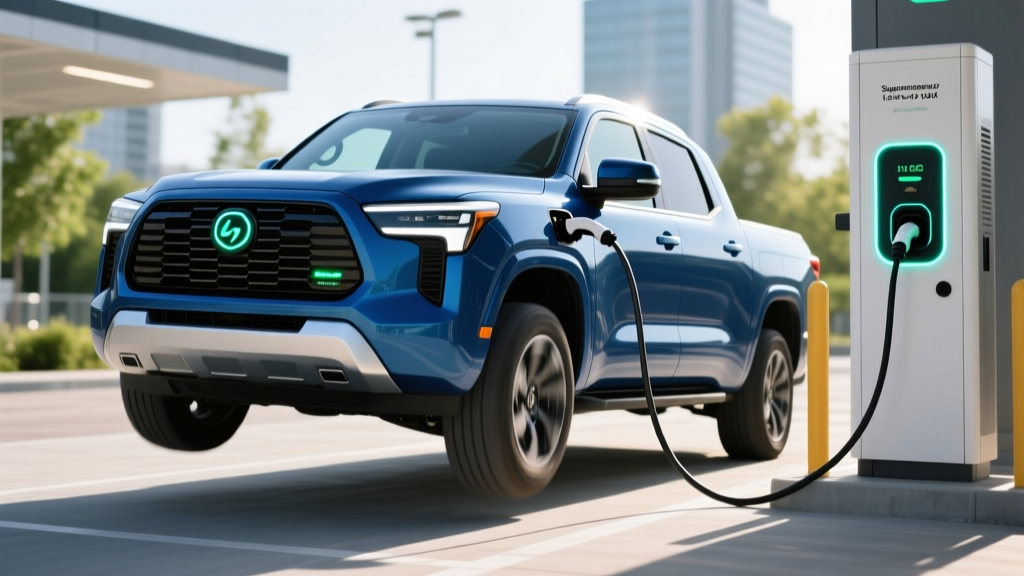
Volta charging stations are predominantly Level 2 units delivering up to 30 kW of power — well above the typical home Level 2 charger but below DC fast-charging speeds. They are installed in retail parking lots, grocery store plazas, movie theaters, and shopping malls. The original business model subsidized free charging through large-format digital advertising screens on the pedestal itself.
As of 2026, the Volta network operates in 30+ states, with the highest concentration in California, Texas, Florida, and the Northeast corridor. Under Shell's ownership, many locations now feature a mix of:
- Legacy Volta Level 2 stations — 30 kW, J1772 connector (with NACS adapter compatibility), some still free, some pay-per-session
- Shell Recharge DC fast chargers co-located at select Volta sites — 50 kW to 150 kW, CCS1 and NACS connectors, always paid
- Transitional stations — upgraded Volta hardware with metered billing, typically $0.25–$0.39/kWh depending on the market
To find a station, use the Shell Recharge station finder or apps like PlugShare and ChargeHub, which list real-time availability, pricing status, and connector type for each Volta location.
Charging Speeds: Level 1 vs Level 2 vs DC Fast Explained
Before comparing Volta to home charging, it is essential to understand the three charging levels and the distinction between kW (power — the rate of energy flow) and kWh (energy — the total capacity stored in your battery). A common mistake is using these interchangeably. Think of kW as how fast water flows through a hose, and kWh as the size of the bucket you are filling.
| Charging Level | Voltage / Amperage | Power Output (kW) | Miles of Range Added per Hour | Typical Use Case |
|---|---|---|---|---|
| Level 1 (standard outlet) | 120V / 12–16A | 1.4–1.9 kW | 3–5 miles | Overnight top-up, PHEVs, emergency |
| Level 2 (home / Volta) | 240V / 16–80A | 3.3–19.2 kW | 12–75 miles | Daily charging, destination, retail |
| Volta Level 2 (30 kW) | 208–240V / ~125A (commercial) | Up to 30 kW | ~80–110 miles | Shopping-trip top-up, 1–2 hr stops |
| DC Fast Charging | 400–800V DC | 50–350 kW | 150–1,200 miles (peak) | Road trips, rapid replenishment |
Real-world context: A Volta station delivering 30 kW will add approximately 90 miles of range to a typical EV (like a Tesla Model Y or Hyundai Ioniq 5) in one hour. That is sufficient for a shopping trip or dinner but not a full charge from low battery. A home Level 2 charger at 11.5 kW (48A) adds roughly 35–40 miles per hour overnight — more than enough for daily driving needs of 30–50 miles.
DC fast chargers operate differently: they deliver direct current straight to the battery, bypassing the vehicle's onboard charger. Peak speeds (e.g., 250 kW on a Tesla Supercharger V4 or 350 kW on an Electrify America station) only hold for a portion of the session. Most EVs taper charging speed significantly above 80% state of charge to protect battery health. Expect a 10–80% charge in 18–25 minutes on a modern 800V architecture vehicle like the Ioniq 5 or Porsche Taycan, but 35–50 minutes on a 400V platform.
How Much Does It Cost to Install a Home EV Charger?
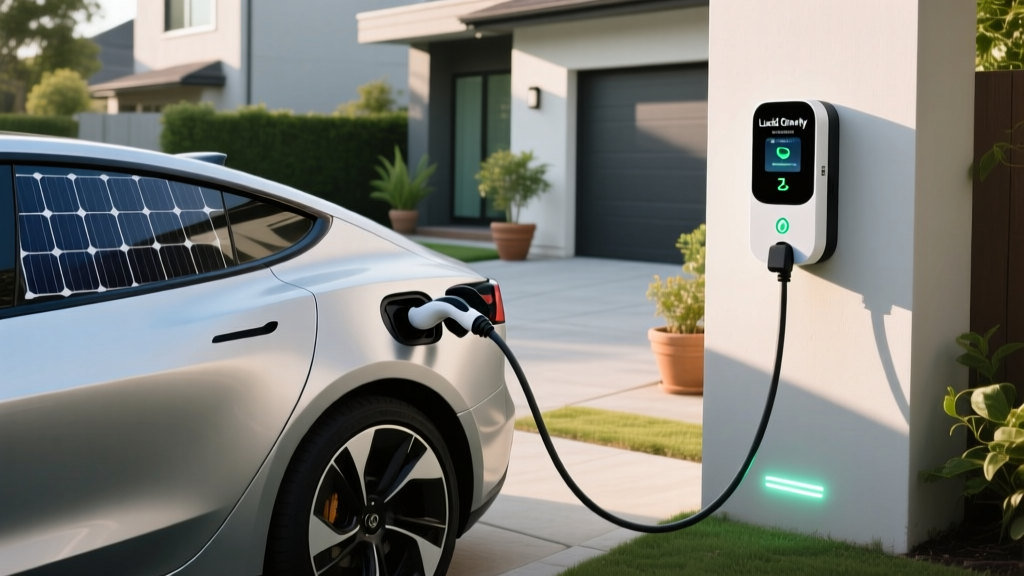
The total cost of installing a Level 2 home charger depends on your electrical panel capacity, the distance from the panel to the charging location, and local permit requirements. Here is a realistic breakdown for a 240V / 48A (11.5 kW) hardwired station — the most common residential setup in 2026:
| Cost Component | Low-End Estimate | High-End Estimate | Notes |
|---|---|---|---|
| Level 2 charger equipment | $350 | $750 | Smart Wi-Fi-enabled units; basic models from ~$250 |
| Electrician labor (install) | $500 | $1,800 | Depends on run length, conduit, wall penetrations |
| Electrical permit | $50 | $250 | Varies by municipality; some areas bundle with inspection |
| Panel upgrade (if needed) | $1,500 | $4,500 | Required if existing panel lacks spare capacity for a 60A breaker |
| Total (no panel upgrade) | $900 | $2,800 | Most homes with 200A service fall in this range |
| Total (with panel upgrade) | $2,400 | $7,300 | Older homes with 100A service often need this |
Panel upgrade reality check: A 48A continuous-draw charger requires a 60A dedicated circuit (per NEC 80% rule for continuous loads). If your electrical panel is already near capacity — common in homes built before 2000 with 100A service — an upgrade to 200A service may be necessary. This is the single largest variable in installation cost and one that many online estimates conveniently omit.
A licensed electrician will perform a load calculation to determine whether your panel can support the new circuit. Do not skip the permit: unpermitted electrical work can void homeowner's insurance and create fire hazards. The National Electrical Contractors Association maintains a directory of qualified installers.
Connector Compatibility: NACS, CCS1, and CHAdeMO
The North American charging connector landscape has consolidated significantly since 2024, when Ford, GM, Rivian, and most major automakers adopted the North American Charging Standard (NACS), originally developed by Tesla. As of 2026:
| Connector Type | Brands Using It (Native) | Adapter Needed? |
|---|---|---|
| NACS (Tesla-style) | Tesla, Ford, GM, Rivian, Volvo, Polestar, Mercedes-Benz (2025+), Hyundai/Kia (2025+), BMW (2026+) | No — native port on new models |
| CCS1 (Combo) | Legacy VW ID.4 (pre-2025), older BMW i4/iX, Stellantis EVs, Honda Prologue (2024–2025) | NACS-to-CCS1 adapter required at Tesla Superchargers |
| CHAdeMO | Nissan Leaf (all years), Mitsubishi Outlander PHEV (older) | Largely obsolete for DCFC; no adapter to NACS |
| J1772 (Level 2 AC) | All non-Tesla EVs (for Level 2 charging) | Tesla vehicles use included J1772-to-NACS adapter; Volta L2 stations use J1772 |
For Volta stations specifically: Legacy Volta Level 2 chargers use the J1772 connector. If you drive a Tesla or any 2025+ NACS-equipped vehicle, you will need your J1772-to-NACS adapter (included with most Tesla vehicles, available for ~$50–$100 from third-party suppliers for other brands). Shell has been gradually adding NACS connectors to newer and upgraded Volta locations, but J1772 remains the standard at the majority of legacy sites.
Cost to Charge: Home vs Volta vs DC Fast Charging Per Mile
One of the strongest arguments for home charging is cost efficiency. Here is how the economics break down across charging scenarios, using a 2026 Hyundai Ioniq 5 (84 kWh usable battery, EPA combined efficiency of ~3.5 miles/kWh) as the reference vehicle:
| Charging Scenario | Cost per kWh | Cost per Mile (at 3.5 mi/kWh) | Full 0–100% Cost (84 kWh) |
|---|---|---|---|
| Home (national avg. electricity, $0.16/kWh) | $0.16 | $0.046 | $13.44 |
| Home (off-peak utility rate, $0.09/kWh) | $0.09 | $0.026 | $7.56 |
| Volta (free station, where still available) | $0.00 | $0.00 | $0.00 |
| Volta / Shell Recharge (paid L2, ~$0.31/kWh avg) | $0.31 | $0.089 | $26.04 |
| DC Fast Charging (Electrify America, $0.48/kWh avg) | $0.48 | $0.137 | $40.32 |
| Gasoline equivalent (30 MPG, $3.40/gal) | — | $0.113 | — |
The takeaway: Home charging at off-peak rates costs roughly $0.026 per mile — about one-quarter the cost of gasoline and one-fifth the cost of DC fast charging. Even at average residential electricity rates ($0.16/kWh), EV charging costs less than half what gasoline does per mile. Volta's free stations, where they still exist, are unbeatable — but relying on them exclusively means planning your schedule around retail locations, dealing with potential ICEing (gas cars blocking EV spots), and accepting slower 30 kW speeds.
According to fueleconomy.gov, the average EV owner who charges primarily at home saves between $800 and $1,200 annually compared to a gasoline vehicle at 2026 fuel prices.
Home Charger Equipment Recommendations (2026)
If you are installing a Level 2 charger at home, here are three proven options across different budgets, all supporting the dominant connector standards:
Emporia Vue Level 2 Smart Charger
- Power output: 11.5 kW (48A) on 240V hardwired; 9.6 kW (40A) on NEMA 14-50 plug
- Connector: J1772 (NACS adapter available) or native NACS (2025+ models)
- Cable length: 24 feet
- Smart features: Wi-Fi, energy monitoring via Emporia Vue panel integration, scheduled charging, solar-aware charging
- Price: ~$399 (hardwired) / ~$449 (plug-in)
- Best for: Budget-conscious buyers who want smart scheduling and energy tracking
ChargePoint Home Flex (2nd Gen)
- Power output: Up to 12 kW (50A) adjustable down to 16A to match circuit capacity
- Connector: J1772 or NACS (selectable at purchase)
- Cable length: 23 feet
- Smart features: Wi-Fi, Alexa/Google Home integration, flexible amperage dial for older panels, detailed session history
- Price: ~$599–$649
- Best for: Homes with limited panel capacity — the adjustable amperage means you can install on a 20A or 30A circuit and upgrade later
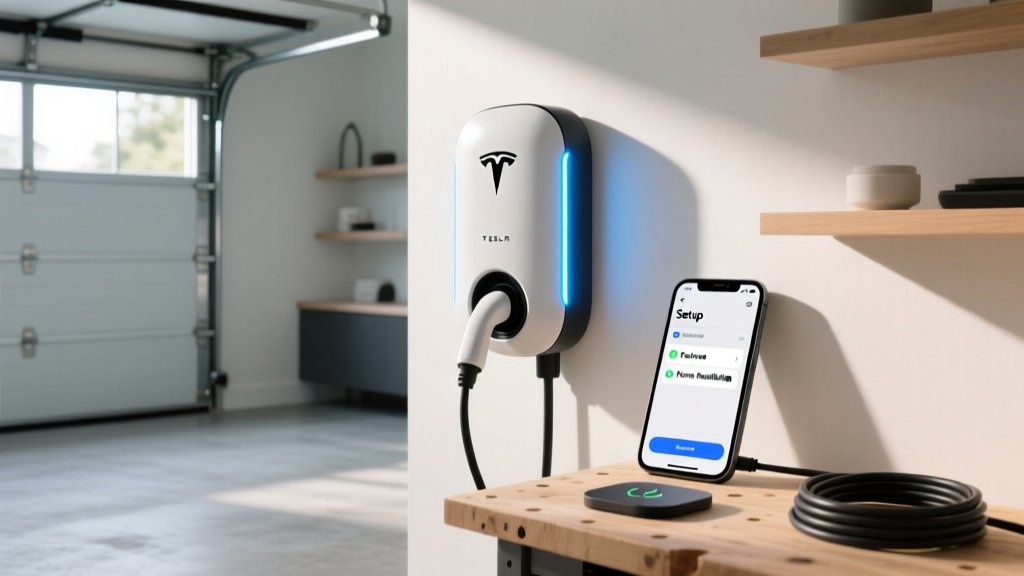
Tesla Wall Connector (Gen 4)
- Power output: 11.5 kW (48A) hardwired
- Connector: Native NACS; J1772 adapter included in box
- Cable length: 24 feet
- Smart features: Wi-Fi, over-the-air updates, Power Sharing (link up to 6 units on one circuit for multi-stall garages), vehicle-charge-limit integration
- Price: ~$450
- Best for: Tesla owners or households with multiple NACS vehicles; the Power Sharing feature is uniquely valuable for two-EV garages on a single 60A circuit
Safety, Code, and Installation Considerations
Home EV charger installation is governed by the National Electrical Code (NEC), specifically Article 625 for Electric Vehicle Charging System Equipment. Key requirements include:
- Dedicated circuit: Your EV charger must be on its own dedicated breaker — no sharing with other appliances or outlets. A 48A charger requires a 60A breaker (NEC 125% rule for continuous loads running 3+ hours).
- GFCI protection: The 2020 NEC revision requires GFCI protection for all receptacles used for EV charging (including NEMA 14-50 outlets). Hardwired installations are exempt from the GFCI breaker requirement because most modern chargers include built-in ground-fault protection. This is a practical reason to choose hardwired over plug-in — you avoid the $100–$150 GFCI breaker and nuisance trips.
- Outdoor rating: If your charger is installed outdoors (carport, driveway), the unit must carry a NEMA 4 or IP65 rating for weather resistance. All three chargers recommended above meet this standard.
- Cable management: NEC requires that charging cables not create a tripping hazard. Wall-mounted cord organizers or retractors are strongly recommended and required by some local inspectors.
- Permit and inspection: Nearly all jurisdictions require an electrical permit for EV charger installation. The inspection verifies proper grounding, breaker sizing, wire gauge, and GFCI compliance. Skipping the permit risks insurance denial in the event of an electrical fire.
Charging Time Examples for Common EV Battery Sizes
Here is how long a 10–80% charge takes at different power levels for three popular 2026 EVs. Note that charging speed is limited by whichever is lower: the station's output or the vehicle's onboard charger capacity.
| Vehicle (Battery Size) | Level 1 (1.9 kW) | Home Level 2 (11.5 kW) | Volta Level 2 (30 kW) | DC Fast (150 kW) |
|---|---|---|---|---|
| Tesla Model Y (75 kWh usable) | ~27 hours | ~4.5 hours | ~1.7 hours | ~25 minutes |
| Hyundai Ioniq 5 (84 kWh usable) | ~30 hours | ~5 hours | ~2 hours | ~18 minutes (800V) |
| Ford F-150 Lightning (131 kWh extended) | ~48 hours | ~8 hours | ~3 hours | ~41 minutes |
Important nuance: The Volta 30 kW stations can only deliver their full output if the vehicle's onboard AC charger supports it. Most EVs have onboard chargers rated at 11.5 kW (48A) or 19.2 kW (80A). If your vehicle's onboard charger maxes at 11.5 kW — like the Tesla Model Y — you will only receive 11.5 kW at a Volta station, not the full 30 kW. Vehicles with larger onboard chargers (e.g., the Ford F-150 Lightning at 19.2 kW, or the BMW iX at 11 kW) will see a proportionate benefit. This is a critical detail often overlooked: the station's kW rating is a ceiling, not a guarantee.
Should You Rely on Volta or Install a Home Charger?
Decision Framework
Choose home Level 2 installation if:
- You have access to a garage, carport, or dedicated parking spot near your electrical panel
- Your daily driving exceeds 30 miles round-trip
- You want the lowest per-mile cost (~$0.03–$0.05/mile with off-peak rates)
- You value the convenience of waking up to a full battery every morning
Rely on Volta / public charging if:
- You live in an apartment or condo without charging access and cannot install at home
- A free or low-cost Volta station is within 5 minutes of your regular routine (grocery, gym, work)
- Your daily driving is under 25 miles and you can top up 1–2 times per week during errands
- Your electrical panel would require a costly upgrade ($3,000+) and you plan to move within a few years
For most homeowners, a Level 2 installation pays for itself within 18–24 months through fuel savings alone, based on DOE efficiency data. The convenience factor — never visiting a gas station, pre-conditioning your car while plugged in to preserve range in cold weather — compounds the value over time.
Frequently Asked Questions
Are Volta EV chargers still free in 2026?
Some legacy Volta Level 2 stations still offer free charging, but under Shell's ownership, many have transitioned to paid sessions averaging $0.25–$0.39/kWh. Use the Shell Recharge app or PlugShare to check pricing at a specific station before you visit. Free stations are most commonly found at locations where the advertising revenue or retail partnership still subsidizes the electricity cost.
How fast will a Volta charger charge my EV?
Volta Level 2 stations can deliver up to 30 kW, but your actual speed depends on your vehicle's onboard AC charger. Most EVs (Tesla Model 3/Y, Hyundai Ioniq 5, Ford Mustang Mach-E) have 11.5 kW onboard chargers and will only draw 11.5 kW at a Volta station. Vehicles with larger onboard chargers (Ford F-150 Lightning at 19.2 kW) will charge faster. Expect roughly 35–40 miles of range per hour at 11.5 kW, or up to 80–90 miles per hour if your vehicle supports the full 30 kW.
What connector does a Volta charger use?
Legacy Volta Level 2 stations use the J1772 connector. Tesla and NACS-equipped vehicles will need a J1772-to-NACS adapter (included with Tesla vehicles, available separately for ~$50–$100). Newer Shell-upgraded locations may include NACS connectors — always check the station listing on PlugShare or the Shell Recharge app before visiting.
Do I need an electrical panel upgrade for a home EV charger?
Not necessarily. If you have a 200A service panel with spare breaker slots and your electrician's load calculation shows adequate remaining capacity, you can install a 60A breaker for a 48A charger without a panel upgrade. Homes with 100A service, or 200A panels that are already heavily loaded (electric range, dryer, HVAC, water heater), will likely need an upgrade. Budget $1,500–$4,500 for this work if required.
Is it cheaper to charge at home or at public stations?
Home charging is almost always cheaper. At the national average residential electricity rate of ~$0.16/kWh, you will pay about $0.046 per mile. Paid public Level 2 stations average $0.25–$0.39/kWh ($0.07–$0.11/mile), and DC fast chargers average $0.40–$0.55/kWh ($0.11–$0.16/mile). Home charging with a time-of-use plan and off-peak scheduling can drop your cost to $0.02–$0.03 per mile — roughly one-quarter the cost of gasoline.
Can I charge a Tesla at a Volta station?
Yes. Tesla vehicles can charge at any J1772 Level 2 station using the J1772-to-NACS adapter that Tesla includes in the vehicle's mobile connector kit. Simply attach the adapter to the Volta's J1772 plug and connect it to your Tesla's charge port. Charging will proceed at the rate limited by your Tesla's onboard charger (11.5 kW for Model 3/Y, 11.5 kW for Model S/X on newer models).