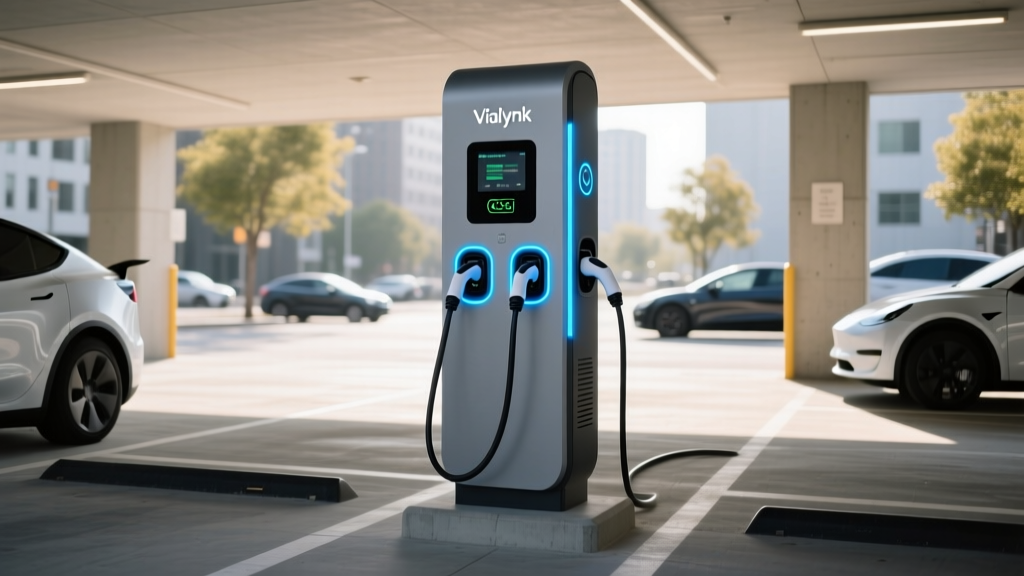
If you've just taken delivery of a new EV or are about to, the single most impactful ownership decision you'll make is how you charge at home. Public DC fast chargers are fine for road trips, but 80% or more of EV charging happens at your residence — and the hardware you pick dictates your daily convenience, electrical safety, and long-term cost. The Vialynk charging station has surfaced in 2026 as a budget-friendly Level 2 option aimed at homeowners who want smart connectivity without the premium price tag of brands like ChargePoint or Enel X. But does it deliver where it counts: sustained power output, connector flexibility, and safe installation?
We've evaluated the Vialynk's specifications, cross-referenced its claims against real-world home electrical requirements, and broken down the full cost of getting one on your wall — including the panel upgrades many older homes quietly require.
Understanding EV Charging Levels: What Speed Are You Actually Getting?
Before evaluating any specific charger, you need clarity on the three charging tiers available to EV owners. The distinction between kW (kilowatts — the rate of power delivery) and kWh (kilowatt-hours — the total energy stored in your battery) is the single most important piece of EV literacy. Think of kW as how fast water flows from a hose; kWh is the size of the bucket you're filling.
| Level | Voltage | Power (kW) | Miles of Range Added per Hour | Typical Use Case |
|---|---|---|---|---|
| Level 1 | 120V AC | 1.2–1.9 kW | 3–5 mi/hr | Overnight trickle; PHEVs; emergency |
| Level 2 | 240V AC | 3.3–19.2 kW | 12–75 mi/hr | Home daily charging; workplace; retail |
| DC Fast Charge | 400–800V DC | 50–350+ kW | 150–1,000+ mi/hr | Road trips; highway corridors |
The Vialynk charging station is a Level 2, 240V unit rated at 48 amps, which translates to a maximum continuous power output of 11.5 kW (240V × 48A). This requires a dedicated 60-amp circuit breaker, because the National Electrical Code (NEC) mandates that continuous loads not exceed 80% of a circuit's rated capacity.
At 11.5 kW, a vehicle like the 2026 Hyundai Ioniq 5 (84 kWh usable battery, NMC chemistry) would add roughly 35–40 miles of range per hour of charging — enough to replenish a full day's driving in about 45 minutes, or go from 10% to 80% State of Charge (SoC) in roughly 5.5 to 6 hours. That same Ioniq 5 on a DC fast charger, by contrast, peaks at 240 kW and hits 10–80% in about 18 minutes — but those stations cost more per kWh and aren't where your car sleeps at night.
Vialynk Charging Station: Specifications and Equipment Profile
The Vialynk is positioned in the value-smart segment of the Level 2 market. Here's what the hardware offers based on current 2026 specifications:
Vialynk Level 2 Home Charger — Key Specs
- Max Output: 48A / 11.5 kW (240V)
- Connector: J1772 (standard for non-Tesla EVs); NACS-compatible units also listed
- Cable Length: 25 feet
- Wi-Fi: Yes — 2.4 GHz app connectivity for scheduling and energy monitoring
- Enclosure Rating: NEMA 4 (indoor/outdoor, weather-resistant)
- Cord Management: Integrated wrap hook
- Energy Metering: Per-session kWh tracking via companion app
- Approximate Retail Price: $299–$379 (varies by retailer and connector variant)
The 25-foot cable is generous — most competitors in this price bracket offer 18 to 23 feet — which matters if your garage outlet is on the opposite wall from where you park. The NEMA 4 rating means it can be mounted outdoors in rain and dust without an additional weatherproof enclosure, though we always recommend installing under an eave or carport where possible to extend cable jacket life.
Smart Features: Useful, Not Gimmicky
The Vialynk app lets you schedule charging during off-peak utility hours (critical if your provider offers time-of-use rates), view real-time kW draw, and set a maximum amperage limit — useful if your electrical panel has limited headroom and you want to cap the unit at 32A or 40A without swapping breakers. The app also logs cumulative kWh delivered, which simplifies tracking your fuel cost for tax or fleet-reimbursement purposes.
One limitation: the Vialynk does not currently support utility demand-response programs (like those offered by some co-ops that pay you to pause charging during grid peaks). If participation in those programs matters to you, the ChargePoint Home Flex or Emporia Level 2 offer that integration.
How Much Does It Cost to Install a Home EV Charger?
The charger itself is often the cheapest part of the equation. Installation costs vary wildly depending on your home's electrical panel capacity, the distance from panel to charge point, and local permit fees. Here's a realistic breakdown for a 48A / 11.5 kW installation like the Vialynk:
| Component | Low Estimate | High Estimate | Notes |
|---|---|---|---|
| Charger unit (Vialynk 48A) | $299 | $379 | Varies by connector and retailer |
| 60A breaker + wiring (up to 50 ft run) | $400 | $900 | 6 AWG copper; longer runs cost more |
| Electrician labor (3–6 hours) | $450 | $1,200 | $150–$200/hr licensed rate |
| Electrical permit | $50 | $250 | Varies by municipality |
| Panel upgrade (if needed: 100A → 200A) | $1,500 | $3,500 | Common in pre-2000 homes |
| Total (no panel upgrade) | $1,200 | $2,730 | |
| Total (with panel upgrade) | $2,700 | $6,230 |
The Panel Upgrade Reality Check
Homes built before 2000 frequently have 100-amp or even 60-amp main panels. Adding a continuous 48A load (which draws 60A of breaker capacity) to a 100A panel that's already serving an electric dryer, HVAC, and kitchen range will almost certainly require an upgrade to 200A service. This is not optional — it's a code and safety requirement, and any licensed electrician will flag it during the load calculation.
Before purchasing any Level 2 charger, have an electrician perform a load calculation on your panel. Many jurisdictions now require this as part of the permit process. The National Electrical Contractors Association provides guidance on residential EV circuit requirements.
Federal Tax Credit for Home Charging Equipment
Under the IRS Residential Clean Energy Credit, you may be eligible to claim 30% of the cost of home EV charging equipment and installation, up to $1,000, through 2032. This is separate from the §30D vehicle purchase credit. Eligibility depends on your tax liability and whether your home is in a qualifying census tract. Consult a tax professional before filing — the rules have specific geographic and income considerations.
Connector Compatibility: Will the Vialynk Work With Your EV?
The North American EV market in 2026 is mid-transition. Most new vehicles from Ford, GM, Rivian, Hyundai, Kia, and others now ship with the NACS (North American Charging Standard, originally Tesla's connector) as their native charge port. Legacy vehicles from 2020–2024 model years largely use CCS1 (Combined Charging System). A small number of older Nissan Leafs and Mitsubishi Outlander PHEVs use CHAdeMO.
| Connector | Brands Using It (2026 Models) | Adapter Needed for Vialynk J1772? |
|---|---|---|
| NACS (Tesla-style) | Tesla, Ford, GM, Rivian, Hyundai, Kia, Volvo, Polestar | Yes — J1772-to-NACS adapter (~$150–$250), or order Vialynk NACS variant |
| CCS1 | VW ID.4 (pre-2025), BMW iX (pre-2025), some Stellantis | Yes — J1772-to-CCS adapter (~$200–$300) |
| J1772 | All EVs for Level 2 AC (universal standard) | No — native plug |
| CHAdeMO | Nissan Leaf (legacy) | Rare adapter; limited availability |
Practical recommendation: If you own or plan to own a NACS-equipped vehicle (the vast majority of 2025+ EVs), order the Vialynk in its NACS configuration to avoid adapter clutter. The J1772 variant makes sense if you're charging a CCS1 vehicle or want maximum flexibility for guests with different EVs. Note that adapters add a connection point that can introduce resistance and heat — high-quality adapters from reputable brands (Lectron, Tesla, A2Z) are essential.
Cost to Charge: Home vs. Public vs. Gas — What's the Real Per-Mile Price?
Charging cost is where EV ownership economics either shine or disappoint, depending entirely on your local electricity rates and whether you charge at home or rely on public DC fast networks.
| Scenario | Rate | Cost per Mile (250 Wh/mi EV) | Annual Cost (12,000 mi) |
|---|---|---|---|
| Home, off-peak utility rate | $0.11/kWh | $0.028 | $330 |
| Home, standard residential rate | $0.17/kWh | $0.043 | $510 |
| Public Level 2 (network pricing) | $0.30/kWh | $0.075 | $900 |
| DC Fast Charge (Electrify America, EVgo) | $0.48/kWh | $0.120 | $1,440 |
| Gasoline vehicle (27 MPG avg, $3.40/gal) | $3.40/gal | $0.126 | $1,511 |
The math is unambiguous: home charging at off-peak rates costs roughly one-quarter to one-fifth of gasoline per mile. Even public DC fast charging, the most expensive EV option, undercuts gasoline on a per-mile basis in most markets. But the savings collapse if you exclusively use public DC fast chargers — a scenario common among apartment dwellers without home charging access.
For the Vialynk specifically, its app-based scheduling lets you program charging to start at, say, 11 PM when your utility's off-peak rate kicks in. Over a year, the difference between charging at $0.17/kWh (anytime) and $0.11/kWh (off-peak) saves roughly $180 on 12,000 miles of driving — effectively paying for the charger hardware in year one.
Charging Time Examples: What to Expect With Real Battery Sizes
Charge time depends on your battery's usable capacity (kWh), the vehicle's onboard charger acceptance rate (kW), and the charger's output. Most 2026 EVs accept between 7.2 kW and 11.5 kW on Level 2 AC. Here are real-world estimates using the Vialynk at its 11.5 kW peak:
Estimated 10–80% Charge Times on Vialynk (11.5 kW)
- 2026 Tesla Model 3 Long Range (75 kWh usable, 11.5 kW acceptance): ~4.5 hours
- 2026 Hyundai Ioniq 5 (84 kWh usable, 10.9 kW acceptance): ~5.3 hours
- 2026 Ford F-150 Lightning Extended Range (131 kWh usable, 19.2 kW acceptance but limited to 11.5 kW by charger): ~8.0 hours
- 2026 Toyota RAV4 Prime PHEV (18.1 kWh usable, 6.6 kW acceptance): ~2.0 hours
- 2026 Chevrolet Equinox EV (85 kWh usable, 11.5 kW acceptance): ~5.2 hours
Note: Charging slows significantly above 80% SoC to protect battery health. The times above reflect the practical 10–80% window most EV owners use for daily charging.
For overnight charging, these times are largely academic — plug in at 10 PM and any of these vehicles will be at 80%+ by 6 AM. The F-150 Lightning's larger battery is the exception; if you regularly deplete it below 20%, a single overnight session on 11.5 kW won't fully replenish it. Owners who tow frequently may benefit from a 19.2 kW (80A) charger, but that requires a 100A dedicated circuit and panel capacity to match.
Equipment Comparison: Vialynk vs. the Competition
The Level 2 home charger market in 2026 is crowded. Here's how the Vialynk stacks up against three established alternatives:
Vialynk 48A
Price: $299–$379
Output: 11.5 kW / 48A
Cable: 25 ft
Smart Features: Wi-Fi scheduling, energy metering
Connector: J1772 or NACS
Best For: Budget-conscious homeowners wanting smart features
ChargePoint Home Flex
Price: $599–$699
Output: Up to 12 kW / 50A (adjustable)
Cable: 23 ft
Smart Features: App, Alexa, utility demand-response
Connector: J1772 (NACS adapter included)
Best For: Ecosystem integration and utility program participation
Emporia Vue Level 2
Price: $399–$499
Output: 11.5 kW / 48A
Cable: 24 ft
Smart Features: Whole-home energy monitoring integration, solar-aware
Connector: J1772
Best For: Homes with Emporia whole-panel monitoring or solar
Tesla Wall Connector
Price: $475
Output: 11.5 kW / 48A
Cable: 24 ft
Smart Features: Wi-Fi updates, power sharing (multi-unit)
Connector: NACS native
Best For: Tesla-only households or NACS-native EVs
The Vialynk's price advantage is real — it undercuts the ChargePoint by $250+ while matching its core output and cable length. Where it falls short is utility demand-response compatibility and the broader ecosystem support that ChargePoint and Tesla offer. If your utility offers rebates tied to specific approved chargers (many do), check their list before buying — the rebate may erase the Vialynk's price advantage.
Safety, Code, and Installation Best Practices
A Level 2 charger is a continuous high-amperage load — effectively the same electrical demand as an electric oven running nonstop for hours. Cutting corners on installation is not a cost-saving strategy; it's a fire risk. Here's what proper installation requires:
- Dedicated circuit: The Vialynk at 48A requires its own 60A double-pole breaker. It cannot share a circuit with other appliances.
- Wire gauge: 6 AWG copper (THHN in conduit or NM-B/Romex where code allows) for runs up to 50 feet. Longer runs may require 4 AWG to prevent voltage drop.
- GFCI protection: The 2023 NEC (adopted by most states by 2026) requires GFCI protection for all 240V EV charging outlets. Hardwired installations (no plug) may be exempt in some jurisdictions — confirm with your inspector.
- NEMA 14-60 receptacle (if plug-in): If you opt for a plug-in Vialynk rather than hardwired, you'll need a NEMA 14-60 outlet. Industrial-grade receptacles (Hubbell, Bryant) are strongly recommended over residential-grade — EV charging cycles a receptacle far harder than a dryer does, and cheap receptacles can overheat.
- Outdoor rating: The Vialynk's NEMA 4 enclosure handles rain and dust, but the connection point between cable and vehicle should be elevated off the ground and, ideally, under cover to prevent water intrusion into the charge port.
- Permit and inspection: Nearly all jurisdictions require an electrical permit for new 240V circuits. The inspection ensures wire gauge, breaker sizing, and grounding meet code. Skipping this step can void your homeowner's insurance in the event of an electrical fire.
For detailed residential EV charging installation requirements, the National Fire Protection Association's NEC resource page provides code references and adoption maps by state.
Frequently Asked Questions
How much does it cost to install a home EV charger?
For a 48A Level 2 charger like the Vialynk, expect $1,200–$2,730 total (equipment + electrician + permit) if your electrical panel has sufficient capacity. If a panel upgrade from 100A to 200A is needed, add $1,500–$3,500. Always get a load calculation before purchasing equipment.
How fast will each charging level add range?
Level 1 (120V) adds 3–5 miles per hour. Level 2 (240V, 48A) adds roughly 35–40 miles per hour for a typical EV. DC fast charging adds 150–1,000+ miles per hour but is designed for road trips, not daily use, and costs significantly more per kWh.
Which connector and charger is compatible with my EV?
All EVs accept Level 2 AC charging via the J1772 standard (or NACS, which is now native on most 2025+ vehicles). If your EV has a NACS port, order the Vialynk in its NACS variant or use a J1772-to-NACS adapter. CCS1 vehicles need a J1772-to-CCS adapter. CHAdeMO vehicles (older Nissan Leafs) have limited adapter options.
How much does EV charging cost per mile compared to gas?
At a national average home electricity rate of $0.17/kWh, an efficient EV consuming 250 Wh/mile costs about $0.043 per mile — roughly one-third the cost of a 27 MPG gasoline vehicle at $3.40/gallon ($0.126/mile). Off-peak home rates ($0.11/kWh) drop EV fuel cost to under $0.03 per mile.
What electrical upgrades might I need for a Level 2 charger?
The most common upgrade is a panel increase from 100A to 200A service, needed in many pre-2000 homes. You will definitely need a new dedicated 60A double-pole breaker, appropriate-gauge wiring (6 AWG for runs under 50 ft), and a permit. Some homes may also need a whole-panel surge protector or upgraded grounding electrode, depending on local code.
Is the Vialynk charging station safe for outdoor installation?
Yes. The Vialynk carries a NEMA 4 enclosure rating, meaning it is sealed against rain, sleet, and windblown dust. That said, mounting under a carport or eave extends the life of the cable jacket and keeps the connector cleaner. Always use a licensed electrician and pull a permit for outdoor installations, where GFCI requirements are strictly enforced.
Can I charge two EVs simultaneously with one Vialynk unit?
No. The Vialynk is a single-vehicle charger. If you need to charge two EVs on one circuit, the Tesla Wall Connector offers a power-sharing feature that splits amperage between two units on a single breaker. Alternatively, installing two dedicated circuits is the most reliable approach — provided your panel has the capacity.