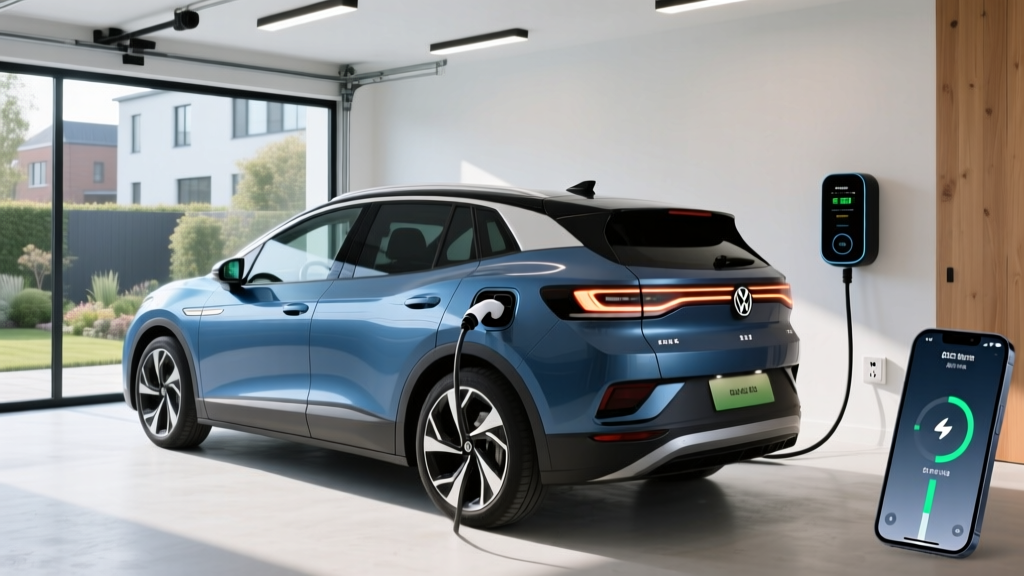
If you own a compatible electric vehicle, your battery pack can do more than move you down the highway — it can power your home during an outage or offset peak electricity rates. A vehicle-to-home charger (also called V2H or bidirectional charger) turns your EV into a rolling backup generator, feeding energy from its high-voltage battery back through your electrical panel. But the hardware, installation, and vehicle requirements are far more complex than plugging in a standard Level 2 wallbox.
This guide breaks down exactly what V2H requires in 2026, which EVs support it, what you will pay, and whether the investment makes sense for your household.
What Is a Vehicle-to-Home (V2H) Charger?
A vehicle-to-home charger is a bidirectional EV supply equipment (EVSE) unit that allows electricity to flow in both directions: from the grid into your EV's battery (normal charging), and from your EV's battery back into your home's electrical panel (discharging). This is fundamentally different from a standard Level 2 charger, which is unidirectional — energy only goes into the car.
Most current V2H systems deliver between 9.6 kW and 11.5 kW of continuous home power output. For context, the average U.S. home draws roughly 1–3 kW on a normal evening and might spike to 8–12 kW when running central air conditioning, an electric oven, and a dryer simultaneously. A V2H system can sustain most essential circuits — refrigerator, lights, HVAC fan, Wi-Fi, and outlets — for multiple days from a typical 75–100 kWh EV battery.
- V2H (Vehicle-to-Home): Powers your home's electrical panel through a transfer switch or smart panel. Requires a hardwired bidirectional charger and utility interconnection agreement.
- V2G (Vehicle-to-Grid): Sends power back to the utility grid for grid services or demand response. Requires utility participation and specific rate programs — not yet widely available in most U.S. markets as of 2026.
- V2L (Vehicle-to-Load): Powers standalone devices through built-in 120V AC outlets on the vehicle (e.g., Hyundai Ioniq 5, Kia EV6, Ford F-150 Lightning). No external charger needed, but limited to 1.9–3.6 kW — not enough to back-feed a whole home.
Which EVs Support Vehicle-to-Home Charging in 2026?
Bidirectional charging requires both vehicle-side hardware and software support. As of early 2026, the following production EVs have confirmed V2H capability (either standard or via software update and compatible hardware):
| Vehicle | Battery (kWh usable) | V2H Output | Connector | Status (2026) |
|---|---|---|---|---|
| Ford F-150 Lightning (Extended Range) | 131 kWh | 9.6 kW | CCS1 | Available with Ford Charge Station Pro + Home Integration Kit |
| Hyundai Ioniq 5 (2025+ refresh) | 84 kWh (NMC) | Up to 11.5 kW | NACS (2025+) | Available via V2H-enabled bidirectional charger |
| Kia EV6 / EV9 | 77.4 / 100 kWh | Up to 11.5 kW | NACS (2025+) | Available with compatible bidirectional EVSE |
| GM Silverado EV / Sierra EV | ~200 kWh (Ultium) | Up to 19.2 kW | NACS | Available on select trims with PowerUp+ system |
| Nissan LEAF (legacy) | 40–62 kWh | Up to 6 kW | CHAdeMO | Limited — requires specific CHAdeMO bidirectional units |
Important caveat: Tesla vehicles (Model 3, Y, S, X, Cybertruck) do not support V2H or V2G as of 2026. Tesla's Powerwall is their home battery strategy, and while Tesla has hinted at bidirectional capability in future vehicles, no production Tesla currently supports it. If V2H is a priority, Tesla is not the right platform.
Charging Levels and Speeds: The Full Picture
Even with a bidirectional V2H unit installed, your EV still charges normally from the grid. Here is how all three charging levels compare — including the bidirectional discharge rate:
| Level | Voltage / Amperage | Power (kW) | Miles of Range Added per Hour | Typical Use |
|---|---|---|---|---|
| Level 1 (120V) | 120V / 12–16A | 1.4–1.9 kW | 3–5 mi/hr | Overnight top-off, emergency |
| Level 2 (240V) | 240V / 32–48A | 7.7–11.5 kW | 25–44 mi/hr | Daily home charging |
| DC Fast Charging | 400–800V DC | 50–350 kW | 150–1,200+ mi/hr (peak) | Road trips, rapid top-ups |
| V2H Discharge | 240V AC (to home panel) | 9.6–19.2 kW | Reverse — powers home | Backup power, peak shaving |
Charging time examples (Level 2 at 11.5 kW):
- Ford F-150 Lightning (131 kWh): 0–100% in ~11.4 hours; 10–80% in ~8 hours
- Hyundai Ioniq 5 (84 kWh): 0–100% in ~7.3 hours; 10–80% in ~5.1 hours
- Kia EV9 (100 kWh): 0–100% in ~8.7 hours; 10–80% in ~6.1 hours
At DC fast chargers, the Ioniq 5 can peak at 240 kW on a 350 kW charger, reaching 10–80% in approximately 18 minutes. The F-150 Lightning peaks around 155 kW, with a 10–80% time of roughly 35–41 minutes due to its larger battery. Remember: peak kW is not sustained — charge curves taper significantly above 80% state of charge, which is why 10–80% time is the standard benchmark.
Home Installation: Electrical Requirements and Costs
A V2H installation is substantially more involved than a standard Level 2 charger. You are not just adding an outlet — you are integrating a bidirectional power source into your home's electrical panel, which requires a transfer switch or smart energy management panel to safely isolate your home from the grid during an outage (anti-islanding protection is a National Electrical Code requirement).
Electrical Requirements
- Dedicated circuit: 60A breaker (for a 48A continuous charger) on a 240V circuit
- Panel capacity: Most homes need a 200A main panel minimum; many older homes with 100A or 150A panels will need a panel upgrade
- Transfer switch or smart panel: Devices like the Ford Home Integration Kit (based on Sunrun Brightbox hardware) or a Span smart panel manage the grid-to-home switchover
- Permit: Required in virtually all U.S. jurisdictions for any panel modification or new 240V circuit
- Utility notification: Most utilities require an interconnection agreement for bidirectional equipment — they need to know your system can feed power, even if it is only to your own home
Installation Cost Breakdown
| Component | Cost Range | Notes |
|---|---|---|
| Bidirectional charger unit | $1,500 – $3,500 | Ford Charge Station Pro ~$1,700; Wallbox Quasar ~$3,000+; Fermata House ~$3,500 |
| Transfer switch / smart panel | $1,500 – $4,000 | Ford Home Integration Kit ~$3,500 incl. install; Span panel ~$4,000–$5,000+ |
| Electrician labor (wiring, circuit, mounting) | $1,000 – $3,000 | Varies by run length, conduit, local rates |
| Electrical panel upgrade (if needed) | $2,000 – $5,000 | 100A→200A upgrade; not always required |
| Permit and inspection | $150 – $500 | Local jurisdiction dependent |
| Total (no panel upgrade) | $3,500 – $9,000 | Typical range for most homes |
| Total (with panel upgrade) | $6,000 – $14,000+ | Older homes with 100A/150A service |
Panel upgrade reality check: If your home was built before 1990, there is a meaningful chance you have a 100A or 150A panel. Adding a 60A EV circuit plus a bidirectional system can exceed the panel's safe load calculation. Budget for a 200A (or even 325A) upgrade. Get a licensed electrician to perform a load calculation before purchasing hardware.
Connector Compatibility: What Plugs Into What
The connector on your EV must match the connector on the bidirectional charger. The North American market has largely converged on NACS (the Tesla-designed standard, now SAE J3400), but bidirectional V2H chargers have been slower to adopt it — most early units were designed for CCS1 or CHAdeMO.
| Connector | Vehicles Using It (2026) | V2H Charger Availability |
|---|---|---|
| NACS (J3400) | Tesla (all), Ford (2025+), GM (2025+), Hyundai/Kia (2025+), Rivian, most new EVs | Limited — emerging bidirectional units in 2025–2026 |
| CCS1 | Ford F-150 Lightning (2022–2024), VW ID.4, BMW iX, older Hyundai/Kia | Ford Charge Station Pro, Wallbox Quasar (limited) |
| CHAdeMO | Nissan LEAF (discontinued in U.S.), Mitsubishi Outlander PHEV | Nichicon V2H units (rare in U.S.) |
Adapter note: NACS-to-CCS adapters (like those from Lectron or A2Z) allow charging but do not support bidirectional power flow. You cannot use an adapter to make a NACS vehicle work with a CCS bidirectional charger for V2H. The bidirectional protocol (ISO 15118-20) requires native connector and vehicle firmware support.
Cost to Charge: Home vs. Public vs. Gas
Whether or not you use V2H, your daily charging costs matter. Here is a realistic breakdown based on 2026 national averages:
| Scenario | $/kWh | Cost to Add 200 Miles* | Cost per Mile |
|---|---|---|---|
| Home Level 2 (off-peak TOU rate) | $0.08–$0.14 | $4.80–$8.40 | $0.024–$0.042 |
| Home Level 2 (standard flat rate) | $0.14–$0.18 | $8.40–$10.80 | $0.042–$0.054 |
| Public Level 2 (ChargePoint, EVgo) | $0.25–$0.40 | $15.00–$24.00 | $0.075–$0.12 |
| DC Fast Charging (Electrify America, Tesla) | $0.32–$0.56 | $19.20–$33.60 | $0.096–$0.168 |
| Gasoline vehicle (25 MPG, $3.40/gal) | — | $27.20 | $0.136 |
*Based on 3.0–3.5 miles per kWh efficiency (typical for midsize EVs like Ioniq 5 or Model Y). Source: fueleconomy.gov EPA data.
Home charging on a time-of-use (TOU) plan is dramatically cheaper than gas — roughly $0.03/mile vs. $0.14/mile. Even DC fast charging is competitive with gas on a per-mile basis. The savings widen further if your utility offers EV-specific off-peak rates (many do, dropping to $0.06–$0.09/kWh between 11 PM and 6 AM).
V2H peak-shaving bonus: If your utility charges high peak rates (e.g., $0.30–$0.45/kWh from 4–9 PM), a V2H system can power your home from the EV battery during peak hours and recharge overnight at off-peak rates. This can save $50–$150/month in markets like California (PG&E/SCE SDG-6 rate) or the Northeast, partially offsetting the V2H hardware cost over time.
Recommended Bidirectional and Level 2 Equipment
Not every home needs V2H. If you simply want reliable daily Level 2 charging, a standard unidirectional wallbox is far simpler and cheaper. Below are options for both paths:
Bidirectional (V2H) Chargers
Ford Charge Station Pro (80A)
- Power: 19.2 kW charge / 9.6 kW discharge (CCS1)
- Connector: CCS1 (J1772 Combo)
- Cable: 25 ft
- Smart features: FordPass app, scheduled charging, V2H with Home Integration Kit
- Price: ~$1,700 (charger only; kit sold separately)
Wallbox Quasar 2
- Power: 11.5 kW charge / 11.5 kW discharge
- Connector: CCS1 or CHAdeMO (model dependent)
- Cable: 18 ft
- Smart features: myWallbox app, solar integration, V2H/V2G ready
- Price: ~$3,000–$3,500
Fermata House (FD-20)
- Power: 20 kW charge / 20 kW discharge
- Connector: CCS1
- Cable: 25 ft
- Smart features: Fleet-grade V2H/V2G, utility demand response compatible
- Price: ~$3,500+ (often sold through fleet/commercial programs)
Standard Level 2 Chargers (Unidirectional)
ChargePoint Home Flex (NACS or J1772)
- Power: Up to 11.5 kW (48A, 240V)
- Connector: NACS or J1772 (configurable)
- Cable: 23 ft
- Smart features: Wi-Fi, app scheduling, Alexa, Energy Star certified
- Price: ~$550–$650
Grizzl-E Smart (United Chargers)
- Power: Up to 10 kW (40A, 240V)
- Connector: J1772 (NACS adapter available)
- Cable: 24 ft
- Smart features: Wi-Fi, OCPP compatible, -40°F rated
- Price: ~$450–$550
Tesla Wall Connector
- Power: Up to 11.5 kW (48A, 240V)
- Connector: NACS (native Tesla)
- Cable: 24 ft
- Smart features: Wi-Fi updates, power sharing, load management
- Price: ~$475
Safety, Code, and Permit Considerations
Any hardwired 240V EV charger — bidirectional or not — must comply with the National Electrical Code (NEC) Article 625 and your local amendments. Key requirements:
- Dedicated circuit: Your EV charger must have its own breaker — no sharing with dryers, ranges, or HVAC
- GFCI protection: NEC 2020+ requires GFCI breakers for all EVSE circuits (some older installations may be grandfathered, but inspectors increasingly enforce this)
- Outdoor rating: If mounted outside, the charger must be rated NEMA 4 (weatherproof). All units listed above carry NEMA 4 or equivalent ratings
- Anti-islanding (V2H specific): Bidirectional systems must automatically disconnect from the grid during an outage to prevent backfeeding power lines — this is handled by the transfer switch or smart panel, and is verified during inspection
- Load calculation: Your electrician must perform a NEC Article 220 load calculation to confirm your panel can handle the added circuit. This is where many older homes discover they need a panel upgrade
Utility interconnection: Even though V2H does not export power to the grid during normal operation, most utilities still require you to file an interconnection application because the equipment could theoretically backfeed. Approval is usually straightforward, but skipping this step can result in fines or forced disconnection. Contact your utility before installation.
Is V2H Worth It? Decision Framework
Choose V2H If:
- You live in an area with frequent multi-hour or multi-day power outages (storm-prone, wildfire PSPS zones, unreliable rural grid)
- You already own or plan to buy a V2H-compatible EV (F-150 Lightning, Ioniq 5, EV9, Silverado EV)
- Your utility has steep peak/off-peak rate differentials (TOU rates above $0.30/kWh peak)
- You want to avoid the $10,000–$18,000 cost of a dedicated home battery (Tesla Powerwall 3, Enphase IQ 5P) and your EV is usually parked at home
- Your home has a 200A+ electrical panel or you are already planning an upgrade
Stick With Standard Level 2 If:
- Your grid is reliable and outages are rare or brief
- You drive a Tesla (no V2H support) or an EV with a smaller battery (<60 kWh — limited backup value)
- Your home needs a panel upgrade you are not prepared to fund
- You rent or plan to move within 3–5 years (V2H hardware is not easily portable)
- Your primary goal is simply fast, convenient daily charging — a $500–$650 Level 2 unit handles this perfectly
Frequently Asked Questions
How much does it cost to install a vehicle-to-home charger?
A complete V2H installation typically costs between $3,500 and $9,000 if your electrical panel is already 200A. If you need a panel upgrade (common in homes built before 1990), total costs can reach $6,000 to $14,000+. This includes the bidirectional charger unit ($1,500–$3,500), transfer switch or smart panel ($1,500–$4,000), electrician labor ($1,000–$3,000), and permits ($150–$500).
How fast will each charging level add range to my EV?
Level 1 (120V) adds 3–5 miles per hour. Level 2 (240V, 48A) adds 25–44 miles per hour depending on vehicle efficiency. DC fast charging can add 150–1,200+ miles per hour at peak power, but sessions are typically limited to 10–80% in 15–40 minutes due to charge-curve tapering above 80% state of charge.
Which connector and charger is compatible with my EV?
Check your vehicle's charge port. Most 2025+ EVs use NACS; older Ford, VW, and Hyundai/Kia models use CCS1; the Nissan LEAF uses CHAdeMO. For V2H specifically, your vehicle must natively support bidirectional charging via software — an adapter will not enable V2H. Refer to the vehicle compatibility table above and confirm with your dealer.
How much does EV charging cost per mile compared to gasoline?
Home Level 2 charging costs approximately $0.03–$0.05 per mile depending on your electricity rate. Gasoline at $3.40/gal in a 25 MPG vehicle costs $0.14 per mile. Even public DC fast charging at $0.35–$0.50/kWh typically costs $0.10–$0.17/mile — still competitive with or cheaper than gas. Source: EPA efficiency data at fueleconomy.gov.
What electrical upgrades might I need for a V2H system?
The most common upgrade is a panel upgrade from 100A or 150A to 200A ($2,000–$5,000). You will also need a dedicated 60A breaker, a transfer switch or smart panel for grid isolation, and potentially new conduit runs from the panel to the charger location. A licensed electrician must perform a load calculation per NEC Article 220 to determine if your existing panel can handle the added load.
Can I use a V2H system with solar panels?
Yes — V2H pairs well with rooftop solar. During the day, solar can charge your EV; at night or during an outage, the EV battery powers your home. Some bidirectional chargers (like the Wallbox Quasar 2) include native solar integration features. This combination can dramatically reduce grid dependence, though it requires careful system design by a qualified installer.
Does using V2H degrade my EV battery faster?
Bidirectional cycling does add charge/discharge cycles, but modern NMC and LFP batteries are rated for 1,500–3,000+ full cycles before reaching 70–80% capacity. Occasional V2H use (a few outages per year, daily peak-shaving at partial depth-of-discharge) adds minimal wear. Most manufacturers warranty the traction battery for 8 years / 100,000 miles at a minimum 70% capacity retention — check your specific warranty terms, as some OEMs may exclude or limit coverage for V2G (grid export) use while allowing V2H.