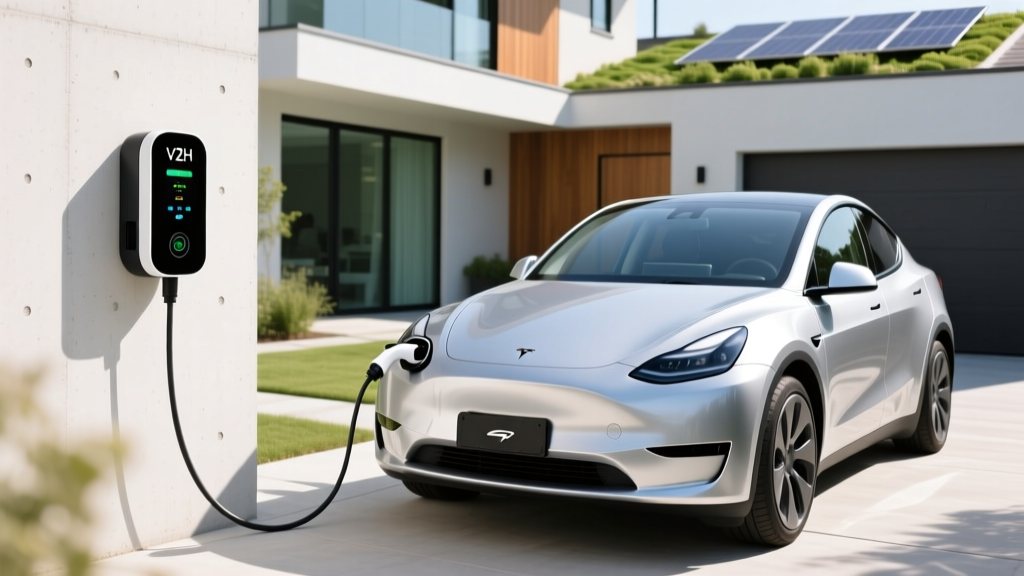
Most EV owners think of charging as a one-way street: electrons flow from the grid into the battery. Vehicle-to-Home (V2H) flips that equation. With the right bidirectional charger and a compatible EV, your car's battery can power your house during outages, offset peak electricity rates, or even feed energy back to the grid (V2G). As of 2026, V2H is no longer a concept — it's a purchasable, installable reality, though the ecosystem remains narrow and the costs are significant.
This guide breaks down what V2H chargers actually do, which EVs support them, what your electrical panel needs to handle, and whether the math works compared to a standalone home battery like the Tesla Powerwall.
What Is a V2H Charger and How Does Bidirectional Charging Work?
A V2H (Vehicle-to-Home) charger is a bidirectional EVSE — Electric Vehicle Supply Equipment — that can both charge your EV and discharge its battery back into your home's electrical panel. Unlike a standard Level 2 charger, which only pushes current one way, a V2H unit contains an inverter/charger capable of converting the DC stored in your EV's battery back into 120V/240V AC that your home circuits can use.
Here's the critical distinction: kW (kilowatts) measures the rate of power flow — how fast energy moves in or out. kWh (kilowatt-hours) measures total energy stored or delivered. A V2H charger rated at 11.5 kW can deliver up to 11.5 kilowatts of power to your home at any instant. If it sustains that rate for one hour, it delivers 11.5 kWh of energy. Your EV's battery capacity — say 77 kWh usable in a Ford F-150 Lightning — determines how long that supply lasts.
V2H requires three things working together:
- A V2H-capable EV with bidirectional onboard hardware and compatible software
- A bidirectional charger (the V2H EVSE unit) installed at your home
- An energy management system or transfer switch that safely isolates your home panel from the grid during discharge (to prevent backfeeding, which endangers utility workers)
V2H vs. V2L vs. V2G: Know the Difference
These terms get conflated, but they describe different capabilities:
- V2L (Vehicle-to-Load): Your EV has built-in AC outlets (typically 120V/240V, up to 3.6 kW) that can power individual appliances or tools directly from the car. No special home charger needed. Available on the Hyundai Ioniq 5, Kia EV6, Ford F-150 Lightning (Pro Power Onboard), and Rivian R1T/R1S.
- V2H (Vehicle-to-Home): Your EV powers your entire home electrical panel through a bidirectional charger and transfer switch. Requires dedicated hardware and electrical integration.
- V2G (Vehicle-to-Grid): Your EV feeds energy back to the utility grid for grid services or demand response programs. Requires utility cooperation and is currently limited to pilot programs.
V2L is useful for camping or running a refrigerator during a short outage. V2H is a whole-home backup solution that can keep lights, HVAC, and kitchen circuits running for days.
Which EVs Support V2H in 2026?
The list of production vehicles with confirmed, consumer-available V2H capability remains short:
| Vehicle | Battery (kWh usable) | Max V2H Output | Connector | Base MSRP (2026) |
|---|---|---|---|---|
| Ford F-150 Lightning | 98 (Std) / 131 (Ext) | 9.6 kW (up to 19.2 kW with option) | CCS1 / NACS adapter | ~$55,000 |
| GM Silverado EV / Sierra EV | ~200 (Ultium, max) | Up to 19.2 kW (with Energy Transfer Pro) | CCS1 / NACS adapter | ~$57,000 |
| Hyundai Ioniq 5 (2025+ refresh) | 84 | 3.6 kW (V2L standard; V2H via partner hardware) | NACS (native, 2025+) | ~$43,000 |
| Kia EV9 | 100 | 3.6 kW V2L; V2H pilot programs | NACS (2025+) | ~$55,000 |
Ford's Intelligent Backup Power system, paired with the Charge Station Pro, remains the most mature consumer V2H offering. GM's Energy Transfer Pro accessory provides similar capability for Ultium-platform trucks. Hyundai and Kia offer V2L broadly but V2H requires third-party integration that is still limited in availability.
Charging Levels Explained: Speeds and Range Added
Whether you're charging your EV or discharging it back to your home, understanding the power levels is essential:
| Level | Voltage | Max Power (kW) | Miles of Range Added per Hour | Typical Use |
|---|---|---|---|---|
| Level 1 | 120V AC | 1.4–1.9 kW | 3–5 mi/hr | Emergency / overnight trickle |
| Level 2 | 240V AC | 7.2–19.2 kW | 20–60 mi/hr | Home daily charging, V2H discharge |
| DC Fast Charge | 400–800V DC | 50–350 kW | 150–1,000+ mi/hr | Road trips, public stations |
V2H chargers operate at Level 2 power levels — they use 240V AC circuits and bidirectional inverters. Most current V2H units discharge at 9.6 to 19.2 kW, which is sufficient to run an average US home (which draws roughly 1–3 kW continuously, spiking to 5–10 kW when HVAC or electric oven cycles kick in).
How Much Does a V2H Charger Installation Cost?
Bidirectional charger installation is substantially more expensive than a standard Level 2 setup. You're paying for more complex hardware, additional electrical components (transfer switch or energy gateway), and more labor hours.
| Component | Cost Range | Notes |
|---|---|---|
| Bidirectional charger unit | $3,000–$7,500 | Ford Charge Station Pro ~$3,500; GM Energy Transfer Pro ~$4,500; DTEC/V2H-specific units up to $7,500 |
| Transfer switch / energy gateway | $1,500–$4,000 | Required for whole-home backup; Ford uses a proprietary gateway |
| Electrical panel upgrade (if needed) | $2,000–$5,000 | Many V2H setups require 200A+ service; older 100A panels must be upgraded |
| Electrician labor (installation) | $2,500–$6,000 | Bidirectional installs are complex — 1–3 days of work |
| Permits and inspections | $200–$800 | Varies by jurisdiction; some areas require utility interconnection approval |
| Total installed cost | $9,200–$23,300 | Average realistic range: $12,000–$18,000 for a complete V2H system |
For comparison, a Tesla Powerwall 3 (2026 pricing) costs roughly $9,000–$12,000 installed for ~13.5 kWh of dedicated home storage. A V2H system leverages your EV's far larger battery (77–200 kWh) but requires you to keep the car plugged in during outages.
Electrical Requirements for V2H
A typical V2H installation requires:
- Circuit: Dedicated 60A or 80A breaker at 240V (for 11.5 kW or 19.2 kW units respectively)
- Panel capacity: Minimum 200A main service panel. Homes with 100A panels will need a full upgrade ($2,000–$5,000)
- Transfer switch or energy gateway: Prevents backfeeding to the grid — this is a National Electrical Code (NEC) requirement and non-negotiable for safety
- GFCI protection: Required for outdoor-mounted EVSE per NEC 2023/2026 updates
- Utility notification: Many utilities require interconnection agreements for bidirectional systems, similar to solar permitting
V2H Charger Equipment: What's Available?
Ford Charge Station Pro (80A)
- Power output: 19.2 kW bidirectional (charge and discharge)
- Connector: CCS1 (J1772 combo), NACS with adapter
- Cable length: 25 feet
- Smart features: FordPass app integration, scheduled charging, Intelligent Backup Power activation
- Price: ~$3,500 (hardware only)
- Compatibility: F-150 Lightning (required for Intelligent Backup Power)
GM Energy PowerShift Charger (bidirectional accessory)
- Power output: Up to 19.2 kW bidirectional
- Connector: CCS1 (NACS with adapter on 2025+ models)
- Cable length: 25 feet
- Smart features: myChevrolet/myGMC app control, Energy Transfer Pro integration
- Price: ~$4,500 (charger + Energy Transfer Pro unit)
- Compatibility: Silverado EV, Sierra EV, Blazer EV (select trims)
DTEC V2H / Wallbox Quasar 2 (where available)
- Power output: 11.5 kW bidirectional
- Connector: CCS1 or NACS depending on configuration
- Cable length: 20–25 feet
- Smart features: Home energy management integration, solar pairing, time-of-use optimization
- Price: $5,500–$7,500
- Compatibility: Varies — requires EV with CCS bidirectional protocol support
How Much Does Charging (and Discharging) Cost per Mile?
When you're using V2H, cost calculations work in two directions: what you pay to charge the EV, and what you save by using EV-stored energy instead of grid power or a gas generator.
| Scenario | Cost per kWh | Cost per Mile (EV at 3 mi/kWh) | Notes |
|---|---|---|---|
| Home charging (off-peak utility rate) | $0.08–$0.14 | $0.03–$0.05 | Best-case daily charging; time-of-use plans |
| Home charging (peak rate) | $0.22–$0.35 | $0.07–$0.12 | Avoid if possible — charge overnight |
| Public Level 2 (ChargePoint, EVgo) | $0.25–$0.49 | $0.08–$0.16 | Varies by network and location |
| DC Fast Charging (Electrify America, Tesla) | $0.30–$0.55 | $0.10–$0.18 | Idle fees can add cost; peak rates apply |
| Gas vehicle (25 MPG, $3.40/gal) | — | $0.14 | Baseline comparison |
For V2H backup power specifically: if you charge at $0.12/kWh off-peak and discharge during a peak outage window where grid power would cost $0.35/kWh, you're saving $0.23/kWh. A Ford F-150 Lightning with 131 kWh usable battery holds roughly $15.72 worth of off-peak energy that can offset $45.85 in peak costs — a net savings of $30 per full cycle, plus the value of keeping your home powered during an outage.
Connector Compatibility for V2H Systems
The North American charging standard is shifting rapidly. Here's where connectors stand in 2026:
| Connector | Status in 2026 | V2H Support | Brands Using |
|---|---|---|---|
| NACS (J3400) | Adopted by nearly all OEMs for 2025+ models | Emerging — Ford, GM via adapter; native NACS V2H limited | Tesla, Ford (2025+), GM (2025+), Hyundai, Kia, Rivian, Volvo |
| CCS1 | Legacy standard; still on 2022–2024 models | Most mature V2H support (Ford Charge Station Pro designed for CCS1) | Ford (2022–2024 Lightning), VW ID.4 (older), BMW iX (older) |
| CHAdeMO | Effectively discontinued in North America | No V2H support | Nissan Leaf (legacy only) |
If you're buying a V2H charger in 2026, confirm both your EV's connector type and whether the bidirectional protocol is supported over that connector. Some early CCS1 bidirectional implementations do not work through NACS adapters — check with the charger manufacturer before purchasing.
How Long Can Your EV Power Your Home?
This is the question that matters most. Here's realistic backup duration based on average US home consumption (~30 kWh/day, though this varies enormously by climate, home size, and whether you run electric heat):
| Vehicle | Usable Battery (kWh) | Days of Backup (30 kWh/day avg) | Days (reduced load, ~15 kWh/day) |
|---|---|---|---|
| Ford F-150 Lightning (Std Range) | 98 | ~3 days | ~6 days |
| Ford F-150 Lightning (Ext Range) | 131 | ~4 days | ~8 days |
| GM Silverado EV (max battery) | ~200 | ~6 days | ~12 days |
| Hyundai Ioniq 5 | 84 | ~2.5 days | ~5 days |
"Reduced load" means turning off non-essential circuits — no electric dryer, no EV charging (obviously), reduced HVAC usage. Most homes can stretch significantly further by managing consumption. Ford's Intelligent Backup Power system automatically manages circuit priority through its gateway.
Important caveat: battery degradation. Every V2H discharge cycle counts against your EV battery's cycle life. Modern NMC and LFP batteries are rated for 1,500–3,000+ cycles to 80% capacity retention, so occasional outage use (10–20 cycles per year) has negligible impact. Daily V2G cycling for utility arbitrage is a different calculus — consult your warranty terms. Ford's F-150 Lightning battery warranty covers 8 years/100,000 miles with a minimum 70% capacity retention threshold.
Safety, Code, and Permitting for V2H
Bidirectional charging involves connecting a large DC energy source to your home's AC panel and potentially the utility grid. The safety requirements are stringent:
- Anti-islanding protection: Your V2H system must automatically disconnect from the grid during an outage before it begins supplying power. This prevents backfeeding electricity into utility lines, which can electrocute line workers. The transfer switch or energy gateway handles this.
- NEC Article 625 compliance: All EVSE installations must comply with National Electrical Code Article 625 (Electric Vehicle Charging Systems), updated in the 2023 and 2026 editions to address bidirectional equipment specifically.
- GFCI protection: Required for all outdoor-mounted EVSE. Hardwired indoor units may be exempt in some jurisdictions — confirm with your electrician.
- Dedicated circuit: Your V2H charger needs its own dedicated breaker — no sharing with other appliances.
- Utility interconnection agreement: Most utilities require notification and approval for any system that can export power to the grid (even if you only intend V2H, not V2G). This process mirrors solar interconnection and can take 2–8 weeks.
- Outdoor rating: If your charger is mounted outside, it must carry a NEMA 4 (weather-resistant) rating minimum.
Always hire a licensed electrician experienced with bidirectional EVSE. This is not a DIY project — improper installation can void your EV warranty, your homeowner's insurance, and create serious fire or electrocution risk.
V2H vs. Home Battery: Which Makes More Sense?
Choose V2H if:
- You already own or plan to buy a V2H-capable EV (F-150 Lightning, Silverado EV)
- You want 3–12 days of backup without buying a separate battery system
- You can keep your EV parked at home and plugged in during high-risk outage periods (storm season, grid stress events)
- You want to offset peak electricity rates using off-peak charging (where your utility allows)
Choose a standalone home battery (Tesla Powerwall, Enphase IQ) if:
- You need backup power regardless of whether your car is home
- You have solar panels and want integrated storage
- Your EV doesn't support V2H
- You want simpler permitting (no utility interconnection complexity for behind-the-meter systems)
The economics tilt toward V2H if you're already buying the truck. The incremental cost of V2H hardware ($5,000–$10,000 installed beyond a standard Level 2 charger) buys you 5–10x the storage capacity of a single Powerwall, using battery capacity you're already paying for in the vehicle.
Frequently Asked Questions
How much does it cost to install a V2H home charger?
A complete V2H installation — bidirectional charger, transfer switch/energy gateway, electrician labor, permits, and potential panel upgrade — typically runs $12,000 to $18,000. The charger hardware alone costs $3,000 to $7,500. Homes needing a 200A panel upgrade should budget an additional $2,000 to $5,000. Compare this to a standard Level 2 home charger installation, which averages $800–$2,500.
How fast will each charging level add range to my EV?
Level 1 (120V) adds 3–5 miles per hour. Level 2 (240V, 40A) adds roughly 25–35 miles per hour for most EVs. DC Fast Charging at 150+ kW can add 150–300+ miles in 20–30 minutes, though charge speed tapers significantly above 80% state of charge due to battery management system protections.
Which connector and charger is compatible with my EV for V2H?
Check your EV's charging port and model year. 2022–2024 models mostly use CCS1. 2025+ models from Ford, GM, Hyundai, Kia, and Rivian use NACS (or provide adapters). For V2H specifically, the Ford F-150 Lightning with Charge Station Pro (CCS1) is the most proven combination. Confirm bidirectional protocol compatibility with the charger manufacturer before purchasing.
How much does charging cost per mile compared to gas?
Home charging at off-peak rates ($0.10–$0.14/kWh) costs $0.03–$0.05 per mile for an EV averaging 3 miles per kWh. A gas vehicle at 25 MPG with $3.40/gallon fuel costs $0.14 per mile. Even public DC fast charging at $0.45/kWh ($0.15/mile) is roughly equivalent to gas, making home charging the clear economic winner.
What electrical upgrades might I need for V2H?
The most common upgrade is a panel replacement from 100A to 200A service ($2,000–$5,000). V2H chargers drawing 19.2 kW require an 80A dedicated circuit, which consumes significant panel capacity. If your panel is already near capacity with existing loads, an upgrade is mandatory. Your electrician will perform a load calculation per NEC Article 220 to determine this. Some homes may also need a service drop upgrade from the utility.
Does using V2H degrade my EV battery faster?
Every charge/discharge cycle contributes to gradual capacity loss, but the impact of occasional V2H use is minimal. Modern EV batteries are designed for 1,500–3,000+ full cycles before dropping below 80% capacity. Using V2H for 10–20 outage events per year represents a tiny fraction of that cycle budget. Daily V2G cycling for utility arbitrage would accelerate wear — but that's a different use case. Your battery warranty (typically 8 years/100,000 miles) remains in effect for normal V2H use.
Sources: fueleconomy.gov for efficiency data; IRS §30D clean vehicle credit rules (note: V2H charger hardware may qualify under separate residential energy credits — consult a tax professional); manufacturer specifications from Ford and GM press sites.