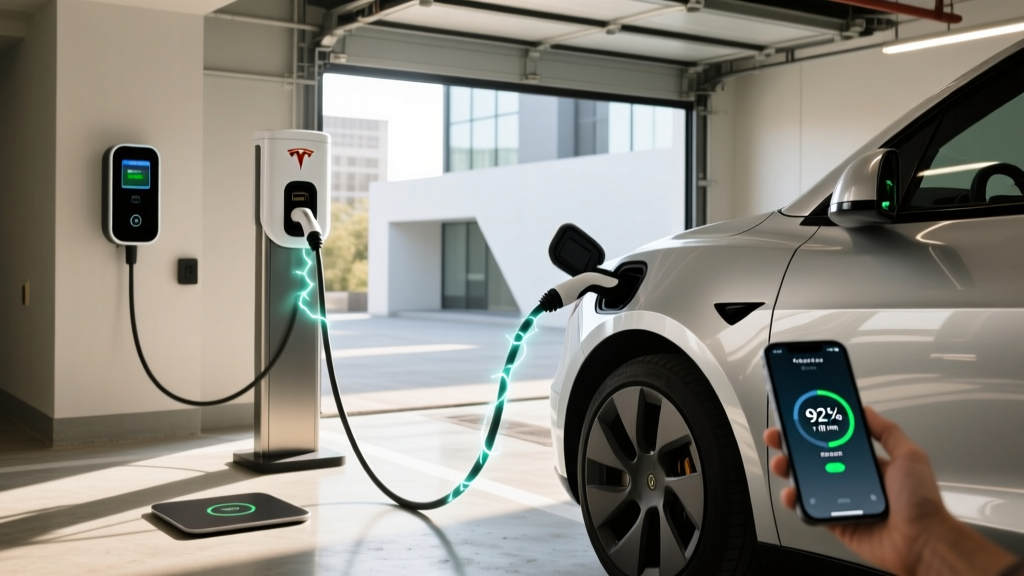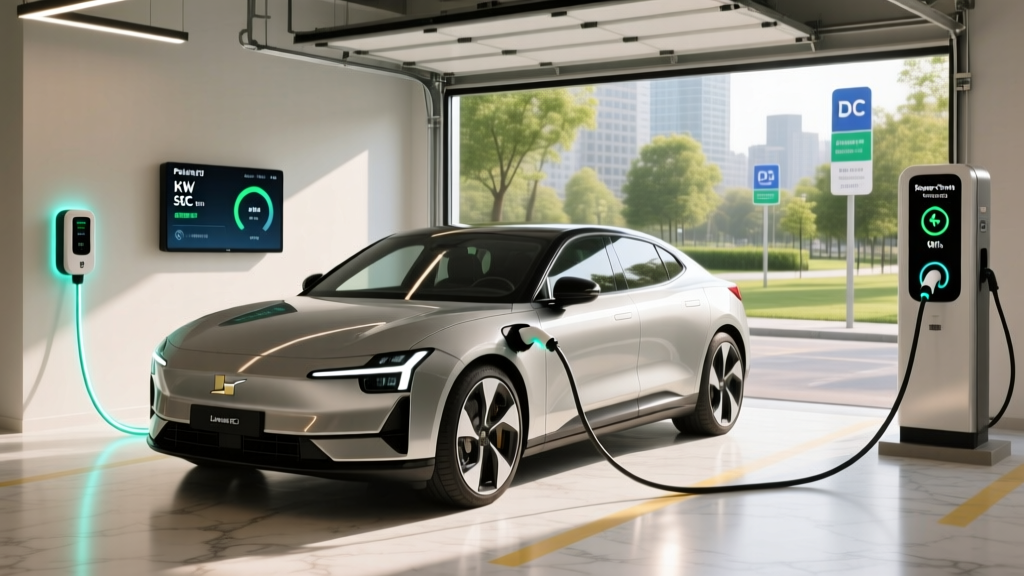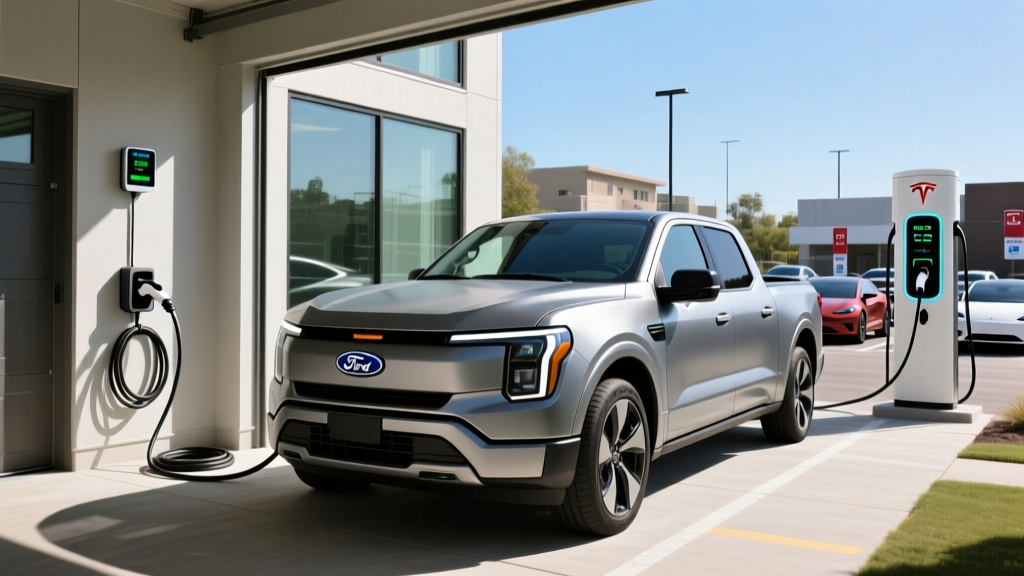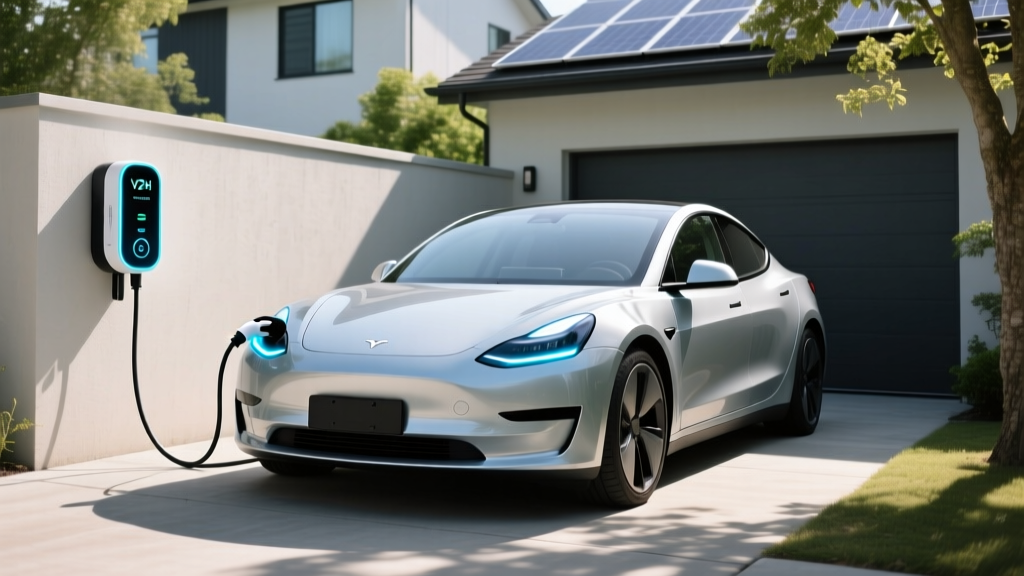
Your electric vehicle's battery holds 60 to 100+ kWh of energy — enough to power an average American home for three to five days during an outage. A V2H charger (vehicle-to-home) unlocks that stored energy, turning your EV into a whole-home backup generator that's quieter, cleaner, and often cheaper than a gas generator or stationary battery. But bidirectional hardware, compatible vehicles, and electrical-panel requirements make this a more complex install than a standard Level 2 wallbox.
This guide breaks down exactly how V2H works in 2026, which vehicles support it, what the real installation costs look like, and whether it makes financial sense compared to alternatives like the Tesla Powerwall or Generac PWRcell.
What Is a V2H Charger and How Does Bidirectional Charging Work?
A V2H charger is a bidirectional EV charger that can both charge your vehicle's battery from the grid and discharge energy from the battery back into your home's electrical panel. Think of it as a two-way bridge between your car and your house.
Here's the critical distinction in terminology:
- V2H (Vehicle-to-Home): Powers your home during outages or peak-rate hours. Requires a transfer switch or backup load panel.
- V2G (Vehicle-to-Grid): Sends power back to the utility grid for demand-response programs. Requires utility approval and a grid-interactive inverter.
- V2L (Vehicle-to-Load): Powers devices via a 120V outlet in the vehicle or adapter — no home integration. Limited to 1.5–3.6 kW.
V2H is the sweet spot for most homeowners: it provides whole-home backup without needing utility coordination. The EV connects to a bidirectional charger hardwired to a backup load panel or an automatic transfer switch, which isolates your home from the grid during an outage (a safety requirement called anti-islanding) and routes battery power to designated circuits.
Charging Levels: What Speeds Are We Talking About?
Before evaluating V2H hardware, you need to understand the three charging levels and their power delivery. V2H chargers operate as Level 2 bidirectional units — they charge your car at Level 2 speeds and discharge at comparable rates.
| Level | Voltage / Amperage | Max Power (kW) | Miles of Range Added per Hour | Typical Use |
|---|---|---|---|---|
| Level 1 | 120V / 12–16A | 1.4–1.9 kW | 3–5 mi/hr | Overnight trickle, PHEVs |
| Level 2 | 240V / 32–48A | 7.7–11.5 kW | 25–45 mi/hr | Home daily charging, V2H |
| DC Fast | 400–800V DC | 50–350 kW | 150–1,000+ mi/hr | Road trips, public stations |
Real-world charging time examples (Level 2, 11.5 kW / 48A):
- Ford F-150 Lightning (Extended Range, 131 kWh usable): 0–100% in ~11.4 hours; 10–80% in ~8.2 hours
- Hyundai Ioniq 5 (84 kWh usable): 0–100% in ~7.3 hours; 10–80% in ~5.3 hours
- Chevrolet Silverado EV (200 kWh, max battery): 0–100% in ~17.4 hours; 10–80% in ~12.5 hours
Note: Level 2 charging maintains a relatively flat power curve compared to DC fast charging, where you'll see peak rates only up to ~50–60% SoC before the battery management system tapers power to protect cell health.
Which EVs Support V2H in 2026?
Bidirectional charging requires support at three levels: the vehicle's onboard hardware and software, the charger, and your home's electrical infrastructure. As of 2026, the V2H-capable vehicle list is growing but still limited.
| Vehicle | Battery (kWh Usable) | Max V2H Discharge | Connector | Backup Duration (Avg Home)* |
|---|---|---|---|---|
| Ford F-150 Lightning | 98 / 131 | 9.6 kW (via Pro Power Onboard) | CCS1 / NACS adapter | 2–5 days |
| Hyundai Ioniq 5 (2025+) | 84 | 11.5 kW (with V2H charger) | NACS (2025+) | 2–4 days |
| Kia EV9 | 76.1 / 99.8 | 11.5 kW (with V2H charger) | CCS1 / NACS adapter | 2–4 days |
| Chevrolet Silverado EV | 200 (max) | 12 kW (Energy Export) | CCS1 / NACS adapter | 4–7 days |
| GMC Sierra EV | 200 (max) | 12 kW (Energy Export) | CCS1 / NACS adapter | 4–7 days |
*Backup duration assumes average home load of ~2 kW during outage with essential circuits only (refrigerator, lights, internet, HVAC fan). Full-home load at 5–8 kW reduces duration proportionally.
Notable exclusions: Tesla vehicles do not currently support V2H despite having the largest battery packs on the road. Tesla's Powerwall ecosystem is their home-backup solution. Rivian offers V2L via bed outlets but has not yet enabled full V2H integration. Always confirm V2H compatibility with the manufacturer before purchasing a bidirectional charger — firmware updates can enable or restrict this feature.
V2H Charger Equipment: What's Available and What to Buy
The bidirectional charger market is narrower than standard Level 2 wallboxes. Here are the leading V2H-capable units available in the US as of 2026:
Ford Charge Station Pro
- Power: 9.6 kW charge / 9.6 kW discharge
- Voltage: 240V / 40A dedicated circuit
- Connector: CCS1 (NACS adapter available)
- Cable length: 25 ft
- Smart features: FordPass app integration, scheduled charging, backup auto-activation
- Price: ~$1,300 (hardware only)
- Requires: Home Integration System (transfer switch), ~$3,800 installed
Wallbox Quasar 2
- Power: 11.5 kW charge / 11.5 kW discharge
- Voltage: 240V / 48A dedicated circuit
- Connector: NACS (CCS1 version available)
- Cable length: 25 ft
- Smart features: myWallbox app, solar integration, TOU optimization, grid-peak shaving
- Price: ~$2,500 (hardware only)
- Requires: Compatible EV with bidirectional protocol support
Emporia V2H System
- Power: 11.5 kW charge / 11.5 kW discharge
- Voltage: 240V / 48A
- Connector: NACS
- Cable length: 24 ft
- Smart features: Whole-home energy monitoring, automatic outage detection, solar pairing
- Price: ~$3,000 (hardware + gateway)
- Requires: Emporia gateway panel sensors for load management
How Much Does It Cost to Install a V2H Charger?
V2H installation is significantly more complex and expensive than a standard Level 2 charger because it requires a backup load panel or automatic transfer switch to safely isolate your home from the grid during discharge. Budget for the following:
| Component | Cost Range | Notes |
|---|---|---|
| Bidirectional charger hardware | $1,300 – $3,000 | Ford Charge Station Pro to Wallbox Quasar 2 |
| Transfer switch / backup load panel | $1,500 – $3,500 | Critical for grid isolation (anti-islanding) |
| Electrician labor (8–16 hours) | $1,200 – $3,200 | Varies by region and install complexity |
| Permit and inspection | $150 – $500 | Required by NEC; some jurisdictions require utility notification |
| Panel upgrade (if needed) | $1,500 – $4,000 | 100A → 200A service upgrade for older homes |
| Total (no panel upgrade) | $4,150 – $9,700 | Most 200A-panel homes |
| Total (with panel upgrade) | $5,650 – $13,700 | Homes with 100A or 150A service |
What Electrical Upgrades Might I Need?
A V2H system demands significant electrical headroom. Here's what to evaluate before scheduling an electrician:
- Panel capacity: You need a 200-amp (minimum) main service panel. The bidirectional charger draws 40–48A while charging and pushes similar amperage back during discharge. If you have a 100A or 150A panel (common in pre-2000 homes), a panel upgrade is mandatory.
- Dedicated circuit: A 50A or 60A double-pole breaker on 240V, using 6 AWG or 4 AWG copper wire depending on run length.
- Transfer switch placement: Must be installed between the meter and your main panel (whole-home) or as a sub-panel feeding critical circuits (partial-home backup).
- GFCI protection: NEC 2023 (Article 625) requires GFCI protection for EV charging circuits — your electrician will include this in the breaker.
- Outdoor rating: If the charger is mounted outside, it must carry a NEMA 4 or NEMA 4X rating for weather resistance.
Pro tip: Some utilities offer rebates of $500–$1,500 for V2H-capable installations, particularly in areas with high outage frequency or time-of-use rate structures. Check with your local utility before finalizing equipment choices.
Connector Compatibility: NACS, CCS1, and Adapter Requirements
The North American connector landscape has shifted heavily toward NACS (Tesla's standard, now SAE J3400) as of 2025–2026. Most new EVs ship with NACS ports, but millions of CCS1-equipped vehicles remain on the road. Here's what you need to know for V2H:
| Connector | V2H Support | Vehicles (2026) | Adapter Needed? |
|---|---|---|---|
| NACS (J3400) | Yes — native on newest V2H chargers | Tesla (no V2H), Ford (2025+), Hyundai/Kia (2025+), GM (2025+), Rivian (2025+) | No for NACS vehicles; CCS1→NACS adapter for older EVs |
| CCS1 | Yes — on Ford Charge Station Pro and Wallbox Quasar 2 (CCS variant) | Ford Lightning (2022–2024), VW ID.4, Kia EV6 (pre-2025), Hyundai Ioniq 5 (pre-2025) | NACS→CCS1 adapter if charger is NACS-only |
| CHAdeMO | No — not supported for V2H | Nissan Leaf (legacy only) | N/A |
Critical warning: Not all adapters support bidirectional power flow. Standard CCS1-to-NACS passive adapters are designed for charging into the vehicle only. For V2H operation, you need a charger with the native connector matching your vehicle's port, or a manufacturer-certified bidirectional adapter. Confirm bidirectional compatibility in writing before purchasing any adapter for V2H use.
Cost to Charge: V2H Economics vs Gas Generator vs Home Battery
The financial case for a V2H charger rests on two value streams: backup power during outages and time-of-use (TOU) arbitrage — charging your EV when electricity is cheap and discharging to your home when rates peak.
| Scenario | Rate ($/kWh) | Cost per Mile* | Notes |
|---|---|---|---|
| Home Level 2 (off-peak TOU) | $0.08 – $0.12 | $0.024 – $0.036 | Best-case daily charging |
| Home Level 2 (peak TOU) | $0.25 – $0.40 | $0.075 – $0.12 | Avoid these hours — use V2H discharge instead |
| Public Level 2 (ChargePoint, etc.) | $0.20 – $0.49 | $0.06 – $0.15 | Varies widely by network and location |
| DC Fast Charging (Electrify America, EA) | $0.35 – $0.56 | $0.11 – $0.17 | Road-trip pricing; some networks offer subscriptions |
| Gas vehicle (25 MPG, $3.40/gal) | — | $0.136 | Baseline comparison |
*Based on 3.0–3.5 kWh/mile efficiency typical of mid-size EVs (per fueleconomy.gov data).
V2H vs Home Battery vs Generator: Backup Power Cost Comparison
| Solution | Usable Energy | Installed Cost | Backup Duration (2 kW avg) | Fuel/Ongoing Cost |
|---|---|---|---|---|
| V2H (F-150 Lightning ER) | 131 kWh | $5,000 – $9,500 | ~65 hours (2.7 days) | $0 (already paid for vehicle) |
| Tesla Powerwall 3 | 13.5 kWh | $12,000 – $16,500 | ~6.75 hours | $0 (grid/solar charged) |
| Portable Gas Generator (7.5 kW) | Unlimited (with fuel) | $800 – $2,000 | 10–14 hrs/tank | $15–25/day in gasoline |
| Whole-Home Standby (Generac 22 kW) | Unlimited (natural gas) | $8,000 – $15,000 | Indefinite | $30–50/day in natural gas |
The V2H value proposition is strongest if you already own a compatible EV. You're leveraging a battery you've already paid for — effectively getting 131 kWh of backup storage for the cost of the charger and transfer switch installation. A single Powerwall holds only 13.5 kWh; you'd need nearly 10 to match an F-150 Lightning Extended Range, at a cost exceeding $100,000.
Safety, Code, and Permit Requirements for V2H
Bidirectional charging involves pushing power back through your home's electrical system, which introduces safety considerations beyond a standard charger install:
- Anti-islanding protection: NEC Article 705 and IEEE 1547 require that any system feeding power into a home must automatically disconnect from the utility grid during an outage. This prevents backfeeding electricity onto lines that utility workers expect to be de-energized. Your transfer switch handles this.
- Utility notification: Many utilities require advance notification and approval before connecting a bidirectional system. Some require a formal interconnection agreement even for V2H (behind-the-meter) systems. Contact your utility's distributed-generation department before installation.
- Permitting: Your electrician will pull an electrical permit. The inspector will verify wire gauge, breaker sizing, GFCI protection, grounding, and transfer-switch installation. Budget $150–$500 for permit fees and allow 1–3 weeks for inspection scheduling.
- Battery warranty implications: Most EV manufacturers warranty their batteries for 8 years / 100,000 miles with a minimum 70% capacity retention threshold (per EPA/fueleconomy.gov battery standards). Frequent V2H cycling adds charge-discharge cycles. Ford has stated that moderate V2H use (a few outage events per year) does not void the battery warranty, but daily TOU arbitrage cycling may accelerate degradation. Check your manufacturer's specific bidirectional-use warranty terms.
- NEMA rating: Outdoor-mounted units require NEMA 4 (splash-resistant) or NEMA 4X (corrosion-resistant) enclosures. Indoor garage installations have no additional enclosure requirement.
Who Should (and Shouldn't) Invest in a V2H Charger?
V2H Makes Sense If:
- You already own a V2H-compatible EV (F-150 Lightning, Ioniq 5, EV9, Silverado EV)
- You live in an area with frequent multi-hour outages (storm-prone, wildfire PSPS zones, aging grid)
- You have a 200A panel with available breaker slots
- Your utility offers TOU rates with a significant peak/off-peak spread (>$0.15/kWh difference)
- You want backup power without buying a separate generator or battery
Skip V2H If:
- Your EV doesn't support bidirectional discharge (Tesla, most sedans)
- You need indefinite backup (multi-day outages without recharging options — get a generator)
- Your home has a 100A panel and upgrade costs are prohibitive
- You primarily want TOU arbitrage but your peak/off-peak spread is less than $0.10/kWh
- You need your EV fully charged every morning for a long commute (V2H discharge reduces morning SoC)
Frequently Asked Questions
Can any EV charger do V2H, or do I need specific hardware?
You need a purpose-built bidirectional charger. Standard Level 2 chargers (ChargePoint Home Flex, Emporia Level 2, Tesla Wall Connector) are one-directional — they only send power to the vehicle. V2H chargers like the Ford Charge Station Pro, Wallbox Quasar 2, and Emporia V2H system include the inverter and communication protocols to reverse power flow. Additionally, you need a transfer switch or backup load panel — a standard charger circuit alone cannot feed power back to your home.
How fast will each charging level add range?
Level 1 (120V) adds roughly 3–5 miles of range per hour — adequate for PHEVs with small batteries but impractical for BEVs. Level 2 (240V, 48A) adds 25–45 miles per hour depending on vehicle efficiency, fully recharging most EVs overnight. DC fast charging (50–350 kW) adds 150–1,000+ miles per hour but is only available at public stations and tapers significantly above 80% SoC to protect battery health.
Does using V2H degrade my EV battery faster?
Every charge-discharge cycle contributes to gradual capacity loss, but modern LFP and NMC batteries are rated for 1,500–3,000+ full cycles before reaching 80% capacity. Occasional V2H use during outages (5–15 events per year) has a negligible impact on long-term battery health. Daily TOU cycling (one additional partial cycle per day) will accelerate degradation slightly. Most manufacturers' 8-year/100,000-mile battery warranties cover capacity loss regardless of V2H use, but confirm this with your specific OEM.
Is a V2H system eligible for the federal tax credit?
The IRS §30D credit applies to new clean vehicles, not chargers. However, the Alternative Fuel Vehicle Refueling Property Credit (§30C) covers up to 30% of home charging equipment costs (max $1,000 for residential). Bidirectional chargers may qualify, but eligibility depends on your census tract (must be a low-income or non-urban area per IRA provisions) and the specific equipment. Consult a tax professional for your situation — rules vary by location and are subject to change.
What happens if I need to drive during a power outage?
This is the key trade-off of V2H vs. a stationary battery. If you've discharged your EV to power your home and then need to drive, your available range is reduced proportionally. Set a reserve threshold in your V2H app (e.g., never discharge below 30% SoC) to maintain driving range for emergencies. A Silverado EV with 200 kWh can discharge 100 kWh to your home and still have ~200 miles of range remaining — a luxury of large-battery trucks.
Can I pair V2H with rooftop solar?
Yes — and this is where V2H becomes most powerful. During a grid outage, solar panels alone cannot power your home without a battery (they shut off for anti-islanding safety). With V2H, your EV battery acts as the solar storage system: solar charges the EV during the day, and the EV powers your home at night. Systems like the Wallbox Quasar 2 and Emporia V2H include solar-integration logic for this exact workflow. This effectively gives you a solar-plus-storage system without buying a dedicated home battery.