Why the US EV Infrastructure Program Matters in 2026
The National Electric Vehicle Infrastructure (NEVI) Formula Program, funded under the Bipartisan Infrastructure Law, has allocated $7.5 billion to build a national network of reliable US EV infrastructure program charging ports along designated Alternative Fuel Corridors. By early 2026, thousands of new DC fast charging ports are either operational or under construction, with a federal mandate that each NEVI-funded station include at least four CCS1-capable ports capable of 150 kW or higher, spaced no more than 50 miles apart along major highways.
But public infrastructure is only half the equation. Most EV owners do 80% or more of their charging at home. Understanding how the public network is evolving — and how to set up your own Level 2 home station — is essential for anyone buying or owning an EV today.
This guide breaks down charging levels, connector compatibility, real-world charging speeds, home installation costs, and how NEVI-funded ports fit into the broader picture.
Charging Levels Explained: Speed, Power, and Real-World Range Added
The most common mistake new EV buyers make is confusing kW (kilowatts — the rate of power delivery, like water pressure from a hose) with kWh (kilowatt-hours — the energy stored in your battery, like the size of the bucket). Charging speed is measured in kW; battery capacity is measured in kWh.
| Level | Voltage | Max Power (kW) | Miles of Range Added per Hour | Typical Use Case |
|---|---|---|---|---|
| Level 1 | 120V AC | 1.2–1.9 kW | 3–5 mi/hr | Overnight top-up, PHEVs, low-mileage drivers |
| Level 2 | 240V AC | 7.2–19.2 kW | 20–60 mi/hr | Home charging, workplaces, retail destinations |
| DC Fast Charge | 400–800V DC | 50–350 kW | 150–1,200+ mi/hr (peak) | Highway travel, rapid top-ups |
A few real-world examples put these numbers in context:
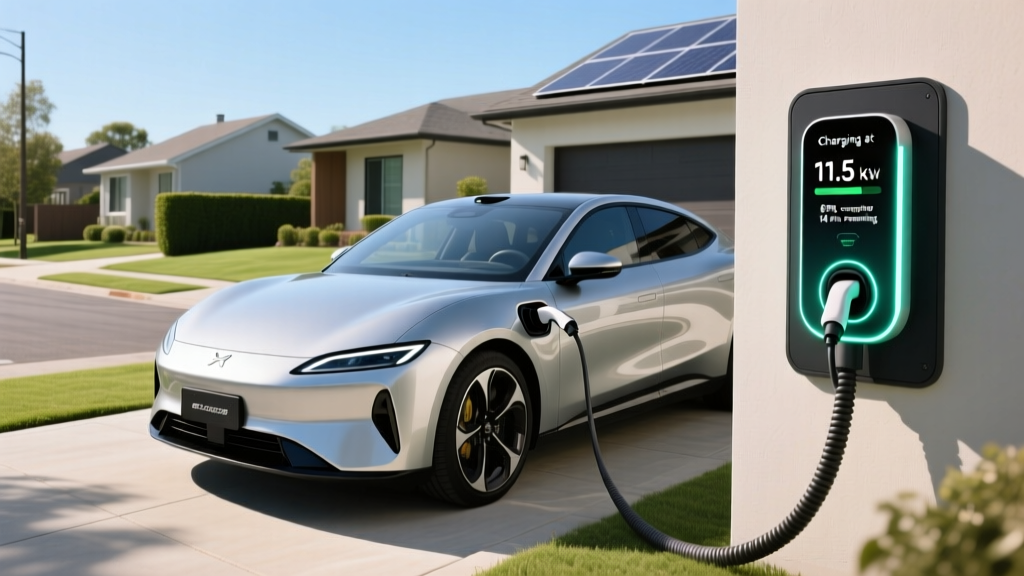
- Tesla Model Y (75 kWh battery, ~310 mi EPA): Level 2 at 11.5 kW adds roughly 37 miles of range per hour. A 10–80% charge takes about 5–6 hours. On a 250 kW Supercharger, 10–80% takes approximately 18–22 minutes.
- Hyundai Ioniq 5 (77.4 kWh, ~303 mi EPA): With its 800V architecture, it can peak at 240 kW on DC fast charging, reaching 10–80% in roughly 18 minutes under ideal conditions — one of the fastest in its class.
- Chevrolet Equinox EV (85 kWh, ~319 mi EPA): Peaks at 150 kW DC, with a 10–80% time of approximately 30 minutes.
Real-world caveat: DC fast charging speeds are not linear. The charge curve tapers significantly above 80% state of charge to protect the battery. Peak kW is sustained only briefly, typically between 10–40% SoC. Cold weather (below 40°F) can reduce charging speed by 20–40% unless the vehicle has preconditioning — always precondition before arriving at a DC fast charger.
Connector Compatibility: NACS, CCS1, and CHAdeMO in 2026
The connector landscape has shifted dramatically. Tesla's North American Charging Standard (NACS) has been adopted by Ford, GM, Rivian, Volvo, Hyundai/Kia, BMW, and most major automakers for their 2025–2026 model-year EVs. CCS1 (Combined Charging System) remains the standard for NEVI-funded infrastructure and is used by Stellantis, Volkswagen (current models), and others. CHAdeMO is effectively legacy — the Nissan Leaf remains the primary vehicle using it, and Nissan has signaled future models will shift to NACS.
| Connector | Brands Using It (2026) | NEVI Station Availability | Adapter Needed? |
|---|---|---|---|
| NACS (Tesla) | Tesla, Ford, GM, Rivian, Volvo, Hyundai, Kia, BMW | Increasingly available; adapters provided at many NEVI sites | CCS-to-NACS adapter for non-Tesla Superchargers (some included free by OEMs) |
| CCS1 | VW, Stellantis, Honda (Prologue), Lucid, some legacy models | Required at all NEVI stations (minimum 4 ports per site) | NACS-to-CCS adapter for Tesla vehicles at non-Tesla DCFC |
| CHAdeMO | Nissan Leaf (legacy), Mitsubishi Outlander PHEV (legacy) | Rarely included at new NEVI stations | No adapter available; rely on remaining CHAdeMO stations |
The Federal Highway Administration's NEVI standards require funded stations to include CCS1 connectors. However, many operators are now adding NACS cables or providing CCS-to-NACS adapters on-site. If you're buying a 2026 EV with NACS, confirm whether the manufacturer includes a CCS adapter — Ford and GM, for example, have provided them to enable access to Electrify America and other CCS networks.
How Much Does It Cost to Install a Home EV Charger?
This is the question every new EV owner asks, and the honest answer spans a wide range depending on your home's electrical panel, the distance from the panel to your parking spot, and local permitting requirements.
| Component | Low Estimate | High Estimate | Notes |
|---|---|---|---|
| Level 2 Charger (Equipment) | $350 | $750 | 32A–48A smart chargers; hardwired or NEMA 14-50 plug |
| Electrician Labor | $500 | $1,500 | Varies by run length, conduit, and local rates |
| Electrical Permit | $50 | $250 | Required in most jurisdictions; varies by municipality |
| Panel Upgrade (if needed) | $1,500 | $4,000+ | Older homes with 100A service often need a 200A upgrade |
| Total (no panel upgrade) | $900 | $2,500 | Typical for homes with 200A service and short wire runs |
| Total (with panel upgrade) | $2,400 | $6,500+ | Common in pre-1990 homes or those with high existing loads |
Electrical Requirements for a 48-Amp Level 2 Charger
A 48-amp Level 2 charger (the most common high-power home unit) requires a dedicated 60-amp circuit on a 240V line. Per the National Electrical Code (NEC), continuous loads cannot exceed 80% of the circuit breaker rating — hence 48A on a 60A breaker.
Panel upgrade warning: If your home has a 100-amp main panel, adding a 60A EV circuit may push your total calculated load beyond the panel's capacity. An electrician will perform a load calculation (NEC Article 220) to determine if an upgrade to 200A service is needed. This is not optional — skipping it risks tripped main breakers, overheated wiring, or fire.
Some newer homes and those with solar panels or recent renovations already have 200A service, making the install straightforward and closer to the low end of the cost range.
Safety and Code Considerations
- Dedicated circuit: Your EV charger must be on its own breaker — not shared with appliances or outlets.
- GFCI protection: NEC 2023 and later require GFCI protection for all EV charging outlets. Hardwired chargers typically have built-in GFCI, but plug-in units on NEMA 14-50 outlets require a GFCI breaker (adding ~$50–$100 to the install).
- Outdoor rating: If your charger is installed outside, it must be rated for outdoor use (NEMA 4 or NEMA 4X). Most quality chargers meet this, but verify before purchasing.
- Permit and inspection: Nearly all jurisdictions require a permit and a post-install inspection. Your electrician should handle this — do not skip it, as unpermitted work can void home insurance claims.
Level 2 Charger Equipment Picks for 2026
These are chargers we've evaluated for reliability, charge speed, build quality, and smart features. All support J1772 connectors (compatible with all non-Tesla EVs) or NACS connectors, with adapters available as needed.
ChargePoint Home Flex
- Power: Up to 12 kW (50A, adjustable down to 16A)
- Connector: J1772 (NACS adapter included with 2025+ units)
- Cable length: 23 feet
- Smart features: Wi-Fi, app scheduling, Alexa integration, utility demand-response
- Price: ~$550
- Best for: Flexibility — adjustable amperage fits various panel capacities
Tesla Wall Connector (Gen 4)
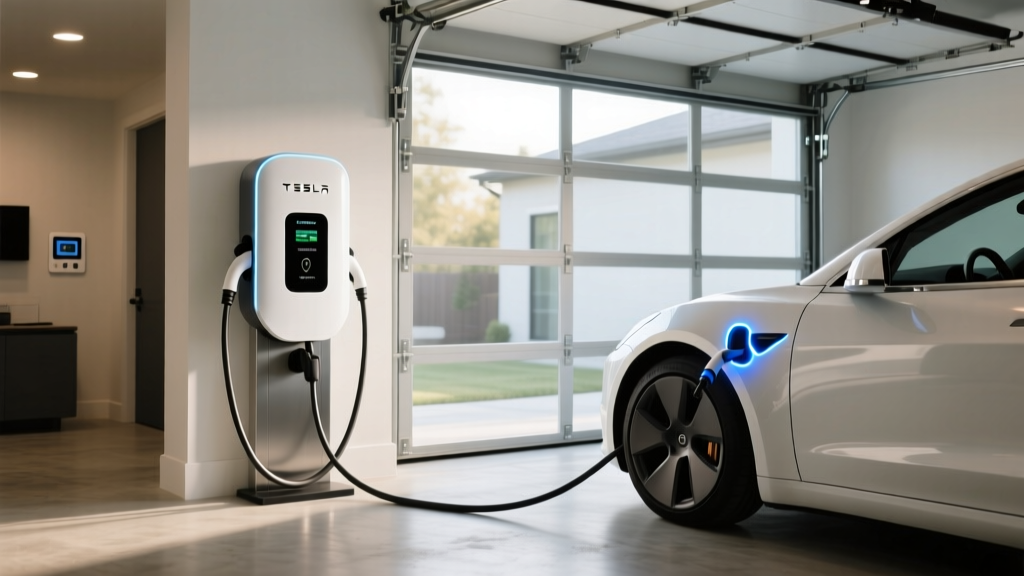
- Power: Up to 11.5 kW (48A)
- Connector: NACS native; J1772 adapter available
- Cable length: 24 feet
- Smart features: Wi-Fi, OTA updates, Power-Share between two units, Tesla app integration
- Price: ~$475
- Best for: Tesla owners who want seamless integration and clean design
Emporia Level 2 EV Charger
- Power: Up to 11.5 kW (48A)
- Connector: J1772 (NACS version available)
- Cable length: 24 feet
- Smart features: Wi-Fi, energy monitoring, solar integration, time-of-use scheduling
- Price: ~$400
- Best for: Budget-conscious buyers who want detailed energy tracking
For homes with limited panel capacity, the ChargePoint Home Flex's adjustable amperage is a standout — you can set it to 32A (requiring only a 40A breaker) and still add roughly 25 miles of range per hour, which covers most daily driving needs overnight.
Charging Cost Per Mile: Home vs. Public vs. Gas
One of the strongest arguments for EVs is the per-mile fuel cost — but it varies enormously depending on where you charge.
| Scenario | Rate ($/kWh) | Cost for 75 kWh Fill | Cost Per Mile (at 3 mi/kWh) |
|---|---|---|---|
| Home — Off-Peak TOU (national avg) | $0.09–$0.14 | $6.75–$10.50 | $0.03–$0.047 |
| Home — Standard Rate (national avg) | $0.16–$0.20 | $12.00–$15.00 | $0.053–$0.067 |
| Public Level 2 (workplace/retail) | $0.20–$0.35 | $15.00–$26.25 | $0.067–$0.117 |
| DC Fast Charging (Electrify America, EVgo, etc.) | $0.35–$0.55 | $26.25–$41.25 | $0.117–$0.183 |
| Gasoline (28 MPG car at $3.40/gal) | — | — | $0.121 |
Key takeaway: Home charging on an off-peak time-of-use plan costs roughly one-quarter to one-third of what gasoline costs per mile. Even DC fast charging is competitive with gas on a per-mile basis in most markets. However, if you rely exclusively on public DC fast charging at $0.45–$0.55/kWh, your per-mile cost can exceed that of a fuel-efficient hybrid. Home charging access is the single biggest factor in EV operating cost.
Many utilities now offer EV-specific time-of-use (TOU) rates. PG&E's EV-A plan in California, for example, offers rates as low as $0.09/kWh between midnight and 3 PM. Check your local utility's EV rate options — this can save $300–$600 annually compared to standard residential rates.
How the US EV Infrastructure Program Is Expanding Public Charging
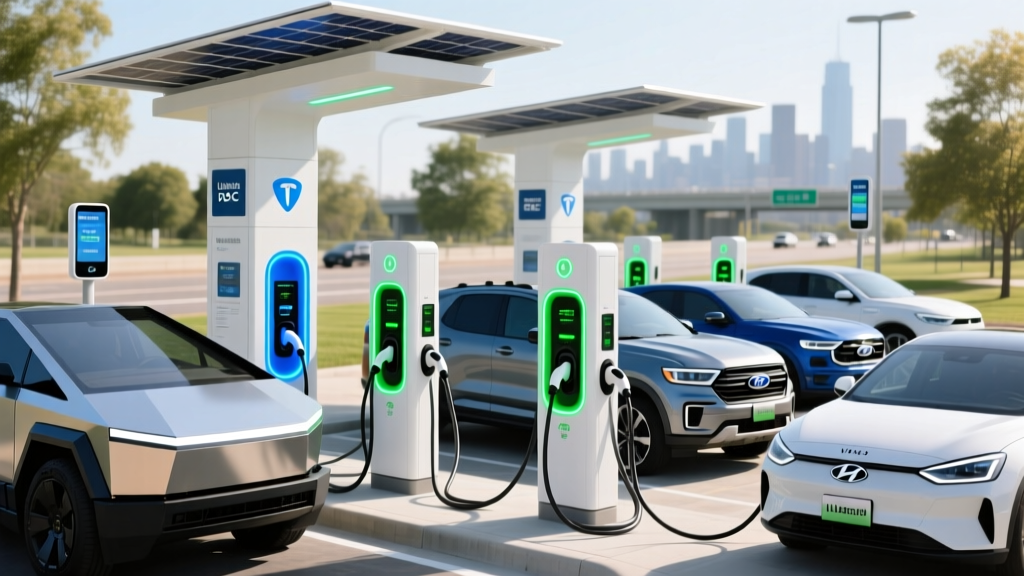
The NEVI program, administered by the Federal Highway Administration, targets 75,000 miles of designated Alternative Fuel Corridors. As of early 2026, the program has funded or is funding:
- Over 4,500 new DC fast charging ports either operational or under construction
- Stations spaced no more than 50 miles apart along interstate corridors
- Minimum 150 kW per port, with many sites deploying 350 kW-capable hardware
- Payment systems that do not require a proprietary app — credit/debit card and contactless payment are federally mandated at NEVI sites
- Uptime requirements of 97% or higher, with penalties for non-compliance
These requirements directly address the most common complaints about public charging: broken chargers, proprietary app requirements, and gaps in highway coverage. The 97% uptime mandate, in particular, is a significant improvement over the historical 80–85% uptime seen on some networks.
Beyond NEVI, the broader US charging ecosystem continues to grow. Tesla's Supercharger network — now open to non-Tesla EVs via the Supercharger network — exceeded 6,500 charging stalls in the US by late 2025. Electrify America, EVgo, and ChargePoint collectively operate thousands of additional DC fast charging ports. The result is a public network that, while still imperfect in rural areas and certain metro corridors, is measurably more reliable and extensive than it was even two years ago.
Decision Framework: How Should You Charge?
Choose Home Level 2 If:
- You have a garage, carport, or dedicated parking spot with electrical access
- Your daily driving is under 60 miles (most Americans drive ~37 miles/day per FHWA data)
- You want the lowest per-mile cost ($0.03–$0.05/mi on off-peak rates)
- You can invest $900–$2,500 upfront for installation
Lean on Public DC Fast Charging If:
- You're an apartment dweller without home charging access
- You frequently take road trips over 200 miles
- Your EV supports 150+ kW DC charging (to minimize stop times)
- Budget $0.12–$0.18/mile — comparable to gas, but with zero tailpipe emissions
Consider a PHEV Instead If:
- You cannot install a Level 2 charger and lack reliable public charging nearby
- You want electric-only commuting (25–50 miles) with gas-engine range for road trips
- Models like the Toyota RAV4 Prime (42 mi electric, 94 MPGe) or Jeep Wrangler 4xe (22 mi electric) offer a practical middle ground
Frequently Asked Questions
How much does it cost to install a home EV charger?
For a typical home with a 200-amp electrical panel and a short wire run, expect $900–$2,500 total (equipment, electrician labor, and permit). If your home needs a panel upgrade from 100A to 200A, add $1,500–$4,000+. Always get a load calculation from a licensed electrician before committing.
How fast will each charging level add range?
Level 1 (120V) adds 3–5 miles per hour. Level 2 (240V, 48A) adds roughly 30–40 miles per hour. DC fast charging (150–350 kW) can add 150–1,200+ miles per hour at peak — but peak speed is sustained only briefly, and the charge curve tapers above 80% SoC. A 10–80% DC fast charge typically takes 18–35 minutes depending on the vehicle and charger.
Which connector/charger is compatible with my EV?
For 2026 models: Tesla, Ford, GM, Rivian, Hyundai, Kia, Volvo, and BMW use NACS. Volkswagen, Stellantis, Honda Prologue, and Lucid use CCS1. Nissan Leaf (legacy) uses CHAdeMO. Check your vehicle's charge port or the manufacturer's spec sheet. Adapters are available for most cross-network scenarios.
How much does charging cost per mile vs gas?
Home charging costs $0.03–$0.07 per mile depending on your electricity rate. Public DC fast charging costs $0.12–$0.18 per mile. A 28 MPG gas car at $3.40/gallon costs about $0.12 per mile. Home charging is significantly cheaper; exclusive public DC fast charging is roughly equivalent to gas.
What electrical upgrades might I need?
A 48A Level 2 charger requires a dedicated 60A breaker on 240V. If your home has a 100A main panel, you'll likely need a 200A service upgrade ($1,500–$4,000+). Homes built after 2000 typically have 200A service. An electrician will perform a NEC Article 220 load calculation to determine your exact needs. Do not skip this step.
Does the US EV infrastructure program cover my area?
NEVI funding targets designated Alternative Fuel Corridors — primarily interstate highways and major US routes. You can check your state's NEVI deployment plan on your state DOT's website or via the FHWA NEVI program page. Rural and off-corridor areas may see slower deployment, but many states are using additional state-level funding to fill gaps.