Americans are searching for EV charging answers at record volume. From "how much does a home charger cost to install?" to "can I charge my Hyundai Ioniq 5 at a Tesla Supercharger?", the questions reflect a market that has crossed the early-adopter phase and entered mainstream ownership. In 2026, with the North American Charging Standard (NACS) now adopted by nearly every major automaker, public networks expanding past 180,000 DC fast-charging ports nationwide, and home installation costs stabilizing, the landscape is clearer — but the technical details still trip up buyers.
This guide answers the most common EV charging queries surfacing across the United States, grounded in exact figures: kilowatt (kW) charge rates, kilowatt-hour (kWh) battery capacities, real installation costs, and per-mile charging economics. Whether you're researching your first EV or optimizing an existing setup, these are the numbers that matter.
The Three Charging Levels: Speeds, kW, and Miles Added Per Hour
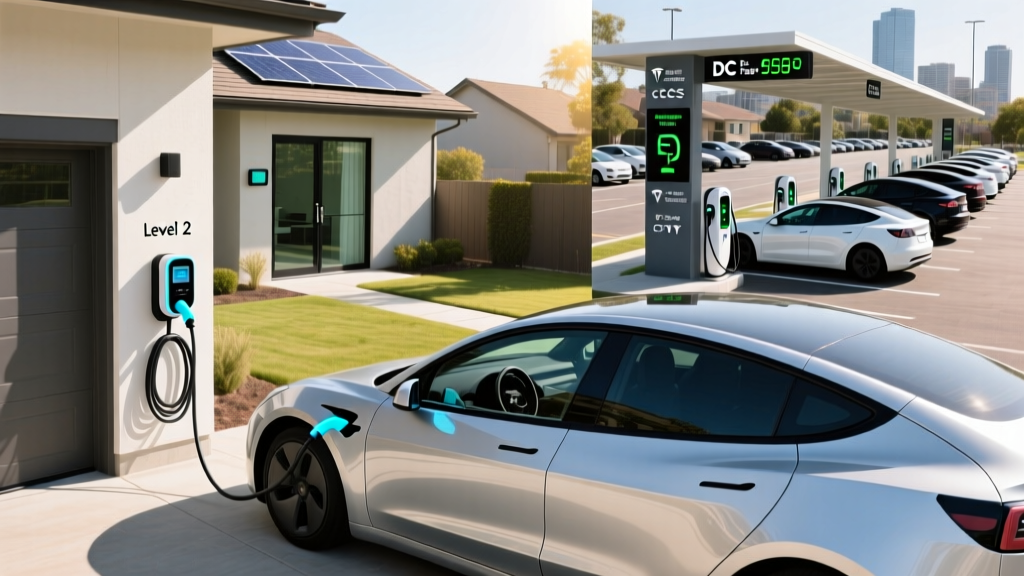
Every EV owner needs to understand three charging tiers. The critical distinction: kW (kilowatts) measures power — how fast energy flows into your battery. kWh (kilowatt-hours) measures energy — the total capacity of your battery. Think of kW as the width of a hose and kWh as the size of the bucket.
| Level | Voltage | Power (kW) | Miles of Range Added Per Hour | Best Use Case |
|---|---|---|---|---|
| Level 1 | 120V AC | 1.2–1.9 kW | 3–5 miles | Overnight top-off for PHEVs or low-mileage commuters |
| Level 2 | 240V AC | 7.2–19.2 kW | 20–65 miles | Daily home charging; primary method for most BEV owners |
| DC Fast Charge | 400–800V DC | 50–350 kW | 150–800+ miles/hr equivalent | Road trips; 10–80% in 18–45 min depending on vehicle |
A few realities that spec sheets often obscure:
- Level 2 home charging at 11.5 kW (48A) will fully replenish a 77 kWh battery (like the Ford Mustang Mach-E Extended Range) from 10% to 100% in roughly 7 hours — perfect for overnight.
- DC fast charging peak rates are not sustained rates. A Hyundai Ioniq 5 may peak at 240 kW on an 800V architecture, but the charge curve tapers significantly above 60–70% State of Charge (SoC). Expect a 10–80% session in approximately 18 minutes, but 80–100% can take another 20+ minutes.
- Level 1 is viable for PHEVs with small batteries (12–18 kWh usable), adding enough overnight to cover most electric-only ranges of 25–40 miles. For full BEVs, Level 1 is an emergency backup only.
How Much Does It Cost to Install a Home EV Charger in 2026?
This is the single most searched EV charging question in the U.S., and the answer depends heavily on your home's electrical panel. Here's a realistic breakdown for a hardwired Level 2 wall connector installation:
| Cost Component | Typical Range | Notes |
|---|---|---|
| Level 2 Charger Equipment | $350–$700 | Smart Wi-Fi-enabled units (ChargePoint Home Flex, Emporia Level 2, Tesla Wall Connector) |
| Electrician Labor | $500–$2,000 | Depends on run length from panel to garage/carport; longer runs cost more |
| Permit Fees | $50–$300 | Varies by municipality; some jurisdictions waive for EV circuits |
| Electrical Panel Upgrade (if needed) | $1,500–$3,500 | Required if your panel is 100A or maxed out; upgrading to 200A is standard |
| Total (no panel upgrade) | $900–$3,000 | Most homes with 200A service and short conduit runs |
| Total (with panel upgrade) | $2,400–$6,500 | Older homes (pre-2000) with 100A or 150A panels |
Panel upgrade reality check: If your home was built before 2000 and has a 100-amp service panel, adding a 40A or 48A dedicated EV circuit may exceed your panel's capacity. A licensed electrician will perform a load calculation per NEC Article 220. Don't skip this step — overloading a panel is a fire hazard, and most jurisdictions require the load calc for permit approval.
Federal incentive: The Alternative Fuel Vehicle Refueling Property Credit (§30C) offers up to $1,000 (30% of equipment and installation costs, capped at $1,000 for residential). Eligibility requires installation in a qualifying census tract. Consult a tax professional and see IRS guidance on §30C for current-year requirements.
Connector Compatibility: NACS, CCS1, CHAdeMO, and Adapter Needs
The connector landscape in 2026 has consolidated significantly. Tesla's North American Charging Standard (NACS) is now the dominant connector, adopted by Ford, GM, Rivian, Hyundai, Kia, BMW, and most other major automakers for new vehicles. CCS1 remains on many 2023–2025 models still on the road. CHAdeMO is effectively legacy — only the Nissan Leaf continues with it, and Nissan has confirmed future models will use NACS.
| Connector | Automakers Using (2026 MY) | Public Network Access | Adapter Needed? |
|---|---|---|---|
| NACS (Tesla standard) | Tesla, Ford, GM, Rivian, Hyundai, Kia, BMW, Volvo, Polestar, Mercedes-Benz | Tesla Supercharger (25,000+ stalls), Electrify America, ChargePoint — increasingly universal | CCS-to-NACS adapters available (~$150–$250) for older CCS vehicles |
| CCS1 | Legacy: 2023–2025 VW ID.4, some older BMW i4/iX, pre-transition models | Electrify America, EVgo, ChargePoint (most non-Tesla DC networks) | NACS-to-CCS adapters available for newer NACS vehicles charging at CCS-only stations |
| CHAdeMO | Nissan Leaf (final generation only) | Limited; Electrify America has phased out most CHAdeMO connectors | No viable adapter to NACS; CHAdeMO owners rely on remaining legacy stations |
Practical advice: If you're buying a 2026 model-year EV, NACS is the connector you want. It unlocks the Tesla Supercharger network — the most reliable DC fast-charging network in the U.S. by uptime metrics — without an adapter. If you own a 2024–2025 CCS-equipped vehicle, a NACS-to-CCS adapter (sold by Ford, GM, and third parties like Lectron) lets you access Superchargers.
Cost Per Mile: EV Charging vs. Gasoline in 2026
The economics of EV charging depend on where and when you charge. Here's how common scenarios compare, using a national average gasoline price of $3.45/gallon and a 30 MPG combined gas vehicle as the baseline:
| Charging Scenario | Cost per kWh | Cost Per Mile (250 Wh/mi EV) | vs. Gas at 30 MPG |
|---|---|---|---|
| Home, off-peak utility rate | $0.08–$0.13 | $0.02–$0.033 | 74–85% cheaper |
| Home, standard residential rate | $0.14–$0.18 | $0.035–$0.045 | 62–70% cheaper |
| Public Level 2 (workplace, retail) | $0.20–$0.35 | $0.05–$0.088 | 24–57% cheaper |
| DC Fast Charge (Electrify America, EVgo) | $0.35–$0.55 | $0.088–$0.138 | 0–24% cheaper (can match gas on highway) |
| Tesla Supercharger (average) | $0.25–$0.40 | $0.063–$0.10 | 13–46% cheaper |
| Gas baseline (30 MPG, $3.45/gal) | — | $0.115 | — |
Key insight: home charging is where EV ownership economics shine. At off-peak rates, an EV costs roughly 2–3 cents per mile to fuel. On DC fast chargers at highway rates, the gap narrows — and in states with expensive public charging (California, some Northeast utilities), a DC fast-charge session can briefly exceed gas per-mile costs. The takeaway: if you can install Level 2 at home, your fuel cost drops dramatically. If you rely exclusively on public DC fast charging, the savings shrink considerably.
For detailed state-by-state electricity rates and utility EV time-of-use plans, check fueleconomy.gov's EV electricity cost tool.
Charging Time Examples: 10–80% for Common Battery Sizes
How long does a charging session actually take? Below are approximate 10–80% times for popular 2026 EVs at their peak supported DC fast-charge rates. Remember: these are best-case scenarios with a preconditioned battery and a charger capable of delivering peak power.
- Tesla Model Y Long Range (75 kWh usable, 250 kW peak): ~15–18 minutes at a V3 Supercharger
- Hyundai Ioniq 5 (77.4 kWh usable, 240 kW peak, 800V): ~18 minutes at a 350 kW-capable station
- Ford Mustang Mach-E Extended Range (91 kWh usable, 150 kW peak): ~32–38 minutes
- Chevrolet Equinox EV (85 kWh usable, 150 kW peak): ~30–35 minutes
- Rivian R1T Dual-Motor (128 kWh usable, 200 kW peak): ~35–42 minutes (larger battery offsets higher peak rate)
- BMW iX xDrive50 (105.2 kWh usable, 200 kW peak): ~34–38 minutes
The charge-curve taper is real. Most EVs pull peak kW only between roughly 10–40% SoC. From 40–60%, rates often drop 20–30%. Above 80%, charging slows to a trickle — often under 30 kW — to protect battery health. This is why road-trip strategy favors multiple short sessions (10–80%) rather than one long session to 100%.
Recommended Home Level 2 Chargers for 2026
Based on reliability, smart features, cable management, and value, these are the top Level 2 home chargers currently available:
Tesla Wall Connector (Gen 4)
- Power Output: Up to 11.5 kW (48A) on a 60A circuit
- Connector: NACS native
- Cable Length: 24 ft
- Smart Features: Wi-Fi, over-the-air updates, Power Sharing between multiple units, Tesla app integration
- Price: ~$450
- Best For: Tesla owners and NACS-equipped vehicles; cleanest integration if you're in the Tesla ecosystem
ChargePoint Home Flex
- Power Output: Up to 12 kW (50A) on a 65A circuit; configurable down to 16A
- Connector: NACS (2026 model); CCS1 adapter included for older vehicles
- Cable Length: 23 ft
- Smart Features: Wi-Fi, ChargePoint app scheduling, Alexa integration, flexible amperage dip-switch settings
- Price: ~$550–$650
- Best For: Multi-EV households; the adjustable amperage works well for homes with limited panel capacity
Emporia Level 2 EV Charger
- Power Output: Up to 11.5 kW (48A) on a 60A circuit
- Connector: NACS (2026 model); CCS adapter available
- Cable Length: 24 ft
- Smart Features: Wi-Fi, Emporia Energy app with real-time power monitoring, solar integration for homes with PV systems, load management
- Price: ~$350–$400
- Best For: Budget-conscious buyers who still want smart features; excellent energy monitoring for solar homes
Hardwired vs. plug-in (NEMA 14-50): Hardwired installations are generally preferred for 48A+ chargers because they eliminate the receptacle as a potential failure point (NEMA 14-50 outlets can overheat under continuous high-amperage load if not installed with commercial-grade receptacles). The NEC requires GFCI protection on receptacle-based EV circuits, which can cause nuisance tripping with some chargers. Hardwired connections avoid this issue entirely.
Safety, Code, and Installation Considerations
EV charging draws sustained high current for hours — more like running an electric furnace than plugging in a phone. Follow these non-negotiable safety principles:
- Dedicated circuit: Your Level 2 charger must be on its own dedicated circuit. A 48A charger requires a 60A breaker (NEC 125% rule: continuous loads cannot exceed 80% of circuit rating).
- GFCI protection: Required for receptacle-based installations per NEC 625. Hardwired installations are exempt from the GFCI breaker requirement in most jurisdictions.
- Outdoor rating: If your charger is installed outside (carport, driveway), ensure the unit carries a NEMA 4 or NEMA 4X rating for weather resistance. All three chargers recommended above are outdoor-rated.
- Wire gauge: A 60A circuit typically requires 6 AWG copper wire (THHN in conduit) or 4 AWG NM-B (Romex) depending on local code. Your electrician will specify based on run length and local amendments.
- Permit and inspection: Most municipalities require an electrical permit and post-installation inspection. Don't skip this — unpermitted work can void home insurance and cause issues at resale.
- Load management: If your panel is near capacity but a full upgrade isn't feasible, consider a smart charger with built-in load management (like the Emporia or ChargePoint with panel monitoring). These devices dynamically reduce charge current when other household loads spike, keeping you within your panel's capacity without a costly upgrade.
Frequently Asked Questions
How fast will each charging level add range to my EV?
Level 1 (120V) adds roughly 3–5 miles of range per hour — adequate for PHEVs with small batteries but impractical for full BEVs. Level 2 (240V, 48A) adds approximately 30–40 miles per hour for most EVs, fully replenishing overnight. DC fast charging adds 150–800+ miles-per-hour equivalent, but only for short sessions (10–80% in 18–42 minutes depending on battery size and peak kW).
How much does it cost to install a home EV charger?
Expect $900–$3,000 for a standard Level 2 installation in a home with adequate 200A panel capacity. If your home needs a panel upgrade (common in pre-2000 construction with 100A service), total costs can reach $2,400–$6,500. The federal §30C credit may offset up to $1,000 of these costs if you're in an eligible census tract.
Which connector and charger is compatible with my EV?
If your EV is a 2026 model year from nearly any major automaker, it uses NACS. If you have a 2023–2025 model from VW, older BMW, or pre-transition vehicles, you likely have CCS1. Check your vehicle's charge port or owner's manual. For home Level 2 charging, buy a wall connector matching your vehicle's connector — or use a certified adapter (Lectron, Ford, or OEM-branded).
How much does EV charging cost per mile compared to gasoline?
At home on off-peak rates ($0.08–$0.13/kWh), EV charging costs 2–3.3 cents per mile — 74–85% less than a 30 MPG gas car at $3.45/gallon. On public DC fast chargers ($0.35–$0.55/kWh), the cost rises to 9–14 cents per mile, which can approach or briefly match gas costs. Home charging is the economic sweet spot.
What electrical upgrades might I need for a home charger?
The most common upgrade is a panel upgrade from 100A to 200A service ($1,500–$3,500), required when your existing panel lacks capacity for a 60A dedicated EV circuit. Other potential upgrades include: replacing a Federal Pacific or Zinsco panel (known fire hazards, ~$2,500–$4,000 replacement), running new conduit for long wire runs (over 50 ft from panel to garage), or adding a smart load-management system to avoid a panel upgrade altogether.
Can I use a regular 120V outlet for my EV?
Yes, but only for emergency or supplemental charging. Level 1 (120V, 12–16A) adds 3–5 miles per hour. For a PHEV with 15 kWh of usable battery, an overnight charge (10 hours) adds roughly 35–50 miles — sufficient for many commutes. For a full BEV with a 75+ kWh battery, Level 1 would take 3–4 days for a full charge and is only practical as a backup.
Is the Tesla Supercharger network open to non-Tesla EVs?
Yes. As of 2026, Tesla has opened thousands of Supercharger stalls to NACS-equipped non-Tesla vehicles. Ford, Rivian, GM, and other NACS-equipped EVs can access Superchargers using the Tesla app for payment. CCS-equipped vehicles can access select Superchargers with a Magic Dock adapter built into the stall, or with an aftermarket NACS-to-CCS adapter. Check the Tesla app for real-time stall availability and compatibility.
For the most current EV efficiency data, range ratings, and MPGe figures, reference the EPA's fueleconomy.gov database. For federal tax credit and refueling property credit eligibility, always verify current-year rules at irs.gov or consult a qualified tax professional — incentive rules shift annually and depend on income, vehicle MSRP, battery sourcing, and installation location.