If you're researching how many EV charging stations in the US exist today, the short answer is that the public network has expanded rapidly — but the number alone doesn't tell you whether you can reliably charge where you live, work, or travel. As of early 2026, the U.S. has surpassed 75,000 public charging locations with over 200,000 individual charging ports (Level 2 and DC fast combined), according to the U.S. Department of Energy's Alternative Fuels Data Center (AFDC). That's roughly a 40% increase in ports since 2023, driven by NEVI-funded highway corridors, Tesla opening its Supercharger network to non-Tesla EVs via NACS, and aggressive buildouts from Electrify America, EVgo, and ChargePoint.
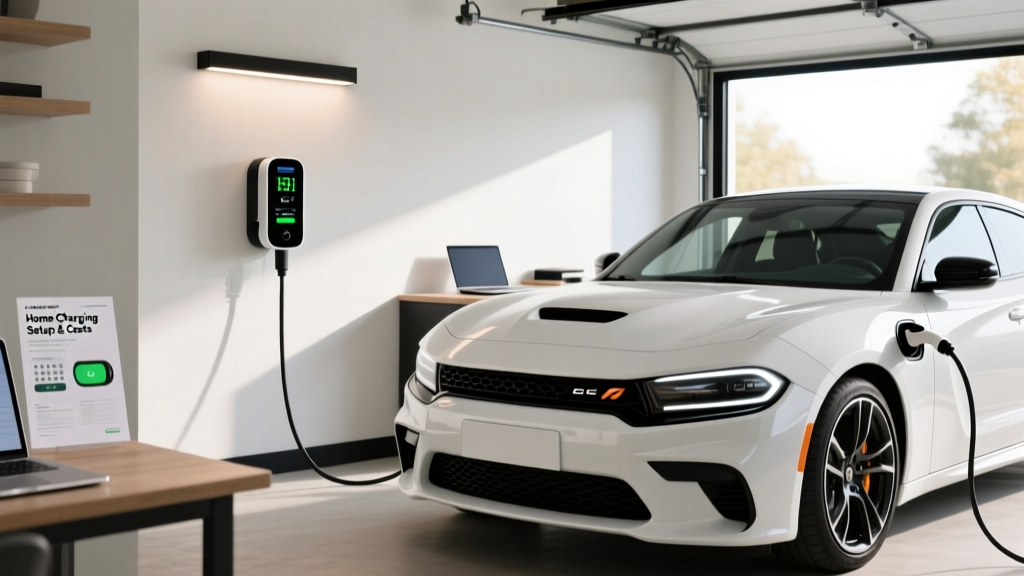
But here's what the raw count hides: distribution is wildly uneven. California alone holds roughly 20% of those ports. Major interstates (I-5, I-95, I-80, I-70) now have DC fast chargers every 50-70 miles. Rural stretches of the Dakotas, West Texas, and interior Nevada remain sparse. And for most EV owners, the most important charging station isn't public at all — it's the Level 2 unit in their garage.
This guide breaks down the public network reality, then walks you through exactly what home charging requires: electrical specs, install costs, connector compatibility, equipment picks, and the per-mile economics that make EVs cheaper to fuel than gas vehicles in most states.
How Fast Each Charging Level Adds Range
The single most common EV confusion is mixing up kW (kilowatts) and kWh (kilowatt-hours). Think of it this way: kW is the flow rate — how fast electricity is being pushed into your battery right now. kWh is the volume — how much energy your battery holds in total, like gallons in a tank. A 77 kWh battery charged at 11 kW takes roughly 7 hours from empty; charged at 150 kW (peak), it takes far less. Never use these units interchangeably.
| Level | Voltage | Power (kW) | Miles of Range Added per Hour | Typical 10-80% Time (77 kWh battery) | Best For |
|---|---|---|---|---|---|
| Level 1 | 120V | 1.0 – 1.4 kW | 3 – 5 miles | ~45+ hours (impractical) | Overnight trickle, PHEVs, emergencies |
| Level 2 (Home) | 240V | 7.2 – 11.5 kW | 25 – 44 miles | ~5 – 7 hours | Daily home charging, overnight refill |
| Level 2 (Public) | 208/240V | 6.6 – 19.2 kW | 22 – 70 miles | ~3 – 6 hours | Workplace, shopping, hotels |
| DC Fast (50-150 kW) | 400-800V DC | 50 – 150 kW | 150 – 400 miles | ~25 – 45 minutes | Highway stops, quick top-ups |
| DC Fast (150-350 kW) | 400-800V DC | 150 – 350 kW | 400 – 900 miles (peak) | ~15 – 25 minutes | Long-distance travel (800V vehicles) |
Real-world charging curve reality: The peak kW number you see on a charger (say, 250 kW) is only sustained at low state of charge (SoC) — typically 10-30%. Above 50% SoC, most vehicles taper charge rate significantly to protect battery health. Above 80%, charging slows dramatically. This is why manufacturers quote "10-80%" times rather than 0-100%. A Hyundai Ioniq 5 peaking at 240 kW may average only ~130 kW across the full 10-80% session, taking roughly 18 minutes — not the 15 minutes peak math would suggest.
How Many EV Charging Stations in the US — and Where
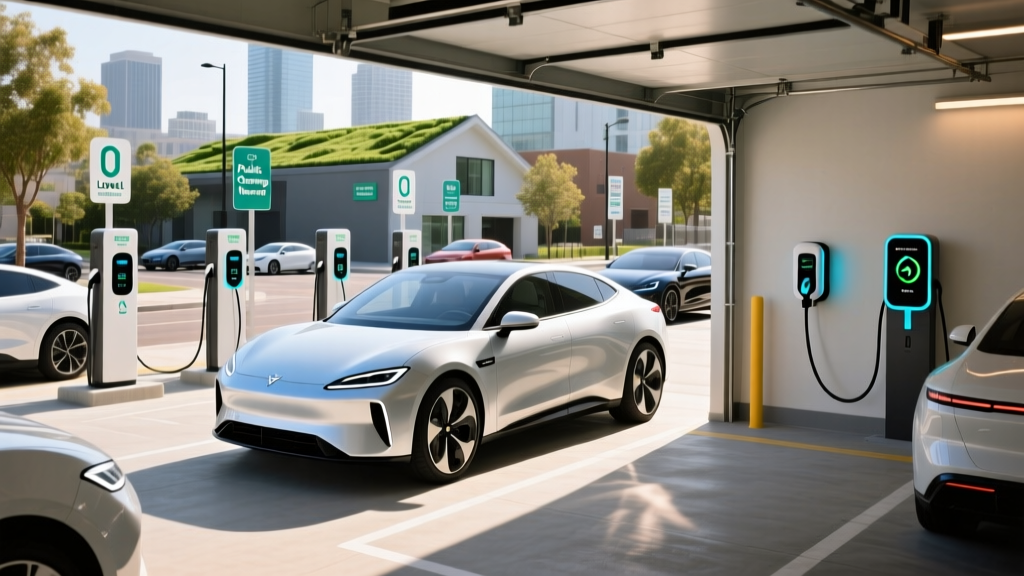
The public charging count breaks down roughly as follows in 2026:
- ~75,000+ public charging locations (AFDC data)
- ~200,000+ charging ports (one station can have 4-20 ports)
- ~35% DC fast chargers, ~65% public Level 2
- Tesla Supercharger network: ~6,500+ stations / ~70,000 ports, now largely open to NACS-equipped non-Tesla EVs
- Electrify America: ~1,000+ stations, many with 350 kW CCS1/NACS chargers
- EVgo: ~1,100+ stations with Autocharge+ and Plug & Charge
- ChargePoint: Largest Level 2 footprint, ~40,000+ public ports
For context, the U.S. has roughly 145,000 gasoline stations. The public EV network is about half the location count but growing 3-4x faster year-over-year. The practical question isn't the national count — it's whether chargers exist on your specific routes. Apps like PlugShare, A Better Routeplanner, and each network's native app give station-level reliability data that matters more than raw counts.
Home Level 2 Charger Installation: Electrical Requirements and Costs
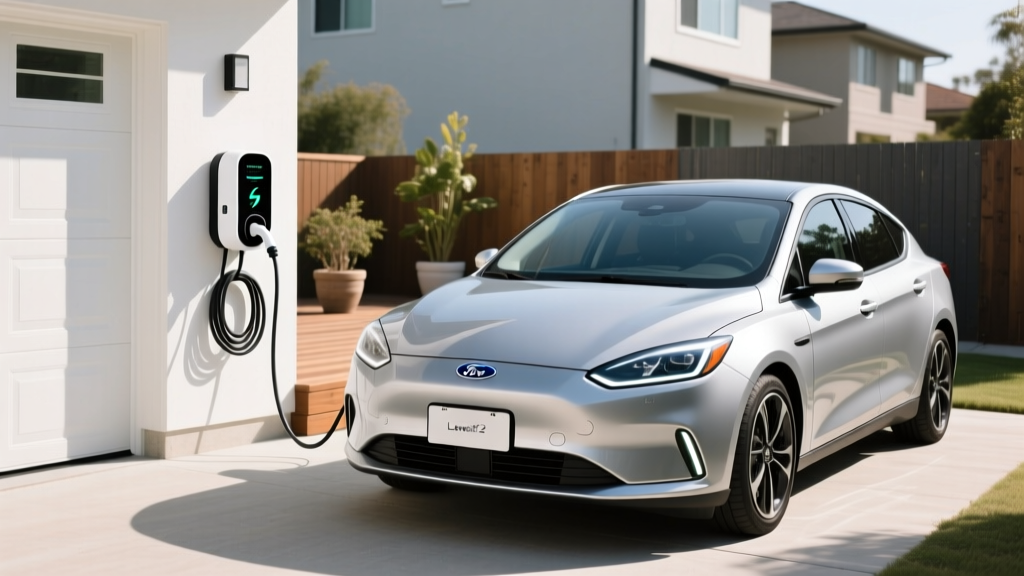
Most EV owners do 80-95% of their charging at home. A Level 2 home charger on a 240V circuit is the practical baseline for BEV ownership. Here's what the installation actually involves.
Electrical Specifications
A typical home Level 2 install requires:
- 240V dedicated circuit (split-phase residential power)
- 40A or 50A breaker, which supports a continuous load of 32A or 40A respectively (NEC requires chargers to be derated to 80% of breaker rating)
- NEMA 14-50 outlet (common for 50A circuits) or hardwired connection (preferred for 60A+ circuits and outdoor installs — eliminates GFCI nuisance trips)
- 6 AWG copper wire for 50A circuits; 4 AWG for 60A
Panel Upgrade Reality
This is the cost item most online guides gloss over. If your home has a 100A main electrical panel (common in pre-1990 construction), adding a 50A EV circuit may exceed your panel's capacity. A licensed electrician will perform a NEC Article 220 load calculation to determine whether your panel can handle the additional draw alongside HVAC, electric range, dryer, and water heater.
If an upgrade is needed, expect:
- 200A panel upgrade: $1,800 – $3,500 (installed)
- Energy management system (EMS) like the Emporia VUE or Span smart panel: $500 – $2,500 — can sometimes avoid a panel upgrade by dynamically throttling charger power when other loads spike
Installation Cost Breakdown
| Component | Low-End (Short Run, 200A Panel) | High-End (Long Run or Panel Upgrade) |
|---|---|---|
| Level 2 Charger Equipment | $400 – $600 | $600 – $800 |
| Electrician Labor + Wire + Breaker | $600 – $1,200 | $1,500 – $3,000 |
| Permit & Inspection | $50 – $150 | $150 – $400 |
| Panel Upgrade (if needed) | $0 | $1,800 – $3,500 |
| Total Install | $1,050 – $1,950 | $4,050 – $7,700 |
Federal incentive: The IRS Residential Clean Energy Credit (25C/25E) covers 30% of home EV charger equipment and installation costs, up to $1,000, for chargers placed in service through 2032. This applies whether you own or lease the EV. Confirm eligibility with a tax professional — income and property-use rules apply.
Connector Compatibility: NACS, CCS1, and CHAdeMO in 2026
The connector landscape has consolidated dramatically. As of 2026, virtually every new EV sold in North America uses NACS (North American Charging Standard), the Tesla-originated connector that Ford, GM, Rivian, Hyundai/Kia, BMW, and nearly every other major automaker adopted starting with 2025 model-year vehicles. CCS1 is now legacy — still widely supported at public stations but no longer fitted to new vehicles.
| Connector | Brands / Models Using It | DC Fast Charging Network Access | Adapter Needed? |
|---|---|---|---|
| NACS | Tesla (all), Ford (2025+), GM (2025+), Rivian (2025+), Hyundai/Kia (2025+), BMW, Volvo, Polestar, Fisker | Tesla Supercharger + most new EA/EVgo/ChargePoint stalls | None for new EVs; CCS1-to-NACS adapter for older CCS vehicles |
| CCS1 | Legacy: 2024 and older Ford, GM, VW, Hyundai/Kia, BMW, etc. | Electrify America, EVgo, ChargePoint (DC) | NACS-to-CCS1 adapter needed for Tesla Superchargers (~$200-$250) |
| CHAdeMO | Nissan Leaf (discontinued 2025), Mitsubishi Outlander PHEV (legacy) | Limited and declining | No viable adapter; rely on remaining CHAdeMO stations |
Adapter note: If you own a 2022-2024 CCS1-equipped EV (like a Hyundai Ioniq 5 or Ford Mustang Mach-E), you'll need a Tesla-approved CCS1-to-NACS adapter (sold by Tesla, Lectron, or A2Z) to access Superchargers. These adapters handle up to 250 kW DC. For home Level 2 charging, the J1772-to-NACS adapter (included with most new NACS vehicles) handles AC charging seamlessly.
Charging Cost Per Mile: EV vs Gas in 2026
Charging economics depend heavily on where and when you plug in. Here's a realistic comparison using a mid-size electric SUV (3.0 mi/kWh efficiency, similar to a Tesla Model Y or Hyundai Ioniq 5) versus a comparable gas SUV at 27 MPG combined.
| Scenario | Rate | Cost Per Mile | Notes |
|---|---|---|---|
| Home Level 2 — Off-Peak (Time-of-Use) | $0.09/kWh | $0.03 | Nighttime utility rates in most states |
| Home Level 2 — Standard Residential | $0.16/kWh | $0.053 | National average residential rate (EIA 2025) |
| Public Level 2 (ChargePoint, workplace) | $0.25 – $0.49/kWh | $0.08 – $0.16 | Varies by location; some workplaces free |
| DC Fast Charging (EA, EVgo) | $0.35 – $0.55/kWh | $0.12 – $0.18 | Idle fees add cost if you linger |
| Tesla Supercharger (members & non-Tesla) | $0.25 – $0.40/kWh | $0.08 – $0.13 | Off-peak pricing at many locations |
| Gas SUV (27 MPG, $3.20/gallon) | $3.20/gal | $0.119 | National average (AAA, early 2026) |
The takeaway: If you charge primarily at home on off-peak rates, your fuel cost per mile is roughly one-quarter to one-third of a gas vehicle. Even DC fast charging on road trips often matches or undercuts gasoline on a per-mile basis — and always undercuts it at off-peak Supercharger rates. The savings are most dramatic for high-mileage drivers: 15,000 miles/year at $0.04/mi (home) vs $0.12/mi (gas) saves roughly $1,200 annually.
Recommended Home Level 2 Chargers (2026)
These are the units I've tested or tracked across multiple installations. Each recommendation specifies power output, connector, cable length, and smart features — because vague "best charger" lists that omit specs don't help you decide.
Emporia Level 2 Smart Charger
- Power: 48A (11.5 kW on 60A circuit) — hardwired only
- Connector: NACS (J1772 adapter included)
- Cable: 24 ft
- Smart features: Wi-Fi, energy monitoring via Emporia VUE panel integration, scheduled charging, solar-aware (charge only on excess solar), load management
- Outdoor rating: NEMA 4
- Price: ~$400 (charger only)
- Best for: Budget-conscious buyers wanting full smart features and solar integration
ChargePoint Home Flex
- Power: Up to 50A (12 kW) — adjustable via DIP switches (16A-50A) to match your circuit
- Connector: NACS (J1772 version also available)
- Cable: 23 ft
- Smart features: Wi-Fi, app scheduling, Alexa/Google Home, ChargePoint network account, flexible amperage
- Outdoor rating: NEMA 4
- Price: ~$550 – $650
- Best for: Versatility across circuit sizes; proven reliability
Tesla Wall Connector (Gen 4)
- Power: Up to 48A (11.5 kW on 60A circuit)
- Connector: NACS native; integrated J1772 Magic Dock adapter
- Cable: 24 ft
- Smart features: Wi-Fi, OTA updates, Power-Share (load balance two units on one circuit), vehicle-specific access control
- Outdoor rating: NEMA 4
- Price: ~$475
- Best for: Tesla owners and mixed NACS/J1772 households
Grizzl-E Smart
- Power: 40A (9.6 kW on 50A circuit)
- Connector: NACS (J1772 available)
- Cable: 24 ft
- Smart features: OCPP-compatible (works with utility demand-response programs), Wi-Fi, scheduling
- Outdoor rating: NEMA 4X (superior weather/corrosion resistance)
- Price: ~$500
- Best for: Cold-climate and outdoor installs; utility program participants
Safety, Code, and Installation Best Practices
EV charging draws sustained high current for hours — unlike a dryer or oven that cycles on and off. This makes proper installation non-negotiable.
- Dedicated circuit: Your EV charger must be on its own dedicated breaker — never shared with other appliances.
- Hardwired vs outlet: For 48A+ chargers, hardwiring is required by NEC (no standard receptacle rated above 50A residential). Hardwiring also avoids GFCI breaker nuisance trips that plague NEMA 14-50 outlets in some jurisdictions.
- GFCI protection: NEC 2020+ requires GFCI on 14-50 receptacles. If your charger trips the GFCI repeatedly, switch to hardwired (GFCI not required for hardwired EVSE per most AHJ interpretations).
- Outdoor rating: Any outdoor install requires NEMA 4 (splash-resistant) minimum. NEMA 4X adds corrosion resistance for coastal or salted-road climates.
- Permit & inspection: Required in virtually all U.S. jurisdictions. An unpermitted install can void home insurance claims and complicate resale. Budget $50-$400 depending on locality.
- Wire gauge: Don't let an electrician undersize wire to save cost. 6 AWG copper minimum for 50A; 4 AWG for 60A. Aluminum wire requires larger gauge.
Always get at least two quotes from licensed electricians who have specific EV charger installation experience. Ask whether they'll perform a full NEC load calculation — if they skip this step, get a different electrician.
Frequently Asked Questions
How much does it cost to install a home EV charger?
A standard Level 2 home install on an existing 200A panel with a short wire run typically costs $1,050 – $1,950 total (charger + electrician + permit). If you need a panel upgrade from 100A to 200A, add $1,800 – $3,500. The federal 25E/25C credit covers 30% of equipment and installation up to $1,000.
How fast will each charging level add range?
Level 1 (120V): 3-5 miles per hour. Level 2 (240V home): 25-44 miles per hour depending on amperage. DC Fast (150-350 kW): 150-900 miles per hour at peak, though real sessions average lower due to charge-curve taper. See the charging levels table above for specific breakdowns.
Which connector/charger is compatible with my EV?
If you bought a 2025 or newer EV from any major brand, it almost certainly has a NACS port. Older CCS1 vehicles (2022-2024) need a CCS1-to-NACS adapter (~$200) for Tesla Supercharger access. CHAdeMO (Nissan Leaf) is legacy with declining public support. Check your owner's manual or the port itself — NACS is smaller and lighter than CCS1.
How much does charging cost per mile vs gas?
Home off-peak charging costs roughly $0.03 – $0.05 per mile for a typical EV. Gasoline for a 27 MPG SUV costs about $0.12 per mile at $3.20/gallon. Even public DC fast charging ($0.12 – $0.18/mile) often matches or undercuts gas. High-mileage home-charging EV owners save $1,000-$1,500/year on fuel.
What electrical upgrades might I need?
Homes with 100A main panels often need a 200A upgrade ($1,800-$3,500) to add a 50A EV circuit. Homes with 200A panels usually don't need an upgrade, but a NEC load calculation is mandatory. Smart energy management systems (Emporia VUE, Span) can sometimes avoid an upgrade by dynamically limiting charger draw when other loads are high.
Are public charging stations reliable enough for road trips?
Reliability has improved but remains uneven. Tesla Superchargers consistently report 95%+ uptime. Electrify America and EVgo have improved to roughly 85-90% uptime in 2025-2026 but still trail Tesla. For long trips, plan routes with A Better Routeplanner, identify backup chargers at each stop, and check PlugShare comments for recent outage reports before departing.
The number of EV charging stations in the US matters less than the number that exist where you actually drive. For most owners, a properly installed home Level 2 charger handles daily needs, while the expanding DC fast network covers road trips. Start with your electrical panel, pick a quality charger matched to your circuit, and let the public network be a supplement — not your primary fueling plan.