The Three Types of Electric Vehicle Chargers You Need to Know
If you're shopping for an EV or just took delivery of one, charging logistics are probably your biggest open question. The good news: the ecosystem breaks down into three clear tiers — Level 1, Level 2, and DC Fast Charging — each with distinct speeds, use cases, and costs. The bad news: marketing materials and even some dealer salespeople blur the lines between them, or worse, confuse kW (kilowatts, the rate of power delivery) with kWh (kilowatt-hours, the amount of energy stored in your battery).
Here's the mental model: kW is like the diameter of a hose. kWh is the size of the bucket. A bigger hose (higher kW) fills the bucket (your battery's kWh capacity) faster. Every charger type below is defined by its maximum kW output, and your EV's onboard charger or battery management system determines how much of that power it can actually accept.
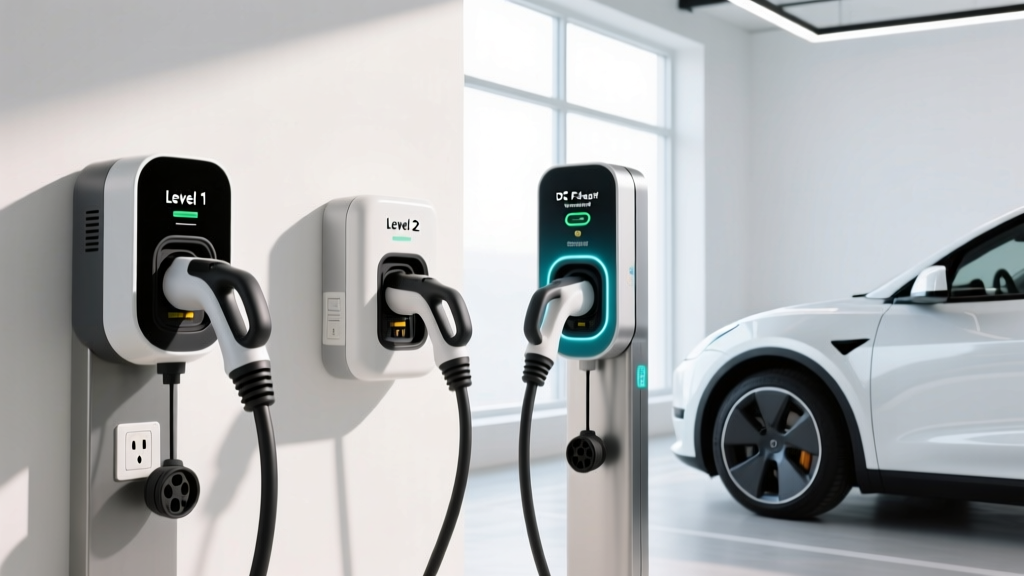
| Level | Voltage | Typical kW | Miles of Range Added per Hour | Best For |
|---|---|---|---|---|
| Level 1 | 120V AC | 1.0–1.9 kW | 3–5 miles | Overnight top-offs, PHEVs, emergencies |
| Level 2 | 240V AC | 3.3–19.2 kW | 12–75 miles | Daily home charging, workplace, destinations |
| DC Fast Charge | 400–900V DC | 50–400 kW | 150–1,000+ miles (peak) | Road trips, highway corridors, fleet depots |
The "miles per hour" column assumes roughly 3–4 miles per kWh of efficiency (typical for midsize EVs like the Tesla Model Y or Hyundai Ioniq 5). Your actual mileage varies with vehicle weight, aerodynamics, and climate settings. And for DC fast charging, those peak rates only hold for a fraction of the session — more on charge-curve taper below.
Level 1 Charging: The Included-but-Slow Option
Every EV and PHEV sold in the U.S. ships with a Level 1 charging cable that plugs into a standard 120V household outlet (NEMA 5-15). At 12 amps continuous (the safe limit for a 15-amp circuit), you'll get about 1.4 kW, translating to roughly 4 miles of range per hour.
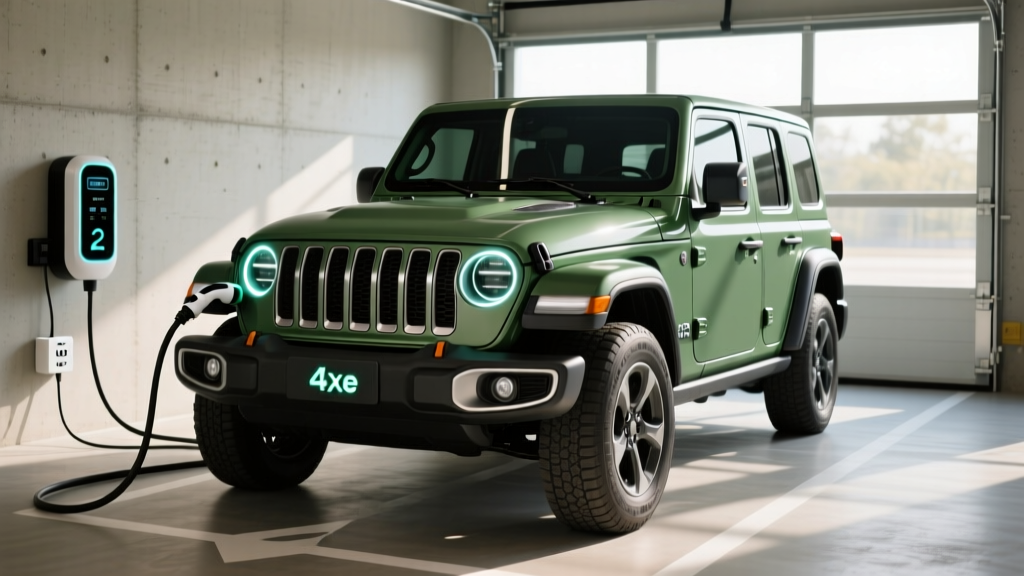
For a plug-in hybrid with 30–40 miles of electric range (say, the Toyota RAV4 Prime or Jeep Wrangler 4xe), Level 1 is perfectly adequate — a full overnight charge easily replenishes the battery. For a battery-electric vehicle with a 75–100 kWh pack, Level 1 is an emergency trickle. Charging a Ford F-150 Lightning extended-range from 10% to 80% on Level 1 would take roughly 70+ hours. It exists as a safety net, not a strategy.
When Level 1 makes sense: PHEV owners with short commutes, apartment dwellers without Level 2 access who can plug in overnight, and as a backup cable to keep in the frunk.
Level 2 Charging: The Home and Workplace Standard
Level 2 charging operates at 240V — the same voltage as your electric dryer or oven — and delivers between 3.3 kW and 19.2 kW depending on the charger's amperage and your EV's onboard charger capacity. This is the tier that makes EV ownership genuinely convenient: plug in when you get home, wake up to a full battery every morning.
Most residential Level 2 chargers run at 40 amps (9.6 kW) or 48 amps (11.5 kW) on a dedicated 50-amp or 60-amp circuit, respectively. At 11.5 kW, a typical EV gains about 35–44 miles of range per hour. An overnight session of 8–10 hours easily adds 250+ miles — more than enough to refill even large-battery EVs like the Rivian R1S or BMW iX.
Here's the catch: your EV's onboard charger caps how much AC power it can accept. The Chevrolet Equinox EV, for example, has an 11.5 kW onboard charger, so a 48-amp station is a perfect match. The Nissan Ariya's onboard charger tops out at 7.2 kW, meaning even a 48-amp station will only deliver 7.2 kW to the battery. Always check your vehicle's onboard charger spec before overspending on a high-amperage wall unit.
Real-World Level 2 Charging Times (10%–80%)
| Vehicle (Battery Size) | Onboard Charger | 48A Station (11.5 kW) | 32A Station (7.7 kW) |
|---|---|---|---|
| Tesla Model Y LR (75 kWh usable) | 11.5 kW | ~4.5 hours | ~6.8 hours |
| Hyundai Ioniq 5 (77.4 kWh) | 10.9 kW | ~5 hours | ~7 hours |
| Ford F-150 Lightning Ext. (131 kWh) | 19.2 kW | ~5 hours (at 80A) | ~12 hours |
| Chevrolet Bolt EV (65 kWh) | 11.5 kW | ~4 hours | ~6 hours |
The 10%–80% window matters because lithium-ion batteries charge fastest in the middle of their state-of-charge (SoC) range. Above ~80%, the battery management system tapers current to protect cell health — the same principle applies to DC fast charging, just more dramatically.
DC Fast Charging: Road-Trip Speeds with Real-World Caveats
DC fast chargers bypass your EV's onboard charger entirely, sending direct current straight to the battery at high voltage and high power. In 2026, public DC fast chargers range from legacy 50 kW units to cutting-edge 350–400 kW stations from Electrify America, EVgo, and Tesla Superchargers.
Peak speeds are genuinely impressive. A Hyundai Ioniq 5 on a 350 kW charger can add 10%–80% in roughly 18 minutes, thanks to its 800V battery architecture. The Tesla Model Y on a V3 Supercharger (250 kW peak) does the same in about 25–28 minutes. The Porsche Taycan and Kia EV6 also use 800V systems for similarly fast sessions.
But here's what the marketing brochures bury: peak kW is not sustained kW. A charger rated for 250 kW might deliver that rate only between 10%–30% SoC, then step down to 150 kW, then 100 kW, then 50 kW as the battery fills. The actual session average for a 10%–80% charge is typically 60–70% of the advertised peak. This "charge curve taper" is why we always report 10%–80% times, not peak kW figures, as the meaningful metric.
Cold-weather reality check: Below about 40°F, lithium-ion batteries resist accepting charge quickly. Without preconditioning (warming the battery before you arrive at the charger), a 150 kW session might start at 40–50 kW until the cells warm up. Most modern EVs — Teslas, Hyundai/Kia E-GMP vehicles, GM Ultium-based models — automatically precondition the battery when you navigate to a charger. If yours doesn't, plan for sessions that are 30–50% longer in winter.
Connector Compatibility: NACS, CCS, and CHAdeMO in 2026
The connector landscape has consolidated significantly since Ford, GM, Rivian, Volvo, and nearly every other major automaker adopted Tesla's North American Charging Standard (NACS) starting in the 2025–2026 model years. Here's where things stand:
| Connector | Brands Using It (Built-In) | Public Network Access |
|---|---|---|
| NACS (Tesla standard) | Tesla, Ford, GM, Rivian, Volvo, Polestar, Mercedes, BMW, Hyundai (2026+) | Tesla Supercharger (native), Electrify America, EVgo (NACS stalls expanding) |
| CCS1 | Hyundai/Kia (2025 and earlier), VW ID.4 (2025 and earlier), Stellantis, legacy EVs | Electrify America, EVgo, ChargePoint, most non-Tesla networks |
| CHAdeMO | Nissan Leaf (all years), Mitsubishi Outlander PHEV | Limited — most networks have phased out CHAdeMO connectors |
Adapter reality: If you drive a CCS1-equipped EV (2025 model year or earlier from most brands), you'll likely need a CCS-to-NACS adapter (roughly $200–$300) to access Tesla Superchargers, which now welcome non-Tesla vehicles at many locations. Ford and Rivian provide these adapters to owners. Hyundai began shipping adapters with 2025 Ioniq 5 models. Check with your dealer before purchasing one — you may already have access to a free or discounted unit.
CHAdeMO is effectively a legacy connector in North America. Nissan switched the Ariya to CCS, and new public chargers rarely include CHAdeMO cables. Leaf owners can still charge at home (Level 2 uses the universal J1772 connector) and at older public stations, but road-trip flexibility is increasingly limited.
Home Charger Installation: Electrical Requirements and True Costs
Installing a Level 2 home charger is straightforward if your electrical panel has capacity — and potentially expensive if it doesn't. Here's what the process actually involves.
Electrical Requirements
A 48-amp Level 2 charger requires a dedicated 60-amp, 240V circuit (the National Electrical Code requires circuits to be rated at 125% of continuous load, so 48A × 1.25 = 60A). The charger must be hardwired or connected via a NEMA 14-60 outlet. A licensed electrician will run appropriately gauged wire (typically 6 AWG copper for runs under 50 feet) from your panel to the charger location.
Panel capacity is the wildcard. Most modern homes have 200-amp service panels, which can usually accommodate a 60-amp EV circuit alongside existing loads. Older homes with 100-amp panels may need a panel upgrade to 200 amps — a $2,000–$4,000 job on its own. Some utilities and municipalities now allow "load management" devices that let you add an EV circuit without a panel upgrade by throttling the charger when other heavy loads (AC, electric oven) are running. Ask your electrician about this option.
Permits are required in nearly every U.S. jurisdiction for new 240V circuits. Your electrician typically pulls the permit and schedules the inspection. Permit fees range from $50 to $300 depending on your municipality. Never skip the permit — it protects you from liability, ensures code compliance, and is required for most homeowner's insurance policies to cover electrical fires.
| Component | Cost Range | Notes |
|---|---|---|
| Level 2 Charger (Equipment) | $350 – $750 | 40A–48A smart Wi-Fi charger |
| Electrician Labor (standard install) | $600 – $1,800 | Depends on wire run length, wall type, conduit needs |
| Electrical Permit | $50 – $300 | Varies by municipality |
| Panel Upgrade (if needed) | $2,000 – $4,000 | 100A → 200A service; ~20% of homes need this |
| Total (No Panel Upgrade) | $1,000 – $2,850 | Most common scenario for homes built after 2000 |
| Total (With Panel Upgrade) | $3,000 – $6,850 | Older homes with 100A service |
Federal Tax Credit for Home Charging Equipment
The IRS §30C Alternative Fuel Vehicle Refueling Property Credit covers 30% of home charger equipment and installation costs, up to $1,000. Eligibility depends on your census tract meeting certain low-income or rural criteria — not all ZIP codes qualify. Check the IRS guidance or consult a tax professional before counting on this credit. As with the §30D vehicle credit, tax rules are subject to legislative change.
Charging Cost per Mile: EV vs. Gas in Real Dollars
The cheapest electron is the one you use at home on a time-of-use (TOU) rate. The most expensive is the one you buy at a DC fast charger on the highway. Here's how the math breaks down:
| Scenario | Rate ($/kWh) | Cost per Mile* |
|---|---|---|
| Home (off-peak TOU rate) | $0.08 – $0.14 | $0.024 – $0.042 |
| Home (flat/standard rate) | $0.13 – $0.20 | $0.039 – $0.060 |
| Public Level 2 (workplace, destination) | $0.20 – $0.40 | $0.060 – $0.120 |
| DC Fast Charging (highway) | $0.35 – $0.65 | $0.105 – $0.195 |
| Gas vehicle (28 MPG combined, $3.40/gal) | — | $0.121 |
| Gas vehicle (22 MPG combined, $3.40/gal) | — | $0.155 |
*Assumes 3.3 miles per kWh (midsize EV average). Source: fueleconomy.gov efficiency data.
The takeaway: home charging on off-peak rates is 3–5× cheaper per mile than gasoline. Even DC fast charging on the highway is roughly cost-competitive with a 28 MPG gas car at $3.40/gallon. The EV cost advantage shrinks if you rely exclusively on public DC fast chargers at $0.50+/kWh — a scenario that applies mainly to apartment dwellers without home charging access.
For a concrete annual comparison: driving 12,000 miles per year at 3.3 mi/kWh with home off-peak charging at $0.11/kWh costs about $400/year. The same miles in a 25 MPG gas car at $3.40/gallon costs about $1,632/year. That's $1,200+ in annual fuel savings, which typically offsets the higher purchase price of an EV within 3–5 years even before factoring in reduced maintenance.
Equipment Recommendations: Which Home Charger to Buy
Not all Level 2 chargers are created equal. After testing dozens of units, here are the categories that matter: power output (must match your circuit and EV's onboard charger), cable length (25 feet is the minimum for most garages), smart features (Wi-Fi scheduling, TOU rate optimization, energy monitoring), and build quality (outdoor NEMA 4 rating if installed outside).
Best Overall: ChargePoint Home Flex
- Power: Up to 12 kW (50A), configurable from 16A–50A to match your circuit
- Connector: J1772 (NACS version available for 2026+ EVs)
- Cable: 23 feet
- Smart features: Wi-Fi, app scheduling, Alexa/Google integration, energy reports
- Price: ~$550
- Best for: Flexible amperage for older panels, reliable app
Best for Tesla & NACS Owners: Tesla Wall Connector
- Power: Up to 11.5 kW (48A)
- Connector: NACS native (also includes J1772 adapter in 2026 kit)
- Cable: 24 feet
- Smart features: Wi-Fi updates, power sharing (link two units on one circuit), Tesla app integration
- Price: ~$475
- Best for: Tesla and NACS-equipped Ford/GM/Rivian owners who want native plug compatibility
Best Budget Pick: Emporia Level 2 EV Charger
- Power: Up to 11.5 kW (48A)
- Connector: J1772
- Cable: 24 feet
- Smart features: Wi-Fi, solar integration, TOU scheduling, energy monitoring via Emporia Vue panel
- Price: ~$399
- Best for: Budget-conscious buyers, solar-panel owners who want integrated energy tracking
Best for High-Power Needs: Grizzl-E Smart
- Power: Up to 19.2 kW (80A) — requires 100A circuit
- Connector: J1772 or NACS
- Cable: 24 feet
- Smart features: Wi-Fi, OCPP compatibility, adjustable amperage
- Price: ~$699
- Best for: Ford F-150 Lightning owners (19.2 kW onboard charger), dual-EV households
Safety, Code, and Installation Best Practices
Level 2 charging involves continuous high-current draw for hours at a time — longer than almost any other household appliance. This makes proper installation non-negotiable.
- Dedicated circuit: Your EV charger must be on its own dedicated breaker — never shared with other outlets or appliances. A 48A charger needs a 60A breaker; a 40A charger needs a 50A breaker.
- GFCI protection: The 2023 NEC (National Electrical Code) requires GFCI (ground-fault circuit interrupter) protection for all EV charging outlets. Hardwired chargers typically have built-in ground-fault protection. If you're installing a receptacle (NEMA 14-60), your electrician must use a GFCI breaker — these cost $50–$100 more than standard breakers.
- Outdoor rating: If your charger is installed outside (driveway, carport), it must carry a NEMA 4 or NEMA 4X rating for weather resistance. All chargers recommended above meet this standard.
- Wire gauge: Undersized wire causes overheating and fire risk. For a 60A circuit, 6 AWG copper is standard for runs under 50 feet; longer runs may require 4 AWG to prevent voltage drop. Your electrician will calculate this based on your specific layout.
- Permit and inspection: As noted above, every jurisdiction requires a permit for new 240V circuits. The inspection verifies wire gauge, breaker sizing, grounding, and GFCI compliance. Skipping this step can void your homeowner's insurance and create a resale-title issue.
One more note: if you're installing a NEMA 14-60 outlet (rather than hardwiring), do not use a dryer outlet adapter from an online marketplace. Dryer outlets in older homes may have degraded wiring, shared circuits, or inadequate grounding. Have your electrician inspect any existing 240V outlet before using it for EV charging.
Frequently Asked Questions
How much does it cost to install a home EV charger?
A standard Level 2 installation (48A charger, 60A circuit, no panel upgrade) typically costs $1,000–$2,850 including equipment, electrician labor, and permit fees. If your home has a 100-amp electrical panel that needs upgrading to 200 amps, add $2,000–$4,000. Get at least three quotes from licensed electricians — prices vary significantly based on wire run length and local labor rates. The IRS §30C credit may offset up to $1,000 (30% of costs) if your census tract qualifies.
How fast will each charging level add range?
Level 1 (120V): about 3–5 miles per hour. Level 2 (240V, 48A): about 35–44 miles per hour for a typical EV. DC Fast Charging: 150–1,000+ miles per hour at peak, but sustained averages are 60–70% of peak due to charge-curve taper. A 10%–80% DC fast charge session typically takes 18–35 minutes depending on your vehicle's architecture and the charger's power output.
Which connector and charger is compatible with my EV?
For Level 2 home charging, all EVs use the J1772 connector (or NACS, which is backward-compatible with J1772 via adapter on most 2026 chargers). For DC fast charging, check your vehicle: 2026 model-year vehicles from Tesla, Ford, GM, Rivian, Volvo, and BMW use NACS. Older models from Hyundai, Kia, and VW use CCS1. Nissan Leaf uses CHAdeMO. Adapters are available for cross-compatibility at most networks.
How much does charging cost per mile compared to gas?
Home charging on off-peak electricity ($0.11/kWh average) costs roughly $0.033 per mile — about 4× cheaper than a 25 MPG gas car at $3.40/gallon ($0.136/mile). Even public DC fast charging at $0.48/kWh works out to ~$0.145/mile, roughly matching a fuel-efficient gas car. The savings are largest for homeowners with access to time-of-use rates who charge overnight.
What electrical upgrades might I need?
The most common upgrade is a panel capacity increase from 100A to 200A service, needed in roughly 20% of homes (typically those built before 1990). Other potential upgrades include: replacing a Federal Pacific or Zinsco panel (known fire hazards, insurance companies often require replacement), adding a sub-panel if your main panel is full, or installing a load-management device to avoid a full panel upgrade. Your electrician's initial assessment (usually free or $100–$200) will identify what's needed.
Can I charge my EV from a regular household outlet?
Yes — that's Level 1 charging, and it adds about 3–5 miles of range per hour. It's adequate for PHEVs with small batteries (30–40 mile electric range) and for emergency top-offs on full EVs. For daily BEV use, Level 1 is impractically slow. Plan for Level 2 as your primary home charging solution.
Is DC fast charging bad for my battery?
Occasional DC fast charging has minimal impact on battery health. Frequent daily DC fast charging (especially at high power and in hot climates) can accelerate degradation slightly — studies show roughly 2–5% additional capacity loss over 100,000 miles compared to exclusive Level 2 charging. Modern battery management systems actively protect against this by throttling charge rates when cells are too hot or too cold. For daily use, Level 2 at home is ideal; use DC fast charging for road trips without concern.