Shopping for an EV charger or planning your first road trip? The phrase "types of charging stations" covers a wide spectrum — from the standard 120V wall outlet in your garage to 350 kW highway chargers that can add 200 miles of range in 15 minutes. Understanding the differences in power output, connector compatibility, and cost is essential before you spend a dollar on equipment or installation.
This guide breaks down every charging level with exact numbers: kilowatts (kW) delivered, miles of range added per hour, 10–80% charge times for common battery sizes, and the real cost to install and operate each type. We also cover the connector landscape as of 2026, where the North American Charging Standard (NACS) has largely unified the market but legacy CCS1 and CHAdeMO vehicles still need attention.
The Three Levels of EV Charging: Speed, Power, and Use Case
EV charging is categorized into three levels based on voltage and power delivery. The critical distinction to keep straight: kW (kilowatts) measures the rate of power delivery — how fast energy flows into your battery. kWh (kilowatt-hours) measures total energy stored — the size of your battery. Think of kW as the width of the pipe and kWh as the size of the tank.
| Level | Voltage | Max Power (kW) | Miles of Range Added/Hour | Typical Use Case | 10–80% Time (75 kWh Battery) |
|---|---|---|---|---|---|
| Level 1 | 120V AC | 1.4–1.9 kW | 3–5 mi/hr | Overnight top-off, PHEVs, emergencies | ~37+ hours |
| Level 2 | 240V AC | 3.3–19.2 kW | 12–75 mi/hr | Home daily charging, workplace, destinations | 3–12 hours (depends on kW) |
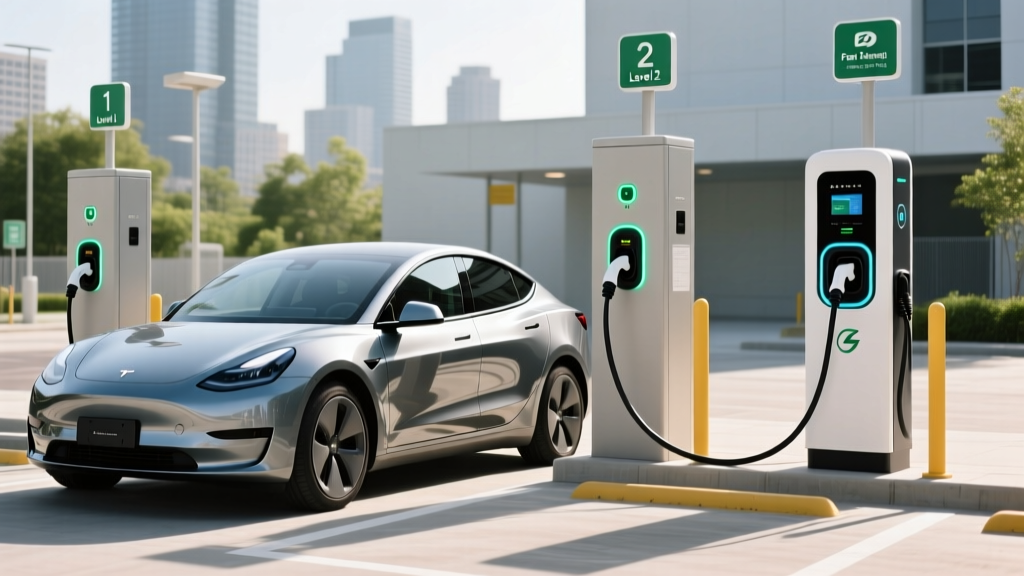
| DC Fast Charge (DCFC) | 400–800V DC | 50–350 kW | 150–1,200+ mi/hr (peak) | Road trips, highway corridors, fleet depots | 12–45 minutes (varies widely) |
A few real-world caveats on those numbers: Level 1 at 120V/12A delivers about 1.4 kW continuously, but a 120V/16A circuit can push ~1.9 kW. Level 2 speeds depend on both the charger and your vehicle's onboard charger — a 19.2 kW wall connector won't charge a car with an 11.5 kW onboard charger any faster than 11.5 kW. DC fast charging speeds are governed by the vehicle's charge curve: peak kW is typically available only between roughly 10–50% state of charge (SoC), then tapers significantly above 80% to protect battery health.
Level 1 Charging: The Outlet You Already Have
Every EV sold in the US ships with a portable cord that plugs into a standard 120V household outlet (NEMA 5-15). This is Level 1 charging. At 1.4 kW (12 amps on a 15-amp circuit), you'll recover about 3–5 miles of range per hour of charging, depending on vehicle efficiency. For a plug-in hybrid like the Toyota RAV4 Prime with 42 miles of electric range, a full overnight charge is easily achievable. For a long-range BEV with a 75–100 kWh battery, Level 1 is impractical as a primary strategy — a full charge could take 50+ hours.
When Level 1 makes sense: PHEV owners with small batteries (10–20 kWh), BEV owners who drive fewer than 30 miles per day and can top off over 10–12 hours nightly, or anyone in a rental or apartment where installing a 240V circuit isn't possible.
Cost: $0 for equipment if your vehicle includes the cord (some no longer do — Tesla dropped the included Mobile Connector in 2022 but has since resumed including a basic cord). Replacement cords run $200–$400. No electrician needed if you have a dedicated 15A or 20A outlet near your parking spot.
Level 2 Charging: The Home Standard for Daily Driving
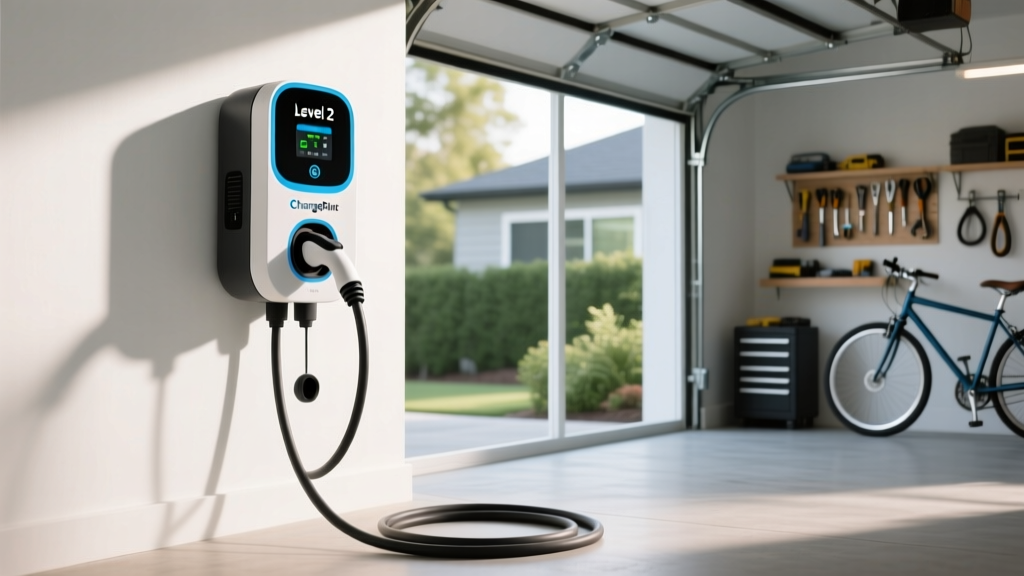
Level 2 operates at 240V — the same voltage as your electric dryer or oven — and is the practical backbone of home EV ownership. Most BEV owners consider a Level 2 home charger essential. At 48 amps (11.5 kW), a typical Level 2 setup adds roughly 35–45 miles of range per hour, meaning a 75 kWh battery charges from 10–80% in about 5–6 hours. Hardwired units on a 60A circuit can deliver up to 19.2 kW (80A), though few vehicles accept that full rate.
The onboard charger inside your vehicle is the bottleneck: the Ford F-150 Lightning accepts up to 19.2 kW AC, while the Hyundai Ioniq 5 is limited to 10.9 kW AC on Level 2. Always match your charger's output to your car's acceptance rate — overspending on a 19.2 kW unit for a car that maxes at 11.5 kW wastes money without adding speed.
Electrical Requirements for Home Level 2 Installation
A Level 2 charger requires a dedicated 240V circuit. The most common setup is a 240V/48A circuit on a 60-amp breaker (National Electrical Code requires continuous loads to be derated to 80% of breaker capacity, so a 60A breaker supports 48A continuous). Here's what your electrician will evaluate:
- Panel capacity: Your main electrical panel must have enough spare amperage to support the new circuit. A 200A panel with existing heavy loads (electric heat, dryer, range) may be too tight for a 60A EV circuit. A panel upgrade to 200A or adding a subpanel costs $1,500–$3,500.
- Plug-in vs. hardwired: A NEMA 14-50 receptacle allows portable chargers and easy replacement. Hardwired units avoid the outlet cost and are required above 48A (NEC does not permit plug-in connections above 48A on a 60A breaker without specific connectors). Many jurisdictions now require GFCI protection on 14-50 receptacles, which can cause nuisance tripping with some chargers — hardwired avoids this issue entirely.
- Permit: Most municipalities require an electrical permit for a new 240V circuit. Permit fees range from $50–$250 depending on jurisdiction. The work must pass inspection.
- Wire run length: Longer runs from panel to charger location require thicker (more expensive) copper wire. A 50-foot run of 6 AWG copper costs significantly more than a 10-foot run. Some installers use aluminum wire for cost savings on longer runs.
| Component | Cost Range | Notes |
|---|---|---|
| Level 2 charger (equipment) | $300–$750 | Varies by brand, power, smart features |
| Electrician labor (standard install) | $500–$1,500 | Short wire run, same wall as panel |
| Electrician labor (complex install) | $1,500–$3,000+ | Long wire run, conduit, trenching, subpanel |
| Electrical permit | $50–$250 | Varies by municipality |
| Panel upgrade (if needed) | $1,500–$3,500 | Upgrading from 100A to 200A service |
| Total (standard install, no panel upgrade) | $850–$2,500 | Most homeowners land in this range |
| Total (complex install + panel upgrade) | $3,000–$6,500+ | Older homes, long runs, service upgrades |
The IRS §30D tax credit does not cover home charging equipment for most buyers in 2026. The separate §30C Alternative Fuel Infrastructure Tax Credit expired for residential installations at the end of 2014 and was not reinstated for home charger purchases under current law. Some states and utilities offer rebates — check your local utility's EV program page and the DOE's Alternative Fuels Data Center for state-specific incentives.
DC Fast Charging: Road-Trip Speeds and the Charge Curve Reality
DC fast chargers (DCFC) bypass your vehicle's onboard charger and deliver direct current straight to the battery at 400–800 volts and 50–350 kW. These are the chargers you use on road trips, located along highways, at rest stops, and increasingly at retail locations. A 350 kW charger can add 100+ miles of range in 10 minutes to a compatible vehicle.
But peak kW is not sustained kW. Here's what actually happens during a DC fast charging session:
- 10–50% SoC: The vehicle accepts near-peak power. An Ioniq 5 on a 350 kW charger pulls ~230 kW here.
- 50–70% SoC: Power begins tapering. The same Ioniq 5 may drop to ~150 kW.
- 70–80% SoC: Steeper taper. Perhaps 80–100 kW.
- 80–100% SoC: Dramatic slowdown. Below 50 kW, sometimes under 20 kW near 100%. This is why road-trip strategy focuses on 10–80% charges.
Vehicles with 800V battery architectures (Hyundai Ioniq 5/6, Kia EV6/EV9, Porsche Taycan, Audi e-tron GT) sustain higher charge rates longer than 400V platforms. The Ioniq 5's 10–80% time on a 350 kW charger is approximately 18 minutes; a 400V vehicle like the Chevrolet Equinox EV on the same charger takes closer to 28–32 minutes for 10–80%.
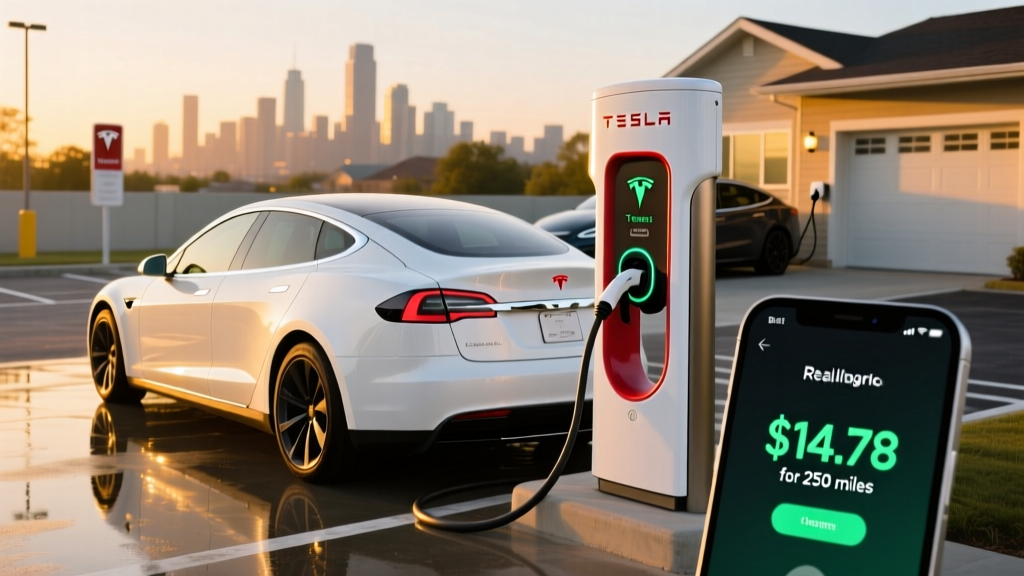
Where to find DC fast chargers: The major US networks in 2026 include Tesla Superchargers (now open to non-Tesla vehicles with NACS connectors via the Magic Dock adapter at select stalls), Electrify America, EVgo, ChargePoint, and Blink. Reliability varies — Electrify America and Tesla Superchargers consistently report the highest uptime rates (90–97%), while smaller networks can struggle with maintenance.
Connector Compatibility: NACS, CCS1, and CHAdeMO in 2026
The connector landscape has consolidated significantly since Ford, GM, Rivian, and most major automakers adopted the North American Charging Standard (NACS) — originally Tesla's proprietary connector — starting in 2024–2025. Here's where things stand for new vehicles in 2026:
| Connector | Brands Using It | DC Fast Charge Access | Adapter Needed? |
|---|---|---|---|
| NACS (native) | Tesla, Ford, GM, Rivian, Volvo, Polestar, Mercedes-Benz, Nissan (Ariana), Hyundai/Kia (select 2026+ models), Lucid, Fisker | Tesla Supercharger network + NACS-equipped public stations | No adapter for Superchargers; CCS adapter may be needed for legacy Electrify America stations |
| CCS1 | Hyundai/Kia (2025 and earlier), Volkswagen ID.4 (pre-2026), BMW i4/iX, Stellantis brands, remaining legacy models | Electrify America, EVgo, ChargePoint, and other CCS networks | NACS-to-CCS adapter needed for Tesla Supercharger access (available from Ford, GM, Rivian, and third parties ~$200–$250) |
| CHAdeMO | Nissan Leaf (discontinued after 2025), Mitsubishi Outlander PHEV (older model years) | Limited and shrinking network | No adapter widely available; CHAdeMO infrastructure is declining |
Practical advice: If you're buying a new EV in 2026, prioritize a NACS-equipped vehicle for the broadest charging access. If you own a CCS1 vehicle, invest in a NACS-to-CCS adapter to unlock Tesla Supercharger access — the Supercharger network has over 25,000 stalls in North America and remains the most reliable DC fast charging infrastructure. CHAdeMO owners face a shrinking network and should plan road trips carefully around Electrify America and EVgo stations that still maintain CHAdeMO connectors.
Cost to Charge: Home vs. Public vs. Gas Comparison
One of the strongest arguments for EV ownership is lower fueling cost — but the savings depend heavily on where you charge. Electricity rates vary enormously by region, time of day, and utility plan.
| Scenario | Rate ($/kWh) | Cost to Charge 75 kWh Battery | Cost Per Mile (at 3 mi/kWh) | Equivalent Gas Price at 30 MPG |
|---|---|---|---|---|
| Home, off-peak utility rate | $0.08–$0.12 | $6.00–$9.00 | $0.027–$0.040 | $0.80–$1.20/gallon |
| Home, average US rate | $0.16–$0.20 | $12.00–$15.00 | $0.053–$0.067 | $1.60–$2.00/gallon |
| Home, high-cost state (CA, HI, MA) | $0.25–$0.40 | $18.75–$30.00 | $0.083–$0.133 | $2.50–$4.00/gallon |
| Public Level 2 (workplace, retail) | $0.20–$0.49 | $15.00–$36.75 | $0.067–$0.123 | $2.00–$3.70/gallon |
| DC fast charge ( Electrify America, EVgo) | $0.35–$0.65 | $26.25–$48.75 | $0.117–$0.163 | $3.50–$4.90/gallon |
| Tesla Supercharger (varies by location) | $0.25–$0.45 | $18.75–$33.75 | $0.083–$0.113 | $2.50–$3.40/gallon |
| Gasoline baseline: $3.30/gallon national average (2026), 30 MPG combined = $0.110/mile | ||||
The takeaway: home charging on an off-peak or time-of-use plan delivers the most dramatic savings, effectively cutting fuel cost to one-third or less of gasoline. DC fast charging on road trips is more expensive and can approach or slightly exceed gasoline cost per mile in high-rate states. Most EV owners do 80–90% of their charging at home, so the blended real-world cost per mile typically lands well below gas.
Pro tip: Many utilities offer EV-specific time-of-use (TOU) plans that provide rates as low as $0.06–$0.09/kWh during overnight hours (typically 10 PM – 6 AM). Setting your charger to schedule charging during these windows maximizes savings. Check with your utility about EV rate plans before installing your charger.
Recommended Level 2 Home Chargers (2026)
These are the wall connectors we recommend based on reliability, features, connector type, and value. All are UL-listed and suitable for indoor or outdoor installation.
Tesla Wall Connector (Gen 4)
- Power output: Up to 11.5 kW (48A on a 60A circuit)
- Connector: NACS native
- Cable length: 24 feet
- Smart features: Wi-Fi, OTA updates, power sharing (load balance up to 6 units on one circuit), access control, energy tracking via Tesla app
- Price: ~$425
- Best for: Tesla owners and any NACS-equipped vehicle. The best value in Level 2 hardware.
ChargePoint Home Flex (2nd Gen)
- Power output: Up to 12 kW (50A on a 60A circuit) — adjustable from 16A to 50A via dip switches to match your circuit
- Connector: NACS (2026 model); CCS1 available on older stock
- Cable length: 23 feet
- Smart features: Wi-Fi, ChargePoint app scheduling, Alexa integration, energy reports, flexible amperage
- Price: ~$550–$650
- Best for: Non-Tesla EV owners wanting a feature-rich smart charger with adjustable amperage for panel-limited homes.
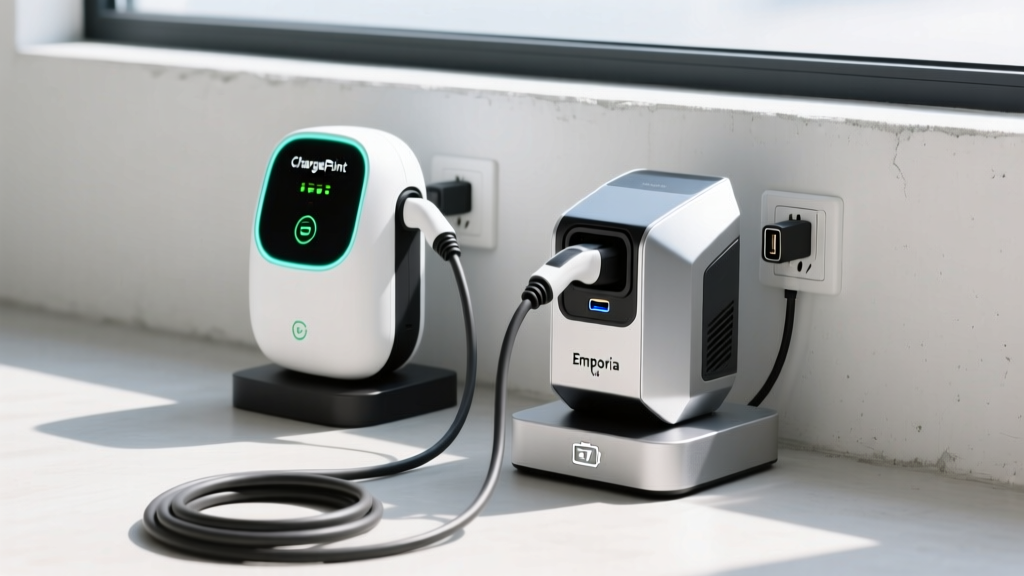
Emporia Vue Smart EV Charger
- Power output: Up to 11.5 kW (48A on a 60A circuit)
- Connector: NACS (2026 version)
- Cable length: 24 feet
- Smart features: Wi-Fi, integration with Emporia Vue energy monitor for whole-home load management, solar-aware charging, scheduling, energy cost tracking
- Price: ~$400
- Best for: Homes with solar panels or Emporia energy monitoring. Excellent budget option with full smart features.
FLO Home X5
- Power output: Up to 11.5 kW (48A on a 60A circuit)
- Connector: J1772 (CCS1-compatible) with NACS adapter available; NACS native version shipping 2026
- Cable length: 25 feet
- Smart features: Wi-Fi, FLO app, robust build quality rated for -40°F to 122°F, 3-year warranty
- Price: ~$600–$700
- Best for: Cold-climate installations and Canadian buyers. FLO's network integration is strong in fleet and commercial settings.
All four units above support plug-in (NEMA 14-50) or hardwired installation. We recommend hardwired for any unit delivering over 40A to avoid GFCI nuisance-trip issues that some jurisdictions now require on 14-50 receptacles. Hardwired installations also simplify inspection in many municipalities.
Safety, Code, and Installation Best Practices
EV charging is a high-draw, continuous electrical load that runs for hours — often unattended overnight. Proper installation is non-negotiable. Here's what to verify with your electrician:
- Dedicated circuit: Your Level 2 charger must be on its own dedicated breaker — no sharing with other appliances or outlets.
- Correct wire gauge: 6 AWG copper for 48A/60A circuits; 4 AWG for 64A/80A circuits. Aluminum wire is acceptable if sized appropriately (typically two gauges larger than copper equivalent).
- GFCI protection: NEC 2023 (and adopted in most 2026 jurisdictions) requires GFCI protection for 14-50 receptacles in garages. Many EV charger manufacturers recommend hardwired installation to avoid GFCI breaker nuisance trips, which are a documented issue with some charger/breaker combinations.
- Outdoor rating: If installing outside, the charger must carry a NEMA 4 or NEMA 4X rating for weather resistance. All four chargers recommended above are outdoor-rated.
- Load calculation: Your electrician should perform a NEC Article 220 load calculation on your panel to confirm the new circuit doesn't exceed 80% of your service capacity. If it does, a panel upgrade or a smart load-management device (like the Emporia Smart Load Center or Tesla Power Sharing) can avoid the upgrade cost.
- Permit and inspection: Always pull a permit. Unpermitted electrical work can void homeowner's insurance and create fire/liability risk. The inspection ensures the work meets code.
Frequently Asked Questions
How much does it cost to install a home EV charger?
A standard Level 2 installation with a short wire run and no panel upgrade typically costs $850–$2,500 total (equipment + electrician + permit). Complex installations with long wire runs, conduit, trenching, or a panel upgrade can reach $3,000–$6,500+. Get at least three quotes from licensed electricians and confirm they have EV charger installation experience.
How fast will each charging level add range?
Level 1 (120V): 3–5 miles per hour. Level 2 (240V, 48A): 30–45 miles per hour depending on vehicle efficiency. DC fast charging: effectively 150–1,200+ miles per hour at peak, but real sessions are measured in minutes (10–80% in 18–45 minutes) because you don't charge to 100% on the road.
Which connector is compatible with my EV?
Check your vehicle's charge port. Most new 2026 models from Ford, GM, Rivian, Tesla, Volvo, and others use NACS. Older or carryover models from Hyundai, Kia, VW, and BMW may still use CCS1. The Nissan Leaf (discontinued after 2025) used CHAdeMO. For public DC fast charging, NACS vehicles have the broadest access in 2026 thanks to the Supercharger network opening to all NACS-equipped vehicles.
How much does charging cost per mile vs. gas?
Home charging on an average US electricity rate ($0.16/kWh) costs about $0.053/mile in a vehicle averaging 3 mi/kWh — roughly half the cost of gasoline at $3.30/gallon and 30 MPG ($0.11/mile). Off-peak home rates can drop that to $0.03/mile. DC fast charging on road trips costs $0.10–$0.16/mile, which is comparable to or slightly above gas but represents a small share of total charging for most owners.
What electrical upgrades might I need?
The most common upgrade is a panel capacity increase from 100A to 200A service, costing $1,500–$3,500. Homes with existing 200A panels and moderate electrical loads usually have headroom for a 60A EV circuit. If your panel is maxed out, alternatives include a smart load-management device that throttles the charger when other appliances draw heavily, or a dedicated subpanel. Your electrician's load calculation will determine what's needed.
Can I charge my EV with solar panels?
Yes. If you have rooftop solar, excess daytime generation can offset your EV charging cost entirely. Smart chargers like the Emporia Vue charger or the Wallbox Pulsar Plus offer solar-aware modes that automatically adjust charge rate to match available solar production, maximizing self-consumption and minimizing grid draw.