From Engine Boost to Battery Boost: What "Supercharger" Really Means Today
If you've spent any time around internal-combustion performance cars, you know the appeal of a turbocompresor supercharger setup — forcing more air into the cylinders to extract more power from every drop of fuel. But in 2026, the word "supercharger" carries a second, increasingly dominant meaning: Tesla's Supercharger network and, more broadly, the entire ecosystem of DC fast charging that keeps electric vehicles moving on road trips.
This guide bridges both worlds. We'll explain exactly how EV charging levels work — from a standard 120V wall outlet to 350 kW DC fast chargers — and show you the math on installation costs, charging speeds, connector compatibility, and per-mile energy costs compared to gasoline. Whether you're cross-shopping a turbocharged gas car against an EV or simply need a no-nonsense home charging setup, the numbers below will tell you everything you need to know.
EV Charging Levels Explained: kW, Miles Per Hour, and Real-World Speeds
The single most important distinction in EV literacy is kW (kilowatts) versus kWh (kilowatt-hours). Think of kW as the flow rate of water through a hose (power), and kWh as the total volume of water in the bucket (energy stored in your battery). A 77 kWh battery charged at 11 kW takes roughly 7 hours; that same battery at 150 kW DC fast charging can go from 10% to 80% in about 25 minutes. Never confuse the two.
| Level | Voltage / Phase | Typical Power (kW) | Miles of Range Added Per Hour | Best Use Case |
|---|---|---|---|---|
| Level 1 | 120V AC / Single | 1.2 – 1.9 kW | 3 – 5 mi/hr | Overnight top-off, PHEVs, low-mileage drivers |
| Level 2 | 240V AC / Single | 7.2 – 19.2 kW | 20 – 60+ mi/hr | Daily home & workplace charging |
| DC Fast (Level 3) | 400V–800V DC | 50 – 350 kW | 150 – 1,200+ mi/hr (peak) | Road trips, commercial fleets, quick top-ups |
Real-world caveat: DC fast charging speeds follow a charge curve. A vehicle rated for 250 kW peak may only sustain that rate between 10%–40% State of Charge (SoC), then taper to 150 kW, then 80 kW, and finally trickle below 30 kW above 90%. That's why manufacturers and the EPA quote 10–80% charging times rather than 0–100%. On a 350 kW Electrify America stall, a Hyundai Ioniq 5 (84 kWh battery, 800V architecture) can add 10–80% in roughly 18 minutes. A Tesla Model Y Long Range (~75 kWh usable, 400V) on a V4 Supercharger at 250 kW takes about 25 minutes for the same 10–80% session.
Home Level 2 Installation: Electrical Requirements, Panel Upgrades, and Total Cost
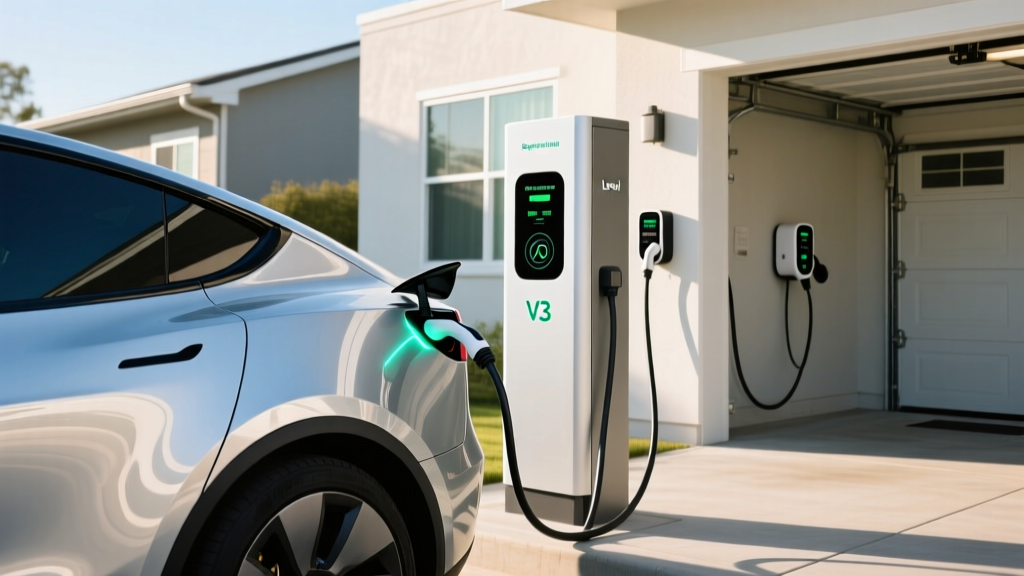
A Level 2 home charger is the backbone of practical EV ownership. Most EV owners do 80%–95% of their charging at home, so getting this right matters far more than any public network.
Electrical Requirements
A typical Level 2 installation requires a dedicated 240V circuit rated for 40A, 50A, or 60A, depending on the charger's maximum draw. The National Electrical Code (NEC) requires that continuous loads (like EV charging) not exceed 80% of the circuit breaker rating. That means:
- A 40A circuit supports up to 32A continuous (7.7 kW)
- A 50A circuit supports up to 40A continuous (9.6 kW)
- A 60A circuit supports up to 48A continuous (11.5 kW)
If your home's electrical panel is already near capacity — common in older homes with 100A service — you may need a panel upgrade to 200A, which adds significantly to the cost.
Installation Cost Breakdown
| Component | Low Estimate | High Estimate | Notes |
|---|---|---|---|
| Level 2 Charger (Equipment) | $350 | $750 | 32A–48A smart chargers; hardwired or NEMA 14-50 plug |
| Electrician Labor | $500 | $2,000 | Depends on run length from panel to garage/driveway |
| Permit & Inspection | $50 | $300 | Required in most jurisdictions; varies by city/county |
| Panel Upgrade (if needed) | $1,500 | $4,000 | 100A → 200A service upgrade; not always required |
| Conduit, Wiring, Misc. | $100 | $500 | THHN copper wire, PVC/metal conduit, junction boxes |
| Total (No Panel Upgrade) | $1,000 | $3,550 | Most homes with 200A service fall in $1,200–$2,200 |
| Total (With Panel Upgrade) | $2,500 | $7,550 | Older homes, long wire runs, or high-draw 48A+ setups |
Federal incentive note: The IRS §30C Alternative Fuel Vehicle Refueling Property Credit covers up to 30% of home charger equipment and installation costs, capped at $1,000. Eligibility depends on census-tract income and rural-area requirements — check the IRS guidelines or consult a tax professional, as rules are subject to legislative change.
Connector Compatibility: NACS, CCS1, and CHAdeMO in 2026
The connector landscape has consolidated dramatically. As of 2026, the North American Charging Standard (NACS) — originally Tesla's proprietary connector — has been adopted by Ford, GM, Rivian, Volvo, Hyundai, Kia, and most other major automakers for new vehicles. CCS1 remains on many 2022–2025 models still on the road, while CHAdeMO is effectively legacy (Nissan Leaf being the last major holdout).
| Connector | Brands Using It (New Vehicles) | Adapter Needed for Superchargers? |
|---|---|---|
| NACS (Tesla/J3400) | Tesla, Ford, GM, Rivian, Volvo, Polestar, Hyundai, Kia, Mercedes (select) | No — native NACS port |
| CCS1 | VW ID.4 (2022–2025), BMW iX (older), legacy models | Yes — CCS-to-NACS adapter ($150–$250) for Tesla Superchargers |
| CHAdeMO | Nissan Leaf (discontinued), Mitsubishi Outlander PHEV (older) | Limited adapter options; network shrinking |
Adapter reality check: If you own a CCS1-equipped EV from the 2023–2025 model years, most automakers now sell or include an official NACS adapter. Ford, for example, provides a complimentary adapter for F-150 Lightning and Mustang Mach-E owners. Third-party adapters exist but verify they're NHTSA-compliant and rated for the full amperage of the chargers you'll use. Never use an unrated adapter at a 250+ kW DC fast charger — thermal runaway risk is real.
Level 2 Home Charger Recommendations: Power, Features, and Price
Not all Level 2 chargers are equal. The critical specs are maximum amperage (which determines kW output), cable length (25 ft is the practical minimum for most garages), smart features (scheduling, energy monitoring, utility integration), and whether the unit is hardwired or plug-in (NEMA 14-50). Here are three proven picks for 2026:
Emporia Level 2 Smart Charger — Best Value
- Power: 48A / 11.5 kW (requires 60A circuit)
- Connector: J3400 (NACS) with CCS adapter included
- Cable: 24 ft
- Smart Features: Real-time energy monitoring, solar integration, scheduled charging, utility demand-response compatible
- Price: ~$400
- Install: Hardwired only — requires electrician
ChargePoint Home Flex — Best All-Rounder
- Power: Up to 50A / 12 kW (adjustable 16A–50A via dip switch)
- Connector: NACS (2026 model); CCS1 adapter available
- Cable: 23 ft
- Smart Features: Alexa/Google Home integration, app-based scheduling, flexible amperage for older panels
- Price: ~$550
- Install: NEMA 14-50 plug or hardwired
Tesla Wall Connector — Best for Tesla Owners
- Power: 48A / 11.5 kW (requires 60A circuit)
- Connector: Native NACS; J1772 adapter built in for non-Tesla guests
- Cable: 24 ft
- Smart Features: Wi-Fi updates, Power-Share (two units on one circuit), Tesla app integration
- Price: ~$475
- Install: Hardwired only
Cost Per Mile: EV Charging vs. Gasoline in 2026
The economic case for EVs hinges on fuel cost. Here's how home charging, public Level 2, and DC fast charging compare to a gasoline vehicle averaging 28 MPG combined at $3.40/gallon (2026 national average per fueleconomy.gov).
| Scenario | Rate | Vehicle Efficiency | Cost Per Mile |
|---|---|---|---|
| Home Level 2 (Off-Peak Utility Rate) | $0.09/kWh | 3.0 mi/kWh (100 MPGe) | $0.030/mi |
| Home Level 2 (National Avg. Residential) | $0.16/kWh | 3.0 mi/kWh | $0.053/mi |
| Public Level 2 (ChargePoint, EVgo) | $0.28/kWh | 3.0 mi/kWh | $0.093/mi |
| DC Fast Charging (Electrify America, Tesla) | $0.38/kWh | 3.0 mi/kWh | $0.127/mi |
| Gasoline Vehicle (28 MPG, $3.40/gal) | $3.40/gallon | 28 MPG | $0.121/mi |
The takeaway: Home charging at off-peak rates costs roughly one-quarter of gasoline per mile. Even DC fast charging at the most expensive public networks is now essentially at parity with gasoline — and that's the worst-case scenario for an EV. If you can charge at home, the fuel-cost advantage is overwhelming. A driver covering 12,000 miles/year saves $1,092–$1,452 annually by charging at home versus fueling a 28 MPG gas car.
Safety, Electrical Code, and Installation Best Practices
EV charging is a continuous, high-draw electrical load — often running 8–10 hours straight overnight. Cutting corners on installation is a fire risk. Here's what the NEC and best practices require:
- Dedicated circuit: Your EV charger must have its own breaker — never share a circuit with other appliances.
- GFCI protection: Outdoor installations require Ground Fault Circuit Interrupter protection. Many modern chargers have built-in GFCI; verify with your electrician.
- Outdoor rating: If mounted outside, the charger must carry a NEMA 4 (weatherproof) rating. All units listed above meet this standard.
- Wire gauge: A 60A circuit requires 6 AWG copper (THHN) or 4 AWG aluminum. Your electrician will spec this based on run length and local code.
- Permit and inspection: Most jurisdictions require an electrical permit for new 240V circuits. The inspection ensures your installation meets NEC Article 625 (EV charging). Skipping the permit can void homeowner's insurance claims related to electrical fires.
- Load management: If your panel is near capacity, consider a smart load-management system (e.g., Emporia's smart panel integration) that dynamically throttles charger draw based on real-time household usage, avoiding a panel upgrade entirely.
How a Turbocompresor Supercharger Compares to an EV "Supercharger"
Let's close the loop on the keyword that brought you here. A mechanical turbocompresor supercharger (turbocharger or supercharger, technically distinct — turbos use exhaust gas; superchargers are belt-driven) forces additional air into an engine's intake, increasing volumetric efficiency and power output by 20%–50%. It's a power-density solution: more horsepower from a smaller displacement engine, often improving efficiency under light loads but consuming more fuel under boost.
An EV "supercharger" — whether Tesla's Supercharger network or any 150+ kW DC fast charger — solves a fundamentally different problem. It's not about extracting more energy from fuel; it's about replenishing stored energy quickly. The engineering challenge is thermal management: pushing 250 kW into a lithium-ion battery pack without overheating cells, which requires sophisticated liquid cooling, cell chemistry optimization (NMC and LFP packs handle charge rates differently), and charge-curve software that modulates current in real time.
In practical terms, a turbocharger gives a gas car a 0–60 mph advantage (think 5.8 seconds in a turbocharged 2.0L vs. 8.1 seconds naturally aspirated). An EV Supercharger gives an electric car a road-trip advantage (think 18-minute 10–80% stop vs. 45 minutes on a 50 kW legacy charger). Both are "forced delivery" technologies — one forces air, the other forces electrons — but the ownership experience diverges completely. The turbocharged gas car still visits the pump every 350 miles at $0.12/mi. The EV with access to home Level 2 and DC fast charging pays $0.03/mi at home and $0.13/mi on road trips, with far fewer moving parts to maintain.
Frequently Asked Questions
How much does it cost to install a home EV charger?
Most homes with a 200A electrical panel spend $1,200–$2,200 total (charger + electrician + permit). Older homes needing a panel upgrade can see costs of $2,500–$7,500. The IRS §30C credit can offset up to $1,000 (30% of costs) for eligible installations in qualifying census tracts.
How fast will each charging level add range?
Level 1 (120V): 3–5 miles per hour. Level 2 (240V, 48A): 30–45 miles per hour depending on vehicle efficiency. DC Fast Charging (150–350 kW): can add 150–300+ miles in a 20–30 minute session, though the charge curve tapers significantly above 80% SoC.
Which connector or charger is compatible with my EV?
For 2026 models, most new EVs use NACS (J3400). Vehicles from 2022–2025 may have CCS1 and require a NACS adapter ($150–$250) to access Tesla Superchargers. CHAdeMO is limited to older Nissan Leafs and is being phased out. Check your vehicle's charge port or owner's manual to confirm.
How much does EV charging cost per mile compared to gas?
Home charging at off-peak rates costs approximately $0.03/mile — about one-quarter the cost of gasoline at $3.40/gallon and 28 MPG ($0.12/mile). Even the most expensive DC fast charging ($0.38/kWh) is roughly at parity with gasoline. The savings are greatest when you charge at home consistently.
What electrical upgrades might I need for a home charger?
If your home has a 100A electrical panel, you will likely need a 200A panel upgrade ($1,500–$4,000). Homes with 200A service usually have sufficient capacity for a 40A–60A dedicated EV circuit. If your panel is near capacity even at 200A, a smart load-management device can dynamically share power between the charger and other appliances, potentially avoiding an upgrade.
Is a NEMA 14-50 outlet or hardwired installation better?
A NEMA 14-50 outlet offers portability — you can unplug the charger and take it if you move. Hardwired installations support higher amperage (up to 48A vs. 40A on a 14-50) and eliminate one potential failure point (the receptacle itself). If you plan to stay in your home, hardwired is generally preferred for reliability and maximum charging speed.