If you've ever searched "can you turbo and supercharge a car" and landed on EV content, you're not alone. The terminology collision between internal-combustion performance mods and electric-vehicle charging is real — and confusing. Tesla's "Supercharger" network, the colloquial use of "turbo" to mean "fast," and actual turbocharging/supercharging hardware all share vocabulary but describe fundamentally different engineering domains.
This guide untangles both worlds. First, we'll clarify what twin-charging (turbo and supercharger) means for a gas engine. Then we'll pivot to the EV side: what "supercharging" actually means for a battery-electric vehicle, how DC fast charging works in kilowatts (kW), what it costs to install at home, and how the economics compare to pumping gas in 2026.
Turbo + Supercharger on a Gas Car: Twin-Charging Explained
Yes, you can equip a single internal-combustion engine with both a turbocharger and a supercharger. This is called twin-charging (or sequentially forced induction). The concept exploits the complementary weaknesses of each device:
- Supercharger: Belt- or gear-driven from the crankshaft, it delivers instant boost at low RPM with zero lag — but parasitically consumes engine power to spin.
- Turbocharger: Exhaust-gas-driven, it's essentially "free" power recovery but suffers from lag at low RPM while the turbine spools up.
Combined, a twin-charged setup delivers linear low-end torque from the supercharger while the turbo takes over at higher RPM for peak power. Volkswagen's 1.4L TSI twin-charged engine (producing up to 180 hp from a tiny displacement) is the most famous production example. However, twin-charging adds significant cost, complexity, heat management challenges, and packaging constraints — which is why most modern performance cars choose one or the other, not both.
On the aftermarket side, twin-charging a car that didn't ship that way is technically possible but extremely rare. Custom fabrication, standalone ECU tuning, complex plumbing, and reliability concerns put it well beyond typical enthusiast budgets. Expect $8,000–$15,000+ in parts and labor for a one-off build, with no guarantee of longevity.
EV "Supercharging" vs Turbo: Completely Different Physics
When EV owners say "supercharging," they're almost always referring to DC fast charging — specifically at Tesla's Supercharger network, which has become the dominant public fast-charging infrastructure in North America. The term has nothing to do with forced induction. Instead, it describes pushing high-voltage direct current (DC) directly into the battery pack, bypassing the vehicle's slower onboard AC-to-DC converter.
Here's the critical terminology distinction every EV owner must internalize:
- kW (kilowatts) = power, or the rate of energy delivery. Think of it like water flow rate from a hose. A 350 kW charger delivers energy faster than a 50 kW charger.
- kWh (kilowatt-hours) = energy, or the total amount stored. Think of it like gallons in a bucket. An 84 kWh battery holds 84 kWh of energy.
Confusing these two is the single most common EV literacy mistake. A car with a 75 kWh battery charging at 150 kW doesn't take 30 minutes to fill — because the charge rate tapers as the battery approaches full (more on charge curves below).
Charging Levels: Speeds in kW and Miles Added Per Hour
EV charging falls into three tiers. Each uses different voltage, amperage, and connector hardware — and delivers vastly different speeds.
| Level | Voltage / Amperage | Max Power (kW) | Miles of Range Added Per Hour | Typical Use Case |
|---|---|---|---|---|
| Level 1 | 120V / 12–16A | 1.4–1.9 kW | 3–5 mi/hr | Overnight trickle; PHEV topping off |
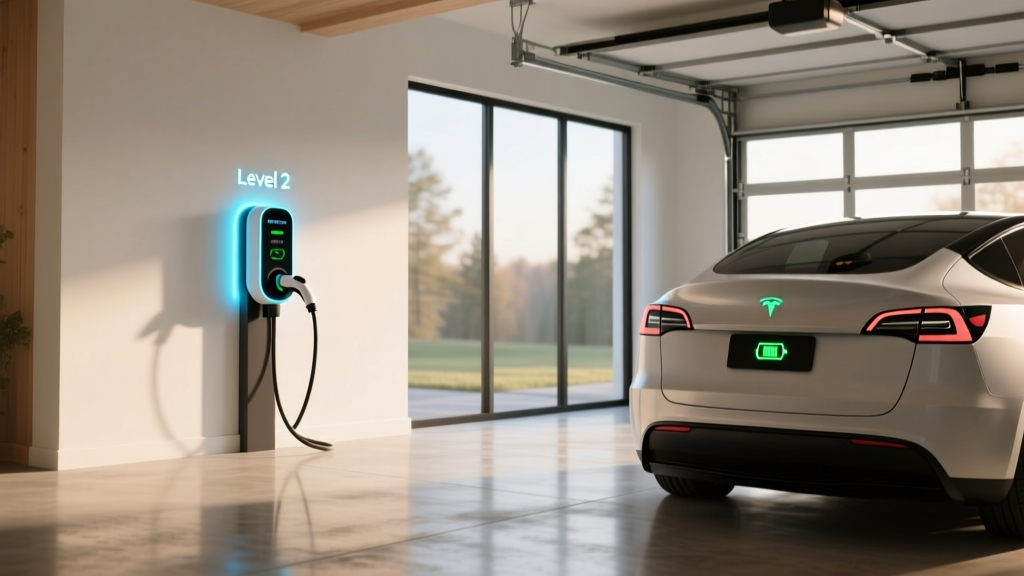
| Level 2 | 240V / 32–48A | 7.7–11.5 kW | 25–44 mi/hr | Home daily charging; workplace; destinations |
| DC Fast (Level 3) | 400–800V DC | 50–350 kW | 150–1,000+ mi/hr (at peak) | Road trips; rapid top-ups; Tesla Supercharger, Electrify America |
Real-world note: Those DC fast "miles per hour" figures apply only at peak power, typically between 10% and 40% state of charge (SoC). Above ~80% SoC, the battery management system (BMS) throttles current to protect cell health — this is the charge curve taper. A vehicle rated for 250 kW peak may sustain that rate for only 10–15 minutes before dropping to 100 kW, then 50 kW, then lower. Always look at 10–80% charge times, not peak kW, for practical trip planning.
Home Level 2 Installation: Electrical Requirements and Real Costs
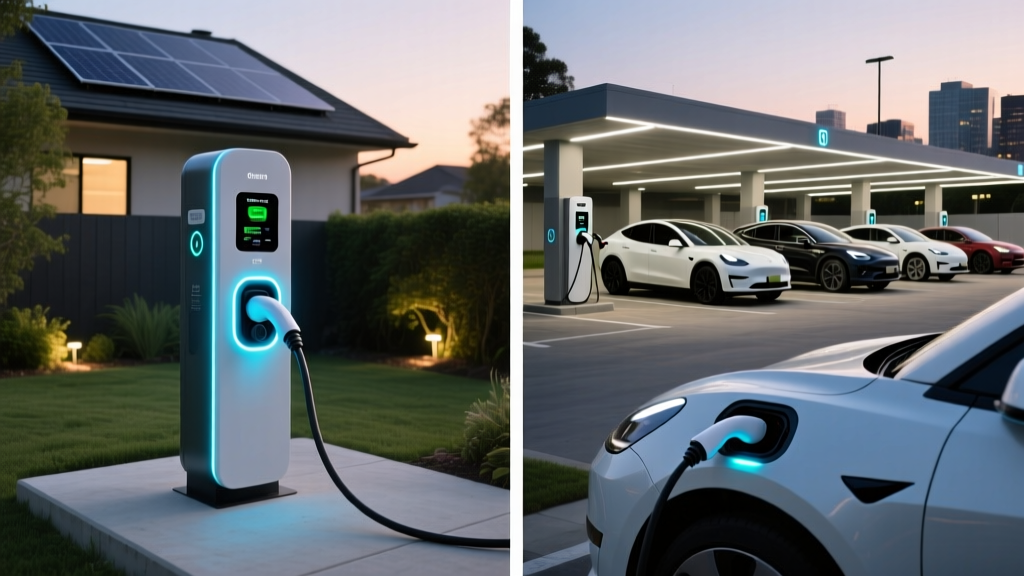
Most EV owners do 80–90% of their charging at home on a Level 2 circuit. But installation costs vary wildly depending on your home's electrical panel, the distance from panel to charger location, and local permitting. Here's what to expect in 2026.
Electrical Requirements
A typical Level 2 home charger runs on a 240V dedicated circuit, similar to a clothes dryer or electric range. Common configurations:
- 40A circuit / 32A continuous draw: Delivers ~7.7 kW. Adequate for most daily needs (adds ~200+ miles overnight).
- 50A circuit / 40A continuous: Delivers ~9.6 kW. Recommended for larger batteries (100+ kWh trucks/SUVs).
- 60A circuit / 48A continuous: Delivers ~11.5 kW. Maximum for most residential chargers; requires robust panel capacity.
The National Electrical Code (NEC) requires that continuous loads (defined as running 3+ hours — which EV charging does) not exceed 80% of the circuit breaker rating. That's why a 40A breaker only delivers 32A of usable current.
Panel Upgrade Considerations
Homes built before 2000 often have 100A or 150A main service panels. Adding a 40–60A EV circuit may push total load past safe capacity, especially if you also run electric heat, an electric dryer, and an electric range. A licensed electrician will perform a load calculation (NEC Article 220) to determine if your panel can handle the addition.
If a panel upgrade is needed — say from 100A to 200A — expect to pay $1,800–$4,000 for the upgrade alone, on top of charger installation. This is the single biggest surprise cost for older-home EV buyers. Some utilities offer rebates or load-management devices (like the Span smart panel or EMPoria VUE) that can defer or avoid a full upgrade.
| Component | Typical Cost Range | Notes |
|---|---|---|
| Level 2 Charger Hardware (smart, 40–48A) | $400–$750 | Wi-Fi enabled, NACS or J1772; Energy Star certified models eligible for some utility rebates |
| Electrician Labor (standard install, <50 ft run) | $500–$1,500 | Varies by region; conduit, wiring, mounting |
| Permit & Inspection | $50–$300 | Required by most jurisdictions; varies by municipality |
| Panel Upgrade (if needed) | $1,800–$4,000 | 100A → 200A service upgrade; not always required |
| Total (no panel upgrade) | $950–$2,550 | Most common scenario for modern homes |
| Total (with panel upgrade) | $2,750–$6,550 | Older homes with 100A service |
Federal incentive note: The IRS §30C Alternative Fuel Vehicle Refueling Property Credit offers up to $1,000 (30% of cost, capped) for home charging equipment installed in eligible census tracts through 2032. Eligibility depends on your address — check the IRS tool or consult a tax professional. This is separate from the §30D vehicle purchase credit.
Connector Compatibility: NACS, CCS1, CHAdeMO, and Adapters
The connector landscape has consolidated significantly since 2024, when Ford, GM, Rivian, Volvo, and most other automakers committed to adopting Tesla's North American Charging Standard (NACS) for new vehicles. By the 2026 model year, nearly all new EVs sold in North America ship with a native NACS charge port.
| Connector | Used By | AC Level 2? | DC Fast? | Notes |
|---|---|---|---|---|
| NACS (J3400) | Tesla (all), Ford, GM, Rivian, Volvo, Polestar, Mercedes, most 2025+ EVs | Yes | Yes (up to 350+ kW) | Now the SAE standard; compact, single-port design |
| CCS1 (Combo) | Legacy Hyundai/Kia, BMW iX, VW ID.4 (pre-2025), older non-Tesla EVs | Yes (via J1772 upper portion) | Yes (up to 350 kW) | Phasing out on new models; adapters to NACS widely available |
| CHAdeMO | Nissan Leaf (legacy), Mitsubishi Outlander PHEV | No (separate J1772 port) | Yes (up to 100 kW) | Effectively discontinued; new infrastructure rarely includes CHAdeMO |
| J1772 | All non-Tesla AC Level 2 (legacy) | Yes | No | AC-only; being replaced by NACS for AC+DC in one port |
Adapter reality: If you own a CCS1-equipped EV (like a 2024 Hyundai Ioniq 5 or VW ID.4), you can access Tesla Superchargers using a CCS-to-NACS adapter. Tesla sells an official adapter for ~$250, and third-party options from brands like Lectron and A2Z are available for $150–$200. Conversely, NACS-equipped vehicles can use CCS stations with a NACS-to-CCS adapter. Most new NACS vehicles ship with the appropriate adapter included.
Cost to Charge: Home vs Public vs Gas — Per Mile Economics
The financial case for EVs hinges on fuel cost savings, but the math depends heavily on where you charge. Home charging on a time-of-use (TOU) plan is dramatically cheaper than public DC fast charging.
| Scenario | Cost per kWh | Vehicle Efficiency | Cost Per Mile |
|---|---|---|---|
| Home Level 2 — Off-Peak TOU Rate | $0.08–$0.12/kWh | 3.0 mi/kWh (avg EV) | $0.03–$0.04 |
| Home Level 2 — Standard Residential Rate | $0.14–$0.18/kWh | 3.0 mi/kWh | $0.05–$0.06 |
| Public Level 2 (ChargePoint, workplace) | $0.20–$0.35/kWh | 3.0 mi/kWh | $0.07–$0.12 |
| DC Fast Charging (Electrify America, EVgo) | $0.35–$0.55/kWh | 3.0 mi/kWh | $0.12–$0.18 |
| Tesla Supercharger V4 (average) | $0.28–$0.40/kWh | 3.0 mi/kWh | $0.09–$0.13 |
| Gasoline (28 MPG car, $3.30/gal) | — | 28 mi/gal | $0.12 |
| Gasoline (22 MPG truck/SUV, $3.30/gal) | — | 22 mi/gal | $0.15 |
The takeaway: If you charge at home on off-peak rates, your cost per mile is roughly one-quarter of an equivalent gas car. If you rely exclusively on DC fast charging, your cost per mile approaches or even exceeds gasoline — defeating the economic argument. This is why home charging access is the single most important factor in EV ownership satisfaction and total cost of ownership.
Charging Time Examples: 10–80% for Common Battery Sizes
The 10–80% metric is the industry standard for practical fast-charging comparisons because the final 20% takes disproportionately long due to charge-curve taper. Here's how common 2026 EVs perform at a DC fast charger:
- Tesla Model Y (75 kWh, NMC, 250 kW peak): 10–80% in ~18 minutes at a V3/V4 Supercharger. Sustains ~200+ kW through 40% SoC, then tapers.
- Hyundai Ioniq 5 (84 kWh, NMC, 240 kW peak on 800V architecture): 10–80% in ~18 minutes. The 800V system sustains high power longer than 400V competitors.
- Ford F-150 Lightning Extended Range (131 kWh, NMC, 150 kW peak): 10–80% in ~41 minutes. Larger battery + lower peak kW = longer charge time, even though total energy added is much greater.
- Chevrolet Equinox EV (85 kWh, NMC, 150 kW peak): 10–80% in ~30 minutes.
- Tesla Model 3 Standard Range (57.5 kWh, LFP, 170 kW peak): 10–80% in ~25 minutes. LFP chemistry charges slower at peak but tolerates regular 100% charging better than NMC.
Charge curve reality check: The advertised "peak kW" is exactly that — a peak, not a sustained rate. A charger rated at 250 kW may only deliver that rate between 10–30% SoC. By 60% SoC, the rate may drop to 150 kW; by 80%, it may be under 50 kW. This is why 10–80% time is a more honest metric than "X miles in Y minutes" marketing claims.
Equipment Recommendations: Best Home Level 2 Chargers for 2026
Here are our tested picks for home Level 2 chargers, selected for reliability, smart features, connector compatibility, and value:
Tesla Wall Connector (Gen 4)
- Power: Up to 11.5 kW (48A on 60A circuit)
- Connector: Native NACS
- Cable Length: 24 ft
- Smart Features: Wi-Fi, OTA updates, power-sharing (pair two units on one circuit), Tesla app integration
- Price: ~$475
- Best For: Tesla owners or households with multiple NACS vehicles; excellent value for 48A output
ChargePoint Home Flex (NACS version)
- Power: Up to 12 kW (50A on 60A circuit, adjustable down to 16A)
- Connector: NACS (also available in J1772)
- Cable Length: 23 ft
- Smart Features: Wi-Fi, ChargePoint app scheduling, Alexa integration, detailed energy reporting, flexible amperage settings for older panels
- Price: ~$650
- Best For: Non-Tesla EV owners wanting premium app features and adjustable amperage
Emporia Level 2 EV Charger
- Power: Up to 11.5 kW (48A on 60A circuit)
- Connector: J1772 (NACS adapter included)
- Cable Length: 24 ft
- Smart Features: Wi-Fi, Emporia app with solar integration, load management when paired with Emporia VUE panel monitor, TOU scheduling
- Price: ~$400
- Best For: Budget-conscious buyers; solar-panel households wanting coordinated charging; homes needing load management to avoid panel upgrades
Grizzl-E Smart (United Chargers)
- Power: Up to 10 kW (40A on 50A circuit)
- Connector: J1772 (NACS adapter available)
- Cable Length: 24 ft
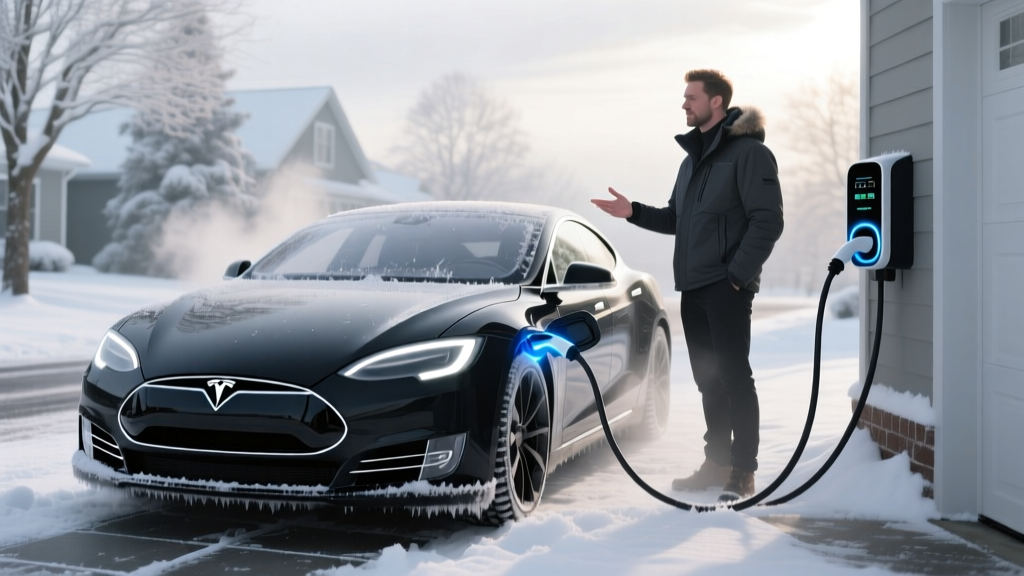
- Smart Features: Wi-Fi, OCPP protocol support, adjustable output, extreme cold rating (-40°F), rugged aluminum enclosure
- Price: ~$550
- Best For: Cold-climate and outdoor installations; durability-focused buyers; commercial/fleet use
Safety, Electrical Code, and Installation Best Practices
EV charging is a high-draw, long-duration electrical load — more like running a welding machine for 8 hours than plugging in a lamp. Safety and code compliance aren't optional:
- Dedicated circuit: Your Level 2 charger must be on its own dedicated breaker — no sharing with other outlets or appliances. NEC 2023/2026 requirements are explicit on this.
- GFCI protection: Outdoor installations require Ground Fault Circuit Interrupter (GFCI) protection. Many modern smart chargers have built-in GFCI; if not, the breaker must be GFCI-rated. Note: some electricians report nuisance GFCI trips with certain charger/breaker combinations — use a breaker brand matched to your panel (Square D for Square D panels, etc.).
- Outdoor rating: If mounting outside, ensure the charger is rated NEMA 4 (weatherproof) or NEMA 4X (weatherproof + corrosion-resistant). Most major chargers meet this standard.
- Permitting: Most jurisdictions require an electrical permit and post-installation inspection for a new 240V circuit. Skipping this can void homeowner's insurance coverage for electrical fires and cause problems at resale.
- Wire gauge: A 48A continuous load on a 60A breaker requires 4 AWG copper wire (or 3 AWG aluminum) for runs up to ~100 feet. Longer runs may require upsizing to minimize voltage drop. Your electrician will calculate this.
- Cable management: Use an EV cord organizer or retractable reel to prevent tripping hazards and protect the cable from UV damage, abrasion, and vehicle runover.
Always hire a licensed electrician — not a handyman — for EV charger installation. Per the National Electrical Code (NFPA 70), improper high-amperage installations create genuine fire risk. Many utilities maintain lists of approved/certified EV installers and may require certified installation for rebate eligibility.
Frequently Asked Questions
Can you turbo and supercharge a car at the same time?
Yes — this is called twin-charging. It combines a supercharger (for instant low-RPM boost) with a turbocharger (for high-RPM power). Volkswagen's 1.4L TSI is the most well-known production example. However, it's complex, expensive, and rarely done as an aftermarket modification. For most enthusiasts, choosing one or the other is more practical and reliable.
How much does it cost to install a home EV charger?
Expect $950–$2,550 for a standard Level 2 installation in a home with adequate panel capacity (200A service, short wire run). If your home needs a panel upgrade from 100A to 200A, total cost rises to $2,750–$6,550. The federal §30C credit may offset up to $1,000 of equipment and installation costs depending on your census tract.
How fast will each charging level add range?
Level 1 (120V) adds 3–5 miles per hour. Level 2 (240V) adds 25–44 miles per hour depending on amperage. DC fast charging adds 150–1,000+ miles per hour at peak, but only for the first 20–30 minutes before the charge curve tapers. For daily driving, Level 2 overnight is sufficient for nearly all owners.
Which connector/charger is compatible with my EV?
If your EV is a 2025+ model from Tesla, Ford, GM, Rivian, Volvo, or most other brands, it uses NACS natively. Older non-Tesla EVs (pre-2025 Hyundai, Kia, VW, BMW) typically use CCS1. The Nissan Leaf uses CHAdeMO. Check your vehicle's charge port or owner's manual. Adapters between NACS and CCS1 are widely available for $150–$250.
How much does charging cost per mile vs gas?
Home charging on off-peak electricity costs $0.03–$0.04 per mile — about one-quarter the cost of gasoline at $3.30/gallon in a 28 MPG car ($0.12/mile). Public DC fast charging costs $0.12–$0.18 per mile, which is comparable to or slightly more than gas. The economic advantage of an EV depends heavily on having reliable home or workplace charging.
What electrical upgrades might I need for a home charger?
The most common upgrade is a panel capacity increase from 100A to 200A, costing $1,800–$4,000. You may also need a new dedicated 240V circuit with appropriate wire gauge and breaker. Homes with 200A or larger panels typically need no upgrade. A licensed electrician will perform a load calculation (NEC Article 220) to determine your panel's available capacity. Some utilities offer load-management devices that can avoid a panel upgrade by throttling charger draw when other high-load appliances are running.
Whether you're asking "can you turbo and supercharge a car" out of ICE curiosity or you're evaluating the "supercharging" potential of your next EV, the engineering answer is the same: forced induction and DC fast charging are both about moving energy faster — just through completely different systems. For the EV owner, the practical priority is a properly installed Level 2 home charger, the right connector for your vehicle, and an understanding of real-world charge-curve behavior. That's the electrified equivalent of bolting on a turbo — and it pays dividends every single day you plug in.