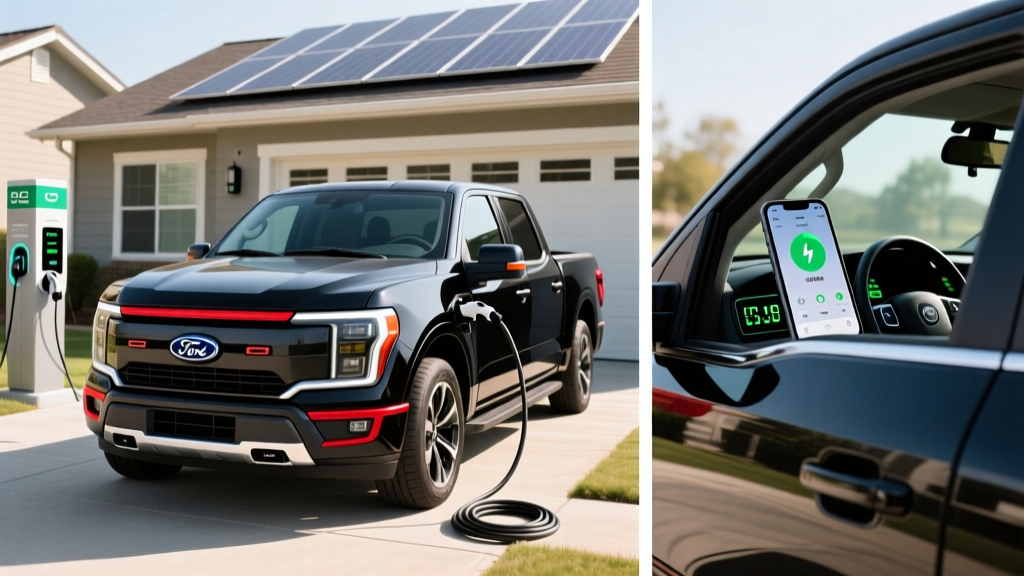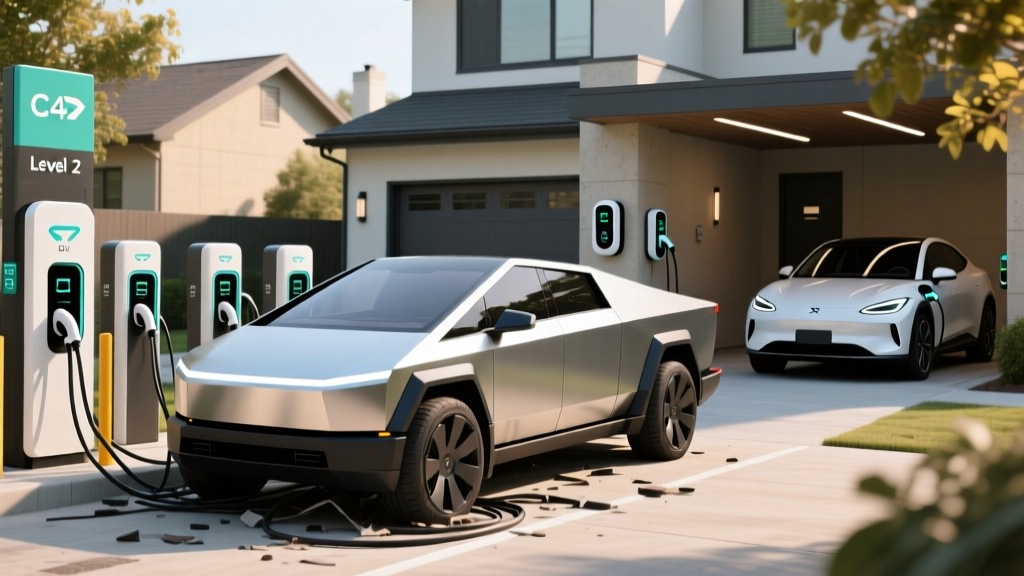
If you've ever pulled up to a public fast-charging plaza only to find a lifted pickup truck parked across two stalls — engine running, no plug in sight — you've experienced what EV drivers call "ICEing" or, more broadly, trucks blocking charging stations. Whether it's intentional hostility, simple ignorance, or a massive F-250 that physically can't fit in a standard pull-through stall, the result is the same: you can't charge, you're late, and your state of charge is dropping.
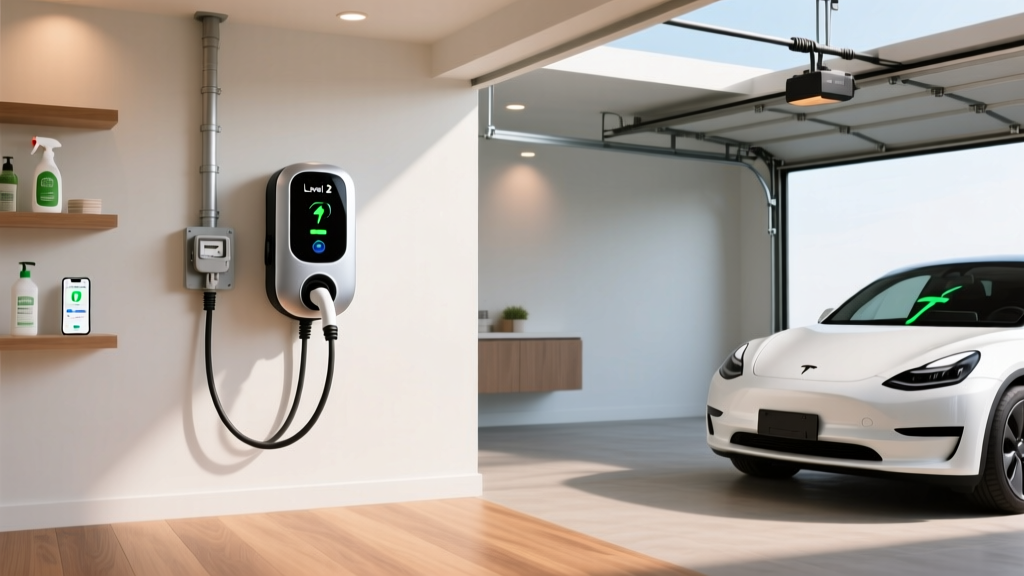
The most durable solution isn't an app or a complaint form. It's a reliable Level 2 home charger that makes public stations a convenience rather than a dependency. Below, we break down exactly what it takes to install one, what it costs, how fast each charging level really adds range, and how to navigate the connector landscape in 2026 — so the next time someone blocks a public charger, it simply doesn't matter to your daily routine.
Why Trucks Blocking Charging Stations Is a Structural Problem
Public DC fast-charging plazas were largely designed around compact sedans and crossovers. A typical pull-in stall offers roughly 18 feet of clearance. A 2026 Ford F-150 Lightning is 232 inches long (over 19 feet); a Chevy Silverado EV stretches past 233 inches. Add a trailer hitch, and many full-size electric trucks simply cannot park in a standard stall without blocking adjacent chargers or the drive lane.
Combine that with the rise of non-EV trucks parking in EV-designated spots — whether out of spite, convenience, or lack of enforcement — and the problem compounds. According to charging-network data aggregated by PlugShare, user-reported station blockages remain one of the top reliability complaints at public chargers.
The practical takeaway: if your daily driving needs can be met with overnight home charging, you eliminate the single biggest variable in public charging reliability.
Charging Levels Explained: Speeds, kW, and Miles Per Hour
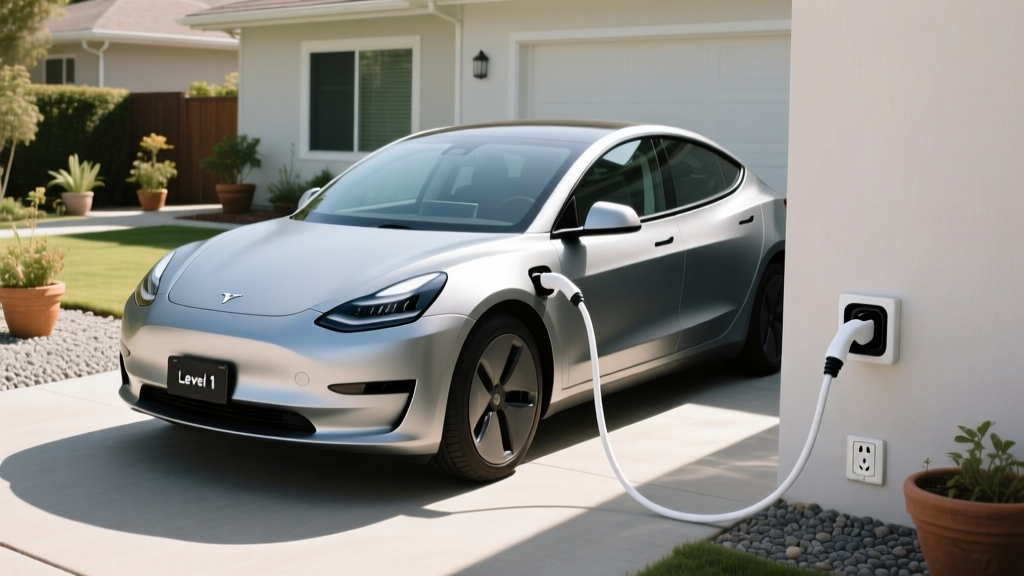
Before spec'ing a home charger, you need to understand the three charging levels and what they actually deliver. Note the critical distinction: kW (kilowatts) measures power — how fast energy flows into your car. kWh (kilowatt-hours) measures energy — how much your battery holds. You'll see both below; they are never interchangeable.
| Level | Voltage | Power (kW) | Miles of Range Added Per Hour | Typical Use |
|---|---|---|---|---|
| Level 1 | 120V AC | 1.0–1.4 kW | 3–5 mi/hr | Emergency / low-mileage daily top-off |
| Level 2 (Home) | 240V AC | 3.3–19.2 kW | 12–75 mi/hr | Primary home / workplace charging |
| DC Fast Charge | 400–800V DC | 50–350+ kW | 150–1,200+ mi/hr (peak) | Road trips, rapid top-ups |
A practical example: a 2026 Hyundai Ioniq 5 (84 kWh usable battery, EPA 305-mile range) charging on a 48-amp Level 2 home circuit at 11.5 kW will add roughly 40 miles of range per hour. A full 10–80% charge takes about 5.5 hours overnight — more than sufficient for daily use. On a 350 kW DC fast charger, that same 10–80% session takes roughly 18 minutes, though real-world sustained speeds taper significantly above 80% State of Charge.
Home EV Charger Installation: Costs, Electrical Requirements, and Panel Upgrades
Installing a hardwired Level 2 charger is the single most impactful upgrade an EV owner can make. But costs vary dramatically based on your home's existing electrical infrastructure.
Electrical Requirements
Most Level 2 home chargers require a 240-volt dedicated circuit. The most common amperages are:
- 40A circuit → delivers up to 32A continuous (7.7 kW at 240V) — sufficient for most daily needs
- 50A circuit → delivers up to 40A continuous (9.6 kW) — faster charging for larger batteries
- 60A circuit → delivers up to 48A continuous (11.5 kW) — ideal for trucks and large-battery EVs
The National Electrical Code (NEC) requires that continuous loads (like EV charging) use no more than 80% of a circuit's rated capacity. So a 48A charger requires a 60A breaker.
Panel Upgrade Reality
If your home has a 100-amp electrical panel — common in homes built before the 1990s — adding a 60A EV circuit may exceed your panel's capacity, especially if you already run electric HVAC, a dryer, and an electric range. A panel upgrade to 200A typically costs $1,500–$3,000 and is the single largest variable in installation cost. Homes with existing 200A panels often have enough headroom for a 40A or 50A EV circuit without an upgrade.
| Component | Low Estimate | High Estimate | Notes |
|---|---|---|---|
| Level 2 Charger (Equipment) | $350 | $750 | 32A–48A smart chargers; WiFi-enabled |
| Electrician Labor | $400 | $1,500 | Depends on run length, conduit, wall type |
| Permit & Inspection | $50 | $250 | Varies by municipality |
| Electrical Panel Upgrade (if needed) | $1,500 | $3,000 | 100A → 200A upgrade; not always required |
| Total (No Panel Upgrade) | $800 | $2,500 | Most homes with 200A panels |
| Total (With Panel Upgrade) | $2,300 | $5,500 | Older homes with 100A service |
Federal tax credit note: The IRS §30D alternative fuel vehicle refueling property credit can cover up to 30% of home charger equipment and installation costs (capped at $1,000). Eligibility depends on census-tract requirements and current-year IRS rules — consult irs.gov or a tax professional before claiming.
Connector Compatibility: NACS, CCS1, and CHAdeMO in 2026
The North American charging connector landscape has consolidated significantly. Tesla's NACS (North American Charging Standard) is now the dominant plug, with Ford, GM, Rivian, Volvo, Hyundai/Kia, and most major automakers adopting it for new vehicles starting in the 2025–2026 model years. CCS1 (Combined Charging System) remains on many 2022–2024 models still on the road, and CHAdeMO is effectively legacy (Nissan Leaf being the primary holdout).
| Connector | Brands Using It (2026 New Vehicles) | Adapter Needed? |
|---|---|---|
| NACS (Tesla) | Tesla, Ford, GM, Rivian, Hyundai, Kia, Volvo, Polestar, Mercedes, BMW, Nissan (Ariya+) | None for new models; CCS→NACS adapter for older CCS vehicles (~$200–$300) |
| CCS1 | Legacy models (2022–2024 VW ID.4, older Bolt EV, etc.) | NACS→CCS adapter needed at Tesla Superchargers |
| CHAdeMO | Nissan Leaf (2025 final year; discontinued after) | Limited public infrastructure; no practical adapter |
For home Level 2 charging, most chargers now ship with a NACS connector or offer a choice between NACS and J1772 (the legacy Level 2 standard). If you own a CCS1-equipped vehicle and plan to upgrade to NACS in the future, buy a charger with a swappable connector or use a J1772-to-NACS adapter.
Level 2 Charger Equipment Recommendations
Here are three chargers we recommend based on reliability, smart features, and real-world performance. All are UL-listed and suitable for indoor or outdoor installation (NEMA 4 rated).
Emporia Vue Level 2 (Best Value)
- Power: 48A max (11.5 kW at 240V)
- Connector: NACS or J1772 options
- Cable length: 24 ft
- Smart features: WiFi, scheduling, energy monitoring via Emporia app, solar integration
- Price: ~$399
ChargePoint Home Flex (Most Flexible)
- Power: Configurable 16A–50A (up to 12 kW at 240V)
- Connector: NACS or J1772 (swappable)
- Cable length: 23 ft
- Smart features: WiFi, app-based scheduling, Alexa integration, amperage adjustable via dip switches
- Price: ~$549
Tesla Wall Connector (Best for NACS Vehicles)
- Power: 48A max (11.5 kW at 240V)
- Connector: NACS native
- Cable length: 24 ft
- Smart features: WiFi, OTA updates, power sharing between two units, integrated cable management
- Price: ~$475
Cost to Charge: Per-Mile Economics vs. Gasoline
One of the strongest arguments for home charging — beyond never encountering trucks blocking charging stations — is cost. Electricity rates vary by region, but home charging on off-peak rates consistently undercuts gasoline on a per-mile basis.
| Scenario | Rate / Cost | Vehicle Efficiency | Cost Per Mile |
|---|---|---|---|
| Home Level 2 (Off-Peak) | $0.11/kWh | 3.0 mi/kWh (avg EV) | $0.037 |
| Home Level 2 (Standard) | $0.16/kWh | 3.0 mi/kWh | $0.053 |
| Public Level 2 (Network) | $0.30/kWh | 3.0 mi/kWh | $0.100 |
| DC Fast Charge (Public) | $0.42/kWh | 3.0 mi/kWh | $0.140 |
| Gasoline (25 MPG avg) | $3.40/gal | 25 mi/gal | $0.136 |
At off-peak residential rates, home charging costs roughly $0.04 per mile — about 70% less than gasoline. Even public DC fast charging at $0.42/kWh is roughly cost-competitive with gas. The sweet spot is clear: charge at home whenever possible, and use public DC fast chargers only for road trips.
Safety, Code, and Installation Best Practices
A Level 2 charger draws significant current for hours at a time. Proper installation isn't optional — it protects your home and your vehicle.
- Dedicated circuit: Your EV charger must be on its own dedicated breaker. Never share a circuit with other high-draw appliances.
- GFCI protection: NEC 2020 and later requires GFCI (Ground Fault Circuit Interrupter) protection for all EV charging outlets. Hardwired installations may have different requirements — your electrician will determine compliance.
- Outdoor rating: If mounting outdoors, ensure the charger carries a NEMA 4 (or IP65+) rating for weather resistance. All three chargers recommended above meet this standard.
- Permit and inspection: Most jurisdictions require an electrical permit for a new 240V circuit. The inspection ensures proper wire gauge, breaker sizing, and grounding. Skipping this step risks insurance claim denials in the event of an electrical fire.
- Wire gauge: A 60A circuit typically requires 6 AWG copper wire (or 4 AWG aluminum). Your electrician will size wire based on run length and local code.
Charging Time Examples for Common Battery Sizes
How long does a 10–80% session actually take? Here's a realistic breakdown using Level 2 home charging at 11.5 kW (48A on a 60A circuit), which is the most common high-power home setup:
| Vehicle (2026) | Battery (kWh Usable) | 10–80% at 11.5 kW (Level 2) | 10–80% at 150+ kW (DCFC) |
|---|---|---|---|
| Tesla Model Y Long Range | 75 kWh | ~4.5 hours | ~22 min |
| Hyundai Ioniq 5 | 84 kWh | ~5.1 hours | ~18 min |
| Ford F-150 Lightning (Extended) | 131 kWh | ~8.0 hours | ~41 min |
| Chevy Equinox EV | 85 kWh | ~5.2 hours | ~28 min |
| BMW i4 eDrive40 | 81 kWh | ~4.9 hours | ~31 min |
For overnight charging, even the massive F-150 Lightning replenishes from 10–80% in a single night at 11.5 kW. Most drivers rarely need a full 0–100% session — the 10–80% window is where charging is fastest, as the charge curve tapers significantly above 80% to protect battery health.
Frequently Asked Questions
How much does it cost to install a home EV charger?
For most homes with an existing 200-amp electrical panel, a hardwired Level 2 charger installation costs $800–$2,500 including equipment, electrician labor, and permits. If your home has a 100-amp panel that needs upgrading to 200A, expect $2,300–$5,500 total. Always get 2–3 quotes from licensed electricians.
How fast will each charging level add range?
Level 1 (120V) adds 3–5 miles per hour — enough for plug-in hybrids but inadequate for most BEVs. Level 2 (240V, 48A) adds roughly 35–45 miles per hour for a typical EV, fully replenishing most batteries overnight. DC fast charging adds 150+ miles in 15–20 minutes at peak speeds, but tapers above 80% SoC.
Which connector/charger is compatible with my EV?
For 2026 model-year vehicles, most new EVs use the NACS connector (Tesla's standard). Older 2022–2024 models may still have CCS1. Check your vehicle's charge port or owner's manual. For home chargers, NACS-native units (Tesla Wall Connector, newer ChargePoint models) are the safest forward-looking choice, with adapters available for CCS1 legacy vehicles.
How much does charging cost per mile vs gas?
Home charging on off-peak electricity ($0.11/kWh) costs roughly $0.04 per mile for an average EV — about 70% less than gasoline at $3.40/gal and 25 MPG. Even public DC fast charging at $0.42/kWh ($0.14/mile) is comparable to gasoline. The real savings come from consistent home charging.
What electrical upgrades might I need?
If your home has a 100-amp panel, you'll likely need a 200A upgrade ($1,500–$3,000) to support a 48A EV charger alongside existing appliances. Homes with 200A panels usually have sufficient capacity. A licensed electrician can perform a load calculation to determine whether an upgrade is necessary. Some utilities offer rebates for panel upgrades tied to EV adoption.
Will a home charger completely eliminate my need for public stations?
For daily commuting and errands, yes — most EV owners do 90%+ of their charging at home. Public DC fast chargers remain necessary for road trips exceeding your vehicle's EPA range. But with home charging handling your baseline, you'll visit public stations far less often, and trucks blocking charging stations become a minor inconvenience rather than a daily frustration.