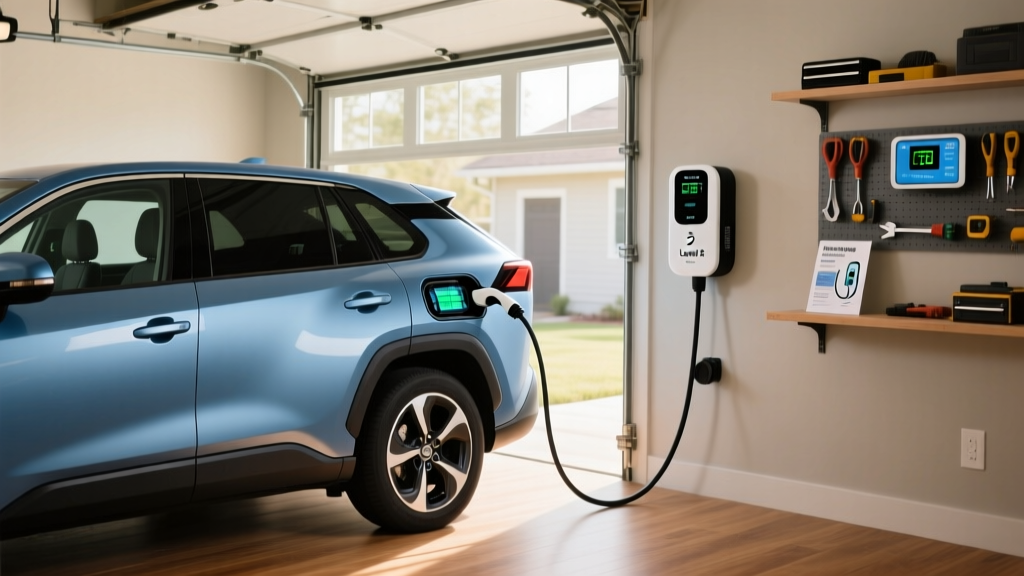
The Toyota RAV4 Prime remains one of the most sought-after plug-in hybrids on the market, and for good reason: it pairs a usable electric-only commute with the flexibility of a gas engine for longer trips. But to actually benefit from that electric capability, you need to charge it at home efficiently. Plugging into a standard 120V outlet works in a pinch, but if you want to wake up to a full battery every morning — and keep your fuel costs as low as possible — a proper Level 2 home charging setup is essential.
This guide breaks down the Toyota RAV4 Prime electric range, exactly how fast each charging level replenishes the battery, what a home installation really costs in 2026, and which chargers are worth your money. Whether you're a current owner optimizing your setup or a prospective buyer planning ahead, the numbers below will help you make a precise, informed decision.
Toyota RAV4 Prime: Battery, Range, and Charging Specs at a Glance
Before we get into chargers and installation, let's establish the baseline specs. The current-generation RAV4 Prime uses an 18.1 kWh lithium-ion traction battery (usable capacity approximately 14.9 kWh due to a top/bottom buffer designed to protect long-term battery health). Here's what that translates to in real-world use:
| Spec | Value |
|---|---|
| Battery (total / usable) | 18.1 kWh / ~14.9 kWh |
| EPA electric-only range | 42 miles |
| Real-world EV range (highway, moderate weather) | ~35–39 miles |
| Real-world EV range (cold weather, 20–35°F) | ~28–33 miles |
| EPA MPGe (EV mode) | 94 MPGe |
| EPA MPG (hybrid mode, battery depleted) | 38 MPG combined |
| Onboard charger (Level 2 max) | 6.6 kW |
| Level 1 charge time (120V / 12A) | ~12 hours (0–100%) |
| Level 2 charge time (240V / 32A) | ~2.5 hours (0–100%) |
| DC fast charging | Not supported |
| Connector type | J1772 (Level 1 & Level 2) |
| Battery warranty | 8 years / 100,000 miles (10 yrs / 150,000 mi in CARB states) |
Real-world range note: The EPA's 42-mile figure assumes a mix of city and highway driving in moderate temperatures. In practice, sustained highway speeds (70+ mph) will reduce your electric range by roughly 10–15%. Cold weather is the bigger hit — expect a 20–30% reduction when temperatures drop below freezing because the battery's internal resistance increases and energy is diverted to cabin heating. If your daily commute is 30 miles or less round-trip, the RAV4 Prime will cover it on electricity alone for most of the year.
Charging Levels Explained: How Fast Will Each Level Add Range?
Understanding charging speed requires distinguishing between kW (kilowatts), which measures power — the rate of energy flow — and kWh (kilowatt-hours), which measures energy — the total amount stored in the battery. Think of kW as the width of a hose and kWh as the size of the bucket. A wider hose (higher kW) fills the bucket faster.
The RAV4 Prime does not support DC fast charging, so your practical options are Level 1 and Level 2. Here's how they compare:
| Level | Voltage / Amperage | Power (kW) | Miles of EV Range Added per Hour | Full Charge Time (0–100%) |
|---|---|---|---|---|
| Level 1 (Standard outlet) | 120V / 12A | ~1.4 kW | ~3–4 miles/hr | ~12 hours |
| Level 2 (240V, 16A) | 240V / 16A | ~3.8 kW | ~9–10 miles/hr | ~4 hours |
| Level 2 (240V, 32A) | 240V / 32A | ~6.6 kW | ~16–18 miles/hr | ~2.5 hours |
| DC Fast Charging | N/A | N/A | N/A | Not supported on RAV4 Prime |
Key insight: The RAV4 Prime's onboard charger caps at 6.6 kW. Even if you install a 48-amp (11.5 kW) Level 2 charger, the car will only draw 6.6 kW maximum. That said, installing a higher-capacity charger isn't wasted money — it future-proofs your setup for a full battery-electric vehicle (BEV) down the road, which may accept 11.5 kW or more on Level 2.
For most RAV4 Prime owners, a 32-amp Level 2 charger on a dedicated 40-amp circuit is the sweet spot: it maxes out the car's onboard charger and delivers a full battery in about 2.5 hours, meaning even a quick evening top-up restores your full 42-mile EV range before bedtime.
Home Charger Installation: Electrical Requirements and Cost Breakdown
This is where many PHEV and EV buyers get sticker shock — or, conversely, find the process simpler and cheaper than expected. Your actual cost depends on your home's electrical panel capacity, the distance from the panel to your desired charger location, and local permit fees.
Electrical Requirements for the RAV4 Prime
To achieve the full 6.6 kW Level 2 charge rate, you need:
- Circuit: Dedicated 40-amp, 240V circuit (for a 32A continuous-draw charger; NEC code requires the circuit to be rated 125% of the continuous load)
- Wire: 8 AWG copper (or 6 AWG aluminum) for runs up to ~50 feet; thicker gauge for longer runs to prevent voltage drop
- Outlet vs. hardwired: A NEMA 14-50 outlet gives you flexibility to unplug and take the charger with you; hardwired is slightly cheaper to install and avoids the code requirement for a GFCI breaker on receptacles in many jurisdictions
- Panel capacity: Your main electrical panel must have room for a double-pole 40A breaker and sufficient total amperage headroom. Most modern 200A panels handle this easily. Older 100A panels may require a load calculation or a full panel upgrade.
Do You Need a Panel Upgrade?
This is the single biggest cost variable. If your home has a 200-amp service panel with open breaker slots, you likely won't need an upgrade. If you have a 100-amp panel — common in homes built before the 1990s — or your panel is already near capacity (running electric HVAC, dryer, oven, water heater), an electrician will perform a load calculation to determine whether you can add a 40A circuit safely.
A panel upgrade from 100A to 200A typically costs $1,800–$3,500 depending on your region and the complexity of the work. It's a significant investment, but it also increases your home's resale value and opens the door to future electrification (heat pumps, second EV charger, etc.).
| Component | Low Estimate | High Estimate | Notes |
|---|---|---|---|
| Level 2 charger (equipment) | $350 | $700 | 32A–48A smart chargers; see recommendations below |
| Electrician labor | $400 | $1,500 | Depends on run length, wall type, conduit needs |
| Materials (wire, conduit, breaker) | $100 | $400 | Longer runs and metal conduit increase cost |
| Permit and inspection | $50 | $250 | Varies by municipality; some jurisdictions waive for EV circuits |
| Panel upgrade (if needed) | $1,800 | $3,500 | Only if existing panel lacks capacity |
| Total (no panel upgrade) | $900 | $2,850 | |
| Total (with panel upgrade) | $2,700 | $6,350 |
Federal incentive: The Residential Clean Energy Credit does not cover EV chargers after 2021 under current IRS rules. However, some states and utilities still offer rebates for Level 2 equipment and installation — check your local utility and state incentive database for current programs.
Connector Compatibility: What Plugs Into the RAV4 Prime?
The RAV4 Prime uses the J1772 connector for all Level 1 and Level 2 charging. This is the standard connector for virtually all non-Tesla EVs and PHEVs sold in North America. Here's how it fits into the broader connector landscape:
| Connector | Used By | RAV4 Prime Compatible? | Adapter Needed? |
|---|---|---|---|
| J1772 | Toyota, Ford, GM (pre-2025), Hyundai, Kia, most PHEVs | Yes — native | None |
| NACS (Tesla) | Tesla; Ford, GM, Rivian, Hyundai (2025+ models) | No — not native | Tesla-to-J1772 adapter (e.g., Lectron, ~$140) for Tesla wall connectors or destination chargers |
| CCS1 | DC fast charging on non-Tesla BEVs | N/A — RAV4 Prime does not support DC fast charging | N/A |
| CHAdeMO | Nissan Leaf (legacy DC fast) | N/A | N/A |
Practical advice: For home charging, simply buy a J1772 Level 2 charger — no adapter needed. If you happen to own a Tesla Wall Connector (perhaps from a previous EV), you'll need a NACS-to-J1772 adapter to use it with the RAV4 Prime. At public Level 2 stations, the J1772 plug is standard, so you're covered everywhere.
Cost to Charge: RAV4 Prime Per-Mile Cost vs. Gas
One of the strongest arguments for the RAV4 Prime is the dramatic cost savings when driving on electricity. Let's run the numbers using the RAV4 Prime's efficiency of approximately 25 kWh/100 miles in EV mode (per fueleconomy.gov) and its 38 MPG combined rating in hybrid mode.
| Scenario | Rate | Cost per Mile (EV Mode) | Cost per Mile (Gas Mode, 38 MPG) |
|---|---|---|---|
| Home charging (off-peak utility rate) | $0.10/kWh | $0.025 | $0.092 (at $3.50/gal) |
| Home charging (average US rate) | $0.17/kWh | $0.043 | $0.092 (at $3.50/gal) |
| Home charging (high-cost state, e.g. CA) | $0.30/kWh | $0.075 | $0.092 (at $3.50/gal) |
| Public Level 2 (network pricing) | $0.25/kWh | $0.063 | $0.092 (at $3.50/gal) |
The bottom line: Charging at home on an average US electricity rate ($0.17/kWh), driving the RAV4 Prime in EV mode costs roughly $0.04 per mile — less than half the cost of gas mode at $3.50/gallon. Over a year of 12,000 miles driven primarily in EV mode (say, 9,000 electric miles and 3,000 gas miles), you'd spend approximately $387 on electricity and $276 on gas, totaling $663. A comparable gas-only RAV4 at 30 MPG combined would cost about $1,400 in fuel. That's a $737 annual savings, and it grows if gas prices rise or if you have access to cheaper off-peak electricity.
Even in high-cost electricity states like California ($0.30/kWh), EV-mode driving still undercuts gasoline — though the margin narrows. If you have time-of-use (TOU) pricing through your utility, scheduling charging for off-peak overnight hours (typically 10 PM – 6 AM) can cut your electricity cost by 40–60%.
Best Level 2 Chargers for the Toyota RAV4 Prime (2026 Picks)
Since the RAV4 Prime caps at 6.6 kW, any quality 32-amp charger will extract maximum performance. We've selected three chargers that balance reliability, smart features, and value. All use the native J1772 connector.
Emporia Level 2 EV Charger
- Power output: 48A max (11.5 kW) — RAV4 Prime will draw 32A / 6.6 kW
- Connector: J1772
- Cable length: 24 feet
- Smart features: Wi-Fi, app-based scheduling, energy monitoring, integrates with Emporia home energy monitor
- Price: ~$399
- Best for: Budget-conscious buyers who want smart scheduling and energy tracking
ChargePoint Home Flex
- Power output: Up to 50A (12 kW) — adjustable via dip switches; set to 32A for RAV4 Prime on a 40A circuit
- Connector: J1772
- Cable length: 23 feet
- Smart features: Wi-Fi, ChargePoint app scheduling, Alexa integration, detailed charging history
- Price: ~$549
- Best for: Owners who want a proven brand with broad public-network integration
Grizzl-E Smart (United Chargers)
- Power output: 40A max (9.6 kW)
- Connector: J1772
- Cable length: 24 feet
- Smart features: Wi-Fi, OCPP-compatible, works with multiple apps (including SmartEVSE), firmware updates
- Price: ~$449
- Best for: Cold-climate owners — rated to -22°F, built in Canada with a rugged aluminum case
Our pick for most RAV4 Prime owners: The Emporia at $399 offers the best value. It delivers more than enough power, includes scheduling to take advantage of off-peak rates, and the energy monitoring feature helps you track exactly how much your EV driving costs. If you live in a region with harsh winters, the Grizzl-E's cold-weather durability is worth the slight premium.
Safety, Code, and Installation Best Practices
Level 2 charging is safe and well-established, but cutting corners on installation creates real risk. Here's what to insist on:
- Dedicated circuit: Your Level 2 charger must be on its own dedicated breaker — never shared with other appliances. A 32A charger requires a 40A breaker per NEC continuous-load rules.
- GFCI protection: The 2020 NEC requires GFCI protection for receptacles in garages. If you install a NEMA 14-50 outlet, your electrician will likely need a GFCI breaker ($80–$150 additional). Hardwired installations may be exempt depending on local code interpretation — ask your electrician.
- Outdoor rating: If your charger will be mounted outside (carport, driveway), ensure the unit is rated NEMA 4 or NEMA 4X for weather resistance. All three chargers recommended above meet this standard.
- Permit and inspection: Most jurisdictions require an electrical permit for a new 240V circuit. The inspection ensures proper wire gauge, breaker sizing, and grounding. Skipping the permit risks insurance coverage issues if an electrical fire occurs.
- Use a licensed electrician: This is not a DIY project unless you are a qualified electrician. Improper 240V wiring can cause fires or electrocution. Get at least two quotes and verify the electrician has EV charger installation experience.
Frequently Asked Questions
How much does it cost to install a home EV charger for the RAV4 Prime?
For most homes with a 200-amp panel and a short wire run to the garage, expect $900–$2,850 total including the charger, electrician labor, materials, and permit. If your home needs a panel upgrade from 100A to 200A, add $1,800–$3,500 to that range. The national average for a straightforward installation is approximately $1,500–$2,000.
How fast will each charging level add range to the RAV4 Prime?
Level 1 (120V) adds roughly 3–4 miles of EV range per hour — enough for an overnight top-up if your daily drive is under 15 miles. Level 2 (240V at 32A) adds 16–18 miles per hour, fully recharging the 42-mile battery in about 2.5 hours. The RAV4 Prime does not support DC fast charging.
Which connector and charger is compatible with the RAV4 Prime?
The RAV4 Prime uses the J1772 connector, which is the North American standard for Level 1 and Level 2 charging on non-Tesla vehicles. Any J1772 Level 2 charger will work. You do not need CCS1 or NACS compatibility for home charging.
How much does charging the RAV4 Prime cost per mile versus gas?
At the US average electricity rate of $0.17/kWh, EV-mode driving costs about $0.04 per mile. Gasoline at $3.50/gallon with the RAV4 Prime's 38 MPG hybrid-mode rating costs about $0.09 per mile. Charging at home on off-peak rates can drop the EV cost to $0.025/mile — roughly one-quarter the cost of gasoline.
What electrical upgrades might I need for a Level 2 charger?
The most common upgrade is adding a dedicated 40-amp, 240V circuit to your existing panel. If your panel is a modern 200A unit with open slots, no upgrade is needed. If you have an older 100A panel or your panel is near capacity, you may need a panel upgrade ($1,800–$3,500) or a load-management device that dynamically limits charger draw when other appliances are running.
Can I use a Tesla Wall Connector with my RAV4 Prime?
Not directly. The Tesla Wall Connector uses the NACS plug, while the RAV4 Prime requires J1772. You can purchase a NACS-to-J1772 adapter (approximately $140 from brands like Lectron), but for most buyers, simply purchasing a native J1772 charger is simpler and more cost-effective.
Does the RAV4 Prime's battery degrade over time?
All lithium-ion batteries degrade, but Toyota's hybrid battery management system is conservative — the ~3.2 kWh buffer (difference between 18.1 kWh total and ~14.9 kWh usable) protects the cells from deep cycling. Real-world data from earlier Prius Prime owners shows minimal degradation over 5–7 years. Toyota's warranty guarantees the battery for 8 years/100,000 miles (10 years/150,000 miles in CARB states), covering defects and excessive capacity loss.