Toyota's entry into the three-row electric SUV segment has been one of the most anticipated launches in the EV market. With the Highlander EV (announced as part of Toyota's expanded bZ electric lineup and built on the e-TNGA platform), buyers are asking the same critical questions they ask about any new EV: What is the real-world range? How fast does it charge? And what will it cost to set up charging at home?
This guide covers everything you need to know about Highlander EV range expectations, charging logistics across Level 1, Level 2, and DC fast charging, and the full cost breakdown for a home charging installation in 2026.
Highlander EV Range: EPA Estimates vs. Real-World Expectations
Toyota has targeted an EPA-estimated range of approximately 300–320 miles for the Highlander EV's larger battery configuration (expected ~85–95 kWh usable capacity, NMC chemistry). However, as with any three-row SUV carrying a heavy battery pack and accommodating up to seven passengers, real-world results will vary.
EPA Estimate: ~300–320 miles (final trim-dependent figure pending official EPA certification)
Real-World Highway (70 mph, moderate climate): Expect ~250–280 miles
Cold Weather (below 32°F, highway): Expect ~200–240 miles — a 20–30% reduction is typical for NMC packs without aggressive heat-pump preconditioning
Full Load (7 passengers + cargo, A/C on): Subtract another 5–10% from highway estimates
These figures align with what we've observed from comparable three-row EVs like the Kia EV9 (EPA 304 mi, real-world highway ~260 mi) and the Rivian R1S. Toyota's e-TNGA platform has shown solid efficiency in the bZ4X, but the Highlander's larger mass and frontal area will naturally reduce MPGe. We expect combined efficiency in the 85–95 MPGe range (roughly 33–37 kWh/100mi).
| Spec | Estimate / Target |
|---|---|
| EPA Range | ~300–320 miles (pending certification) |
| Battery Capacity (usable) | ~85–95 kWh (NMC) |
| Peak DC Fast Charge Rate | ~150–175 kW (est.) |
| 10–80% DC Fast Charge Time | ~30–35 minutes (est.) |
| Level 2 Onboard Charger | ~11.5 kW (48A) |
| Efficiency (combined) | ~85–95 MPGe / 33–37 kWh/100mi |
| Battery/Powertrain Warranty | 8 years / 100,000 miles (Toyota standard) |
| Expected Base MSRP | ~$48,000–$55,000 (est., before incentives) |
Note: The Highlander EV is announced but final EPA certification figures may differ from preliminary estimates. Always verify at fueleconomy.gov once the model is officially rated.
Charging Levels Explained: How Fast Will Each Add Range?
Understanding charging speeds is essential for any EV owner. The critical distinction: kW (kilowatts) measures power — the rate at which energy flows into the battery. kWh (kilowatt-hours) measures energy — the total capacity of the battery. Think of kW as the width of a pipe and kWh as the size of the tank.
| Level | Voltage / Amps | Power (kW) | Miles of Range Per Hour | Best For |
|---|---|---|---|---|
| Level 1 | 120V / 12A | ~1.4 kW | 3–5 mi/hr | Overnight top-up, PHEVs, emergencies |
| Level 2 | 240V / 40–48A | 9.6–11.5 kW | 25–35 mi/hr | Daily home charging — the standard |
| DC Fast | 400–800V DC | 50–350 kW | 150–600+ mi/hr (peak) | Road trips, quick top-ups away from home |
For a Highlander EV with a ~90 kWh battery:
- Level 1 (1.4 kW): A full 0–100% charge would take roughly 64 hours. Practical only for maintaining charge or PHEV-style top-ups.
- Level 2 at 11.5 kW (48A): 0–100% in approximately 8 hours. A 10–80% session (the daily-useful range) takes about 5.5 hours — ideal for overnight charging.
- DC Fast at ~150–175 kW peak: 10–80% in roughly 30–35 minutes. Note that charge speed tapers significantly above 80% SoC to protect battery health — the last 20% can take as long as the first 70%.
Home Charger Installation: Costs, Electrical Requirements & Panel Upgrades
Installing a Level 2 home charger is the single most impactful upgrade for EV ownership. Here's what's involved and what it costs.
Electrical Requirements
A proper Level 2 installation for a 48-amp charger requires a 240V dedicated circuit on a 60-amp breaker (NEC code requires the circuit breaker to be rated at 125% of the continuous load, so 48A continuous = 60A breaker). If you opt for a 40-amp charger, you'll need a 50-amp breaker.
Your home's electrical panel must have sufficient spare capacity. Most modern homes with 200-amp service can accommodate an EV charger without a panel upgrade. Older homes with 100-amp or 150-amp service may need a panel upgrade — a significant additional cost.
Installation Cost Breakdown
| Item | Low End | High End | Notes |
|---|---|---|---|
| Level 2 Charger (hardware) | $350 | $750 | Smart Wi-Fi chargers, 40–48A, 25ft cable |
| Electrician labor (standard install) | $400 | $1,200 | Short run from panel to garage; longer runs cost more |
| Permit & inspection | $50 | $250 | Varies by municipality; some jurisdictions waive for EV |
| Electrical materials (conduit, wire, breaker) | $100 | $400 | Depends on run length and wire gauge needed |
| Panel upgrade (if needed) | $1,500 | $3,500+ | 100A → 200A upgrade; not required for most modern homes |
| TOTAL (no panel upgrade) | $900 | $2,600 | Typical for most homes built after 2000 |
| TOTAL (with panel upgrade) | $2,400 | $6,100+ | Older homes with 100A service |
Federal incentive note: The IRS §30D alternative fuel vehicle refueling property credit can cover up to 30% of home charger hardware and installation costs (capped at $1,000). Eligibility depends on census tract requirements. Consult IRS guidelines or a tax professional for your specific situation.
What Electrical Upgrades Might You Need?
Before hiring an electrician, check your panel for:
- Total service amperage: 200A is standard for modern homes. If yours is 100A or 150A, a panel upgrade is likely needed.
- Available breaker slots: You need two adjacent slots for a 240V double-pole breaker.
- Load calculation: A licensed electrician will perform a NEC Article 220 load calculation to verify your panel can handle the continuous 40–48A draw alongside existing loads (HVAC, dryer, oven, etc.).
- Distance from panel to charger location: Runs over 50–60 feet require thicker (more expensive) wire to prevent voltage drop.
Connector Compatibility: NACS, CCS1, and Adapter Needs
The connector landscape has shifted dramatically. As of 2026, the North American Charging Standard (NACS), developed by Tesla, has been adopted by Toyota for new EV models including the Highlander EV. This means native access to Tesla Supercharger stations — the most reliable and extensive DC fast-charging network in North America.
| Connector | Used By | DC Fast Charge | Level 2 AC | Adapter Needed? |
|---|---|---|---|---|
| NACS (J3400) | Tesla, Toyota, Ford, GM, Rivian, Hyundai, most 2025+ models | Yes — native Supercharger access | Yes | CCS→NACS adapter for older CCS stations ($150–$250) |
| CCS1 | Legacy: 2019–2024 VW, BMW, some older models | Yes — Electrify America, EVgo, ChargePoint | Yes (J1772) | NACS→CCS adapter needed at NACS-only stations |
| CHAdeMO | Nissan Leaf (legacy), Mitsubishi | Yes — declining infrastructure | No (separate J1772 port) | No adapters available to other standards |
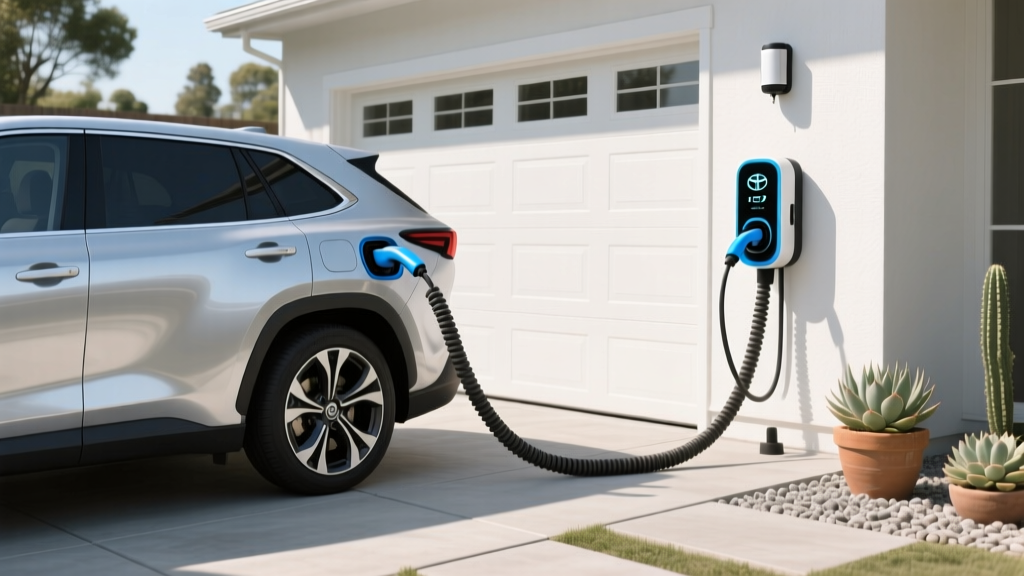
For Highlander EV owners, the NACS connector means:
- Native Tesla Supercharger access for DC fast charging — no adapter required at V3/V4 Superchargers.
- A NACS-to-CCS adapter (available from Ford, Lectron, and others for ~$150–$250) for Electrify America or other CCS-based networks.
- Home Level 2 charging via a NACS wall connector or a J1772 charger with a J1772-to-NACS adapter (most home chargers now ship with NACS connectors or include the adapter).
Cost to Charge: Per-Mile Comparison vs. Gas
Charging costs vary enormously depending on where and when you plug in. Here's a realistic breakdown for a Highlander EV averaging 35 kWh/100mi:
| Scenario | $/kWh | Cost Per Mile | Annual (12,000 mi) |
|---|---|---|---|
| Home — Off-peak utility rate | $0.08–$0.12 | $0.028–$0.042 | $336–$504 |
| Home — Standard rate (no TOU) | $0.14–$0.18 | $0.049–$0.063 | $588–$756 |
| Public Level 2 (workplace, mall) | $0.20–$0.35 | $0.070–$0.123 | $840–$1,476 |
| DC Fast Charging (road trips) | $0.30–$0.55 | $0.105–$0.193 | N/A (occasional use) |
| Gas SUV (25 MPG, $3.40/gal) | — | $0.136 | $1,632 |
At home on off-peak rates, the Highlander EV costs roughly 70–80% less per mile than a comparable gas-powered three-row SUV. Even relying partly on public DC fast charging, the annual fuel savings typically exceed $800–$1,000.
Pro tip: Enroll in your utility's time-of-use (TOU) plan and schedule charging between 10 PM and 6 AM for the lowest rates. Most smart chargers (and the Toyota app) support scheduled charging natively.
Recommended Home Chargers for the Highlander EV
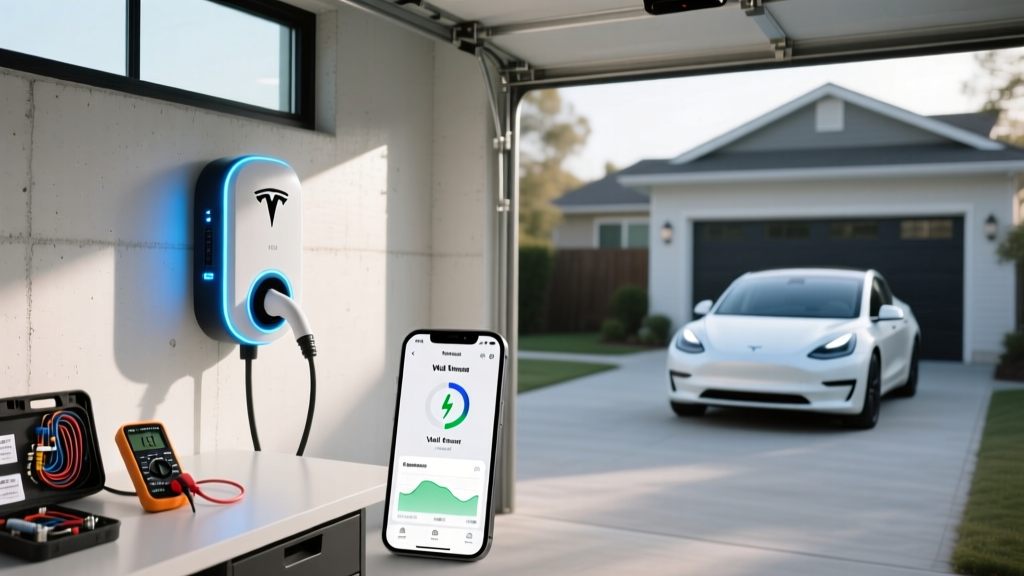
With a NACS connector and an 11.5 kW onboard charger, the Highlander EV pairs best with a 48-amp, 240V hardwired Level 2 charger. Here are our top picks based on reliability, features, and value:
Tesla Wall Connector (NACS)
- Power Output: 11.5 kW (48A)
- Connector: NACS native
- Cable Length: 24 ft
- Smart Features: Wi-Fi, OTA updates, power sharing between two units, access control
- Price: ~$475
- Best For: NACS vehicles; cleanest integration with Highlander EV
ChargePoint Home Flex (NACS)
- Power Output: Up to 12 kW (50A), adjustable down to 16A
- Connector: NACS (2025+ models) or J1772 with adapter
- Cable Length: 23 ft
- Smart Features: Wi-Fi, app scheduling, Alexa integration, flexible amperage
- Price: ~$599
- Best For: Flexibility — adjustable amperage fits panels with limited headroom
Emporia Level 2 Smart Charger
- Power Output: 11.5 kW (48A)
- Connector: J1772 (NACS adapter included) or NACS native
- Cable Length: 24 ft
- Smart Features: Wi-Fi, energy monitoring, solar integration, TOU scheduling
- Price: ~$399
- Best For: Budget-conscious buyers who want full smart features and energy tracking
Grizzl-E Smart (NACS)
- Power Output: 10 kW (40A)
- Connector: NACS
- Cable Length: 24 ft
- Smart Features: Wi-Fi, OCPP compatible, adjustable output
- Price: ~$449
- Best For: Cold-climate durability — rated to -40°F, built in Canada
Safety, Code & Installation Best Practices
A safe, code-compliant installation protects your home, your vehicle, and your insurance coverage. Key requirements:
- Dedicated circuit: Your Level 2 charger must be on its own dedicated double-pole breaker — never shared with other appliances.
- GFCI protection: NEC 2023 (and most 2026 local adoptions) requires GFCI protection for all EV charging outlets. Hardwired installations may be exempt in some jurisdictions, but a GFCI breaker is recommended regardless.
- Outdoor rating: If your charger is installed outdoors (driveway, exterior wall), it must carry a NEMA 4 or IP65 weather rating. All chargers listed above meet this standard.
- Permit required: Most jurisdictions require an electrical permit for EV charger installation. Skipping the permit can void homeowner's insurance claims related to electrical fires.
- Licensed electrician: Always use a licensed, insured electrician. Ask specifically about their EV charger installation experience — improper wire sizing or breaker matching is a fire hazard.
- Cable management: Use a wall-mounted holster or retractable cable system to prevent tripping hazards and cable damage from vehicles driving over cords.
Frequently Asked Questions
How much does it cost to install a home EV charger for the Highlander EV?
A standard Level 2 installation (48A charger, short wire run, no panel upgrade) typically costs $900–$2,600 including equipment, electrician labor, permit, and materials. If your home needs a panel upgrade from 100A to 200A service, add $1,500–$3,500+. The IRS alternative fuel refueling credit may offset up to $1,000 (30% of costs) if you're in an eligible census tract.
How fast will each charging level add range to the Highlander EV?
Level 1 (120V) adds roughly 3–5 miles per hour — essentially maintenance charging. Level 2 (240V, 48A) adds approximately 28–35 miles per hour, fully replenishing the battery overnight. DC fast charging at 150–175 kW can add 150+ miles in 15 minutes during peak charge rate, with a 10–80% session taking about 30–35 minutes.
Which connector and charger is compatible with the Highlander EV?
The Highlander EV uses the NACS (J3400) connector, giving it native access to Tesla Superchargers and any NACS-equipped public station. For CCS-based networks like Electrify America, you'll need a NACS-to-CCS adapter (~$150–$250). For home charging, any NACS Level 2 wall connector or J1772 charger with a J1772-to-NACS adapter will work.
How much does charging cost per mile compared to gas?
At home on off-peak utility rates ($0.08–$0.12/kWh), the Highlander EV costs roughly $0.03–$0.04 per mile. A comparable gas SUV at 25 MPG and $3.40/gallon costs about $0.14 per mile. That's a savings of approximately $0.10 per mile, or $1,200 annually at 12,000 miles driven. Public DC fast charging narrows the gap but is still typically cheaper than gasoline.
What electrical upgrades might I need for a Level 2 charger?
The most common upgrade is a panel capacity increase if your home has 100A or 150A service — this costs $1,500–$3,500+. You'll also need two adjacent breaker slots for the 240V double-pole breaker, and the wire run from panel to charger must be properly sized (typically 6 AWG copper for 48A). Homes built after 2000 with 200A service rarely need a panel upgrade. A licensed electrician's load calculation will determine your exact needs.
Does the Highlander EV qualify for the federal EV tax credit?
Federal §30D tax credit eligibility depends on multiple factors: the vehicle's MSRP must not exceed $80,000 (SUVs), buyer income must fall under caps ($150K single / $300K joint), and the battery must meet critical mineral and component sourcing requirements that tighten annually. The Highlander EV's expected MSRP of $48K–$55K clears the price cap. Verify current eligibility at IRS.gov and consult a tax professional, as sourcing rules change yearly. The credit can be transferred to the dealer at point of sale for an immediate price reduction.
Disclaimer: The Toyota Highlander EV specifications cited in this article are based on Toyota's announced estimates and preliminary data as of early 2026. Final EPA range, efficiency, and pricing will be confirmed upon the vehicle's official launch and EPA certification. Always verify current specifications with Toyota's official site and fueleconomy.gov.