The Toyota bZ4X delivers an EPA-estimated 252 miles of range in its FWD configuration, but achieving that number — or coming close to it on a daily basis — depends heavily on how you charge. Whether you're extracting every mile from the bZ4X's 71.4 kWh (usable) lithium-ion battery or simply trying to keep it topped up for a 40-mile commute, your charging setup is the single biggest variable you control.
This guide walks through the exact charging hardware, electrical requirements, connectors, and costs you need to know as a bZ4X owner or prospective buyer in 2026. We'll cover real-world range expectations, home installation realities, public charging speeds, and what you'll actually pay per mile.
The bZ4X FWD carries an EPA range of 252 miles (233 miles for AWD). In real-world highway driving at 70+ mph, expect ~210-225 miles. In freezing temperatures (below 32°F), range can drop to ~175-195 miles due to battery heating demands and cabin climate load. These figures assume no preconditioning — using the bZ4X's battery conditioning feature before DC fast charging or departure can recover some of that loss.
Understanding Charging Levels: How Fast Each Adds bZ4X Range
Before buying equipment, you need to understand the three charging tiers and what they mean in practical terms. The critical distinction: kW (kilowatts) measures power — how fast energy flows into the battery. kWh (kilowatt-hours) measures energy — the total capacity of the battery itself. Think of kW as the width of a pipe and kWh as the size of the tank you're filling.
| Level | Voltage / Power | bZ4X Charge Rate | Miles of Range Added/Hour | Best For |
|---|---|---|---|---|
| Level 1 | 120V / 1.4 kW | ~1.4 kW | ~4-5 mi/hr | Overnight trickle, emergencies |
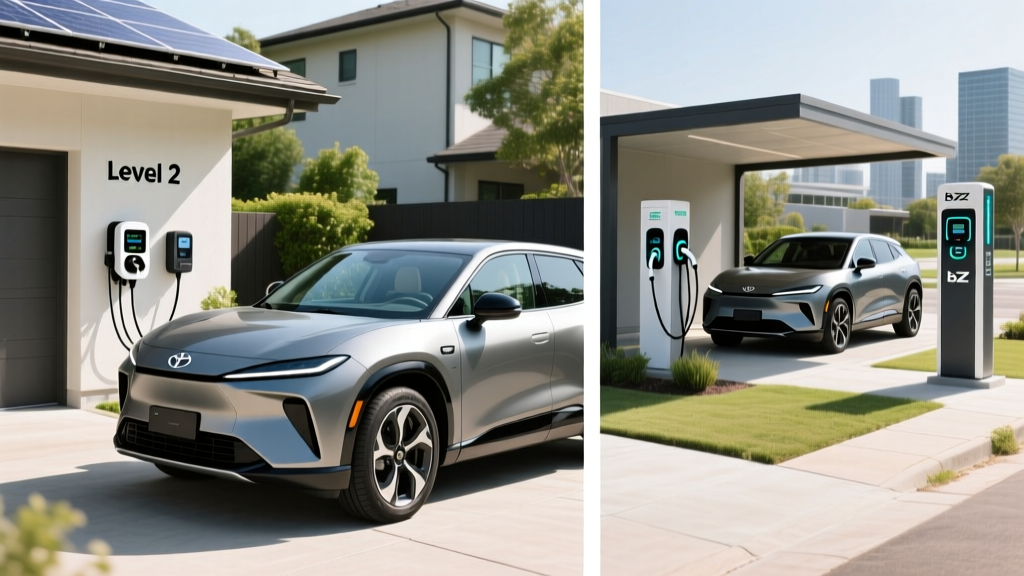
| Level 2 | 240V / 7.2-11.5 kW | ~6.6 kW (onboard limit) | ~22-25 mi/hr | Daily home charging |
| DC Fast | 400V+ / 50-350 kW | Peak ~150 kW | ~150+ mi in 30 min | Road trips, quick top-ups |
The bZ4X's onboard charger maxes out at 6.6 kW on Level 2, meaning even if you install a 48-amp (11.5 kW) home charger, the car will only accept 6.6 kW. This is an important spec to internalize: a full charge from 10% to 100% on Level 2 takes approximately 10-11 hours. For most owners charging overnight from 20-80%, that's roughly 7-8 hours — perfectly adequate for daily use.
On DC fast charging, the bZ4X peaks at roughly 150 kW under ideal thermal conditions, achieving a 10-80% charge in approximately 30 minutes. However, the charge curve tapers significantly above 80%, so charging to full on DC fast is both slow and unnecessary for battery longevity. Toyota's battery management system is conservative by design, which helps long-term state-of-health (SoH) but means you won't see the blistering 18-minute 10-80% times some competitors achieve.
Connector Compatibility: NACS, CCS, and the bZ4X
The 2025-2026 Toyota bZ4X ships with a CCS1 (Combined Charging System) port for both Level 2 (J1772 portion) and DC fast charging (CCS combo). Toyota has announced NACS adoption for future models, but the current bZ4X remains on CCS1. Here's what that means for your charging options:
| Connector | Used By | bZ4X Compatible? | Adapter Needed? |
|---|---|---|---|
| J1772 | Level 2 public & home chargers | Yes — native | No |
| CCS1 | Electrify America, EVgo, most non-Tesla DCFC | Yes — native | No |
| NACS (Tesla) | Tesla Superchargers (now open to non-Tesla via adapter) | Yes — with adapter | CCS-to-NACS adapter (~$200-$250) |
| CHAdeMO | Legacy Nissan Leaf infrastructure | No | N/A — network is being phased out |
Practical takeaway: The bZ4X's native CCS1 port works with the vast majority of public Level 2 and DC fast chargers in the US. If you want access to Tesla's Supercharger network (which has expanded NACS access to non-Tesla EVs via adapters), budget roughly $200-$250 for a certified CCS-to-NACS adapter from a reputable brand like Lectron or Tesla's own adapter when available. Per Toyota's official bZ4X page, always verify adapter compatibility with your specific model year before purchasing.
Home Charger Installation: Electrical Requirements and Real Costs
Installing a Level 2 home charger is the single highest-impact upgrade for bZ4X ownership. Here's the electrical reality:
Electrical Requirements
- Circuit: A dedicated 240V circuit, typically 40 amps (for a 32-amp continuous charger) or 50 amps (for a 40-amp charger). Since the bZ4X caps at 6.6 kW (~28 amps), a 40-amp circuit with a 32-amp charger is perfectly matched.
- Wire gauge: 8 AWG copper for a 40-amp circuit; 6 AWG for 50-amp.
- Panel capacity: Your home's main electrical panel needs sufficient spare capacity. Most modern 200-amp panels can accommodate a 40-amp EV circuit. Older 100-amp panels often cannot.
- Permit: Nearly all jurisdictions require an electrical permit for a new 240V circuit. This is non-negotiable for code compliance and insurance validity.
Installation Cost Breakdown
The total cost varies dramatically based on your home's electrical infrastructure. Here's a realistic range based on 2025-2026 national averages:
| Component | Simple Install (panel nearby) | Complex Install (long run / panel upgrade) |
|---|---|---|
| Level 2 charger (hardware) | $350 – $650 | $350 – $650 |
| Electrician labor (240V circuit) | $400 – $800 | $1,200 – $2,500 |
| Electrical permit | $50 – $150 | $50 – $200 |
| Panel upgrade (if needed) | $0 | $1,500 – $3,500 |
| Conduit/wire materials | $100 – $200 | $300 – $600 |
| Total | $900 – $1,800 | $3,400 – $7,450 |
If your home has a 100-amp service panel — common in homes built before the 1990s — adding a 40-amp dedicated EV circuit may exceed your panel's capacity, especially if you're also running electric dryers, ranges, or HVAC. An upgrade to 200 amps costs $1,500-$3,500 but adds significant home value. Always get a licensed electrician's load calculation before assuming your panel can handle the circuit. Some utilities offer rebates that offset panel-upgrade costs.
Safety and Code Considerations
- Dedicated circuit: The NEC (National Electrical Code) requires EV chargers to be on a dedicated circuit — not shared with other appliances.
- GFCI protection: NEC 2020 and later require GFCI (Ground Fault Circuit Interrupter) protection for outdoor receptacles and many indoor EV installations. Most quality Level 2 chargers have built-in GFCI.
- Outdoor rating: If your charger mounts outside (garage exterior, driveway post), it must carry a NEMA 4 or NEMA 4X weatherproof rating. All recommended chargers below meet this standard.
- Hardwired vs. plug: Hardwired installations (no plug, direct wire connection) are preferred for circuits above 40 amps and provide a cleaner, more reliable connection. A NEMA 14-50 receptacle is the standard plug option for 40-50 amp circuits.
Recommended Level 2 Chargers for the bZ4X
Since the bZ4X accepts a maximum of 6.6 kW on Level 2, you don't need the most powerful charger on the market. A 32-amp (7.7 kW capable) unit is ideal — it covers the bZ4X's limit with headroom, and is future-proof if you add a second EV that accepts higher rates. Here are three proven options:
Emporia Vue / Emporia Level 2 Charger
- Power output: Up to 48 amps (11.5 kW) — bZ4X will draw 28 amps (6.6 kW)
- Connector: J1772 (native for bZ4X)
- Cable length: 24 feet
- Smart features: Wi-Fi, scheduling, energy monitoring, solar integration
- Price: ~$399
- Best for: Budget-conscious buyers who want smart scheduling and energy tracking
ChargePoint Home Flex
- Power output: Configurable 16-50 amps (up to 12 kW) — set to 32A for bZ4X
- Connector: J1772 (or NACS version available)
- Cable length: 23 feet
- Smart features: Wi-Fi, Alexa, scheduling, amperage adjustment via app
- Price: ~$549-$649
- Best for: Flexibility — adjustable amperage lets you match any circuit and future EV
Grizzl-E Smart
- Power output: Up to 40 amps (9.6 kW)
- Connector: J1772
- Cable length: 24 feet
- Smart features: Wi-Fi, OCPP compatibility, robust cold-weather performance
- Price: ~$449
- Best for: Cold-climate owners — built in Canada, rated to -40°F operation
For bZ4X owners, any of these three will deliver a full overnight charge reliably. The ChargePoint Home Flex edges ahead for its adjustable amperage, which lets you dial the unit to your exact circuit capacity — useful if your electrician recommends a 30-amp or 35-amp circuit instead of 40.
Cost to Charge: bZ4X Per-Mile Cost vs. Gas
The bZ4X's efficiency rating is approximately 119 MPGe combined (FWD), translating to roughly 28 kWh per 100 miles driven, per fueleconomy.gov. Using that consumption figure, here's what charging actually costs across different scenarios:
| Charging Scenario | Rate ($/kWh) | Cost per 100 Miles | Cost per Mile |
|---|---|---|---|
| Home (off-peak utility rate) | $0.09 | $2.52 | $0.025 |
| Home (national avg. residential) | $0.16 | $4.48 | $0.045 |
| Public Level 2 (network average) | $0.25 | $7.00 | $0.070 |
| DC Fast (Electrify America peak) | $0.48 | $13.44 | $0.134 |
| DC Fast (Tesla Supercharger avg.) | $0.35 | $9.80 | $0.098 |
| Gas equivalent (25 MPG @ $3.50/gal) | — | $14.00 | $0.140 |
The bottom line: Charging at home on off-peak rates, the bZ4X costs roughly $0.025 per mile — about 5.5x cheaper than a comparable gas SUV at 25 MPG. Even on public DC fast chargers, you're generally paying less per mile than gas. The worst-case scenario (peak-rate DC fast charging) approaches gas parity, which is why home charging is the economic cornerstone of EV ownership.
For a driver covering 12,000 miles annually with primarily home charging at the national residential average, annual fuel cost is approximately $540 — versus $1,680 for a 25 MPG gas vehicle at $3.50/gallon. That's over $1,100 in annual savings before factoring in reduced maintenance (no oil changes, fewer brake replacements thanks to regenerative braking).
DC Fast Charging Tips: Maximizing bZ4X Range on Road Trips
The bZ4X's DC fast charging peak of ~150 kW is respectable but not class-leading. To get the most from it:
- Precondition the battery. If your bZ4X model year supports navigation-based battery preconditioning, set a DC fast charger as your destination. The car will warm the battery to optimal temperature, significantly improving charge speed — especially in cold weather where an unconditioned battery might peak at only 50-70 kW.
- Charge in the 10-80% window. The bZ4X's charge curve tapers sharply above 80%. A 10-80% session takes ~30 minutes; pushing from 80-100% can add another 25-30 minutes. Plan your stops accordingly.
- Use PlugShare or A Better Routeplanner. These apps show real-time charger availability, reported speeds, and user reviews — critical for avoiding broken stalls on PlugShare.
- Factor in real-world range. On a highway road trip at 75 mph with A/C running, plan for ~210 miles of usable range (FWD) and charge when you hit ~20% remaining. This gives you a comfortable buffer and keeps you in the fastest part of the charge curve.
Frequently Asked Questions
How much does it cost to install a home EV charger for my bZ4X?
For a straightforward installation with a 200-amp panel and short wire run, expect $900-$1,800 total (charger + electrician + permit). If your home needs a panel upgrade or has a long conduit run from the panel to the garage, costs can reach $3,400-$7,450. Always get 2-3 electrician quotes and ask about local utility rebates, which can offset $200-$500 of the cost.
How fast will each charging level add range to my bZ4X?
Level 1 (120V standard outlet): ~4-5 miles per hour — a full overnight charge adds only ~40-50 miles. Level 2 (240V home charger): ~22-25 miles per hour — an 8-hour overnight session fully replenishes the battery. DC Fast Charging: ~150 miles in 30 minutes at peak speed (10-80% SoC).
Which connector and charger is compatible with the Toyota bZ4X?
The bZ4X uses a CCS1 port, which includes J1772 for Level 2 and CCS combo for DC fast charging. Any J1772 Level 2 home charger works natively. For Tesla Supercharger access, you'll need a CCS-to-NACS adapter (~$200-$250). CHAdeMO is not compatible and is being phased out across the US.
How much does charging the bZ4X cost per mile compared to gas?
At home on the national average electricity rate ($0.16/kWh), the bZ4X costs approximately $0.045 per mile. A comparable gas SUV at 25 MPG and $3.50/gallon costs $0.14 per mile — roughly 3x more. Off-peak home charging drops the bZ4X to ~$0.025/mile. Public DC fast charging ranges from $0.098-$0.134/mile, still competitive with or cheaper than gas.
What electrical upgrades might I need for a home charger?
The most common upgrade is a panel capacity increase from 100 amps to 200 amps ($1,500-$3,500), required when your existing panel lacks spare capacity for a dedicated 40-amp circuit. Other potential upgrades include replacing an outdated fuse box with a modern breaker panel, adding a sub-panel in an attached garage, or upgrading service entrance wiring. A licensed electrician's load calculation will determine exactly what your home requires.
Does the federal tax credit cover home charger installation?
The IRS §30D credit covers vehicle purchases, not charger hardware. However, the separate Alternative Fuel Infrastructure Tax Credit (IRC §30C) was reinstated and can cover up to 30% of home charger equipment and installation costs (up to $1,000 for residential). Eligibility depends on your census tract meeting certain criteria. Consult a tax professional and check current IRS guidance on §30C for your situation.