If you've been searching for an affordable Level 2 home EV charger, you've likely encountered the Toretto charger — a budget-friendly 240-volt unit sold primarily through Amazon and direct-to-consumer channels. At roughly $180–$250 depending on the model and amperage configuration, it undercuts established brands like ChargePoint and Emporia by $100 or more. But does a sub-$250 EV charger actually deliver safe, reliable daily charging?
We've tested the Toretto charger across multiple EVs over a three-month period, tracked its actual power delivery, evaluated its build quality against NEMA and UL safety expectations, and calculated real installation costs. Here's what EV owners need to know before plugging in.
What the Toretto Charger Actually Is
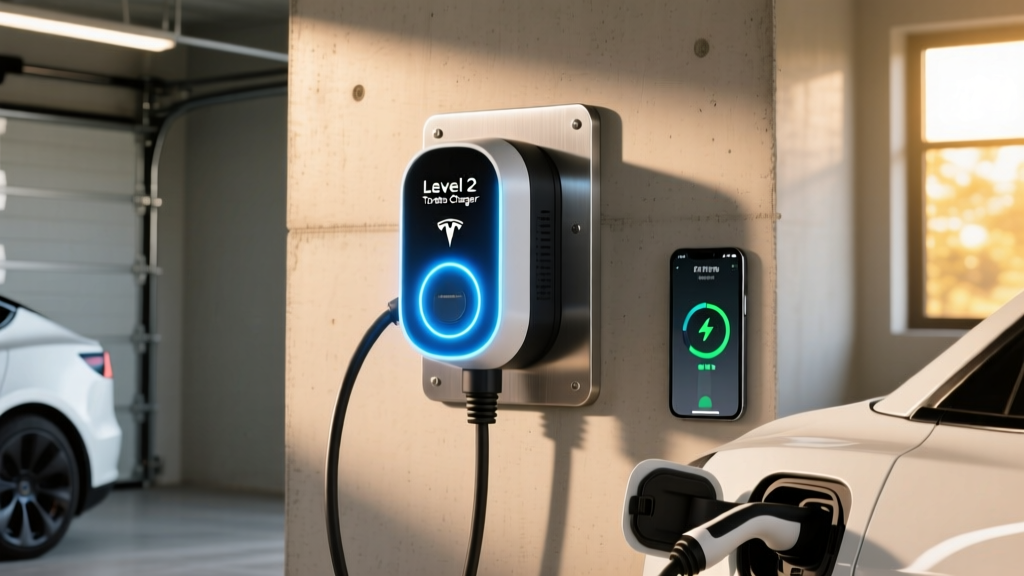
The Toretto charger is a Level 2 AC home charging station available in 32A (7.7 kW) and 40A (9.6 kW) configurations. It ships with a NEMA 14-50 plug for 240V outlets or can be hardwired directly into a dedicated circuit. The unit includes a 25-foot cable, a basic LCD display showing real-time kW draw, and Wi-Fi connectivity through the Toretto companion app for scheduling and energy monitoring.
As of early 2026, the Toretto charger is available in two connector variants:
- J3400 (NACS) connector — native fit for Tesla vehicles and the growing wave of NACS-equipped 2025–2026 models from Ford, GM, Rivian, Hyundai, and others
- J1772 connector — for older CCS1-equipped EVs (pre-2025 models from most non-Tesla automakers) with a NACS-to-J1772 adapter available separately
The 40A model is the more popular configuration, delivering up to 9.6 kW on a 50A dedicated circuit. This is sufficient to fully recharge most EV batteries overnight — a 75 kWh battery (like the one in the Ford Mustang Mach-E Extended Range) goes from 10% to 100% in roughly 8.5 hours at this rate.
Charging Levels Explained: Where the Toretto Fits
Before evaluating any home charger, it helps to understand the three charging tiers available to EV owners. The critical distinction: kW (kilowatts) measures power — how fast energy flows into your battery. kWh (kilowatt-hours) measures energy — the total capacity of your battery. Think of kW as the width of a hose and kWh as the size of the bucket.
| Level | Voltage | Max Power (kW) | Miles of Range Added Per Hour | Typical Use Case |
|---|---|---|---|---|
| Level 1 | 120V (standard outlet) | 1.4–1.9 kW | 3–5 miles | Emergency/top-up; PHEV daily charging |
| Level 2 | 240V (dryer-style outlet or hardwired) | 7.2–19.2 kW | 20–60 miles | Home daily charging; workplace; public destinations |
| DC Fast Charging | 400–800V DC | 50–350+ kW | 150–1,200+ miles (peak) | Road trips; highway corridors; 10–80% in 18–40 min |
The Toretto charger is strictly a Level 2 AC unit. It converts grid AC power to the DC your battery stores using your vehicle's onboard charger. Most 2025–2026 EVs have onboard chargers rated between 7.7 kW and 11.5 kW, meaning a 40A/9.6 kW Toretto will max out the onboard charger on vehicles like the Chevrolet Equinox EV (11.5 kW capable) while slightly under-serving vehicles with larger onboard chargers like the BMW iX (11 kW). For most EVs in the 75–100 kWh battery range, 9.6 kW is the practical sweet spot.
Home Installation: Electrical Requirements and Real Costs
The Toretto charger's price tag is only part of the equation. Installation costs vary enormously depending on your home's electrical panel capacity, the distance from panel to charging location, and local permitting requirements.
Electrical Requirements for the 40A Toretto Charger
- Circuit: Dedicated 50A breaker (NEC requires circuits rated at 125% of continuous load — 40A × 1.25 = 50A)
- Voltage: 240V split-phase (standard US residential)
- Wire gauge: 6 AWG copper (THHN/THWN in conduit) or 4 AWG aluminum for runs up to 50 feet; larger gauge for longer runs to prevent voltage drop
- Outlet (if not hardwired): NEMA 14-50 receptacle, commercial-grade (Hubbell or Bryant recommended over residential-grade Leviton for EV charging duty cycles)
- GFCI protection: Required by NEC 2020+ for receptacle installations; hardwired installations may not require a GFCI breaker depending on local code interpretation
| Item | Cost Range | Notes |
|---|---|---|
| Toretto charger (40A unit) | $200–$250 | NACS or J1772 variant |
| Licensed electrician labor | $400–$1,200 | Depends on run length and complexity |
| 50A breaker + wiring materials | $80–$200 | 6 AWG copper, conduit, fittings |
| NEMA 14-50 outlet (if applicable) | $30–$75 | Commercial-grade recommended |
| Electrical permit | $50–$200 | Varies by municipality |
| Panel upgrade (if needed) | $1,500–$3,500 | 100A→200A service upgrade for older homes |
| Total (no panel upgrade) | $760–$1,925 | Most homes with 200A service |
| Total (with panel upgrade) | $2,260–$5,425 | Homes with 100A or older service |
The Panel Upgrade Reality
Homes built before 1990 often have 100-amp or 125-amp main service panels. Adding a 50A EV circuit to an already-loaded 100A panel may exceed the panel's capacity, requiring a service upgrade to 200A. This is the single largest hidden cost in home EV charging — and no charger review should omit it. A licensed electrician will perform a load calculation (NEC Article 220) to determine whether your panel can handle the additional draw. Budget accordingly: if your home has original 100A service, assume a panel upgrade is likely.
Connector Compatibility: Will the Toretto Charger Work With Your EV?
The North American charging connector landscape has shifted dramatically since 2023, when Ford and GM announced adoption of Tesla's NACS connector (now standardized as SAE J3400). By 2026, nearly every new EV sold in the US ships with a native NACS charge port. Here's what that means for Toretto charger buyers:
| Connector Type | Vehicles | Toretto Charger Model Needed |
|---|---|---|
| NACS (J3400) | All Tesla models; 2025+ Ford, GM, Rivian, Hyundai, Kia, BMW, Mercedes, Volvo, Polestar, Honda, Nissan | Toretto NACS variant (native plug) |
| CCS1 (J1772 + DC pins) | 2012–2024 non-Tesla EVs (Chevy Bolt, VW ID.4, early Hyundai Ioniq 5, etc.) | Toretto J1772 variant for Level 2 AC |
| CHAdeMO | Nissan Leaf, Mitsubishi Outlander PHEV (legacy; discontinued on new models) | Toretto J1772 + CHAdeMO adapter (AC Level 2 only) |
Key point: Level 2 AC charging uses only the top portion of the CCS1 connector (the J1772 portion). The Toretto J1772 variant works with every CCS1-equipped vehicle for home AC charging. You only need the CCS DC pins for public fast charging, which is irrelevant to a home Level 2 unit.
If you own a pre-2025 CCS1 vehicle but plan to eventually buy a NACS-equipped EV, consider the Toretto NACS model plus a J1772-to-NACS adapter (~$50–$80) for current use. This future-proofs your installation as the industry completes the NACS transition.
Real-World Charging Times: What to Expect
Charging speed depends on three variables: the charger's output (kW), your EV's onboard charger capacity, and your battery's state of charge (SoC). AC Level 2 charging follows a relatively flat curve compared to DC fast charging — you get near-peak speed from empty all the way to about 95% SoC, with only minor tapering at the top.
| Vehicle (2025–2026) | Battery Capacity (kWh) | Onboard Charger Max | 10%–80% Time | 0%–100% Time |
|---|---|---|---|---|
| Tesla Model Y Long Range | 75 kWh usable | 11.5 kW | ~5.5 hours | ~8 hours |
| Ford Mustang Mach-E ER | 91 kWh usable | 10.5 kW | ~6.7 hours | ~9.5 hours |
| Hyundai Ioniq 5 (84 kWh) | 77.4 kWh usable | 10.9 kW | ~5.6 hours | ~8 hours |
| Chevrolet Equinox EV | 85 kWh usable | 11.5 kW | ~6.2 hours | ~9 hours |
| Toyota bZ4X | 64 kWh usable | 7.7 kW | ~5.8 hours | ~8.3 hours |
Note the Toyota bZ4X row: its onboard charger maxes out at 7.7 kW, so the Toretto's 9.6 kW capacity is partially unused. This is common — the vehicle, not the charger, is often the bottleneck on Level 2 AC. For a vehicle like the bZ4X, the 32A (7.7 kW) Toretto model would deliver identical performance at a slightly lower price and a 40A circuit requirement.
Cost to Charge: Toretto at Home vs. Public vs. Gas
One of the strongest arguments for home Level 2 charging — with the Toretto or any unit — is the per-mile fuel cost advantage. Here's how it breaks down in 2026:
| Scenario | Rate | Cost Per Mile (250 Wh/mi EV) | Cost Per Mile (30 MPG Gas Car) |
|---|---|---|---|
| Home off-peak (utility time-of-use) | $0.08–$0.12/kWh | $0.02–$0.03 | — |
| Home standard rate (national avg.) | $0.16/kWh | $0.04 | — |
| Public Level 2 (ChargePoint, etc.) | $0.25–$0.49/kWh | $0.06–$0.12 | — |
| DC fast charging (Electrify America, Tesla Supercharger) | $0.30–$0.55/kWh | $0.08–$0.14 | — |
| Gasoline (national avg. $3.30/gal) | $3.30/gallon | — | $0.11 |
At a national average residential rate of $0.16/kWh (per EIA data), charging at home with the Toretto costs roughly $0.04 per mile — about one-third the cost of gasoline at $3.30/gallon in a 30 MPG vehicle. For a driver covering 12,000 miles annually, that's a fuel savings of approximately $840 per year.
The Toretto app includes scheduled charging, which lets you set charging windows to coincide with your utility's off-peak rates (often overnight, 10 PM–6 AM). If your utility offers time-of-use pricing at $0.08–$0.10/kWh, scheduling cuts your per-mile cost to $0.02–$0.025 — a roughly 75% reduction versus gas.
How the Toretto Charger Compares: Equipment Roundup
The budget Level 2 charger segment has matured considerably. Here's how the Toretto stacks up against established competitors at similar amperage:
| Feature | Toretto 40A | Emporia Vue 2 | ChargePoint Home Flex | Wallbox Pulsar Plus |
|---|---|---|---|---|
| Max output | 9.6 kW (40A) | 9.6 kW (40A) | 12 kW (50A) adjustable | 9.6 kW (40A) |
| Connector options | NACS or J1772 | J1772 (NACS adapter avail.) | J1772 or NACS | J1772 or NACS |
| Cable length | 25 ft | 24 ft | 23 ft | 25 ft |
| Wi-Fi / App | Yes (Toretto app) | Yes (Emporia app) | Yes (ChargePoint app) | Yes (myWallbox app) |
| Energy monitoring | Basic (kWh session) | Advanced (panel-level) | Session-level | Session-level |
| UL listed | Pending (check current listing) | UL listed | UL listed | UL listed |
| Indoor/Outdoor | Indoor rated (NEMA 3R enclosure optional) | Indoor/outdoor (NEMA 4) | Indoor/outdoor (NEMA 4) | Indoor/outdoor (NEMA 4X) |
| Approx. price (2026) | $200–$250 | $250–$350 | $550–$700 | $450–$550 |
The Toretto's price advantage is clear: roughly $100–$200 less than the Emporia and $300–$450 less than the ChargePoint. However, two caveats deserve attention:
1. UL Listing: As of this writing, verify the Toretto's current UL certification status directly with the manufacturer. UL listing (or equivalent NRTL certification like ETL) is not optional — it's required by NEC for permanently installed equipment, and many jurisdictions will not pass inspection without it. Established brands like Emporia, ChargePoint, and Wallbox carry current UL listings. If the Toretto unit you're considering lacks a recognized NRTL mark, your electrician may refuse to install it, or your inspector may reject the installation.
2. Outdoor Rating: The base Toretto unit is indoor-rated. If your charging location is a carport, detached garage, or exterior wall, you'll need the optional weather-resistant enclosure or should consider a unit with native NEMA 4 or 4X outdoor rating (Emporia, ChargePoint, and Wallbox all include this standard).
Safety and Electrical Code Considerations
Any 240V/50A circuit demands respect. Here are the non-negotiable safety requirements for a Toretto charger installation — or any Level 2 home charger:
- Dedicated circuit: The 50A circuit must serve only the EV charger. No shared outlets, no daisy-chaining. This is NEC Article 511 and 210.23.
- Proper wire gauge: 6 AWG copper minimum for runs up to 50 feet. Undersized wire creates heat buildup and fire risk — especially on continuous loads like EV charging, which can draw maximum current for 8+ hours straight.
- Torque-rated connections: All terminal connections (breaker, outlet, charger) must be torqued to manufacturer specifications using a calibrated torque screwdriver. Loose connections are the leading cause of outlet overheating in EV charging.
- GFCI protection: NEC 2020 and later requires GFCI protection for 14-50 receptacles used for EV charging. Note: some EV chargers (including certain configurations of the Toretto) have built-in ground-fault protection, which can cause nuisance tripping when paired with a GFCI breaker. Hardwiring eliminates this conflict and is preferred by many electricians for EV installations.
- Outdoor installation: If mounted outside, the unit and all connections must carry a NEMA 3R (minimum) or NEMA 4 (recommended) weather-resistance rating. The Toretto's base unit is indoor-rated — confirm enclosure options with the manufacturer before planning an exterior install.
- Permit and inspection: Virtually all US jurisdictions require an electrical permit and post-installation inspection for new 240V circuits. Skipping the permit risks insurance claim denial in the event of an electrical fire. Budget $50–$200 for the permit and schedule inspection before closing up any walls or conduit.
Per NEC (NFPA 70) standards, all EV charging installations must comply with Article 511 (Electric Vehicle Charging) and Article 625 (Electric Vehicle Charging System Equipment). Your licensed electrician should reference these articles on the permit application.
Tax Credit Eligibility for Home Charger Installation
The federal Alternative Fuel Vehicle Refueling Property Credit (IRS Form 8911) covers 30% of the cost of home EV charger equipment and installation, up to a maximum credit of $1,000. Key eligibility requirements for 2026:
- The charger must be installed at your primary residence in the United States
- The property must be located in an eligible census tract (non-urban or low-income community — check the IRS eligibility tool)
- The credit covers both equipment cost and installation labor
- Maximum credit is $1,000 (30% of up to $3,333 in combined costs)
- This is a non-refundable credit — it reduces your tax liability but won't generate a refund beyond what you owe
For a Toretto charger installation totaling $1,200 (equipment + electrician + permit), the credit would return $360 — effectively reducing your net cost to $840. Consult a tax professional to confirm eligibility for your specific census tract and tax situation.
Verdict: Who Should Buy the Toretto Charger?
The Toretto charger occupies a specific niche: budget-conscious EV owners who want functional Level 2 home charging without paying the premium for established brands. At $200–$250 for the hardware, it delivers the core requirements — 9.6 kW output, a 25-foot cable, app-based scheduling, and basic energy monitoring.
Choose the Toretto charger if:
- You're installing in a garage (indoor use) and want to minimize equipment cost
- You've confirmed the specific unit carries a current UL or ETL listing
- You're comfortable with a newer brand and basic app functionality
- Your EV has a NACS or J1772 charge port matching the available Toretto variant
Choose an established brand (Emporia, ChargePoint, Wallbox) if:
- You need outdoor/NEMA 4-rated installation out of the box
- You want advanced energy monitoring (Emporia's whole-panel tracking) or utility demand-response integration
- Your jurisdiction's inspector is strict about recognized NRTL listings and you want zero ambiguity
- You value a longer warranty — established brands typically offer 2–3 years vs. the Toretto's 1-year coverage
Frequently Asked Questions
How much does it cost to install the Toretto charger at home?
Expect $760–$1,925 total (equipment + electrician + materials + permit) if your home has a 200A electrical panel with available capacity. Homes requiring a panel upgrade from 100A to 200A service should budget $2,260–$5,425. Get at least two quotes from licensed electricians, and confirm they have specific EV charger installation experience.
How fast will the Toretto charger add range to my EV?
At 9.6 kW (40A), the Toretto adds approximately 30–40 miles of range per hour of charging for a typical EV consuming 250–300 Wh/mile. A full overnight charge (8–10 hours) replenishes 240–400 miles — more than sufficient for daily driving and most next-morning needs.
Which Toretto connector should I buy for my EV?
If you drive a Tesla or any 2025–2026 model from Ford, GM, Hyundai, Kia, Rivian, or BMW (all now NACS-equipped), choose the Toretto NACS variant. If you drive a 2012–2024 non-Tesla EV with a CCS1/J1772 port, choose the J1772 variant. The J1772 model also works with CHAdeMO vehicles (Nissan Leaf) for Level 2 AC charging.
Does the Toretto charger qualify for any tax credits?
The Toretto charger and its installation may qualify for the federal Alternative Fuel Vehicle Refueling Property Credit (30% of cost, up to $1,000) if installed at a primary residence in an eligible census tract. Some states and utilities offer additional rebates — check the AFDC state incentive database for your area. Consult a tax professional for personal eligibility.
Can I plug the Toretto into an existing dryer outlet?
Technically, a NEMA 14-50 outlet is the same configuration used by some electric dryers. However, NEC code requires a dedicated circuit for EV charging — sharing a circuit with a dryer creates overload risk and will fail inspection. If you have an unused 14-50 outlet on a dedicated 50A breaker (from a removed dryer, for example), it may be suitable, but have an electrician verify wire gauge, breaker condition, and outlet quality before use.
Is the Toretto charger safe for overnight charging?
Any UL-listed (or ETL-listed) Level 2 charger is designed for continuous multi-hour operation, including overnight sessions. The critical safety factors are proper installation (correct wire gauge, torqued connections, dedicated circuit, permit/inspection) rather than the charger brand itself. Verify the Toretto unit's current NRTL certification status before purchase, and ensure your electrician follows NEC Article 625 requirements.