The EV Charging Landscape Has Shifted — Here's Who's Winning in 2026
If you searched for the ev magazine top ev charging companies september 21 2024 rankings, you were looking at a snapshot of an industry that has since undergone a tectonic shift. The North American Charging Standard (NACS) has all but absorbed CCS1 as the dominant connector, Tesla's Supercharger network opened fully to non-Tesla vehicles, and several networks have consolidated or expanded dramatically. This 2026 guide cuts through the marketing to rank the major charging companies by what actually matters to EV owners: uptime, charge speed, connector availability, pricing transparency, and geographic coverage.
Before we rank the networks, let's ground the discussion in the physics and economics of charging — because picking a network means nothing if you don't understand what your car can actually accept.
Charging Levels Explained: kW, kWh, and Miles Per Hour
The single most important distinction in EV charging is between kW (kilowatts) — the rate of power delivery, like the diameter of a hose — and kWh (kilowatt-hours) — the total energy stored in your battery, like the size of the tank. A 150 kW charger doesn't put 150 kWh into your car; it delivers energy at a rate of 150 kilojoules per second. Your battery's capacity in kWh determines how long charging takes at a given kW rate.
| Level | Voltage | Power (kW) | Miles of Range Per Hour | Typical Use Case |
|---|---|---|---|---|
| Level 1 (120V) | 120V AC | 1.0–1.4 kW | 3–5 mi/hr | Overnight trickle; PHEVs; emergency backup |
| Level 2 (240V) | 240V AC | 3.3–19.2 kW | 12–75 mi/hr | Home daily charging; workplace; shopping centers |
| DC Fast Charge | 400–800V DC | 50–350 kW | 150–1,000+ mi/hr (peak) | Road trips; rapid top-ups; fleet depots |
Real-world caveat: Those "miles per hour" figures assume peak sustained power. DC fast charging follows a charge curve — your car might peak at 250 kW from 10-40% State of Charge (SoC), then taper to 150 kW, then drop to 50 kW above 80%. That's why manufacturers and reviewers quote 10-80% charge times rather than peak kW alone. A car with a 250 kW peak but a flat charge curve (like Hyundai/Kia's 800V E-GMP platform) will beat a car with a 350 kW peak that tapers aggressively.
Ranking the Top EV Charging Companies in 2026
We evaluated the major U.S. networks on five criteria weighted by real ownership impact: uptime/reliability (30%), charge speed availability (25%), connector coverage (20%), pricing transparency (15%), and geographic density (10%). Here's how they stack up.
1. Tesla Supercharger Network — The Reliability Benchmark
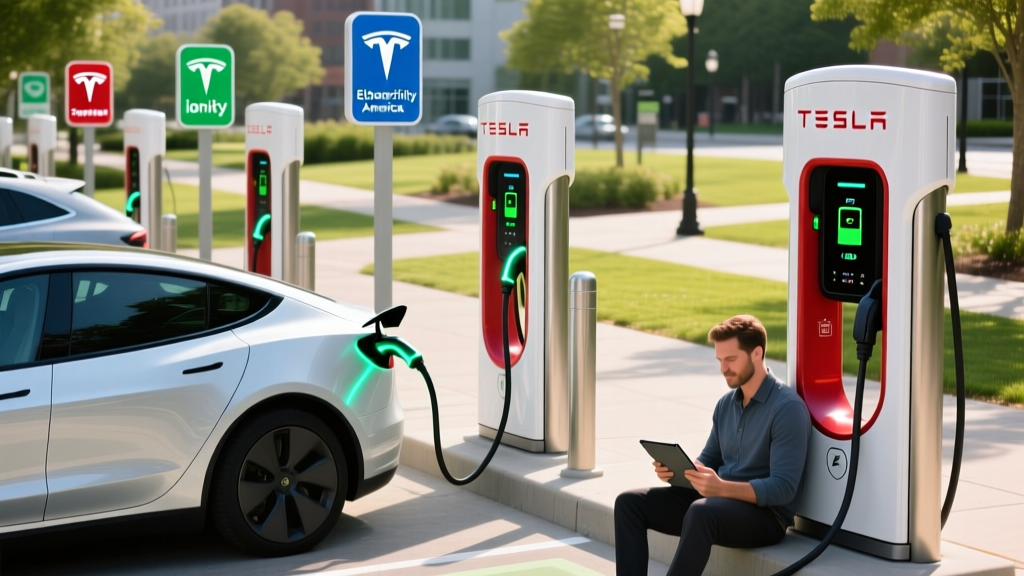
Tesla's Supercharger network remains the gold standard for uptime and ease of use, now serving the broader EV market through NACS adoption. As of early 2026, Tesla operates over 6,500 Supercharger stalls across North America, with the majority now equipped with the Magic Dock adapter for CCS1 vehicles that haven't yet switched to native NACS ports.
- Peak power: 250 kW (V3/V4 stalls); 325+ kW at newer V4 sites
- Connector: NACS (native); CCS1 via Magic Dock adapter
- Pricing: $0.25–$0.48/kWh depending on location and time-of-use; idle fees of $0.50–$1.00/min
- Uptime: ~97%+ — consistently the highest in the industry
- Best for: Road-trippers who value plug-and-charge reliability over lowest cost
The opening of Superchargers to non-Tesla vehicles has been the most significant charging-network event since Electrify America launched. The catch: not every Supercharger stall is compatible with every non-Tesla EV due to parking geometry (short cables designed for Tesla's charge-port location). Tesla's app and in-car navigation now show which specific stalls support non-Tesla vehicles.
2. Electrify America — Broadest Non-Tesla DC Fast Network
Electrify America (EA), the Volkswagen-funded network born from the Dieselgate settlement, has matured significantly. After a rocky 2022-2023 period plagued by broken chargers and payment glitches, EA's 2024-2025 infrastructure refresh and transition to NACS connectors have improved the experience meaningfully.
- Peak power: 150 kW and 350 kW stalls at most stations; newer sites feature 400+ kW chargers
- Connector: NACS (primary, as of 2025+ stations); CCS1 (legacy); CHAdeMO (phased out at most new sites)
- Pricing: $0.35–$0.57/kWh; Pass+ subscription ($7/month) reduces rates by ~25%
- Uptime: ~90-93% (improved from ~85% in 2023)
- Best for: Non-Tesla EV owners on road trips; Walmart/Target parking lot convenience
3. EVgo — Urban and Highway Corridor Coverage
EVgo has carved out a niche as the go-to network for urban DC fast charging and highway corridor coverage, particularly through partnerships with GM (Ultium Charge 360) and Toyota. Their stations tend to cluster in metro areas and along major interstates.
- Peak power: 100 kW, 175 kW, and 350 kW (at newer "ReNew" and flagship stations)
- Connector: NACS and CCS1 at most locations; some legacy CHAdeMO
- Pricing: $0.30–$0.52/kWh; EVgo Plus subscription plans available
- Uptime: ~88-92%
- Best for: Urban apartment dwellers without home charging; GM and Toyota EV owners with bundled credits
4. ChargePoint — The Level 2 King, DC Fast Challenger
ChargePoint dominates the Level 2 landscape — you'll find their blue-branded stations at workplaces, shopping centers, hotels, and parking garages nationwide. Their DC fast-charging footprint is smaller but growing, and their app's real-time availability data is among the best in the industry.
- Level 2 power: 6.6–19.2 kW (site-dependent)
- DC Fast power: 62.5–400 kW (Express stations)
- Connector: NACS, CCS1, J1772 (Level 2); CHAdeMO at older sites
- Pricing: Set by site host — varies wildly from free to $0.49/kWh; always check the app
- Uptime: ~92-95% for Level 2; ~85-90% for DC fast
- Best for: Destination and workplace charging; supplementing home Level 2
5. Emerging Networks: Ionna, Mercedes-Benz HPC, and Pilot/Flying J
Several newer entrants are reshaping the competitive landscape. Ionna — a joint venture between BMW, GM, Honda, Hyundai, Kia, Mercedes-Benz, and Stellantis — began deploying stations in late 2024 and has ramped up through 2025-2026 with high-power chargers and premium amenities. Mercedes-Benz High Power Charging has opened stations in select metro areas with 400 kW chargers and a luxury-oriented experience. Pilot and Flying J travel centers, backed by GM and EVgo, continue expanding DC fast chargers along interstate truck-stop corridors — a game-changer for long-haul EV road trips.
Connector Compatibility: NACS, CCS1, and CHAdeMO in 2026
The connector landscape has consolidated dramatically. NACS (North American Charging Standard, originally Tesla's proprietary connector) is now the de facto standard for nearly every automaker selling in the U.S. as of the 2025-2026 model years. Here's where each brand stands:
| Automaker | Native Connector (2026 Models) | Adapter Needed for Tesla Superchargers? | Adapter Needed for Legacy CCS1 Stations? |
|---|---|---|---|
| Tesla | NACS | No | Yes (NACS-to-CCS adapter, ~$200) |
| Ford | NACS | No | Yes (NACS-to-CCS adapter) |
| GM (Chevy/Cadillac/GMC) | NACS | No | Yes (NACS-to-CCS adapter) |
| Hyundai / Kia / Genesis | NACS | No | Yes (NACS-to-CCS adapter) |
| Rivian | NACS | No | Yes (NACS-to-CCS adapter) |
| BMW | NACS | No | Yes (NACS-to-CCS adapter) |
| Mercedes-Benz | NACS | No | Yes (NACS-to-CCS adapter) |
| Volkswagen / Audi | NACS | No | Yes (NACS-to-CCS adapter) |
| Nissan (Leaf, Ariya) | CHAdeMO (Leaf) / NACS (Ariya 2025+) | Adapter required (Leaf) | Leaf: CHAdeMO stations only |
| 2023-2024 CCS1 models (used) | CCS1 | Yes (CCS-to-NACS adapter, ~$200-250) | No |
Key takeaway: If you're buying a new 2025-2026 EV, it almost certainly has a NACS port. If you own a 2023-2024 model with CCS1, you'll need a CCS-to-NACS adapter (sold by Ford, Tesla, and third parties like Lectron and A2Z) to access the Supercharger network. CHAdeMO is effectively a legacy standard — the Nissan Leaf remains the primary vehicle using it, and new CHAdeMO station deployments have nearly ceased.
How Much Does EV Charging Actually Cost Per Mile vs. Gas?
The cost advantage of EV charging over gasoline depends heavily on where and when you charge. Here's a breakdown using a 2026 Hyundai Ioniq 5 (3.5 mi/kWh efficiency) and a comparable gas vehicle at 28 MPG combined:
| Charging Scenario | Rate | Cost Per kWh | Cost Per Mile (Ioniq 5) | Gas Equivalent (28 MPG, $3.40/gal) |
|---|---|---|---|---|
| Home Level 2 (off-peak utility rate) | Time-of-use | $0.08–$0.12 | $0.023–$0.034 | $0.121 |
| Home Level 2 (standard residential rate) | Flat rate | $0.14–$0.18 | $0.040–$0.051 | $0.121 |
| Public Level 2 (workplace/shopping) | Per kWh | $0.15–$0.30 | $0.043–$0.086 | $0.121 |
| DC Fast (Tesla Supercharger, avg) | Per kWh | $0.30–$0.40 | $0.086–$0.114 | $0.121 |
| DC Fast (Electrify America / EVgo, peak) | Per kWh | $0.45–$0.57 | $0.129–$0.163 | $0.121 |
The math is clear: Home charging at off-peak rates is 70-80% cheaper per mile than gasoline. Even public DC fast charging at moderate rates ($0.30-$0.40/kWh) undercuts gas. But at the highest public DC rates ($0.50+/kWh), EV charging can actually exceed the per-mile cost of a fuel-efficient gas car. This is why home Level 2 charging is the economic foundation of EV ownership — relying exclusively on public DC fast charging erases most of the fuel-cost advantage.
For the latest utility rates and energy cost data, the U.S. Energy Information Administration (EIA) publishes monthly state-by-state electricity pricing.
Charging Time Examples: What to Expect for Common Battery Sizes
Charge time depends on three variables: your battery's usable capacity (kWh), the charger's power output (kW), and your vehicle's charge curve. Here are real-world estimates for popular 2026 EVs:
| Vehicle | Usable Battery | Peak DC Rate | 10-80% at 350 kW Charger | 10-80% at 150 kW Charger | Level 2 (11.5 kW, 0-100%) |
|---|---|---|---|---|---|
| 2026 Tesla Model Y (Long Range) | 75 kWh | 250 kW | ~28 min | ~38 min | ~7.5 hrs |
| 2026 Hyundai Ioniq 5 (Long Range) | 84 kWh | 240 kW (800V) | ~18 min | ~35 min | ~7.3 hrs |
| 2026 Ford F-150 Lightning (Ext. Range) | 131 kWh | 170 kW | ~55 min | ~65 min | ~11.4 hrs |
| 2026 Chevrolet Equinox EV (3RS) | 85 kWh | 190 kW | ~35 min | ~42 min | ~7.4 hrs |
| 2026 BMW iX xDrive50 | 105.2 kWh | 200 kW | ~38 min | ~48 min | ~9.1 hrs |
Charge curve reality check: The Hyundai Ioniq 5's 800V architecture sustains high power longer than most competitors — it holds above 200 kW from roughly 10-55% SoC before tapering. The F-150 Lightning's massive 131 kWh battery means even at 170 kW peak, a 10-80% fill takes close to an hour because there's simply more energy to move. Plan road-trip stops accordingly: a 20-minute stop works for an Ioniq 5, but an F-150 Lightning needs 45-55 minutes.
Home Charger Installation: Requirements, Costs, and Electrical Upgrades
Installing a Level 2 home charger is the single biggest quality-of-life upgrade an EV owner can make. But costs vary enormously depending on your home's electrical infrastructure. Here's what's involved.
Electrical Requirements for Level 2 Home Charging
A Level 2 charger requires a 240V dedicated circuit — the same voltage as your electric dryer or oven. The most common configurations:
- 40-amp circuit / 32-amp continuous: Delivers 7.7 kW — sufficient for most EVs; requires a NEMA 14-50 outlet or hardwired connection
- 50-amp circuit / 40-amp continuous: Delivers 9.6 kW — recommended for larger batteries (100+ kWh)
- 60-amp circuit / 48-amp continuous: Delivers 11.5 kW — fastest residential Level 2; requires robust panel capacity
- 80-amp circuit / 64-amp continuous: Delivers 15.3-19.2 kW — available for vehicles that accept it (e.g., Hummer EV, some Tesla configurations); requires a 100-amp breaker and significant panel headroom
The National Electrical Code (NEC) requires that continuous loads (like EV charging, which runs for 3+ hours) not exceed 80% of the circuit breaker rating. So a 50-amp breaker supports 40 amps of continuous draw, or 9.6 kW at 240V. Always hire a licensed electrician to assess your panel capacity — this is not a DIY project.
Installation Cost Breakdown
| Component | Simple Install (panel nearby, no upgrade) | Moderate Install (long run, permit) | Complex Install (panel upgrade required) |
|---|---|---|---|
| Level 2 charger hardware (40-48A) | $400–$700 | $400–$700 | $400–$700 |
| Electrician labor (2-6 hours) | $300–$600 | $600–$1,500 | $1,000–$2,500 |
| Electrical materials (conduit, wire, breaker) | $50–$150 | $150–$500 | $300–$800 |
| Permit and inspection | $50–$150 | $100–$300 | $100–$300 |
| Electrical panel upgrade (100A → 200A) | Not needed | Not needed | $1,500–$3,500 |
| Total estimated cost | $800–$1,600 | $1,250–$3,000 | $3,300–$7,800 |
Panel upgrade reality: Many homes built before 2000 have 100-amp or 150-amp electrical panels that may not have spare capacity for a 40-50 amp EV circuit, especially if you already run electric heat, an electric dryer, and an electric oven. A panel upgrade to 200 amps (or even 400 amps for all-electric homes) is a significant but one-time investment. Some utilities offer rebates of $500-$1,500 for panel upgrades tied to EV adoption. Check with your local utility before scheduling work.
For detailed guidance on electrical safety standards, the National Fire Protection Association (NFPA) publishes the NEC code that governs residential EV charger installations.
Safety and Code Considerations
- Dedicated circuit: Your EV charger must be on its own dedicated breaker — never share a circuit with other appliances
- GFCI protection: NEC 2023+ requires Ground Fault Circuit Interrupter protection for outdoor receptacles used for EV charging; many modern chargers include built-in GFCI
- Outdoor rating: If mounting outdoors, ensure the charger carries a NEMA 4 or IP65 weather rating; all reputable chargers (ChargePoint, Emporia, Wallbox, Tesla) meet this standard
- Hardwired vs. plug: Hardwired installations avoid the code requirement for GFCI breakers on 240V receptacles (which can cause nuisance tripping with some chargers); hardwired is generally preferred for new installations above 40 amps
- Permit and inspection: Most jurisdictions require an electrical permit ($50-$300) and a post-installation inspection — skipping this can void your homeowner's insurance coverage for electrical fires
Recommended Home EV Chargers for 2026
Based on reliability, features, and value, here are our top picks across categories:
Best Overall: ChargePoint Home Flex
- Power output: Up to 11.5 kW (48 amps) on a 60-amp circuit; configurable down to 16 amps
- Connector: NACS (2025+ models); CCS1 available
- Cable length: 23 feet
- Smart features: Wi-Fi, app scheduling, utility demand-response integration, Alexa compatibility
- Price: $549–$649 (hardware only)
- Why: Proven reliability, flexible amperage configuration for homes with limited panel capacity, UL-listed, excellent app
Best Value: Emporia Level 2 EV Charger
- Power output: Up to 11.5 kW (48 amps)
- Connector: NACS and J1772/CCS1 versions available
- Cable length: 24 feet
- Smart features: Wi-Fi, real-time energy monitoring, solar integration (pairs with Emporia Vue energy monitor), time-of-use scheduling
- Price: $349–$399 (hardware only)
- Why: Lowest price for a full-featured 48A smart charger; solar-aware charging is a standout for homes with rooftop panels
Best for Tesla and NACS-Native Vehicles: Tesla Wall Connector
- Power output: Up to 11.5 kW (48 amps)
- Connector: NACS (native)
- Cable length: 24 feet
- Smart features: Wi-Fi, over-the-air updates, Power Sharing (link multiple Wall Connectors on one circuit), Tesla app integration
- Price: $425–$475
- Why: Seamless Tesla integration, sleek design, load-sharing capability for multi-EV households
Best for High-Power Needs: Wallbox Pulsar Max
- Power output: Up to 19.2 kW (80 amps) on a 100-amp circuit — requires panel capacity
- Connector: NACS and CCS1 options
- Cable length: 25 feet
- Smart features: Wi-Fi + Bluetooth, Eco-Smart mode (solar matching), Power Boost (dynamic load management to avoid panel overload), app scheduling
- Price: $649–$799
- Why: One of the few residential chargers supporting 80A; ideal for large-battery EVs like the F-150 Lightning, Hummer EV, or Silverado EV that benefit from faster Level 2 fills
Frequently Asked Questions
How much does it cost to install a home EV charger?
A straightforward Level 2 home charger installation (panel nearby, no upgrade needed) typically costs $800–$1,600 including hardware, electrician labor, materials, and permit. If your electrical panel is far from the charger location or requires longer conduit runs, expect $1,250–$3,000. If your home needs a panel upgrade (100A to 200A), total costs can reach $3,300–$7,800. Always get at least two quotes from licensed electricians, and check for utility rebates that can offset $200–$1,500 of the cost.
How fast will each charging level add range?
Level 1 (120V standard outlet) adds approximately 3–5 miles of range per hour — adequate only for PHEVs or emergency top-ups. Level 2 (240V, 40-48 amps) adds 25–40 miles per hour for most EVs, fully replenishing a typical 75-85 kWh battery overnight in 7-9 hours. DC fast charging at 150-350 kW can add 100-250+ miles in 15-20 minutes, though speed tapers significantly above 80% SoC. Your vehicle's onboard charger limits Level 2 speed — for example, a car with an 11.5 kW onboard charger won't charge faster even on a 19.2 kW station.
Which connector/charger is compatible with my EV?
For 2025-2026 model-year EVs from nearly every major automaker (Tesla, Ford, GM, Hyundai/Kia, Rivian, BMW, Mercedes, VW, Volvo, and others), the answer is NACS. The Nissan Leaf remains on CHAdeMO. If you own a 2023-2024 EV with a CCS1 port, you'll need a CCS-to-NACS adapter (~$200-$250) to access Tesla Superchargers and new NACS-equipped public stations. Check your vehicle's charge port or owner's manual to confirm. For home Level 2 charging, all new chargers are available with NACS connectors; older J1772 chargers work with an adapter.
How much does charging cost per mile vs gas?
At home on off-peak utility rates ($0.08-$0.12/kWh), an efficient EV like the Ioniq 5 costs roughly $0.02–$0.03 per mile — about 75-80% cheaper than a 28 MPG gas car at $3.40/gallon ($0.12/mile). On standard residential rates ($0.14-$0.18/kWh), home charging costs $0.04–$0.05 per mile. Public DC fast charging at $0.35-$0.50/kWh costs $0.10–$0.14 per mile — comparable to or slightly above gasoline. The economic case for EVs rests heavily on access to affordable home or workplace charging.
What electrical upgrades might I need?
The most common upgrade is a panel capacity assessment. If your home has a 100-amp service panel and you're already running electric heat, a dryer, and an oven, you likely need a panel upgrade to 200 amps ($1,500-$3,500) before adding a 40-50 amp EV circuit. Homes with 200-amp panels usually have sufficient headroom. Other potential upgrades include: adding a new double-pole breaker, running new conduit from the panel to the charger location (especially for detached garages or long runs), and installing a GFCI breaker if using a NEMA 14-50 receptacle outdoors. A licensed electrician can perform a load calculation to determine your exact needs.
Are there tax credits for home charger installation?
The federal Alternative Fuel Vehicle Refueling Property Credit (IRS §30C) was reinstated and modified under the Inflation Reduction Act. As of 2026, it provides a credit of up to 30% of the cost of home EV charging equipment and installation, capped at $1,000 per year. However, eligibility is restricted to residents of census tracts classified as low-income or non-urban. The credit has specific sourcing and location requirements. Consult IRS.gov §30C guidance and a tax professional to determine eligibility — do not assume you qualify.
Bottom Line: Pick Your Network by How You Drive
The top EV charging companies in 2026 have differentiated along clear lines. Tesla Supercharger wins on reliability and road-trip seamlessness — and now serves the broader EV market. Electrify America offers the broadest non-Tesla DC fast footprint but still trails on uptime. EVgo excels in urban and corridor coverage with OEM partnerships. ChargePoint dominates destination and workplace Level 2. And newcomers like Ionna are pushing all networks toward better amenities and higher-power chargers.
For most EV owners, the optimal strategy is: install a Level 2 home charger for 80-90% of your charging needs, use Tesla Superchargers for road trips (with an adapter if your EV has CCS1), and keep the ChargePoint or EVgo app for opportunistic top-ups around town. That combination delivers the lowest cost per mile, the highest convenience, and the least stress — which is exactly what the best charging infrastructure should provide.