Why the EV Charging Landscape Shifted in 2026
If you searched for the "ev magazine top ev charging companies 21 september 2024" roundup and landed here, you are not alone. That late-2024 snapshot captured a market in transition: Tesla had just opened its Supercharger network to non-Tesla vehicles via the Magic Dock, ChargePoint was rolling out its Omni Flex chargers, and Electrify America was retrofitting stations with liquid-cooled 350 kW cables. Two years later, the shakeout has clarified who delivers reliable electrons and who still strands drivers with broken screens and stalled sessions.
This guide consolidates the top EV charging companies across home equipment and public networks in 2026, with exact power figures, real installation costs, and per-mile economics. We will separate kilowatts (kW, the rate of power flow) from kilowatt-hours (kWh, the total energy stored in your battery) — a distinction that trips up more new EV buyers than any other.
Charging Levels Explained: Speeds, kW, and Miles per Hour
Every EV owner needs to internalize three charging tiers. The table below shows typical power delivery and range added per hour of charging for a midsize crossover like the Hyundai Ioniq 5 or Tesla Model Y.
| Level | Voltage | Typical Power (kW) | Miles of Range per Hour | Best Use Case |
|---|---|---|---|---|
| Level 1 | 120V AC | 1.2 – 1.9 kW | 3 – 5 mi/hr | Overnight top-off, PHEVs, low-mileage drivers |
| Level 2 | 240V AC | 7.2 – 19.2 kW | 20 – 60 mi/hr | Daily home and workplace charging |
| DC Fast Charge | 400V – 800V DC | 50 – 350 kW | 150 – 1,000+ mi/hr (peak) | Road trips, commercial fleets, quick top-ups |
Real-world caveat: DC fast charging rarely sustains peak power. A charger rated at 250 kW may deliver that rate only between 10% and 30% state of charge (SoC), then taper as the battery management system protects cell health. Expect a 10-80% session on a 77 kWh battery (Ioniq 5 RWD) to take roughly 18 minutes on a 350 kW charger, but closer to 25 minutes on a 150 kW unit with a less aggressive charge curve.
Home EV Charger Installation: Requirements, Costs, and Panel Gotchas
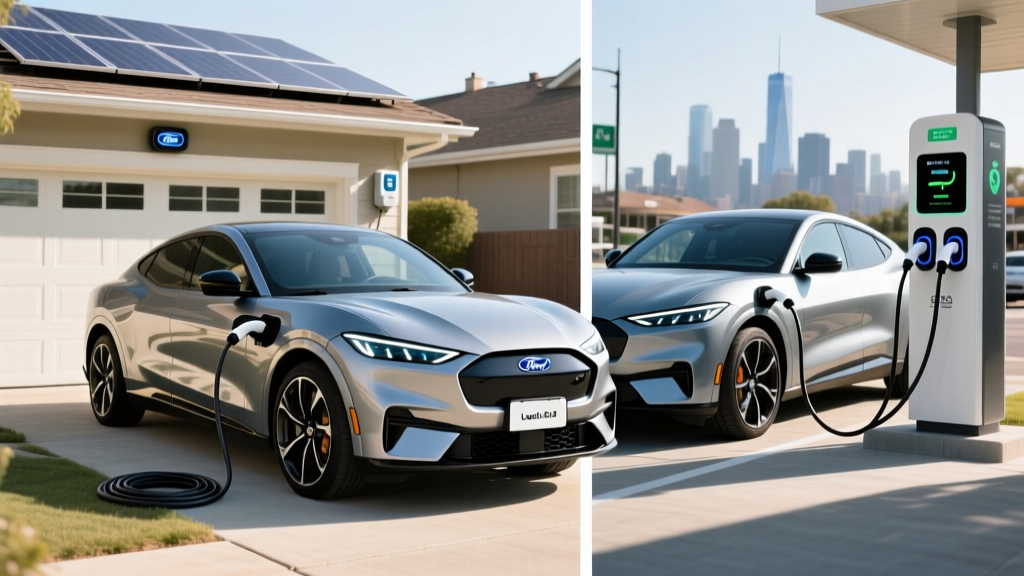
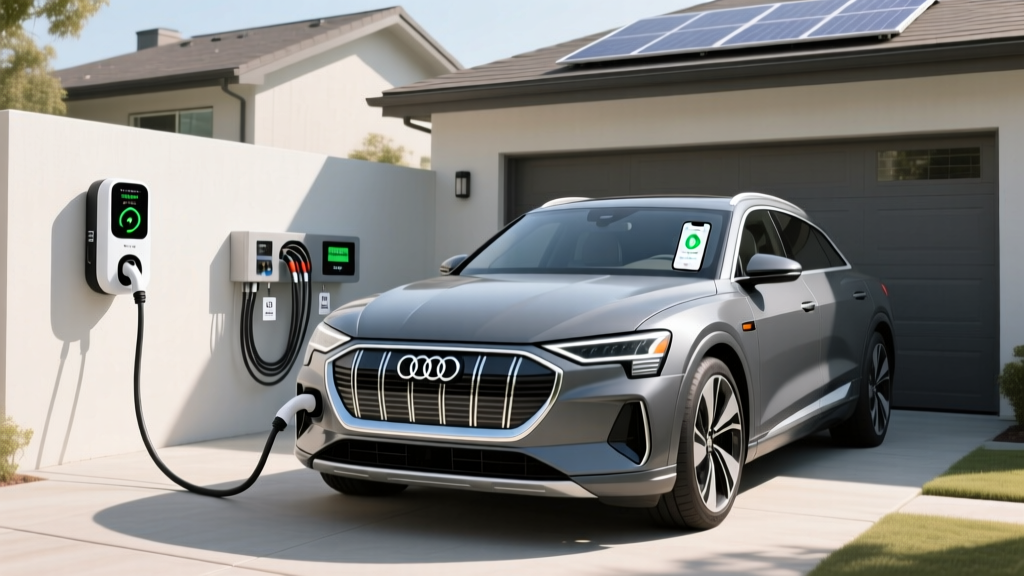
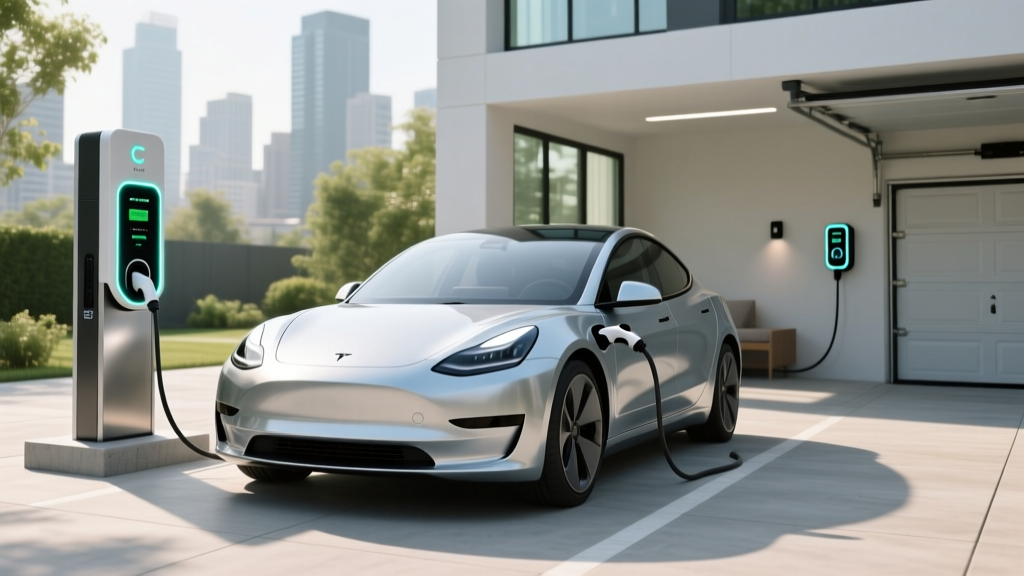
A Level 2 home charger is where 80% or more of lifetime EV charging happens for most owners. Here is what a proper installation demands.
Electrical Requirements
- Circuit: Dedicated 240V circuit, typically 40A or 50A breaker
- Continuous load rule: NEC requires EV chargers to draw no more than 80% of breaker rating — so a 40A breaker yields 32A (7.7 kW) continuous, a 50A breaker yields 40A (9.6 kW)
- Wire gauge: 6 AWG copper for 50A circuits; 8 AWG for 40A (confirm with your electrician)
- Hardwired vs plug: NEMA 14-50 receptacle offers portability; hardwired units allow higher amperage and avoid GFCI breaker nuisance trips common on 14-50 outlets
Panel Upgrade Reality
Homes built before 1990 often have 100A main panels already near capacity. Adding a 50A EV circuit may require a panel upgrade to 200A, which can cost $1,500 – $3,500 before the charger install. A licensed electrician will perform a load calculation per NEC Article 220 to determine if your panel can absorb the new circuit.
| Component | Low End | High End | Notes |
|---|---|---|---|
| Level 2 Charger (hardware) | $350 | $750 | 32A – 48A Wi-Fi-enabled units |
| Electrician labor (standard install) | $400 | $1,200 | Short run from panel to garage |
| Electrical permit | $50 | $200 | Varies by municipality |
| Panel upgrade (if needed) | $1,500 | $3,500 | 100A → 200A service |
| Conduit/trenching (long runs) | $200 | $1,500 | Detached garages, underground runs |
| Total (no panel upgrade) | $800 | $2,150 | Most single-family homes |
| Total (with panel upgrade) | $2,300 | $5,650 | Older homes, high-load panels |
The federal IRS §30D vehicle credit does not cover charger hardware, but the separate §30C Alternative Fuel Vehicle Refueling Property Credit can cover up to 30% of home charging equipment and installation costs (max $1,000) if you live in an eligible census tract. Confirm eligibility with a tax professional.
Connector Compatibility: NACS, CCS, and CHAdeMO in 2026
The connector wars that defined 2023-2024 have largely resolved. The North American Charging Standard (NACS), developed by Tesla, is now the dominant connector for new EVs sold in North America. Here is where each brand stands.
| Brand | Native Connector | Adapter Needed for CCS Stations? | Adapter Needed for Tesla Superchargers? |
|---|---|---|---|
| Tesla (Model 3/Y/S/X) | NACS | Yes (Tesla CCS adapter, ~$175) | No |
| Ford (F-150 Lightning, Mustang Mach-E) | NACS (2025+) | No | No |
| GM (Chevy Equinox EV, Blazer EV, Cadillac Lyriq) | NACS (2025+) | No | No |
| Hyundai/Kia (Ioniq 5/6, EV6, EV9) | CCS1 | No | Yes (included CCS-to-NACS adapter) |
| Volkswagen (ID.4, ID.7) | CCS1 | No | Yes (adapter available) |
| Rivian (R1T, R1S) | NACS (2025+) | No | No |
| Nissan (Leaf — discontinued 2025) | CHAdeMO | Yes (limited adapter options) | Yes (with dual adapter) |
Key takeaway: If you are buying a 2026 model-year EV, NACS is increasingly the default. CCS1 remains on some carryover platforms, and CHAdeMO is effectively legacy — plan around NACS and CCS1 access when evaluating public networks.
Top EV Charging Companies: Public Networks Compared
Public charging reliability has improved since 2024, but disparities remain. Here is how the major networks stack up on uptime, power, and pricing.
Tesla Supercharger Network
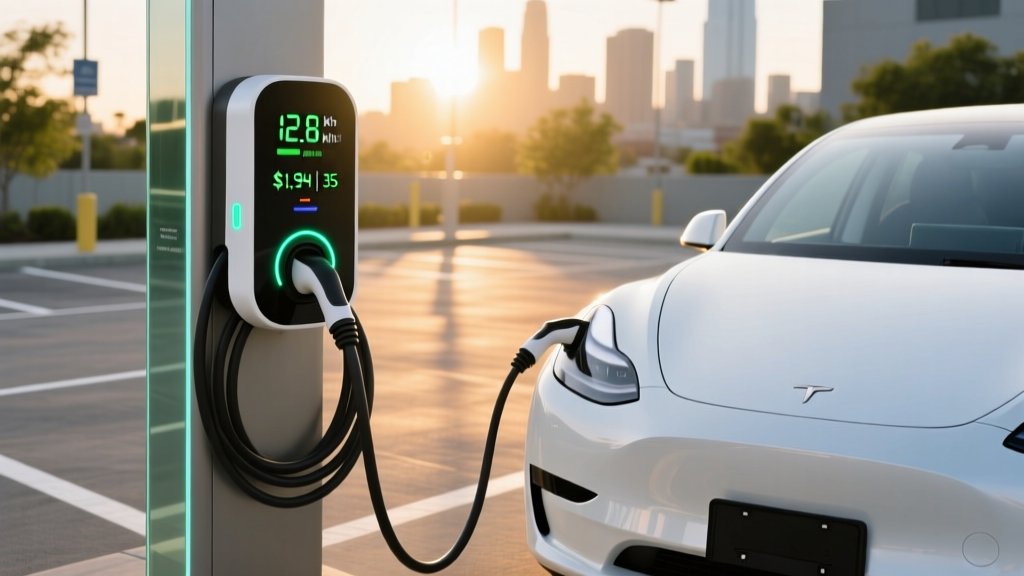
Still the gold standard for reliability. Over 30,000 stalls globally, with most V3 stalls delivering 250 kW and newer V4 stalls supporting up to 350 kW. Non-Tesla access via the Magic Dock or native NACS cable is now standard at most North American locations. Pricing averages $0.28 – $0.36/kWh depending on location and time of day.
Electrify America
Operates over 1,000 stations with 350 kW-capable chargers. The Pass+ subscription ($4/month) reduces rates to roughly $0.31/kWh vs. $0.48/kWh guest pricing. Reliability has improved with the rollout of Plug&Charge authentication, but rural stations still show higher downtime than urban corridors.
ChargePoint / EVgo / Blink
ChargePoint dominates Level 2 destination charging (workplaces, retail, apartments) with over 100,000 ports. EVgo operates a growing DC fast network with 350 kW chargers co-located near highways. Blink remains primarily a Level 2 network for commercial properties. Expect $0.35 – $0.55/kWh at DC fast stations on these networks without subscription discounts.
Cost to Charge: Per-Mile Economics vs. Gas
The financial case for an EV hinges on charging cost. Here is a realistic breakdown for a 2026 Hyundai Ioniq 5 RWD (3.6 mi/kWh efficiency) compared to a 28 MPG combined gas crossover.
| Scenario | Rate ($/kWh) | Cost per Mile (EV) | Cost per Mile (28 MPG Gas @ $3.40/gal) |
|---|---|---|---|
| Home off-peak (utility TOU rate) | $0.09 | $0.025 | $0.121 |
| Home standard rate | $0.15 | $0.042 | $0.121 |
| Public Level 2 (workplace/retail) | $0.22 | $0.061 | $0.121 |
| DC fast charge (subscription) | $0.33 | $0.092 | $0.121 |
| DC fast charge (guest/no subscription) | $0.48 | $0.133 | $0.121 |
The math: If 80% of your charging happens at home off-peak and 20% on DC fast chargers during road trips, your blended EV cost per mile lands around $0.047 — less than half the cost of a 28 MPG gas vehicle. Even at full guest-rate DC fast pricing, the EV only becomes more expensive per mile than gas if you exclusively rely on the most expensive public chargers.
Equipment Recommendations: Top Home Chargers in 2026
These are the Level 2 chargers we recommend based on power output, build quality, smart features, and price.
Emporia Vue Level 2 Charger
- Power: 48A (11.5 kW on 60A circuit)
- Connector: NACS (J1772 adapter included)
- Cable: 24 ft
- Smart features: Wi-Fi, energy monitoring, solar integration via Emporia Vue panel
- Price: ~$399
- Best for: Budget-conscious buyers with solar panels
ChargePoint Home Flex
- Power: Up to 50A (12 kW on 60A circuit), configurable down to 16A
- Connector: NACS or J1772 (choose at purchase)
- Cable: 23 ft
- Smart features: Wi-Fi, Alexa, scheduling, flexible amperage for older panels
- Price: ~$599
- Best for: Homes with limited panel capacity (dial down amps)
Tesla Wall Connector
- Power: 48A (11.5 kW on 60A circuit)
- Connector: NACS (J1776 adapter available separately)
- Cable: 24 ft
- Smart features: Wi-Fi, power sharing between multiple units, OTA updates
- Price: ~$425
- Best for: Tesla owners and NACS-native EVs
Grizzl-E Smart
- Power: 40A (9.6 kW on 50A circuit)
- Connector: J1772 (NACS adapter available)
- Cable: 24 ft
- Smart features: OCPP-compatible, works with multiple apps, extreme cold rated (-40°C)
- Price: ~$449
- Best for: Cold-climate garages, open-platform app users
Safety, Code, and Installation Best Practices
Cutting corners on EV charger installation creates fire and liability risk. Follow these non-negotiable rules:
- Dedicated circuit: Never share the EV charger circuit with other appliances. NEC 625.40 requires a dedicated branch circuit.
- GFCI protection: NEC 2020 and later require GFCI protection for outdoor receptacles. Hardwired installations may bypass this requirement — consult your electrician and local code.
- Outdoor rating: If mounting outside, ensure the unit carries a NEMA 4 (weatherproof) rating. Indoor-rated units (NEMA 3R) may not survive driving rain or ice accumulation.
- Permit and inspection: Most jurisdictions require an electrical permit and post-installation inspection. Skipping this can void homeowner insurance coverage for electrical fires.
- Load management: If your panel is near capacity but you cannot upgrade, consider a smart charger with load-sensing (e.g., Emporia with the Vue panel monitor) that dynamically reduces charge rate when household demand spikes.
Charging Time Examples for Common EV Battery Sizes
| Vehicle (Battery) | Usable kWh | 150 kW DCFC | 250 kW DCFC | 350 kW DCFC | Level 2 (11.5 kW) |
|---|---|---|---|---|---|
| Tesla Model 3 LR (79 kWh) | 75 | ~28 min | ~22 min | ~20 min | ~5.5 hrs |
| Hyundai Ioniq 5 RWD (77.4 kWh) | 74 | ~26 min | ~18 min | ~18 min | ~5 hrs |
| Ford F-150 Lightning Ext. (131 kWh) | 124 | ~44 min | ~34 min | ~30 min | ~9 hrs |
| Chevy Equinox EV (85 kWh) | 81 | ~32 min | ~25 min | ~22 min | ~6 hrs |
Cold-weather note: Below 32°F (0°C), lithium-ion batteries charge more slowly until the thermal management system warms the cells. Preconditioning your battery (available on most EVs via the app or navigation preconditioning) before arriving at a DC fast charger can shave 5-10 minutes off a 10-80% session in freezing conditions.
Frequently Asked Questions
How much does it cost to install a home EV charger?
Expect $800 – $2,150 for a standard Level 2 installation (equipment + electrician + permit) in a home with adequate panel capacity. If a panel upgrade from 100A to 200A is needed, total cost rises to $2,300 – $5,650. Always get a load calculation from a licensed electrician before committing.
How fast will each charging level add range?
Level 1 (120V) adds 3-5 miles per hour — fine for PHEVs and low-mileage drivers. Level 2 (240V) adds 20-60 miles per hour depending on amperage and vehicle acceptance rate. DC fast charging adds 150-1,000+ miles per hour at peak, but taper above 80% SoC means real sessions average 200-400 mi/hr effective rate over a 10-80% session.
Which connector/charger is compatible with my EV?
2026 model-year vehicles from Tesla, Ford, GM, and Rivian use NACS natively. Hyundai, Kia, and Volkswagen still use CCS1 on some models but include or offer NACS adapters. Check the connector table above for your specific brand. For home chargers, match the plug to your vehicle or use a certified adapter.
How much does charging cost per mile vs. gas?
At home off-peak rates (~$0.09/kWh), an efficient EV costs roughly $0.025/mile — about one-fifth the cost of a 28 MPG gas car at $3.40/gallon ($0.121/mile). Even at expensive public DC fast rates ($0.48/kWh), EV cost per mile ($0.133) is only marginally above gas. Most owners charge 80%+ at home, making the blended cost dramatically lower.
What electrical upgrades might I need?
The most common upgrade is a panel increase from 100A to 200A service ($1,500-$3,500). Older homes may also need new conduit runs, a dedicated circuit breaker slot, or a sub-panel for detached garages. A smart charger with load management can sometimes avoid a panel upgrade by dynamically limiting charge rate during peak household demand.