If you've ever driven the I-15 corridor between Los Angeles and Las Vegas, you know the Mojave Desert stretch around Barstow and Yermo is the most critical charging bottleneck on the route. The Tesla Yermo Supercharger expansion — adding new V4 stalls at the existing Yermo station near the intersection of I-15 and CA-58 — is one of the most consequential public-charging upgrades for West Coast EV travelers in 2026. But a Supercharger stop is only one piece of the charging puzzle.
This guide breaks down what the Yermo expansion means for your road trip, then zooms out to cover the full charging ecosystem: home Level 2 setup, public DC fast charging, connector compatibility, and real cost-per-mile math. Whether you drive a Tesla, a Ford with NACS access, or a Hyundai on CCS, you'll leave with exact numbers to plan your next electrified drive.
Why the Tesla Yermo Supercharger Expansion Matters for I-15 Travel
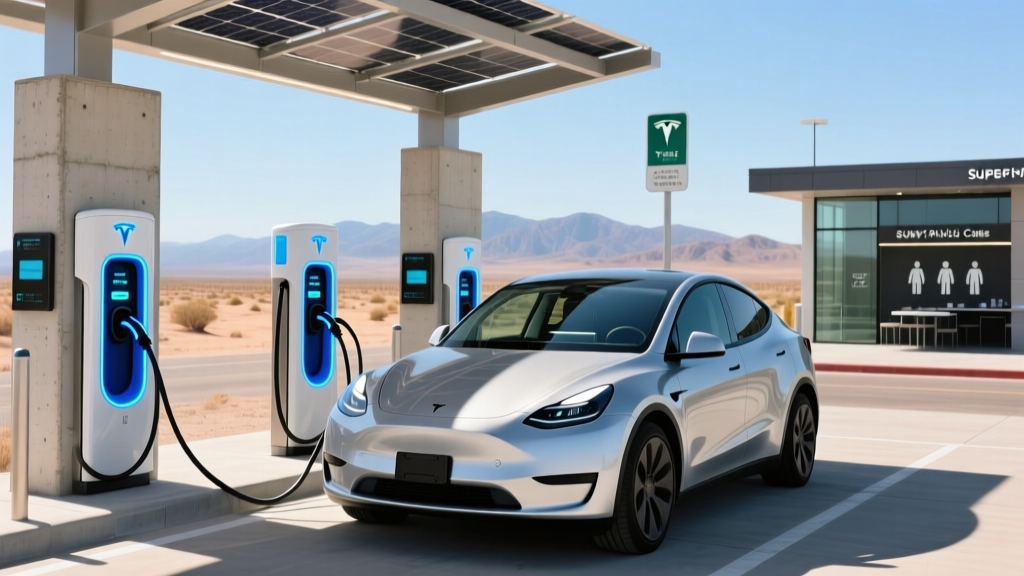
Yermo sits roughly 115 miles northeast of Los Angeles and 155 miles southwest of Las Vegas — a position that makes it the natural mid-point charging stop on the I-15 desert run. Before the expansion, the Yermo station had 12 V3 Supercharger stalls peaking at 250 kW. The 2026 expansion adds V4 Supercharger stalls (capable of up to 350 kW for compatible vehicles) and increases total capacity to reduce the queue times that plagued holiday-weekend travelers.
Key details for the Yermo station:
- Location: Yermo, CA — adjacent to I-15 Exit 178 (Calico Blvd), near the Calico Ghost Town area
- Pre-expansion: 12 V3 stalls at 250 kW peak
- Post-expansion: Additional V4 stalls with up to 350 kW peak output, plus NACS-native connectors and CCS compatibility via Tesla's Magic Dock adapter
- Amenities: Nearby fast food, restrooms, and a travel center
For non-Tesla EVs, the expansion is significant because Tesla's Supercharger network — now open to Ford, GM, Rivian, Volvo, and other NACS-adopting brands — has become the de facto national fast-charging backbone. According to Tesla's Supercharger page, over 6,000 stalls nationwide now support non-Tesla vehicles via the built-in Magic Dock CCS adapter or native NACS ports.
Charging Levels Explained: Speeds, Power, and Range Added Per Hour
Before we get into equipment and costs, let's lock down the three charging levels and what they actually deliver. The critical distinction: kW (kilowatts) measures power — how fast energy flows into your battery. kWh (kilowatt-hours) measures energy — how much your battery holds. A 10 kW charger fills a 75 kWh battery in roughly 7.5 hours (minus taper losses).
| Level | Voltage / Current | Power (kW) | Miles of Range Added Per Hour | Best Use Case |
|---|---|---|---|---|
| Level 1 (120V AC) | 120V / 12-16A | 1.4–1.9 kW | 3–5 mi/hr | Overnight top-ups, PHEVs, emergency |
| Level 2 (240V AC) | 240V / 16–80A | 3.8–19.2 kW | 12–60 mi/hr | Daily home charging, workplace |
| DC Fast Charging | 400–800V DC | 50–350 kW | 150–1,000+ mi/hr (peak) | Road trips, rapid top-ups |
Why "miles per hour" varies so much: A Tesla Model Y (75 kWh battery, ~310 mi EPA) gains roughly 4 mi per kWh. At a 48A Level 2 charger (11.5 kW), that's ~46 mi/hr. A Ford F-150 Lightning (131 kWh extended-range, ~320 mi EPA) gets only ~2.4 mi/kWh, so the same charger adds ~28 mi/hr. Bigger battery + heavier vehicle = fewer miles per kW.
DC fast charging reality check: Peak kW is not sustained kW. A vehicle rated for 250 kW peak might only hold that rate from 10-30% SoC, then taper to 150 kW by 50%, and drop below 50 kW above 80%. This is the charge curve, and it's why manufacturers quote "10-80% in X minutes" rather than a simple full-charge time. Always precondition your battery (via navigation to a charger) for optimal charge-curve performance.
How Much Does It Cost to Install a Home EV Charger?
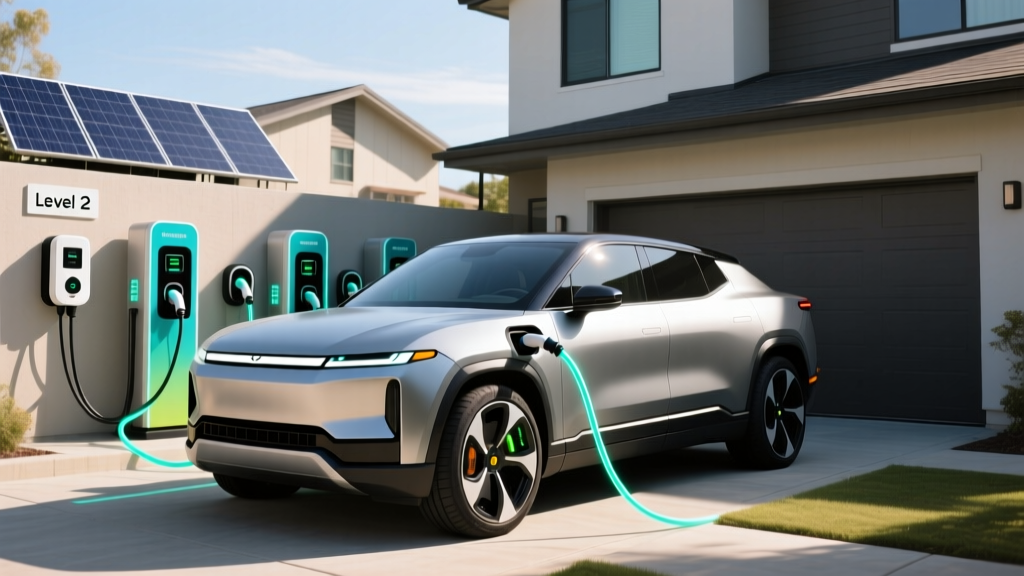
Home Level 2 charging is where 80%+ of EV charging happens for owners with garage or driveway access. But installation costs vary enormously based on your electrical panel, distance from panel to charger location, and local permit requirements.
| Cost Component | Low End | High End | Notes |
|---|---|---|---|
| Level 2 charger (hardware) | $200 | $700 | Varies by brand, amperage, smart features |
| Electrician labor | $300 | $1,500 | Depends on run length, conduit, wall type |
| Electrical permit | $50 | $300 | Required in most jurisdictions; varies by city/county |
| Panel upgrade (if needed) | $1,500 | $4,500 | 100A → 200A service upgrade for older homes |
| TOTAL (no panel upgrade) | $550 | $2,500 | Typical scenario for homes with 200A panel |
| TOTAL (with panel upgrade) | $2,050 | $7,000 | Older homes with 100A or maxed-out panels |
Electrical Requirements for a 48A Level 2 Charger
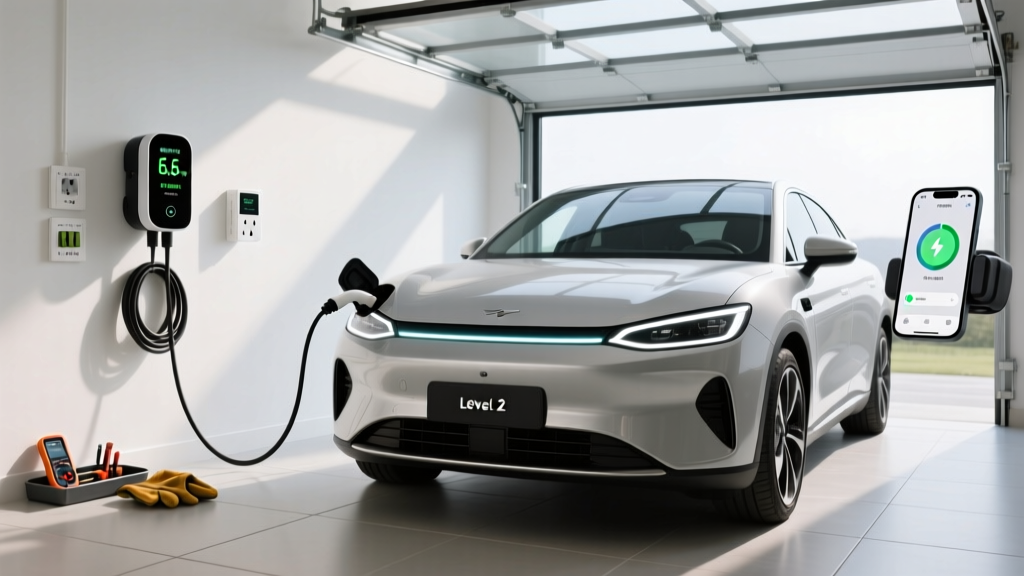
A 48-amp Level 2 charger — the most common high-power home unit — requires a dedicated 60-amp, 240V circuit (NEC code requires the circuit be rated 125% of continuous load: 48A × 1.25 = 60A). The charger must be hardwired or plugged into a NEMA 14-60 outlet installed by a licensed electrician.
Panel capacity check: Your electrician will calculate your home's existing load. A 200-amp panel with significant headroom can usually accommodate a 60A EV circuit without issue. A 100-amp panel already serving central AC, electric range, and electric dryer likely cannot — hence the panel upgrade. Some utilities offer rebates for panel upgrades tied to EV adoption; check with your local provider.
Safety and Code Considerations
- Dedicated circuit: Your EV charger must have its own breaker — never share a circuit with other major appliances.
- GFCI protection: NEC 2020+ requires GFCI protection for outdoor receptacles. Hardwired chargers may not require a GFCI breaker (varies by jurisdiction), but it's recommended for outdoor installs.
- Outdoor rating: If mounting outdoors, ensure the charger carries a NEMA 4 (weather-resistant) rating. Most quality chargers (ChargePoint, Emporia, Grizzl-E) are rated for outdoor use.
- Cable management: Use a holster or cable reel to prevent tripping hazards and protect the connector from ground contact and moisture.
- Permit and inspection: Skipping the permit risks insurance denial in the event of an electrical fire. Most jurisdictions charge $50-$300 and require a post-install inspection.
Which Connector and Charger Is Compatible With My EV?
The connector landscape in North America has consolidated dramatically since 2023, when Ford and GM announced adoption of Tesla's North American Charging Standard (NACS). By 2026, nearly every new EV sold in the US uses NACS natively or ships with a NACS-to-CCS adapter. Here's the breakdown:
| Connector | Brands Using It (2026) | Adapter Needed? | Max DC Fast Charge Rate |
|---|---|---|---|
| NACS (Tesla) | Tesla, Ford, GM, Rivian, Volvo, Polestar, Mercedes, Fisker, Lucid (2025+) | None for Tesla Superchargers; CCS adapter for Electrify America/Ionity | Up to 350 kW (V4 Supercharger) |
| CCS1 | Hyundai, Kia, Volkswagen, BMW, Stellantis, legacy models | NACS adapter needed for Tesla Superchargers (Magic Dock or OEM adapter) | Up to 350 kW ( Electrify America, Ionity) |
| CHAdeMO | Nissan Leaf (legacy), Mitsubishi Outlander PHEV (older) | Limited network; CHAdeMO-to-CCS adapters are rare and expensive | Up to 100 kW (declining infrastructure) |
Practical advice for 2026 buyers: If you're purchasing a new EV, prioritize NACS-native vehicles for the broadest charging access. If you own a CCS vehicle (like a 2023 Hyundai Ioniq 5 or VW ID.4), purchase the OEM NACS adapter ($150-$300 depending on brand) to access Tesla Superchargers. According to the Alternative Fuels Data Center, the combined NACS + CCS network now covers over 90% of US interstate highway miles.
Level 2 Home Charger Recommendations: Equipment Compared
Not all Level 2 chargers are equal. The key specs that matter: amperage (determines charge speed), cable length (reach from outlet to vehicle), connector type (NACS vs J1772), and smart features (Wi-Fi scheduling, utility integration, load management).
ChargePoint Home Flex (NACS)
- Power: Up to 50A (12 kW) on a 60A circuit; adjustable 16-50A
- Connector: NACS (Tesla-native) or J1772 version available
- Cable length: 23 feet
- Smart features: Wi-Fi, Alexa, utility demand-response, charge scheduling
- Price: ~$549
- Best for: Tesla and NACS-adopting EV owners wanting app control
Emporia Vue Level 2 Charger
- Power: Up to 48A (11.5 kW) on a 60A circuit
- Connector: J1772 (NACS adapter included)
- Cable length: 24 feet
- Smart features: Wi-Fi, energy monitoring, solar integration, load balancing
- Price: ~$399
- Best for: Budget-conscious buyers with solar panels or energy monitoring needs
Grizzl-E Smart (48A)
- Power: 48A (11.5 kW) on a 60A circuit
- Connector: J1772 (NACS version available)
- Cable length: 24 feet
- Smart features: Wi-Fi, OCPP-compatible, adjustable amperage
- Price: ~$449
- Best for: Cold-climate durability (rated to -40°F), outdoor installs
Tesla Wall Connector (Gen 3)
- Power: Up to 48A (11.5 kW) on a 60A circuit
- Connector: NACS (native Tesla)
- Cable length: 24 feet
- Smart features: Wi-Fi, power sharing (multiple units on one circuit), OTA updates
- Price: ~$475
- Best for: Tesla-only households; cleanest integration with Tesla app
Charging Cost Per Mile: Home vs. Public vs. Gas
The single biggest ownership advantage of an EV is fuel cost — but only if you charge at home. Public DC fast charging has closed the gap with gasoline in some markets, and in California (where the Yermo station is located), peak-time DCFC rates can actually exceed the per-mile cost of a fuel-efficient gas car.
| Charging Scenario | Rate ($/kWh) | Cost for 75 kWh Fill | Cost Per Mile (3.5 mi/kWh) |
|---|---|---|---|
| Home off-peak (utility TOU) | $0.08–$0.12 | $6.00–$9.00 | $0.02–$0.03/mi |
| Home standard rate | $0.15–$0.22 | $11.25–$16.50 | $0.03–$0.05/mi |
| Tesla Supercharger (Yermo, avg.) | $0.28–$0.38 | $21.00–$28.50 | $0.06–$0.08/mi |
| Electrify America / Ionity DCFC | $0.35–$0.56 | $26.25–$42.00 | $0.08–$0.11/mi |
| Gasoline (30 MPG avg., $3.80/gal) | $3.80/gal | $38.00 (equiv. 10 gal) | $0.13/mi |
The takeaway: Home off-peak charging costs roughly 75-85% less per mile than gasoline. Even Tesla Supercharger pricing at Yermo ($0.28-$0.38/kWh depending on time of day) delivers a 40-55% per-mile savings over a 30 MPG gas car. The worst-case scenario — peak-time Electrify America at $0.56/kWh — is still marginally cheaper than gas for most vehicles.
For the LA-to-Vegas run via Yermo (~270 miles one-way), a Tesla Model Y consuming ~280 Wh/mi would use roughly 76 kWh. At Yermo Supercharger rates (~$0.33/kWh average), that full recharge costs about $25. The same trip in a 30 MPG gas car at $3.80/gallon costs roughly $34 in fuel.
Charging Time Examples: What to Expect With Common Battery Sizes
Charge time depends on three factors: battery size (kWh), the vehicle's maximum charge acceptance rate (kW), and the charger's output. Here are real-world estimates for popular 2026 EVs using the Yermo Supercharger V4 stalls and a typical 48A home Level 2 charger:
| Vehicle | Battery (kWh usable) | Peak DCFC Rate | 10-80% at Yermo V4 | 10-80% at 48A L2 Home |
|---|---|---|---|---|
| Tesla Model Y LR (2026) | 75 kWh (NMC) | 250 kW | ~22 min | ~4.5 hrs |
| Tesla Model 3 LR (2026) | 75 kWh (NMC) | 250 kW | ~22 min | ~4.5 hrs |
| Ford F-150 Lightning ER | 131 kWh (NMC) | 210 kW | ~41 min | ~8 hrs |
| Hyundai Ioniq 5 (NACS adapter) | 77.4 kWh (NMC) | 238 kW | ~25 min* | ~5 hrs |
| Chevrolet Equinox EV (2026) | 85 kWh (NMC) | 190 kW | ~30 min | ~5.5 hrs |
*CCS vehicles using a NACS adapter at V4 Superchargers may experience slightly reduced peak rates depending on adapter throughput. Confirm with your vehicle manufacturer.
Frequently Asked Questions
Can non-Tesla EVs use the Tesla Yermo Supercharger?
Yes. As of 2026, Tesla's Supercharger network is open to Ford, GM, Rivian, Volvo, Polestar, Mercedes-Benz, and other NACS-adopting brands. CCS vehicles can use Tesla's Magic Dock adapter (built into select stalls) or an OEM-purchased NACS adapter. Check the Tesla app for station-specific non-Tesla access and pricing, which may differ from Tesla-owner rates.
What electrical upgrades might I need for a home Level 2 charger?
A 48A Level 2 charger requires a dedicated 60A, 240V circuit. If your home has a 200A electrical panel with available capacity, you'll likely only need the new circuit breaker, wiring, and outlet/hardwire — typically $550-$2,500 total. If your panel is 100A or already near capacity, a panel upgrade to 200A ($1,500-$4,500) may be required. A licensed electrician can perform a load calculation to determine this before installation.
How much does charging at the Yermo Supercharger cost compared to home?
Tesla Supercharger rates at Yermo typically range from $0.28-$0.38/kWh depending on time of day (Tesla uses time-of-use pricing at many stations). Home off-peak charging in Southern California averages $0.08-$0.12/kWh. That means a full 75 kWh charge costs ~$25 at Yermo vs. ~$7 at home — a roughly 3.5× difference. For road trips, the Supercharger cost is still generally cheaper than gasoline per mile.
Is the Tesla Yermo Supercharger expansion already complete?
The expansion has been announced and is in the permitting/construction phase as of early 2026. Tesla typically does not publish exact completion dates. Monitor supercharge.info and Tesla's in-app station listings for real-time status updates, including stall availability and operational status.
Do I need a permit to install a home EV charger?
In most US jurisdictions, yes. Electrical permits for EV charger installations typically cost $50-$300 and require a post-installation inspection by your local building department. Skipping the permit can void your homeowner's insurance coverage for electrical fires and may cause issues during a home sale. Always hire a licensed electrician who pulls the required permits.
Which is better: hardwired or plug-in (NEMA 14-60) Level 2 charger?
Hardwired chargers support higher amperage (up to 48A/60A circuit) and eliminate the receptacle as a failure point. Plug-in units (NEMA 14-60) are limited to 40A continuous on a 50A circuit and offer portability — you can unplug and take the charger when you move. For maximum charge speed and reliability, hardwired is preferred. For renters or those who may relocate, plug-in offers flexibility.
Planning Your Next I-15 EV Road Trip
The Tesla Yermo Supercharger expansion is a meaningful upgrade for one of the most-traveled EV corridors in the American West. More stalls, higher-power V4 hardware, and broader non-Tesla access reduce the two biggest road-trip pain points: wait times and charge duration.
For the best experience, follow this checklist:
- Precondition your battery by entering Yermo as your navigation destination at least 30 minutes before arrival.
- Charge to 80% and move on — the taper above 80% makes the last 20% painfully slow and unnecessary for most I-15 trips.
- Check real-time stall availability in the Tesla app or your vehicle's navigation before departing; holiday weekends still create queues even at expanded stations.
- Have a backup plan: The Barstow area has additional charging options including Electrify America stations. If Yermo is congested, Barstow is only 10 miles west.
- Charge at home before you leave. Starting at 100% SoC means you'll arrive at Yermo with a higher buffer, potentially needing only a 10-15 minute top-up rather than a full 20-25 minute session.
For more on optimizing your home charging setup, see our guides on Level 2 charger installation and the Department of Energy's EV technology resources. For federal tax credits that can offset home charger installation costs (up to $1,000 under the §30C Alternative Fuel Vehicle Refueling Property Credit), consult the IRS §30C guidelines and a qualified tax professional.