If you've searched for "Tesla wireless charging" hoping to pull into your garage and have your Model Y or Cybertruck charge without plugging in, here's the honest answer: Tesla does not currently offer a production wireless charging pad for consumer vehicles. While the company has demonstrated inductive charging concepts and acquired wireless-charging startup Wiferion in 2023 (later reportedly winding down that effort), no Tesla owner can buy a factory-supported wireless charger today.
That doesn't mean the dream is dead — and it certainly doesn't mean your Tesla charging setup has to be inconvenient. In this guide, we'll explain where wireless EV charging actually stands, what Tesla does offer for home charging, and how to build a Level 2 home setup that's nearly as effortless as wireless would be. We'll also cover the electrical requirements, real installation costs, and the best chargers you can buy right now.
What Is Wireless EV Charging and Why Doesn't Tesla Offer It Yet?
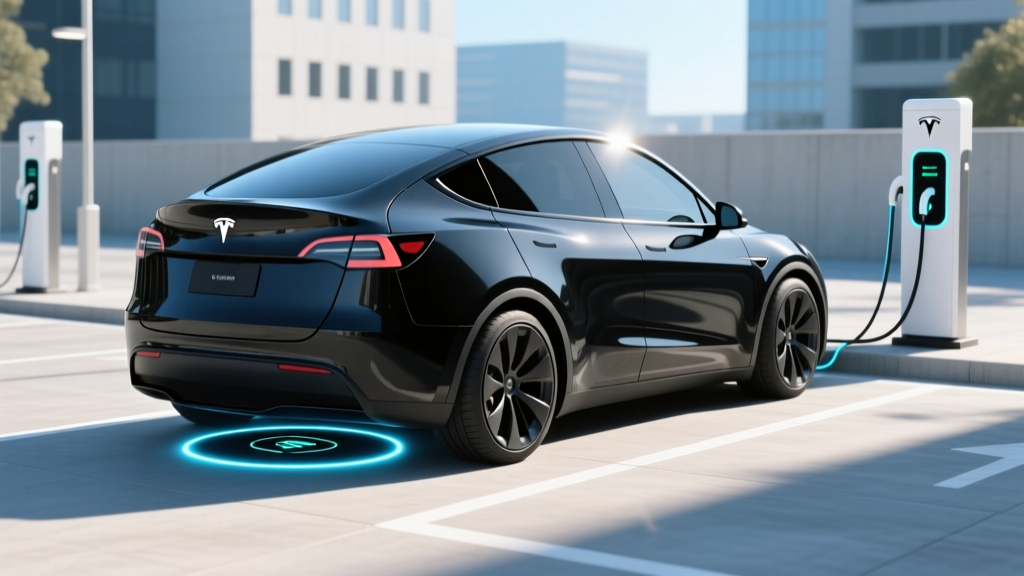
Wireless EV charging — technically called inductive charging — uses electromagnetic coils embedded in a ground pad and a receiver pad mounted under the vehicle. You park over the pad, and energy transfers across a small air gap (typically 4-8 inches) without any physical cable connection. The SAE J2954 standard governs light-duty wireless charging at up to 11 kW.
Several companies have pushed this technology forward:
- WiTricity — licenses inductive charging tech to automakers; demonstrated systems with ~90-93% efficiency
- Plugless Power (Evatran) — offered aftermarket wireless pads for earlier EVs like the Nissan Leaf and Chevy Volt, but the company has largely exited the consumer market
- Qualcomm Halo — demonstrated dynamic (in-road) wireless charging but never reached consumer production
Tesla acquired German wireless-charging firm Wiferion in mid-2023, sparking speculation about a Tesla-branded inductive pad. However, by late 2024, Tesla had reportedly sold off Wiferion's assets, and no consumer product materialized. The engineering challenge is real: wireless charging adds weight (receiver pad), reduces efficiency by 5-10% compared to conductive charging, and requires precise vehicle alignment — all for a convenience gain that a well-designed plug-in setup largely solves.
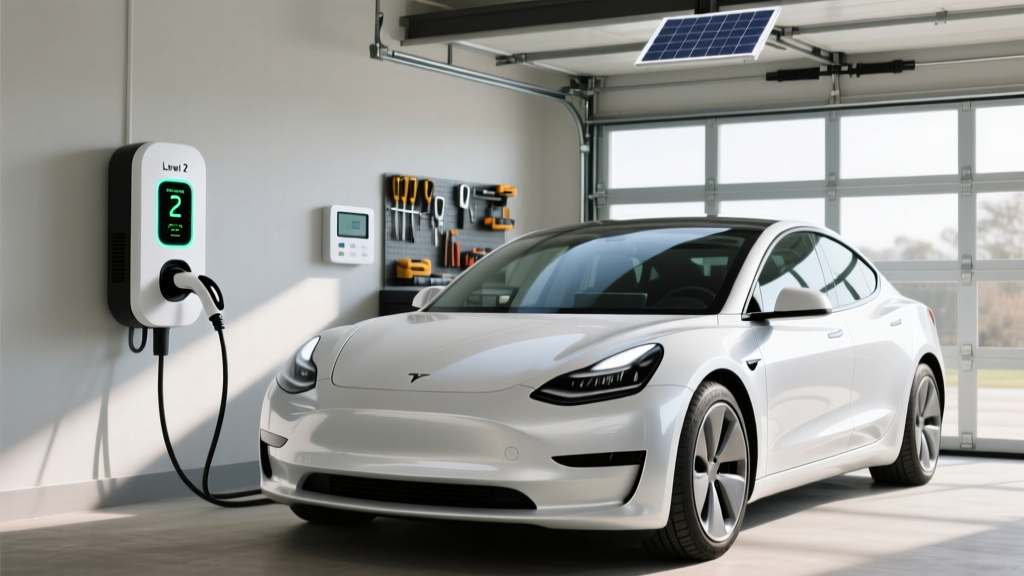
The bottom line: if you own a Tesla in 2026, your best "wireless-like" experience is a high-quality Level 2 wall connector with a cable management system. Plug in when you park; unplug when you leave. It takes about four seconds.
Charging Levels Explained: Speeds, Power, and Real-World Range Added
Whether you're charging a Tesla or any other EV, understanding the three charging levels is essential. Note: kW (kilowatts) measures power — the rate of energy flow. kWh (kilowatt-hours) measures energy — the total capacity of your battery. A 75 kWh battery charged at 11.5 kW takes roughly 6.5 hours from empty to full (ignoring taper and losses).
| Level | Voltage | Max Power (kW) | Miles of Range Added per Hour | Typical Use |
|---|---|---|---|---|
| Level 1 | 120V AC | 1.4–1.9 kW | 3–5 mi/hr | Overnight top-up, emergency, PHEVs |
| Level 2 | 240V AC | 7.2–19.2 kW | 20–60+ mi/hr | Home daily charging, workplace, hotels |
| DC Fast Charging | 400–800V DC | 50–350+ kW | 150–1,000+ mi/hr (peak) | Road trips, highway corridors |
For Tesla owners, Level 2 at home is the primary charging method. A Tesla Wall Connector on a 60-amp circuit delivers up to 11.5 kW (48 amps continuous), adding roughly 44 miles of range per hour to a Model Y. That means a 10-80% charge on a Model Y Long Range (75 kWh usable battery, ~310 miles EPA range) takes about 4.5 hours on Level 2.
On a Tesla Supercharger (DC fast charging), that same 10-80% session takes roughly 20-25 minutes at a V3 stall (peak 250 kW), though sustained rates taper significantly above 60% State of Charge. Real-world charging curves never hold peak kW for the entire session — expect an average of ~120-140 kW across a 10-80% session at a V3 Supercharger.
How Much Does It Cost to Install a Home EV Charger?
This is the question every new EV owner asks, and the answer varies enormously based on your home's electrical panel, the distance from panel to garage, and local permit fees. Here's a realistic breakdown based on 2025-2026 electrician rates and equipment pricing.
| Component | Simple Install (Panel Adjacent) | Complex Install (Long Run / Panel Upgrade) |
|---|---|---|
| Level 2 Charger Equipment | $400–$650 | $400–$650 |
| Electrician Labor (2-4 hrs simple / 6-12 hrs complex) | $300–$800 | $1,200–$3,000 |
| Materials (conduit, wire, junction box) | $100–$300 | $400–$1,200 |
| Electrical Permit | $50–$200 | $50–$300 |
| Panel Upgrade (200A service, if needed) | $0 (not needed) | $1,500–$4,000 |
| Total Estimated Cost | $850–$1,950 | $3,550–$9,150 |
The panel-upgrade wildcard: Many homes built before 2000 have 100-amp or 150-amp electrical service. Adding a 60-amp EV circuit to a 100-amp panel that's already near capacity (electric dryer, HVAC, electric range) will require a service upgrade to 200 amps. This is the single biggest cost variable and can push your total install above $7,000 in some markets.
A licensed electrician should perform a load calculation (NEC Article 220) before quoting. If your panel has spare capacity and is close to the garage, a straightforward install with a hardwired Wall Connector can be under $1,500 total. If you're running 80+ feet of conduit from a basement panel to a detached garage, costs climb fast.
Federal incentive note: The IRS §30C Alternative Fuel Vehicle Refueling Property Credit offers up to 30% of charger equipment and installation costs (capped at $1,000 for residential) — but only if you live in an eligible census tract (typically low-income or non-urban areas). Check the IRS guidelines and consult a tax professional for your specific eligibility. This credit is separate from the §30D vehicle purchase credit.
Connector Compatibility: NACS, CCS, and Adapters
Tesla's proprietary connector — now formally adopted as the North American Charging Standard (NACS) — has become the dominant EV connector in the U.S. As of 2025-2026, Ford, GM, Rivian, Volvo, Polestar, and others have adopted NACS on new vehicles or via adapter. Here's how the connector landscape looks:
| Connector | Native Vehicles | Adapter Available? | DC Fast Charge Network Access |
|---|---|---|---|
| NACS (Tesla) | Tesla (all), Ford (2025+), GM (2025+), Rivian (2025+), Volvo/Polestar (2025+) | CCS-to-NACS adapters from Tesla, A2Z, Lectron ($150-$300) | Tesla Supercharger (20,000+ stalls), growing third-party NACS |
| CCS1 | Hyundai, Kia, BMW, VW, most legacy EVs | NACS-to-CCS adapter (Tesla sells one for ~$250) | Electrify America, EVgo, ChargePoint, Ionity |
| CHAdeMO | Nissan Leaf (legacy), Mitsubishi Outlander PHEV | Limited adapter options | Shrinking network; few new installations |
For Tesla owners installing a home Level 2 charger: the Tesla Wall Connector ships with a native NACS plug. If you also own or plan to own a non-Tesla EV with a CCS port, consider a universal (J1772) charger with a J1772-to-NACS adapter for your Tesla, or simply buy two chargers if your panel supports it. The Tesla Wall Connector can also be ordered with a J1772 plug (the "Universal" version) for mixed-EV households.
Best Level 2 Home Chargers for Tesla and NACS Vehicles
Since wireless charging isn't an option, here are the best hardwired and plug-in Level 2 chargers available in 2026 for Tesla and NACS-equipped EVs. All recommendations include power output, cable length, and smart features.
Tesla Wall Connector (Gen 3, NACS)
Power: Up to 11.5 kW (48A on 60A circuit) | Cable: 24 ft | Connector: NACS native | Smart Features: Wi-Fi, OTA updates, Power Sharing (link multiple units), access control | Price: ~$475 | Verdict: The default choice for Tesla-only households. Clean design, fast charging, reliable. No display screen — monitoring is app-only.
Tesla Universal Wall Connector (J1772 + NACS)
Power: Up to 11.5 kW (48A) | Cable: 24 ft | Connector: J1772 with integrated NACS adapter (stored on unit) | Smart Features: Same as Gen 3 | Price: ~$600 | Verdict: Best for mixed-EV garages. The built-in adapter means no loose dongles to misplace.
ChargePoint Home Flex (NACS or J1772)
Power: Up to 12 kW (50A on 60A circuit, adjustable down to 16A) | Cable: 23 ft | Connector: NACS or J1772 (configurable) | Smart Features: Wi-Fi, app scheduling, Alexa integration, detailed energy tracking, flexible amperage dip-switch | Price: ~$650–$750 | Verdict: Best third-party option. The adjustable amperage is a standout — you can dial it down to match a smaller circuit without buying a different unit.
Emporia Vue EV Charger
Power: Up to 11.5 kW (48A) | Cable: 24 ft | Connector: J1772 (use J1772-to-NACS adapter for Tesla) | Smart Features: Wi-Fi, integrates with Emporia energy monitor for whole-home tracking, solar-aware scheduling | Price: ~$400 | Verdict: Best budget smart charger. Pairs well with home energy monitoring. Requires adapter for Tesla/NACS vehicles.
Charging Cost per Mile: Home vs. Public vs. Gas
One of the strongest arguments for home Level 2 charging is cost. Here's how the economics compare across scenarios, using a Tesla Model Y Long Range (~3.5 miles per kWh efficiency, or ~28 kWh/100mi) as the baseline.
| Scenario | Avg $/kWh | Cost per Mile (Model Y) | Annual Cost (12,000 mi) |
|---|---|---|---|
| Home Level 2 — Off-Peak Rate (utility TOU plan) | $0.08–$0.12 | $0.023–$0.034 | $275–$410 |
| Home Level 2 — Standard Residential Rate | $0.14–$0.18 | $0.040–$0.051 | $480–$615 |
| Tesla Supercharger (V3/V4, national avg) | $0.28–$0.36 | $0.080–$0.103 | $960–$1,235 |
| Electrify America / Public DC Fast (avg) | $0.35–$0.48 | $0.100–$0.137 | $1,200–$1,645 |
| Gas Car (28 MPG combined, $3.40/gal) | — | $0.121 | $1,455 |
Key takeaway: home off-peak charging costs roughly 75-80% less per mile than gasoline. Even at standard residential rates, you're saving $800-$1,000+ annually over gas. But exclusive reliance on public DC fast charging erodes most of that advantage — which is why home Level 2 installation is the single most impactful EV ownership decision you can make.
Time-of-use (TOU) utility plans are critical. Many utilities offer rates as low as $0.06-$0.09/kWh between 10 PM and 6 AM. Schedule your Tesla to charge during those windows (via the car's built-in scheduling or your charger's app), and your fuel cost drops to roughly $300/year for 12,000 miles of driving.
Electrical Requirements, Safety, and Code Considerations
A Level 2 charger installation isn't a DIY project (unless you're a licensed electrician). Here's what the National Electrical Code (NEC) and best practices require:
- Dedicated circuit: Your EV charger must be on its own dedicated breaker — no sharing with outlets, lights, or appliances. A 60-amp breaker (for 48A continuous charging) requires 6 AWG copper wire (or 4 AWG aluminum).
- Hardwired vs. plug-in: Hardwired installations (no plug, direct connection) support the highest amperage (48A/11.5 kW) and avoid the NEC 80% derating rule that limits NEMA 14-50 outlets to 40A continuous (9.6 kW). Hardwired is preferred for maximum charging speed.
- GFCI protection: NEC 2020 and later (Article 625) requires GFCI protection for EV charging outlets. Hardwired chargers with internal ground-fault protection typically satisfy this without a GFCI breaker (which can nuisance-trip with some EV chargers). Check local code amendments.
- Outdoor rating: If your charger is installed outdoors, it must be rated for outdoor use (NEMA 3R or 4). The Tesla Wall Connector and ChargePoint Home Flex are both outdoor-rated.
- Permit and inspection: Nearly all jurisdictions require an electrical permit for EV charger installation. Your electrician pulls the permit; a city/county inspector verifies the work. This protects you and is required for any §30C tax credit claim.
- Load calculation: Before installation, your electrician must calculate your panel's existing load. NEC Article 220 sets the methodology. If your panel is at or near capacity, you'll need a service upgrade or a smart load-management device (like the Emporia Smart Load Center or Tesla's built-in Power Sharing) that dynamically reduces charger amperage when other loads spike.
Charging Time Examples: What to Expect with Common Battery Sizes
Here are real-world charging time estimates for popular EVs on Level 2 and DC fast charging. All 10-80% times assume optimal conditions (battery preconditioned, moderate temperature, no sustained taper).
| Vehicle | Battery (kWh usable) | EPA Range | Level 2 at 11.5 kW (10-80%) | DC Fast Peak kW | DC Fast 10-80% Time |
|---|---|---|---|---|---|
| Tesla Model Y LR | 75 kWh | 310 mi | ~4.5 hours | 250 kW | ~22 min |
| Tesla Model 3 LR | 75 kWh | 340 mi | ~4.5 hours | 250 kW | ~22 min |
| Tesla Cybertruck AWD | 123 kWh | 340 mi | ~7.5 hours | 250 kW | ~35 min |
| Ford F-150 Lightning ER | 131 kWh | 320 mi | ~8 hours (at 11.5 kW) | 150 kW (ext. range) | ~45 min |
| Hyundai Ioniq 5 LR | 77.4 kWh | 305 mi | ~4.7 hours | 240 kW (800V) | ~18 min |
Cold-weather note: In freezing temperatures (below 32°F / 0°C), expect 10-80% DC fast charging times to increase by 20-40% unless the battery is preconditioned. Tesla's navigation system automatically preconditions the battery when you route to a Supercharger — always use the car's nav for fast-charging stops in cold weather to benefit from this.
Frequently Asked Questions
Will Tesla ever release a wireless charging pad?
There's no announced product or timeline. Tesla's acquisition of Wiferion in 2023 suggested interest, but the subsequent divestiture of those assets indicates the company deprioritized consumer wireless charging. The SAE J2954 standard supports up to 11 kW wirelessly, so the technology exists — but efficiency losses, added vehicle weight, and alignment complexity mean Tesla likely sees diminishing returns versus a well-designed plug-in connector.
Can I use a third-party wireless charger with my Tesla?
Not practically. No aftermarket wireless charging system is currently certified or commercially available for Tesla vehicles. The Plugless Power system that once supported some EVs is discontinued. You'd need a vehicle-mounted receiver pad (which Tesla doesn't offer) and a compatible ground pad. Stick with a Level 2 Wall Connector.
What electrical upgrades might I need for a home charger?
The most common upgrade is a panel service increase from 100A or 150A to 200A, which costs $1,500-$4,000 depending on your utility and local rates. If your panel is modern and has spare capacity, you may only need a new 60-amp breaker and a wire run. Homes with older knob-and-tube wiring or Federal Pacific/Zinsco panels (known safety hazards) may require full panel replacement regardless of EV charging.
Is a NEMA 14-50 outlet better than hardwired?
Hardwired is faster and often cheaper to install. A NEMA 14-50 outlet limits you to 40 amps continuous (9.6 kW) due to NEC 80% derating, while hardwired supports 48 amps (11.5 kW) — roughly 19% faster. An outlet offers portability (take your charger when you move), but requires a GFCI breaker ($100-$200 extra) in most jurisdictions. For most homeowners, hardwired is the better choice.
Does the federal tax credit cover home charger installation?
Partially — and only for some taxpayers. The §30C Alternative Fuel Vehicle Refueling Property Credit covers 30% of equipment and installation costs, capped at $1,000 for residential use. However, eligibility is restricted to property placed in service in eligible census tracts (generally low-income or rural areas). Verify your address eligibility on the IRS website and consult a tax professional. This is separate from the §30D new-vehicle credit.
How fast will each charging level add range to my Tesla?
Level 1 (120V standard outlet): roughly 3-4 miles per hour — adequate only for PHEVs or emergency trickle charging. Level 2 (240V, 48A): roughly 44 miles per hour for a Model Y, or a full overnight replenishment of a day's driving. DC Fast Charging (Supercharger at 250 kW peak): up to 200+ miles added in 15 minutes at the start of the session, tapering as the battery fills.