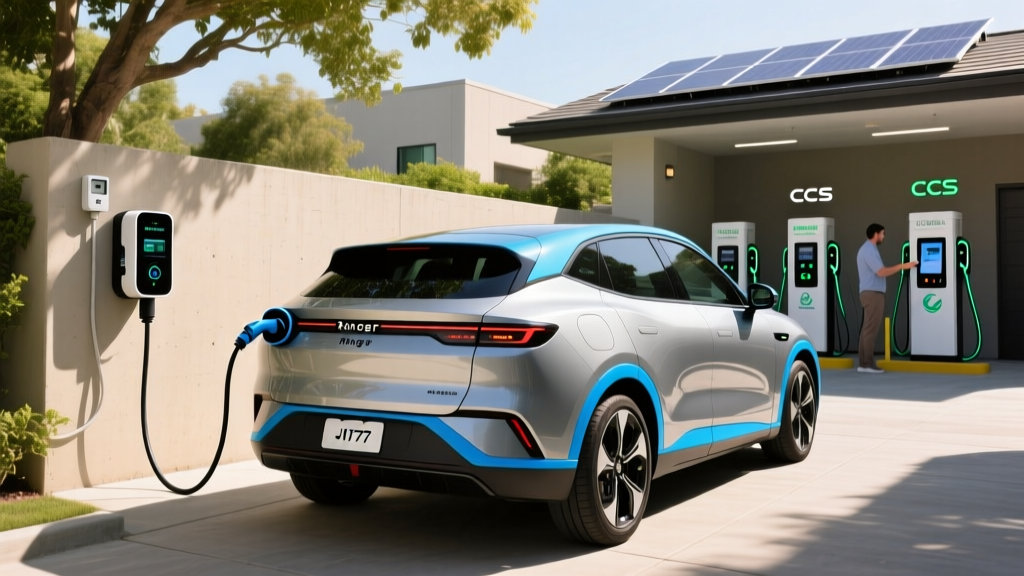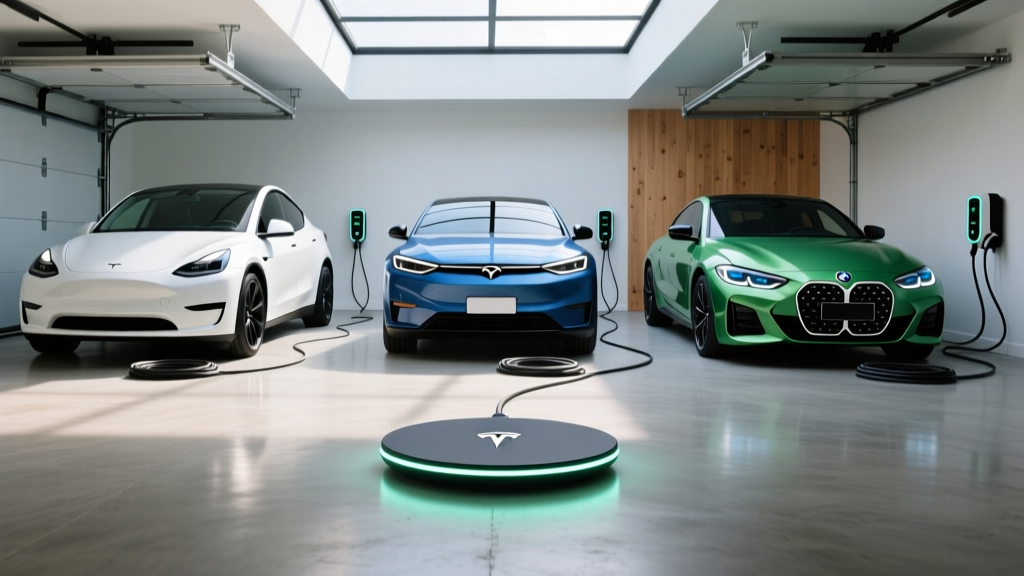
If you've been searching for a Tesla wireless charger pad to park over in your garage and skip the plug-in routine, you're not alone. The idea of inductive charging — simply parking over a pad and letting the car charge without touching a cable — sounds like the ultimate EV convenience upgrade. But here's the reality check every Tesla owner and prospective buyer needs in 2026: Tesla does not sell a wireless EV charger pad for home use, and true wireless charging for full-size electric vehicles remains limited to a handful of commercial and prototype applications.
What Tesla does sell is a $65 wireless charging pad for your phone, designed for the Model 3 and Model Y center console. That's where much of the confusion originates. For actual vehicle charging, Tesla's ecosystem revolves around its Wall Connector (Level 2), Mobile Connector (Level 1/2), and the Supercharger network (DC fast). If wireless EV charging is on your wish list, a few aftermarket companies are working on it — but it's not something you can buy and install today for a Tesla.
This guide breaks down the real state of wireless EV charging, then gives you the exact data you need to set up the fastest, most cost-effective home charging system for a Tesla or any modern EV: charging speeds, install costs, connector standards, equipment picks, and what your electrical panel actually needs to handle.
Wireless EV Charging in 2026: Where Things Actually Stand
Inductive EV charging uses electromagnetic fields to transfer energy between a ground pad and a receiver mounted under the vehicle. The technology works — companies like WiTricity and Plugless Power demonstrated functional systems years ago — but adoption has stalled for several concrete reasons:
- Efficiency loss: Wireless transfer operates at roughly 90-93% efficiency versus 97-99% for a wired Level 2 connection. Over a 60 kWh charge session, that's 4-6 kWh of wasted electricity — real money lost over time.
- Cost premium: Wireless systems have historically cost $3,000-$5,000+ for the ground pad and vehicle receiver, compared to $500-$1,500 for a premium wired Level 2 setup.
- Alignment sensitivity: You must park precisely over the pad. Miss by a few inches and efficiency drops sharply or charging won't initiate.
- Power limitations: Most wireless systems max out around 7-11 kW — comparable to a mid-range wired charger but at significantly higher cost and lower efficiency.
- No OEM support from Tesla: Tesla has not integrated a wireless receiver into any production vehicle. Without a factory-installed receiver, no aftermarket pad will charge your car wirelessly.
BMW offered a wireless charging pad for the 530e PHEV in limited markets around 2019, and Mercedes-Benz has tested inductive charging for the EQS in specific pilot programs. But for Tesla owners — and the vast majority of EV buyers — wired charging remains the only practical path.
Understanding EV Charging Levels: Speed, Power, and What You'll Actually Use
Before choosing equipment, you need to understand the three charging tiers. This is the single most important framework for EV ownership. Note: kW (kilowatts) measures the rate of power delivery — think of it as how fast water flows from a hose. kWh (kilowatt-hours) measures total energy stored in the battery — the size of the tank. These are not interchangeable.
| Level | Voltage | Power (kW) | Miles of Range Added Per Hour | Best For |
|---|---|---|---|---|
| Level 1 | 120V AC | 1.0–1.9 kW | 3–5 miles | Overnight top-ups, PHEVs, emergencies |
| Level 2 | 240V AC | 3.3–19.2 kW | 12–75 miles | Daily home charging (primary method for most owners) |
| DC Fast Charge | 400–800V DC | 50–350 kW | 150–1,000+ miles/hr (equivalent) | Road trips, quick top-ups away from home |
Real-world context: A Tesla Model Y Long Range with its 75 kWh (usable) battery needs about 60 kWh to go from 10% to 90%. On Level 1 (1.4 kW), that's roughly 43 hours — impractical for daily use. On a 48-amp Level 2 charger delivering 11.5 kW, it takes about 5.2 hours. On a 250 kW Supercharger, you'll hit 10-80% in approximately 20-25 minutes, though the charge curve tapers significantly above 80% to protect battery health.
Home Charger Installation: Electrical Requirements, Costs, and Panel Gotchas
Installing a Level 2 home charger is the single highest-impact upgrade for EV ownership. Here's what your electrician will evaluate and what you'll pay.
Electrical Requirements
A typical high-performance Level 2 charger like the Tesla Wall Connector draws up to 48 amps continuous. Per National Electrical Code (NEC), continuous loads require a circuit rated at 125% of the draw — meaning you need a 60-amp breaker on a 240V circuit. Lower-amperage chargers (32A or 40A) require 40A or 50A breakers respectively.
Critical question: Does your electrical panel have the capacity? Most modern homes have 200-amp service, which typically supports an EV charger. Older homes with 100-amp service often need a panel upgrade — and that's where costs escalate significantly.
Installation Cost Breakdown
| Component | Simple Install (panel nearby, no upgrade) | Complex Install (long wire run, sub-panel) | Panel Upgrade Required |
|---|---|---|---|
| Charger Equipment | $400–$700 | $400–$700 | $400–$700 |
| Electrician Labor | $300–$800 | $800–$2,000 | $500–$1,500 |
| Materials (wire, conduit, breaker) | $100–$300 | $300–$800 | $200–$500 |
| Permit & Inspection | $50–$200 | $100–$300 | $100–$300 |
| Panel Upgrade (if needed) | — | — | $1,500–$4,000 |
| Total Estimated Cost | $850–$2,000 | $1,600–$3,800 | $2,700–$7,000 |
Federal incentive note: The IRS §30C Alternative Fuel Vehicle Refueling Property Credit offers up to $1,000 (30% of cost) for home charger installation, but it applies only in census tracts classified as non-attainment or low-income areas. Check your eligibility at the IRS site before counting on it. This is separate from the §30D vehicle purchase credit and has its own geographic restrictions.
Connector Standards in 2026: NACS Wins, But Adapters Still Matter
The connector landscape has consolidated dramatically. As of 2025-2026, the North American Charging Standard (NACS) — originally Tesla's proprietary connector — has become the dominant standard. Ford, GM, Rivian, Volvo, Polestar, and most other automakers have adopted NACS for new vehicles. Here's where things stand:
| Connector | Vehicles Using It (New) | Home Charger Availability | Adapter Needed? |
|---|---|---|---|
| NACS (Tesla) | Tesla (all), Ford, GM, Rivian, Volvo, Polestar, Hyundai/Kia (select) | Widely available (Tesla Wall Connector, ChargePoint, Emporia) | No for Tesla; CCS-to-NACS adapter for older CCS vehicles |
| CCS1 | Legacy models (pre-2025 VW, BMW, Stellantis); still used on some 2026 models | Available; many chargers now ship with NACS or offer swap | NACS-to-CCS adapter if switching to NACS charger |
| CHAdeMO | Nissan Leaf (discontinued after 2025); legacy only | Limited | No practical adapter to NACS |
For Tesla owners: You're already on NACS. The Tesla Wall Connector ships with a native NACS plug — no adapter needed. If you buy a third-party charger (ChargePoint, Emporia, EnelX), verify it ships with NACS or that a NACS cable is available.
For non-Tesla EV owners transitioning to NACS: Most automakers now include or offer a CCS-to-NACS adapter so you can use Tesla Superchargers. For home charging, buy a charger with the connector that matches your car's port, or use the adapter.
Cost to Charge: Home vs. Public vs. Gas — Real Numbers Per Mile
One of the strongest arguments for home Level 2 charging is cost. Let's compare actual per-mile fueling expenses using 2026 national averages.
| Scenario | Rate | Vehicle Efficiency | Cost Per Mile |
|---|---|---|---|
| Home Level 2 (off-peak utility rate) | $0.10/kWh | 3.5 mi/kWh (Tesla Model Y) | $0.029 |
| Home Level 2 (national avg residential) | $0.17/kWh | 3.5 mi/kWh | $0.049 |
| Public Level 2 (network like ChargePoint) | $0.30/kWh | 3.5 mi/kWh | $0.086 |
| DC Fast Charge (Electrify America/Tesla Supercharger) | $0.40/kWh | 3.5 mi/kWh | $0.114 |
| Gas car (28 MPG combined, $3.40/gal) | $3.40/gal | 28 MPG | $0.121 |
Annual savings calculation: At 12,000 miles/year, home charging at $0.17/kWh costs about $588 annually. The equivalent gas car at 28 MPG costs $1,457. That's $869/year in fuel savings — and over $1,000 if you have access to off-peak rates. Even exclusive DC fast charging ($0.40/kWh) costs slightly less than gas at current prices, though the gap narrows.
Source: Residential electricity rates from EIA (U.S. Energy Information Administration); fuel economy data from fueleconomy.gov.
Best Level 2 Home Chargers for Tesla and NACS Vehicles (2026 Picks)
These are the chargers we recommend based on power output, reliability, cable management, smart features, and value. All picks below are available with NACS connectors for Tesla and newer NACS-equipped vehicles.
Best Overall: Tesla Wall Connector
- Power Output: Up to 11.5 kW (48A) on a 60A circuit
- Connector: NACS native
- Cable Length: 24 feet
- Smart Features: Wi-Fi, OTA updates, power sharing (link up to 6 units on one circuit), Tesla app integration
- Price: ~$475
- Why: Best integration with Tesla vehicles, excellent charge speed, cleanest installation. Power sharing is ideal for two-EV households.
Best Smart Charger: Emporia Vue Level 2
- Power Output: Up to 11.5 kW (48A), adjustable down to 16A
- Connector: NACS or J1772 (select at purchase)
- Cable Length: 24 feet
- Smart Features: Real-time energy monitoring, solar integration, load management, scheduling via app, works with Emporia home energy monitor
- Price: ~$400
- Why: Best energy visibility and solar-aware charging. Load management feature can avoid a panel upgrade.
Best Universal: ChargePoint Home Flex
- Power Output: Up to 12 kW (50A), adjustable from 16A-50A
- Connector: NACS cable available (as of 2025 refresh)
- Cable Length: 23 feet
- Smart Features: ChargePoint app, Alexa/Google integration, scheduling, flexible amperage settings
- Price: ~$550
- Why: Flexible amperage lets you match your circuit exactly. Strong app ecosystem, widely available at retailers.
Budget Pick: Lectron V-BOX Pro
- Power Output: Up to 11.5 kW (48A)
- Connector: NACS or J1772
- Cable Length: 20 feet
- Smart Features: Basic app, LED status indicators, no advanced scheduling
- Price: ~$300
- Why: Gets the job done at the lowest price. Good for straightforward installs where smart features aren't a priority.
Safety, Code, and Installation Best Practices
A Level 2 charger is a high-amperage appliance running for hours at a time. Proper installation isn't optional — it's a fire safety issue.
- Dedicated circuit: Your charger must be on its own dedicated breaker. Never share the circuit with other high-draw appliances (dryer, oven, HVAC).
- GFCI protection: NEC 2023 and later require GFCI protection for EV charging outlets in garages and all outdoor installations. Hardwired units (like the Tesla Wall Connector) may have different requirements than plug-in units using a NEMA 14-50 receptacle — your electrician will determine which applies.
- Outdoor rating: If mounting outside, ensure the charger carries a NEMA 4 or IP65 rating. The Tesla Wall Connector and ChargePoint Home Flex are both rated for outdoor use.
- Permit and inspection: Most jurisdictions require an electrical permit for a new 240V circuit. The inspection verifies wire gauge, breaker sizing, grounding, and GFCI compliance. Don't skip this — it protects you and is required for insurance claims if an electrical fire occurs.
- Wire gauge: A 60A circuit typically requires 6 AWG copper wire; a 50A circuit uses 6 AWG or 8 AWG depending on run length and local code. Your electrician will spec this correctly.
Frequently Asked Questions
Does Tesla make a wireless charger pad for the car?
No. Tesla sells a wireless phone charging pad ($65) for the Model 3/Y center console, but there is no Tesla wireless charger pad for the vehicle itself. All Tesla vehicle charging requires a physical cable connection — either the Wall Connector, Mobile Connector, or Supercharger.
How much does it cost to install a home EV charger?
A straightforward Level 2 installation (short wire run, adequate panel) typically costs $850-$2,000 including equipment, electrician labor, materials, and permit. Complex installations with long wire runs or sub-panels run $1,600-$3,800. If your home needs a 100A-to-200A panel upgrade, total cost can reach $2,700-$7,000.
How fast will each charging level add range?
Level 1 (120V) adds roughly 3-5 miles per hour — too slow for daily use on a full EV but adequate for PHEVs with small batteries. Level 2 (240V) at 48 amps adds approximately 35-44 miles per hour on a Tesla Model Y. DC fast charging at 250 kW can add up to 200+ miles in 15 minutes, though the charge curve tapers significantly above 80% state of charge.
Which connector is compatible with my Tesla?
All Tesla vehicles use the NACS connector natively. The Tesla Wall Connector ships with NACS. If you purchase a third-party charger, ensure it has a NACS cable or that you have the appropriate adapter. Tesla also includes a CCS adapter with newer vehicles for access to non-Tesla DC fast chargers.
How much does EV charging cost per mile compared to gas?
Home Level 2 charging at the national average electricity rate ($0.17/kWh) costs about $0.049 per mile in a Tesla Model Y. A comparable gas vehicle at 28 MPG and $3.40/gallon costs about $0.121 per mile. That's roughly a 60% fuel cost reduction with home charging. Even public DC fast charging at $0.40/kWh ($0.114/mile) is competitive with gasoline.
What electrical upgrades might I need?
Homes with 200-amp service usually have sufficient capacity for a 48A/60A charger circuit. Homes with 100-amp service may need a panel upgrade ($1,500-$4,000) or a load management device ($200-$400) that throttles charger output when total home load approaches the panel limit. Your electrician should perform a load calculation before recommending a panel upgrade.
Will wireless EV charging ever be practical for home use?
Possibly, but not in the near term. The efficiency penalty (7-10% energy loss), high equipment cost ($3,000-$5,000+), and requirement for a factory-installed vehicle receiver make it impractical for most buyers. Wired Level 2 charging is faster, cheaper, more efficient, and universally compatible. If wireless charging becomes viable at scale, it will likely debut in commercial fleet applications (taxis, delivery vans) where vehicles park in precisely marked spots — not in residential garages.